





USA remains the most popular study destination for Indian students: 363,019 Indians were enrolled in American colleges and universities in 2024-25, according to the Open Doors 2025 report by the Institute of International Education (IIE). (Source: iie.org/opendoors)
The Fall intake (August-September) is the primary admission cycle for US universities. Nearly all top programs, including MS, MBA, PhD, and undergraduate, have their main application cycle for Fall.
If you are reading this in October 2026, there are two situations: (1) You were admitted to Fall 2026 and your classes have started, so the checklists below help with arrival and visa steps. (2) You are planning for Fall 2027, and the next few weeks matter most: tests, SOP, recommendation letters and the first deadlines are all close. Both situations are covered in this guide.
What is the Fall Intake in the USA?
The Fall intake in the USA refers to the academic semester that begins in late August or early September. It is the primary and largest academic admission cycle in the USA. The Fall intake is when most universities open admission to their full range of programs: MS, MBA, PhD, and undergraduate.
| Intake | When Classes Start | Application Deadline Period | Programs Available | Competition |
|---|---|---|---|---|
| Fall (Main) | Late August to September | Nov-January (for the following Fall) | Full range of programs | Highest, most competitive |
| Spring (Secondary) | January | August-October (of previous year) | Fewer programs; some majors not available | Lower, second chance |
| Summer (Limited) | May-June | January-March | Very few programs; mainly short courses | Very limited |
Fall is when most scholarships, teaching assistantships (TA), and research assistantships (RA) are awarded. If you want the best scholarship and funding opportunities, Fall is the right intake.
Fall 2026 USA Intake: Where Things Stand (October 2026)
If you are admitted to Fall 2026, your classes began in August-September 2026. Here is where you should be right now:
| Task | Status (October 2026) | Action Required |
|---|---|---|
| Application | CLOSED (deadlines were Nov 2025 to March 2026) | If you did not apply, target Spring 2027, rolling Fall 2027 or the main Fall 2027 cycle |
| Classes | Started in August-September 2026 | If you were admitted but could not travel, contact your university’s international student office (DSO) about a late arrival or deferral |
| I-20 form | Should already be with you | Contact the university if you have not received it; it is needed for the F-1 visa |
| SEVIS fee ($350) | Pay before the visa appointment | Pay at fmjfee.com; see SEVIS fee explained |
| F-1 visa (DS-160) | Book your VAC and interview now | US Embassy New Delhi; consulates in Kolkata, Hyderabad, Chennai, Mumbai. See the OFC appointment guide |
| Entry date | You can enter the US up to 30 days before the program start date on your I-20 | Check the start date printed on your I-20 before booking flights |
| Health insurance | Buy before departure | Compare US student health insurance plans on GradRight |
| Education loan | Should be sanctioned | If not done, compare 18+ lenders on GradRight; disbursement to the university is typically within 7-10 days |
Also Read: I-20 Form Process for International Students: Documents, Timeline and Visa Steps
Fall 2027 USA Intake: Complete Planning Timeline
If you start now, you still have time to prepare a strong application for Fall 2027. Here is the full timeline:
| Phase | Timeline | Actions |
|---|---|---|
| Research and Shortlisting | July-October 2026 (finish by mid-October) | Research universities and programs; use GradRight to get an AI-matched shortlist; identify 10-15 target programs across reach, match and safety categories |
| Standardized Tests | June-November 2026 | GRE: for top programs, a score of 315+ (Quant 165+) is competitive, but many programs now make it optional; GMAT if MBA; TOEFL minimum 90-100 iBT on the old 0-120 scale (about 4.5 on the new 1-6 scale ETS introduced in January 2026) or IELTS 6.5-7.0. Check which scale each university accepts |
| Profile Building | August-November 2026 | Research projects, publications, internships, work experience; reach out to professors at target universities for research assistantship discussions |
| SOP and LOR Preparation | September-November 2026 | Draft your Statement of Purpose; request Letters of Recommendation from professors or employers (give them 6-8 weeks notice); update CV/resume |
| Early Action / Early Decision | November 1-15, 2026 (mainly undergraduate) | EA/ED options exist mostly for undergraduate applications. MS and PhD programs usually do not have them, but some have priority or funding deadlines in November-December, so check each program |
| Regular Decision Deadline | Mid-December 2026 to mid-January 2027 (some till March) | Main application deadline for most MS and PhD programs; apply to all remaining universities on your list |
| Rolling Admissions | Open till April 2027 | Some programs at universities such as Arizona State, Penn State, Michigan State and Pittsburgh accept applications on a rolling basis; check each program |
| Decisions Phase | February-April 2027 | Admission letters arrive; compare financial aid offers; if waitlisted, send a Letter of Continued Interest |
| Financial Preparation and I-20 | March-May 2027 | Accept offer; submit proof of funding (bank statements or a loan sanction letter covering the first-year cost on your I-20); receive I-20 form |
| F-1 Visa | May-July 2027 | Pay the $350 SEVIS fee at fmjfee.com; complete the DS-160 (list your social media handles and set your profiles to public); book the VAC and interview on usvisascheduling.com |
| Pre-Departure | July-August 2027 | Book flights; arrange accommodation; buy health insurance; complete vaccination requirements set by your university |
Start your Fall 2027 preparation now. GradRight uses 8 million+ data points to match your profile with the right US programs, with the right mix of admission probability, career outcomes, and scholarship availability. Free. Start Fall 2027 Planning on GradRight
Also Read: Application Deadlines for USA, UK and Australia: Complete Guide
Top US Universities for Fall Intake 2026 and 2027
Ranks below are from the QS World University Rankings 2027, released in June 2026.
| QS 2027 Rank | University | Location | Best Programs | Typical MS Deadline |
|---|---|---|---|---|
| 1 | MIT | Cambridge, MA | CS, Engineering, Physics | December (for following Fall) |
| =2 | Stanford University | Stanford, CA | CS, Business, Engineering | December (for following Fall) |
| 5 | Harvard University | Cambridge, MA | Economics, Law, CS | January (for following Fall) |
| 7 | Caltech | Pasadena, CA | Physics, Engineering, Astronomy | January |
| 16 | Yale University | New Haven, CT | Law, Economics, Biomedical Engineering | January |
| =20 | UC Berkeley | Berkeley, CA | CS, Business, Civil Engineering | December |
| =20 | Johns Hopkins University | Baltimore, MD | Biomedical Engineering, Public Health, CS | December |
| 24 | University of Chicago | Chicago, IL | Economics, Physics, Law | January |
| 15 (QS 2026) | University of Pennsylvania | Philadelphia, PA | Business (Wharton), Engineering | December |
| 16 (QS 2026) | Cornell University | Ithaca, NY | Engineering, Business, Hotel Management | January |
Deadlines above are typical patterns based on historical cycles. Always verify exact deadlines at each university’s official graduate admissions page for the 2027 cycle, as dates change annually.
Also Read: Top Public Universities in the USA 2026: Rankings, Fees and Admission
Fall USA Intake: Complete Documents Checklist
This is the checklist the article title promised. Save this and check off each item:
Phase 1: Application Documents
| Document | Details | Status Check |
|---|---|---|
| Application Form | Completed online via the university portal (Common App, Coalition App, or university-specific portal) | Done / Pending |
| Official Transcripts | All undergraduate and graduate mark sheets and degree certificates; sent directly from the institution to the university | Done / Pending |
| Statement of Purpose (SOP) | 800-1,200 words; tailored to each program; specific faculty, research interests, career goals | Done / Pending |
| Letters of Recommendation (LOR) | 2-3 from academic or professional references; submitted directly by recommenders | Done / Pending |
| GRE/GMAT Scores | Official scores sent from ETS (GRE) or GMAC (GMAT) directly to the university, if the program requires them | Done / Pending |
| TOEFL/IELTS Scores | Check each program’s minimum. TOEFL reports from 21 January 2026 show both the new 1-6 band and a comparable 0-120 score; IELTS 6.5-7.0 is common for competitive programs | Done / Pending |
| Updated Resume/CV | Academic and professional experience; publications, projects, internships | Done / Pending |
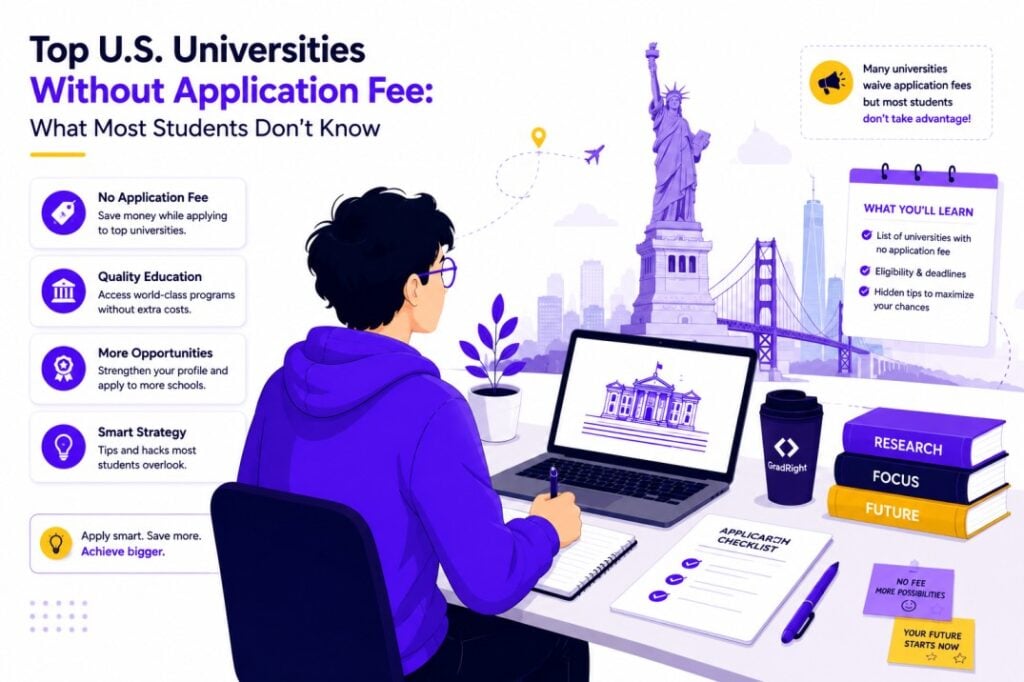
| Application Fee | USD 50-150 per university; paid online; some universities waive it. See universities in the USA without an application fee | Done / Pending |
| Passport Copy | Valid passport; minimum 6 months validity beyond intended stay | Done / Pending |
Phase 2: Financial Documents (for I-20 and Proof of Funding)
| Document | Details | Status Check |
|---|---|---|
| Bank Statements | Showing sufficient liquid funds to cover at least the first-year cost on your I-20; for many MS programs this is in the $50,000-$100,000 range. Last 3-6 months statements. | Done / Pending |
| Education Loan Sanction Letter | From a bank or NBFC; must show the sanctioned amount in USD equivalent. See education loans for studying in the USA | Done / Pending |
| Scholarship Documentation | Official scholarship award letters with amount and duration | Done / Pending |
| Affidavit of Support (Form I-134) | If a sponsor in the USA is covering your costs; notarized form from the sponsor | Done / Pending |
| I-20 Form | Issued by the university after proof of funding is verified; needed for the SEVIS fee and F-1 visa application | Received from university |
Phase 3: F-1 Visa Documents
| Document | Details | Status Check |
|---|---|---|
| I-20 Form | From your university; required to pay the SEVIS fee and for the DS-160 | Received |
| SEVIS Fee Receipt (I-901) | $350; pay at fmjfee.com; keep the receipt for the visa interview | Done / Pending |
| DS-160 Nonimmigrant Visa Application | Complete online at ceac.state.gov; print the confirmation page with barcode. F-1 applicants must list their social media handles and set their profiles to public. See what is the DS-160 form | Done / Pending |
| Visa Appointment Confirmation | VAC (OFC) and interview booked on usvisascheduling.com for the US Embassy in New Delhi or consulates in Kolkata, Hyderabad, Chennai, Mumbai. See the OFC appointment guide | Done / Pending |
| Passport | Valid for at least 6 months beyond your intended stay in the USA | Ready |
| Passport Photos | Photos meeting US visa photo requirements (white background, specific dimensions) | Done / Pending |
| Financial Documents | Bank statements, loan sanction letter, scholarship letters; take originals + copies to the interview | Ready |
| Admission Letter | Official acceptance letter from the university; take it to the visa interview | Ready |
| Academic Records | Transcripts, degree certificates; take originals + attested copies to the interview | Ready |
For rules that changed recently, read new F-1 visa rules for the USA and the F-1 visa interview questions guide.
Phase 4: Pre-Departure Checklist
| Task | Details | Status Check |
|---|---|---|
| Vaccination requirements | University-specific; usually MMR, Tdap, Hepatitis B and Meningococcal. Check your university health portal for the current list. | Done / Pending |
| Health Insurance | Mandatory before departure at most universities. Compare plans at gradright.com/health-insurance; read what student health insurance costs in the USA | Done / Pending |
| Flight Tickets | Book 1-2 months in advance. Student discounts are available on several airlines. Book as soon as you get the F-1 visa. | Done / Pending |
| Accommodation | On-campus housing (apply early, it fills fast) or off-campus. Most universities have international student housing offices. | Done / Pending |
| Money abroad | Carry a forex card for the first weeks and open a US bank account after arrival. See the best forex cards for students | Done / Pending |
| India-USA calling plan | International SIM or eSIM for USA; T-Mobile prepaid, Google Fi, or an Airtel international plan | Done / Pending |
| Transcript copies | Bring multiple attested copies of all academic records for US bank account opening, state ID, etc. | Done / Pending |
Scholarships for Fall US Intake
| Scholarship | Coverage | Program | Deadline Note |
|---|---|---|---|
| Fulbright-Nehru Fellowship | Full tuition + living + airfare + health insurance | Master’s (Arts, Humanities, Social Sciences) | Applications usually open in the first half of the year; check usief.org.in |
| Stanford Reliance Dhirubhai Fellowship | Partial funding; check the current coverage with Stanford GSB | MBA at Stanford GSB | Check stanford.edu/mba |
| AAUW International Fellowship | Awards vary by degree level; check aauw.org | Graduate/Post-doctoral (Women only) | Applications typically close in November; aauw.org |
| Inlaks Shivdasani Foundation | Up to $100,000 total | Any graduate program at a top US university | Check inlaksfoundation.org |
| University-Specific Grants | Partial to full (need-based or merit) | MS, MBA at MIT, Yale, Stanford, etc. | Apply at time of admission; mention financial need on the application |
| Teaching Assistantships (TA) | Tuition waiver plus a stipend; amounts vary by university | Primarily research/PhD; increasingly MS programs | Apply through the department; email professors 6-12 months before applying |
Need an education loan for your US Fall intake? GradRight connects you with 18+ lenders, and you can get competitive loan offers in 48 hours. A loan sanction letter helps with the I-20 and proof of funding. Apply for US Education Loan on GradRight
Also Read: Ultimate Guide to Funding Your US Master’s Without Breaking the Bank
What If I Am Late? Rolling Admissions and Spring 2027 Option
If you missed the main Fall 2027 deadlines (December 2026 to January 2027), you still have options:
| Option | Details |
|---|---|
| Rolling Admissions (Fall 2027) | Some programs at universities like Arizona State, Michigan State, Penn State, Pittsburgh, Alabama and Tulsa accept applications on a rolling basis through March-April 2027. Check each program and apply immediately. |
| Spring 2027 Intake | Spring 2027 classes start in January 2027. Applications opened around April-August 2026, and many universities close in October-November 2026, so check the deadline of each program now. There are fewer programs and scholarships than in Fall, but it is a real option. |
| Fall 2028 Planning | If you want top universities with full scholarship consideration, target Fall 2028. Begin standardized test preparation now and apply in Fall 2027 for August 2028 admission. |
Related Guides
- Application Deadlines for USA, UK and Australia: Complete Guide
- Top Public Universities in the USA 2026: Rankings and Admission
- I-20 Form Process for International Students: Documents and Visa Steps
- Ultimate Guide to Funding Your US Master’s
- F1 Student Visa Rejection Reasons and How to Avoid Them
- Top Exams Required to Study in the USA for Indian Students
- OFC Appointment for US Visa 2026: Step-by-Step Guide
- STEM Courses in the USA: Complete Guide
- GradRight University Selection: USA


 Australia
  Canada
  France
  Germany
  India
India  Ireland
  UAE
UAE  United Kingdom
  United States