




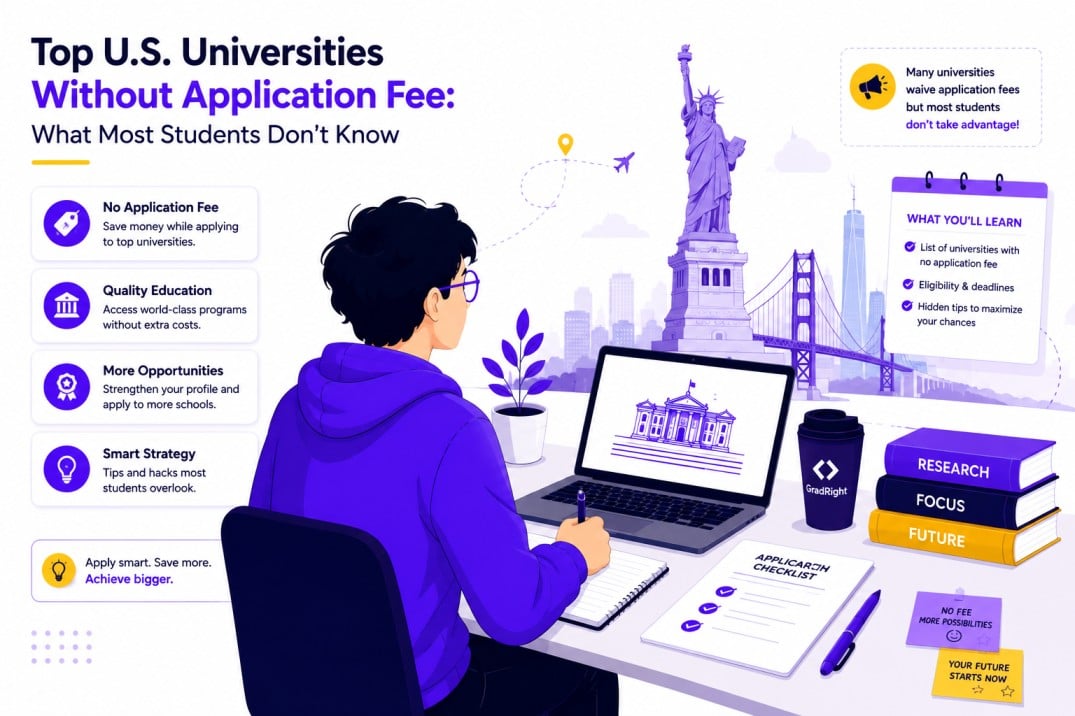
If you’ve started shortlisting schools for the US, you already know the drill: transcripts, SOPs, recommendation letters, test scores, and a $50 to $250 charge every single time you hit “submit.” Multiply that by six or seven applications, and the fee alone can cost as much as a semester of textbooks. This is why so many Indian students search for universities in the USA without an application fee before they finalize their college list.
The good news is that this isn’t a myth or a workaround for a lucky few. A genuine, well-documented group of universities in the USA without application fee, from large public systems to small liberal arts colleges to a handful of Ivy League programs, either never charge an application fee or waive it routinely for eligible international applicants. This guide breaks down exactly which schools these are, why they do it, how to actually qualify, and what to watch out for so you don’t confuse “no fee” with “no chance.”
Why do some universities in USA offer no application fee at all
Application fees exist to cover the administrative cost of processing applications and, at selective schools, to discourage low-intent submissions. But a growing number of institutions have concluded that the fee does more harm than good, especially when it comes to reaching talented international applicants. Here’s what’s driving the shift toward universities in USA without application fee:
- Wider, more diverse applicant pools: Removing a $50–$100 barrier means more first-generation, low-income, and international students apply, which directly supports diversity goals.
- Competitive recruiting: With hundreds of US graduate programs competing for the same pool of strong GRE/GMAT/IELTS scorers, waiving the fee is a low-cost way to stand out.
- Higher application volume, more selectivity: More applications (at no added cost to the applicant) can mean a larger, stronger pool for the admissions committee to choose from.
- Marketing and outreach tie-ins: Many schools tie fee waivers to attending a webinar, information session, or education fair – a way to reward engaged applicants while building their funnel.
- Institutional mission: Public university systems and mission-driven colleges (community-focused liberal arts schools, HBCUs, some state schools) waive fees as a matter of access policy, not a promotional gimmick.
Whatever the reason, the outcome for applicants is the same: one less line item in an already expensive process.
How much are you actually saving
Application fees at US universities typically fall in these ranges:
- Undergraduate applications: roughly $50–$100 per school
- Graduate (Master’s) applications: roughly $70–$110 per school
- MBA and other elite graduate programs: can run as high as $150–$250 per application at schools like Harvard, Yale SOM, or Kellogg
If you’re applying to 6–8 schools, a fairly typical number for Indian students building a balanced list of reach, match, and safety schools, fees alone can add up to $500–$1,500 (roughly ₹42,000 to ₹1.25 lakh). Choosing even two or three universities in the USA without an application fee for your list can meaningfully lower this upfront cost, freeing up your budget for test prep, visa fees, and the SEVIS charge.
Building your shortlist around a mix of universities in the USA without application fee and fee-charging reach schools is one of the simplest ways to stretch a study-abroad budget further.
Universities in the USA that waive or don’t charge an application fee
This list of universities in the USA without application fee combines schools that never charge an application fee and schools with well-established, routinely available waivers for international applicants. Always verify current-year policy on the university’s official admissions page before you rely on it, since these policies can change by intake.
Ivy League and Highly Selective Private Universities
- Harvard University: Offers a need-based fee waiver for undergraduate and graduate applicants (including Harvard Business School), with no impact on your admission decision.
- Yale University: Charges an application fee by default but offers generous need-based waivers for both Yale College and the Yale School of Management, assessed on a case-by-case basis.
- Carnegie Mellon University: Provides fee waivers for applicants who demonstrate financial need.
Liberal Arts Colleges With a No-Fee Policy
- Colby College: Waives the application fee for all applicants, domestic and international, as a standing policy.
- Grinnell College: Known for a strong focus on access and community engagement; offers fee waivers broadly to eligible applicants.
- Wellesley College, Carleton College, and Smith College: Regularly cited among schools that waive application fees to reduce financial barriers for a diverse applicant pool.
Public University Systems
- California State University (CSU) system: Offers fee waivers to eligible California residents and non-resident students who qualify under AB540, covering 23 campuses.
- University of Virginia, School of Engineering and Applied Science: Has dropped the application fee entirely for graduate applicants in recent admission cycles.
Research Universities With Established Waiver Programs
- Case Western Reserve University: Offers fee waivers for eligible applicants, particularly those demonstrating financial hardship or participating in designated outreach programs.
- University of Dayton: One of the more approachable private research universities for international applicants, with an accessible fee-waiver process alongside significant merit scholarships.
- Michigan Technological University: Waives fees for specific applicant categories, including those coming through designated partner and outreach programs.
- Northeastern University: Frequently waives the fee for students who attend official recruitment webinars or information sessions, including those held in India.
- NYU Tandon School of Engineering: Regularly distributes waiver codes during virtual open houses and info sessions for prospective engineering applicants.
Also Read: The Ultimate Guide to Funding Your U.S. Master’s Without Breaking the Bank 2026
Schools That Waive Fees Tied To Graduate Events And Webinars
Several universities don’t have a blanket no-fee policy but will waive the fee automatically if you attend a specific graduate open house, webinar, or recruitment event. Examples include Lehigh University, Missouri University of Science and Technology, and Montclair State University, which have all offered fee waivers tied to attendance at official graduate information sessions in recent cycles. Because these programs change term to term, check each university’s graduate admissions page for the current schedule before you apply.
Note: Fee-waiver policies, eligible programs, and waiver codes change frequently and can vary by intake, campus, and even by department within the same university. Treat this list of universities in the USA without an application fee as a strong starting point, not a guarantee. Always confirm directly on the university’s admissions website immediately before you apply.
How to qualify for a fee waiver if a school isn’t already on the no-fee list
If a university isn’t already part of the list above and doesn’t waive fees for everyone by default, you’ll typically need to demonstrate eligibility. The most common paths are:
Through the Common App
If you’re applying through the Common Application, nearly half of all member colleges are already universities in the USA without application fee, so start there before assuming you need a waiver. For the rest, you may qualify for a Common App fee waiver if you meet any of the following:
- You’re enrolled in or eligible for a Federal Free or Reduced-Price Lunch program (a US-specific criterion, though some international equivalents are accepted case by case)
- Your family income falls within income-eligibility guidelines set by the USDA
- You’ve received or are eligible for an SAT or ACT fee waiver
- You can provide a supporting statement from a school official, counselor, or community leader confirming financial need
International students can request a Common App fee waiver, but approval isn’t guaranteed – each college sets its own policy on whether to honor it for applicants outside the US.
Directly Through the University
Many schools that don’t publish a blanket waiver still accept individual waiver requests. Common triggers include:
- Attending an official virtual information session, webinar, or education fair booth
- Demonstrated financial need, submitted through a short waiver form
- Being a McNair Scholar, TRIO/Upward Bound participant, or similar program alumnus
- A recommendation or supporting note from your school counselor or an education consultant
University-Specific Waiver Codes
Some schools distribute time-bound promo codes at recruiting events – NYU Tandon’s past use of codes like “TANDONBKLYN” is a good example. These codes are usually announced during the event itself, so keep an eye on official university communications and social channels if you’re targeting a specific school.
Should you pick a school just because it has no application fee
No, and this is the part most guides skip. Universities in the USA without an application fee are worth adding to your list because they reduce cost, not because they lower your standards. In fact, the strongest universities in the USA without application fee on this list, such as Harvard, Yale, and Carnegie Mellon, are also some of the most competitive schools in the country. A no-fee policy has zero bearing on:
- Program quality, faculty research output, or industry reputation
- Employment outcomes or average starting salaries for graduates
- Visa sponsorship history or international student support services
- Whether the program is genuinely the right academic and career fit for you
Use the fee savings to apply to more of the right schools, not to replace research on curriculum, faculty, location, and post-study outcomes. A balanced list still needs reach, match, and safety schools chosen on fit, not fee structure alone.
Save on fees, don’t compromise on fit
Application fees are just one line item in a much bigger budget decision. The real risk for most Indian students isn’t overpaying $80 for one extra application; it’s choosing the wrong program, underestimating total cost of attendance, or picking a loan that doesn’t actually work in their favor. That’s the gap GradRight was built to close.
Instead of relying on scattered blog lists, GradRight’s platform helps you compare universities and programs side by side on what actually matters: program outcomes, cost of attendance, scholarship potential, and post-study ROI.
If financing is part of your plan, we also help you compare education loan offers from multiple lenders so you know the true cost of your degree before you commit, not after. Whether you’re weighing a fee-free public university against a private research school with a strong placement record, GradRight gives you the data to make that call with confidence, not guesswork.






 Australia
  Canada
  France
  Germany
  India
India  Ireland
  UAE
UAE  United Kingdom
  United States