



In the USA, STEM jobs are expected to grow at 10.8% between 2024 and 2034. That’s particularly impressive when compared to the 2.7% growth for non-STEM jobs. This is only one of the many reasons that make STEM courses in USA the #1 choice for Indian students planning to study abroad.
What Are STEM Courses in the USA?
STEM stands for Science, Technology, Engineering, and Mathematics. This table offers an overview of STEM disciplines and some of the key master’s degrees or specializations related to each area.
| Discipline | Examples of Relevant MS Degrees or MBA Specializations |
| Science | MS in Biotechnology, MS in Environmental Science, MS in Chemistry, MS in Physics, MS in Astronomy |
| Technology | MS in Information Technology, MS in Cybersecurity, MS in Data Science, MS in Artificial Intelligence, MBA with Technology Management focus |
| Engineering | MS in Civil Engineering, MS in Mechanical Engineering, MS in Electrical Engineering, MS in Chemical Engineering |
| Mathematics | MS in Applied Mathematics, MS in Statistics, MS in Financial Mathematics, MS in Data Analytics |
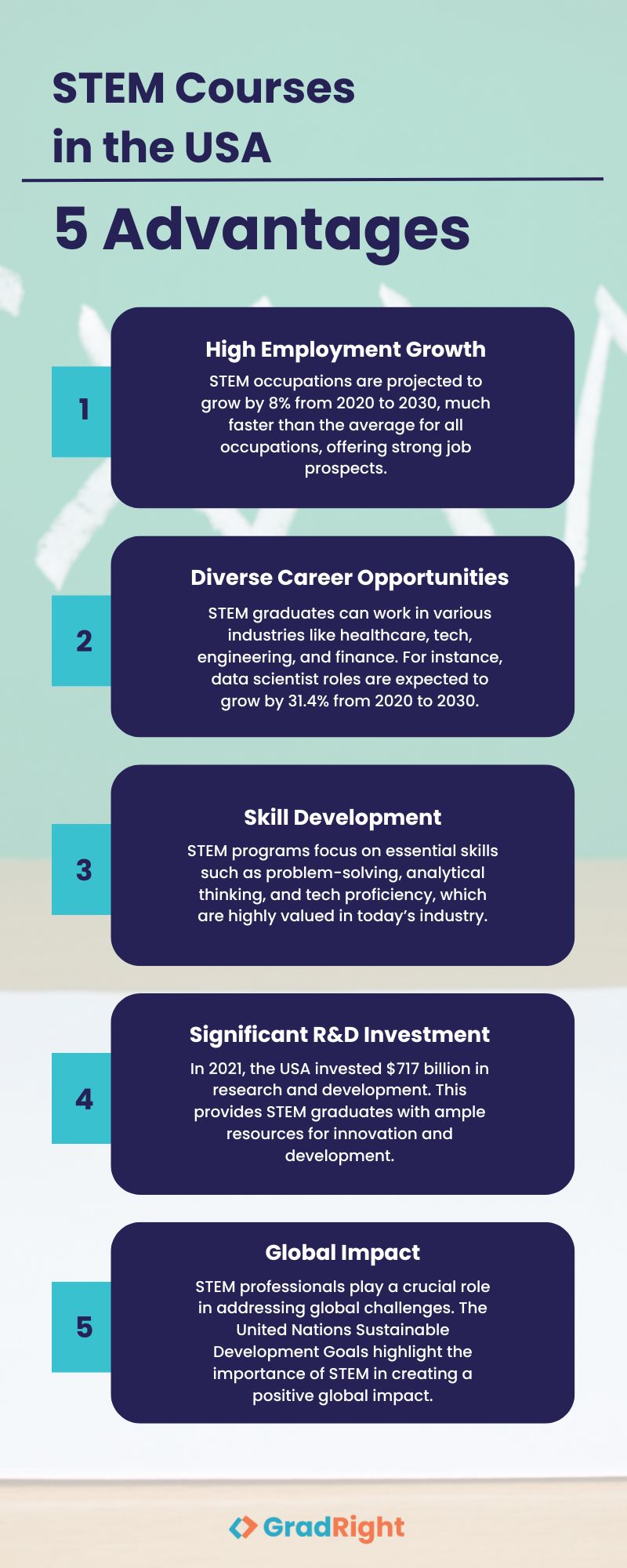
Advantages of STEM Courses in the USA
- STEM occupations are projected to grow at 10.8% between 2024 and 2034, compared to 2.7% for non-STEM jobs. The professional, scientific, and technical services sector is projected to grow 7.5% over the same period. (Source: BLS Employment Projections 2024-34, August 2025)
- Data scientist roles are expected to grow by 34% from 2024 to 2034 — the 4th fastest-growing occupation in the US economy. Median wage: $112,590 (BLS, 2024). (Source: BLS Occupational Outlook Handbook, bls.gov/ooh)
- STEM programs focus on developing essential skills such as problem-solving, analytical thinking, and tech proficiency — highly relevant in today’s industry.
- The US invested approximately $930 billion in R&D in 2023 (NSF National Patterns of R&D Resources, 2023). STEM graduates have access to world-class research infrastructure.
- STEM professionals play a vital role in addressing global challenges. The United Nations Sustainable Development Goals highlight the role of STEM in creating a global impact.
Why Study STEM Courses in the USA?
- The USA hosts many of the world’s top universities renowned for their STEM programs. MIT, Stanford, and Harvard consistently rank at the top of global university rankings, with state-of-the-art labs, research centers, and technological resources.
- The USA offers a diverse array of STEM programs — students can choose from over 200 different STEM-designated programs at various academic levels.
- 36-month OPT extension: International students graduating from STEM courses get an OPT extension. Regular OPT allows 12 months of work authorization. STEM graduates can extend by an additional 24 months, for a total of 36 months of US work experience.
- Most American universities have dedicated international student offices providing academic advising, cultural adjustment assistance, immigration guidance, and counseling.
Popular STEM Courses in the USA
| STEM Component | Popular Fields and Programs |
| Science (S) | Biology, Chemistry, Physics, Environmental Science, Astronomy, Biomedical Sciences (Biochemistry, Genetics, Neuroscience) |
| Technology (T) | Information Technology, Cybersecurity, Data Science, Artificial Intelligence, Software Development, Computer Science |
| Engineering (E) | Civil Engineering, Mechanical Engineering, Electrical Engineering, Chemical Engineering, Aerospace Engineering, Robotics |
| Mathematics (M) | Applied Mathematics, Statistics, Algebra, Geometry, Calculus, Data Science and Analytics |
Top Colleges for STEM Courses in the USA
The USA is home to some of the world’s leading STEM colleges. Here are the top 10 STEM colleges as per QS World University Rankings:
Note: Acceptance rates and annual tuition fees change each academic year. Verify current figures on each university’s official website before applying.
| University | Location | Acceptance Rate | Est. Tuition (Annual — verify) |
| MIT | Cambridge, MA | ~4.7% | ~$59,750 |
| Georgia Institute of Technology | Atlanta, GA | ~18% | ~$32,940 |
| Caltech | Pasadena, CA | ~4% | ~$63,255 |
| Harvey Mudd College | Claremont, CA | ~10% | ~$65,954 |
| Stanford University | Stanford, CA | ~4% | ~$62,484 |
| UC Berkeley | Berkeley, CA | ~11% | ~$27,417 (non-resident) |
| UC San Diego | La Jolla, CA | ~34% | ~$47,196 (non-resident) |
| Texas A&M University | College Station, TX | ~63% | ~$40,000+ (non-resident) |
| UIUC | Champaign, IL | ~60% | ~$36,068 (non-resident) |
| University of Michigan | Ann Arbor, MI | ~18% | ~$55,000+ (non-resident) |
With so many options, students often get confused and end up selecting from a very limited set of universities — missing out on programs that could have offered the highest ROI.
GradRight’s AI-powered university search solves this by eliminating bias and shortcuts. The algorithm crunches 8 million data points to match your profile with 40,000+ programs and 4,000+ universities.
Here’s how it works:
- Create an account and complete your profile.
- Enter your academic scores, preferred program, and tuition fee expectations.
- Receive personalized program recommendations based on your criteria.
- Compare the recommended programs using detailed insights and data.
- Connect with peers, alumni, and experts to finalize your choice.
Find the best STEM program for your profile — AI-powered, 40,000+ programs, free. Start on GradRight
Eligibility Criteria for STEM Courses in the USA
| Category | Criteria |
| Academic qualification | Bachelor’s degree (3-4 years) from a recognized university. GPA of 3.0+ on a 4.0 scale recommended. |
| English language proficiency | TOEFL, IELTS, PTE, or Duolingo scores. Minimum IELTS 6.0 or TOEFL 90 recommended. |
| Standardized test scores | SAT or ACT (undergraduate); GRE (graduate). Not always mandatory but strengthen your application. |
| Recommendations | 2-3 academic or professional letters of recommendation. |
| Essays | A personal essay reflecting your goals and why you are suitable for the program. |
| Visa requirements | An F-1 student visa. |
Documents Required for STEM Courses in the USA
- Academic transcripts
- Standardized test scores (SAT/ACT/GRE)
- English proficiency test scores (TOEFL/IELTS/Duolingo/PTE)
- Letters of recommendation (LORs)
- Statement of purpose (SOP)
- Resume/CV
- Financial proof (bank statements, scholarship letters)
- Passport copy
- Application form
How to Apply for STEM Courses in the USA?
- Check the eligibility criteria: Make sure you meet the academic qualifications, standardized test scores, and English proficiency requirements.
- Register and prepare for standardized tests: Choose from GMAT, GRE, or other test options. Also prepare for TOEFL, IELTS, PTE, or DET.
- Collect all required documents: Include transcripts and diplomas. Ensure documents are translated into English if necessary.
- Draft compelling personal essays or SOP: Reflect your motivations, achievements, and goals. Tailor each essay to the specific program.
- Get letters of recommendation: Provide recommenders with sufficient time and information to write strong letters.
- Fill out application forms: Complete online applications and additional program-specific forms. Pay fees online.
- Research and apply for scholarships, grants, and financial aid: Submit all forms before deadlines.
- Prepare for interviews: Practice common questions about your background, goals, and interest in the program.
- Apply for an education loan: Use GradRight’s loan platform to compare education loan offers from 18+ lenders competing for your business — instead of approaching banks individually. Loan approval typically takes about 10 days.
Compare education loans from 18+ lenders for your STEM program in the USA. Explore GradRight Loans
Job Opportunities for STEM Graduates in the USA
Salary data updated to BLS Occupational Employment and Wage Statistics (OEWS) 2024. Note: BLS reports median wages; your actual salary will depend on university, location, experience, and specialization.
| Job Title | BLS Median Annual Wage (2024) |
| Data Scientist | $157,707 |
| Software Developer | $100,774 |
| Mechanical Engineer | $99,030 |
| Electrical Engineer | $106,950 |
| Civil Engineer | $99,920 |
| Chemical Engineer | $112,100 |
| Information Security Analyst | $139,233 |
| Environmental Scientist | $76,530 |
| Statistician | $104,860 |
| Biomedical Engineer | $99,550 |
Source: BLS Occupational Employment and Wage Statistics (OEWS), May 2024. All figures are national median annual wages. Source: bls.gov/ooh
Also Read: STEM MBA in USA: Top Programs, Universities, Fees and Jobs
Also Read: Top STEM Co-op Master’s Programs in the USA
Also Read: Top Universities in the USA for MS in Computer Science
Also Read: MS in Biotechnology in the USA

 Australia
  Canada
  France
  Germany
  India
India  Ireland
  UAE
UAE  United Kingdom
  United States