




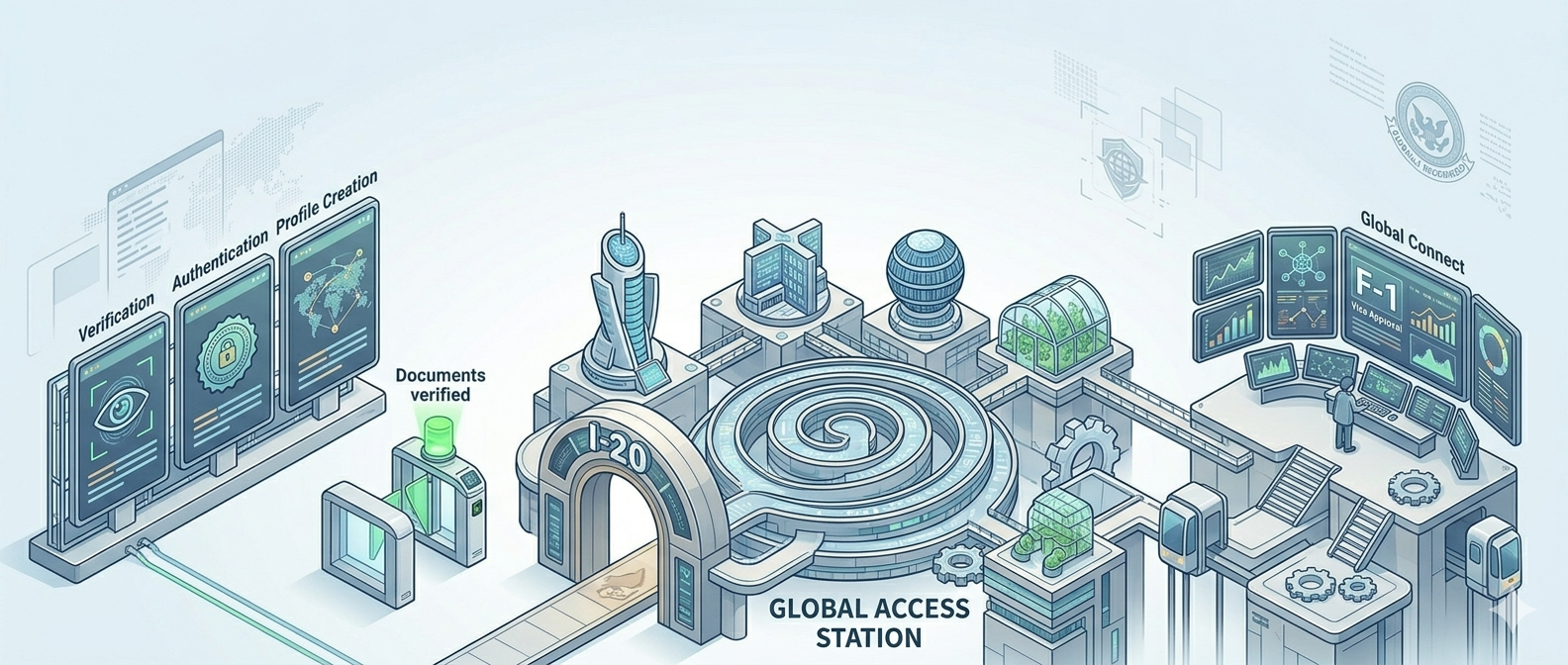
You’ve received your admission letter from a USA university. Now comes the next important step: getting your I-20 form.
The I-20 is the document that officially allows you to begin your F-1 visa process. Without it, you cannot schedule your visa interview, pay the SEVIS fee, or enter the USA as an international student.
But how exactly do universities issue the I-20? What financial documents do you need? How long does the process take?
In this guide, we explain the complete I-20 process for international students, including required documents, timelines, common delays, and what to do after receiving your form.
What is an I-20 form?
The I-20 form (officially called the Certificate of Eligibility for Nonimmigrant Student Status) is a document issued by SEVP-certified USA universities and colleges to admitted international students.
It confirms three important things:
- You have been admitted to a full-time academic program
- The university recognizes you as an eligible international student
- You have demonstrated sufficient financial support for your education
The I-20 is required to:
- Pay the SEVIS I-901 fee
- Apply for your F-1 student visa
- Attend your visa interview
- Enter the USA as a student
- Re-enter the USA after international travel
In short, the I-20 is the foundation of your USA student journey. Without it, the visa process cannot begin.
Also Read: Complete guide on the I-20 application form
When do universities issue the I-20 form?
USA universities typically issue the I-20 only after you complete certain post-admission steps.
In most cases, the process looks like this:
- You receive your admission letter
- You accept the offer
- You submit proof of finances
- The university verifies your documents
- Your SEVIS record is created
- The university issues your I-20
Some universities may also require:
- Tuition deposit payment
- Passport verification
- Sponsor documentation
- Additional financial clarification
This means receiving admission alone does not automatically generate the I-20. Financial verification is one of the most important stages of the process.
Documents required for the I-20 form
Before your university can issue the I-20, you must submit documents proving your financial ability to cover your education expenses in the USA.
Most universities ask for the following:
Financial Documents
- Recent bank statements
- Fixed deposit certificates
- Education loan sanction letter
- Scholarship or assistantship letters
- Income proof of sponsors
- Affidavit of financial support (if applicable)
Academic & Identity Documents
- Passport copy
- Admission letter
- Completed university financial forms
- Sponsor identification documents (if needed)
The required amount usually matches the Cost of Attendance (CoA) mentioned by the university. This includes:
- Tuition fees
- Living expenses
- Health insurance
- Miscellaneous expenses
For many students, arranging proof of funds becomes the biggest challenge in the I-20 process, especially when education loans are involved.
Step-by-step I-20 process for international students
Here’s how the I-20 issuance process usually works for international students heading to the USA.
Step 1: Accept Your Admission Offer
Once admitted, you may need to formally accept your offer through the university portal.
Some universities also require:
- Enrollment confirmation
- Seat acceptance
- Deposit payment
Only after this step does the university begin the I-20 process.
Step 2: Arrange Proof of Funds
You must demonstrate that you can financially support your education in the USA.
Students usually use:
- Personal savings
- Parent or sponsor funds
- Education loans
- Scholarships
- Assistantships
A sanctioned education loan letter is accepted by most universities as valid financial proof.
This stage is often where delays happen. Many students spend weeks comparing lenders, arranging collateral, or waiting for sanction approvals.
At GradRight, students can compare multiple education loan offers through a reverse-search model where lenders compete to provide better loan options based on the student’s profile.
Sai Sree Meka, now pursuing a Master’s in Computer Science at the University of Georgia, shared her experience:
“I didn’t know I had an option to get a loan until I learnt of Prodigy from my financial adviser on GradRight.”
Once your financial documents are ready, you can upload them to your university portal for verification.
Step 3: Submit Documents to the University
Your university’s international admissions office or Designated School Official (DSO) reviews:
- Financial documents
- Passport details
- Sponsorship information
- Program details
If something is unclear or insufficient, the university may request revised documents.
Step 4: SEVIS Record Creation
Once approved, your DSO enters your information into the Student and Exchange Visitor Information System (SEVIS).
This generates your:
- SEVIS ID number
- Official student immigration record
Your SEVIS ID appears on the top-right section of your I-20 and usually begins with the letter “N”.
Step 5: Receive Your I-20 Form
After verification, the university issues your I-20 electronically or physically.
Most universities now send:
- Digital PDF I-20s
- Electronically signed copies
You must:
- Print the document
- Sign it manually
If you are under 18 years old, a parent or legal guardian must sign on your behalf.
Step 6: Verify All Information Carefully
Before proceeding with your visa process, check:
- Name spelling
- Passport number
- Date of birth
- Program name
- Degree level
- Funding information
- Program start and end dates
Even small mistakes can create visa complications later.
Step 7: Pay the SEVIS Fee & Begin Visa Process
Once you receive your I-20, you can begin your F-1 visa application.
The process usually includes:
- Paying the SEVIS I-901 fee
- Completing the DS-160 form
- Paying the visa fee
- Booking your visa appointment
- Attending the visa interview
You may enter the USA up to 30 days before the start date listed on your I-20.
Also Read: A Comprehensive Guide To Student Visa For USA
How long does it take to get an I-20?
Most universities issue the I-20 within 5–15 business days after receiving complete financial documents.
However, delays are common during:
- Fall intake season
- Peak visa months
- Financial verification periods
The timeline may increase if:
- Documents are incomplete
- Loan sanction letters are delayed
- Sponsor information is unclear
- Passport details do not match records
Students planning for Fall intake should ideally begin the I-20 process immediately after receiving admission.
Common reasons why I-20 issuance gets delayed
Several small issues can slow down the process significantly.
The most common reasons include:
- Insufficient proof of funds
- Incomplete bank statements
- Delayed education loan sanction
- Passport mismatch
- Missing sponsor affidavits
- Incorrect financial forms
- University backlog during peak intake season
One delayed document can postpone:
- Visa slots
- Flight bookings
- Housing arrangements
- University onboarding
That’s why students are usually advised to finalize funding early.
Types of I-20 forms
There are two main types of I-20 forms issued by USA institutions.
| I-20 Type | Visa Type | Purpose |
| F-1 I-20 | F-1 Visa | Academic programs such as Bachelor’s, Master’s, and PhD degrees |
| M-1 I-20 | M-1 Visa | Vocational and non-academic programs |
Most international students pursuing university degrees receive the F-1 I-20.
Important I-20 rules international students must know
-
30-Day Entry Rule
You can enter the USA only within 30 days before your program start date.
-
Travel Signatures Matter
Your DSO must sign the travel authorization section before international travel.
-
Report Changes Quickly
Changes in:
- Address
- Major
- Funding
- Academic status
must usually be reported within 10 days.
-
Watch Your Program End Date
If you need extra time to complete your program, request an extension before your I-20 expires.
Can an education loan be used for the I-20 form?
Yes. Most USA universities accept education loan sanction letters as proof of funds for issuing the I-20.
The sanction letter should clearly mention:
- Student name
- Approved loan amount
- Bank details
- Official signature and stamp
For many students, the loan sanction letter becomes the key document that unlocks the I-20 process.
At GradRight, students can compare loan offers from multiple lenders in one place, making it easier to secure funding without delaying their I-20 timelines.
As our CEO Aman Singh explains:
“A student comes into the platform, shares their university admission and funding requirement, and lenders compete to offer better loan options.”
Once your funding is finalized, the rest of the I-20 and visa process becomes significantly smoother.
Final thoughts
The I-20 is much more than just a university document. It is the starting point of your entire USA student visa journey.
And while the process itself is straightforward, delays usually happen because of funding issues, incomplete paperwork, or late submissions.
The earlier you arrange your finances, submit your documents, and verify your details, the smoother your I-20 process will be, and the faster you can move toward your visa interview and travel plans.
If you are still exploring education loan options for your USA degree, starting early can help avoid unnecessary delays in your I-20 issuance timeline.








 Australia
  Canada
  France
  Germany
  India
India  Ireland
  UAE
UAE  United Kingdom
  United States