For 2026–2027 admissions, students should check the specific requirements of each college before applying, particularly for Class 12 marks, PCM requirements, entrance exams, and admission cut-offs.
B.Tech AI eligibility after Class 12
Most B.Tech AI and B.E. AI programs are designed for students with a science background. Engineering admissions commonly require Physics and Mathematics in Class 12, along with the other subjects specified by the institute or examination authority.
Students applying through national or state engineering entrance exams may also need to meet exam-specific eligibility and subject requirements.
Can I study B.Tech AI without Computer Science?
Computer Science is generally not required in Class 12 for B.Tech AI. Students with the required Class 12 subjects can typically learn programming and computer science fundamentals as part of their undergraduate curriculum. However, subject combinations and eligibility criteria vary by college.
BCA and B.Sc AI eligibility
Students who do not meet the subject requirements for engineering programs can explore BCA in Artificial Intelligence, BCA AI & Data Science, B.Sc Artificial Intelligence, and related undergraduate degrees.
Eligibility can be more flexible than B.Tech programs, with some colleges accepting students from Science, Commerce, or Arts streams. Mathematics or Computer Science may be preferred or required by individual institutions, so students should check the eligibility criteria for each program.
AI entrance exams after 12th
Admission to undergraduate AI programs can involve national-level, state-level, or university-specific entrance exams.
National entrance exams
Depending on the institution and program, students may encounter exams such as JEE Main, JEE Advanced, and CUET-UG.
State-level entrance exams
State engineering admissions may use exams such as MHT-CET, KCET, COMEDK, and WBJEE, depending on the state and participating institutions.
University-level entrance exams
Some universities conduct their own entrance tests for engineering and technology programs. These can include BITSAT, VITEEE, and SRMJEEE, subject to the eligibility and admission rules of the respective university.
AI admission process in India
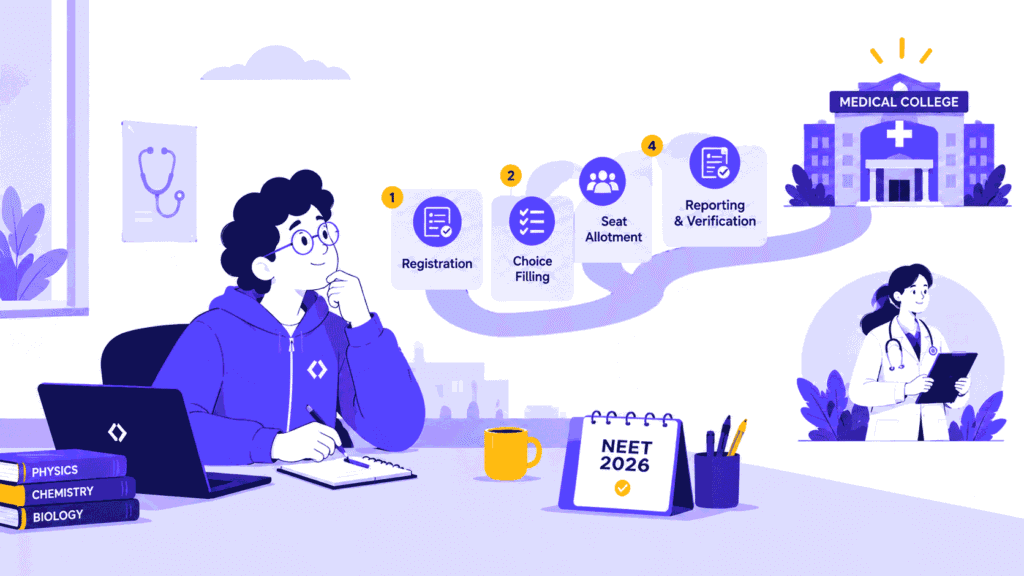
The AI admission process after Class 12 usually involves checking eligibility, appearing for the required entrance exam, applying through the relevant counselling or university portal, selecting preferred programs, and completing document verification.
For participating engineering institutions, students may go through centralized counselling systems such as JoSAA, CSAB, or state-level counselling. Private universities may have separate application and admission processes.
AI cut-offs and seat allotment
AI college cut-offs can vary by institution, entrance exam, category, course, and admission year. A college may also have different cut-offs for different AI specializations or counselling rounds.
Students should compare previous cut-offs with current eligibility requirements rather than relying on a single qualifying score when shortlisting AI programs.
Can you study AI without PCM?
Students without the required Physics, Chemistry, and Mathematics (PCM) combination may not be eligible for many B.Tech AI programs. However, they can explore alternative undergraduate pathways such as BCA AI, BCA AI & Data Science, B.Sc AI, and other application-focused technology programs, depending on the college’s eligibility criteria.
Students from Commerce or Arts backgrounds should check whether Mathematics, Computer Science, or another specific subject is required for their chosen program.
AI eligibility for different undergraduate degrees
| AI Degree | Typical Eligibility Focus | Common Admission Route |
| B.Tech AI | PCM and engineering eligibility | JEE/state/university entrance |
| B.Tech AI & ML | PCM and engineering eligibility | JEE/state/university entrance |
| B.Tech AI & Data Science | PCM and engineering eligibility | JEE/state/university entrance |
| B.Sc AI | Institute-specific Class 12 requirements | Merit/entrance |
| BCA AI | Class 12 eligibility; subject requirements vary | Merit/entrance |
Exact requirements vary by institution.
B.Tech AI vs BCA AI vs B.Sc AI
The choice between B.Tech AI, BCA AI, and B.Sc AI depends on the student’s academic background and intended career path. B.Tech programs generally follow an engineering-oriented curriculum with greater emphasis on mathematics, computing, and technical foundations. BCA programs typically focus more on software and applications, while B.Sc programs can offer a science-oriented approach to AI and data.
Students should compare eligibility, fees, syllabus, duration, entrance requirements, and career options before choosing a degree.
AI courses after 12th without JEE
Not every undergraduate AI program requires JEE. Students can explore university-specific entrance exams, state-level examinations, CUET-UG, or merit-based admissions, depending on the college and program.
Private universities may have their own admission tests or accept Class 12 marks for selected programs. The admission route should always be checked against the current university guidelines.
Documents required for AI admission
Students may need documents such as:
- Class 10 marksheet and certificate
- Class 12 marksheet or provisional result
- Entrance exam scorecard
- Transfer or migration certificate
- Identity proof
- Category or reservation certificate, where applicable
- Passport-size photographs
Individual colleges and counselling authorities may request additional documents.
AI admission trends for 2026–2027
For 2026–2027 AI admissions, students can explore a growing range of undergraduate options across Artificial Intelligence, Machine Learning, Data Science, and AI-integrated Computer Science programs.
Popular searches include B.Tech AI eligibility, AI courses after 12th, AI colleges without JEE, B.Tech AI admission, AI entrance exams, AI cut-offs, BCA AI eligibility, B.Sc AI eligibility, and AI colleges accepting JEE Main.
Compare AI programs based on eligibility, entrance exams, fees, syllabus, cut-offs, colleges, placements, and career options before applying.




 Australia +61
 Canada +1
 France +33
 Germany +49
 India +91
 Ireland +353
 UAE +971
 United Kingdom +44
 United States +1