






Recent reports showed 901 international student visas revoked across 128 American college campuses. Several proposals have recommended restrictions on Optional Practical Training. The H-1B visa lottery remains highly competitive – only 1 in 3 applicants receive approval. Overall, the post-study journey for international students in America is marked by uncertainty.
Against this backdrop, a counterintuitive trend is emerging. More Indian graduates are refinancing their education loans – not fewer. The uncertainty is driving refinancing decisions, not stopping them.
This article explains the logic behind that trend.
The Uncertainty Indian Graduates Are Living With
| Source of Uncertainty | What It Means for Indian Graduates |
| 901 student visa revocations, 128 campuses | Even enrolled students faced revocations in 2025. The assumption of stability post-admission is no longer automatic. |
| OPT restriction proposals | OPT is the primary bridge from F-1 student status to H-1B employment. Any restriction directly affects the post-graduation employment timeline. |
| H-1B lottery: 1 in 3 approval rate | Even with strong employment and sponsorship, H-1B is probabilistic. Two years of STEM OPT does not guarantee H-1B approval. |
| Tech sector hiring slowdown | Employers have become more cautious about visa sponsorship. Offer withdrawals and sponsorship hesitation are more common than three years ago. |
| Policy reversal risk (SAVE plan example) | Government programmes can be reversed. Depending on policy-based relief is less reliable than private contractual arrangements. |
Visa lotteries and policy changes are outside the influence of any individual graduate. That is the core reality. Refinancing is the one area where they can exercise direct control.
Why Uncertainty Is Driving Refinancing, Not Stopping It
Graduates are realizing they cannot pause life decisions until Washington finalizes immigration policy. Refinancing becomes a way to claim certainty in at least one area while the rest remains unpredictable.
The original GradRight article makes this precise: ‘Loan refinancing gives graduates control in the one area they can actually control. Visa lotteries or policy changes are way outside their influence. But choosing when, how, and at what cost they repay their education loan offers a sense of stability against a backdrop of shifting rules.’
This is not rationalization. It is a defensible financial logic. A graduate paying 13% on an Indian education loan while earning USD 90,000 is losing lakhs per year in avoidable interest. Waiting for visa certainty before refinancing means losing that money every month the uncertainty continues.
Six Reasons Refinancing Makes Sense Even in Uncertain Times
1. The Rate Gap Is Too Large to Ignore
As of 2025-26, Indian education loan rates range from 11% to 14%. US refinancing rates for international graduates range from 5.5% to 9%. That 4-8 percentage point gap on a Rs 40-50 lakh loan costs Rs 4-12 lakh in additional interest over 10 years. Every month at 13% instead of 7% is money that cannot be recovered. Waiting for visa certainty does not make the rate gap smaller – it makes the total overpayment larger.
2. Repaying Indian Loan in USD Doubles the Risk
An Indian loan repaid from a US salary involves two risks: the high INR rate, and the rupee depreciating against the dollar (approximately 4% annually on historical average). Refinancing to a USD loan removes both. The rate drops and the currency mismatch disappears. Uncertainty about visa status does not change the fact that you are currently earning in dollars and overpaying in rupees.
3. Cosigner Release Is an Emotional and Financial Priority
Parents often pledge property or sign as guarantors in India. Refinancing with a USA lender releases them from that responsibility. For many graduates, this decision is as much emotional as financial. Refinancing relieves family members of stress tied to collateral or liability. The uncertainty in the USA does not reduce the urgency of protecting parents’ financial standing in India.
4. Tenure Flexibility Accommodates Uncertainty
Unlike rigid Indian bank terms, refinancing in the USA offers varied tenures from 5 to 20 years. A graduate unsure about visa continuity might opt for a shorter loan to clear debt faster. Someone worried about cash flow during a job-search period might stretch payments to keep monthly obligations lighter. This flexibility is precisely what visa uncertainty calls for – the ability to adapt repayment to circumstances rather than being locked into fixed terms.
5. Alumni Success Stories Are Spreading Fast
Stories of Indian graduates who saved Rs 10-15 lakh by refinancing are circulating in university WhatsApp groups, alumni networks, and LinkedIn. Social proof is accelerating adoption faster than any marketing campaign. Each graduate who refinances successfully becomes an informal advisor to their network.
6. Refinancing Is a Private Contract – Immune to Policy Reversal
The SAVE plan reversal showed that government programmes can disappear. A private refinancing agreement at 6.5% is a legal contract. No administration can change the rate you agreed to. Compared to any form of policy-dependent relief, a refinanced private loan at a lower rate is the more stable outcome.
Also Read: How the US SAVE Plan Changes Are Driving Indian Students to Refinance
When Refinancing Amid Uncertainty Is the Wrong Move
Refinancing is a smart move but it is not automatically the right choice for every Indian graduate in the USA. The original article is explicit about this. Here are the situations where refinancing may not help:
| Situation | Why Refinancing Does Not Help Here |
| Less than 1-2 years of repayment left | Transition costs may outweigh potential savings in the remaining months |
| Employment or visa status is actively unstable | Refinancing locks you into a new contract. If you may lose employment or visa status soon, committing to new repayment terms can create additional risk. |
| Cannot qualify: no cosigner and insufficient income | Some lenders require stronger profiles than OPT-stage graduates can demonstrate. International-friendly options exist but not all graduates qualify. |
| Current rate is already at or near US market rates | If your existing loan rate is already 6-8%, refinancing offers limited advantage after transition costs. |
| Definitely leaving the USA within 6-12 months | Refinancing with a US lender and then repaying from India on an Indian salary reverses the currency advantage. |
How to Refinance Thoughtfully When Visa Status Is Uncertain
Some graduates still refinance early – even with visa uncertainty – to capture lower rates, but ensure they have a backup plan. Here is the approach GradRight recommends for graduates navigating refinancing alongside visa uncertainty:
- Choose a shorter tenure: if visa continuity is uncertain, a 7-year loan instead of 12 means you are debt-free sooner regardless of what happens with H-1B.
- Choose a lender with unemployment protection: SoFi pauses payments during job loss and provides job-search assistance. This buffer matters if tech layoffs or visa issues interrupt income.
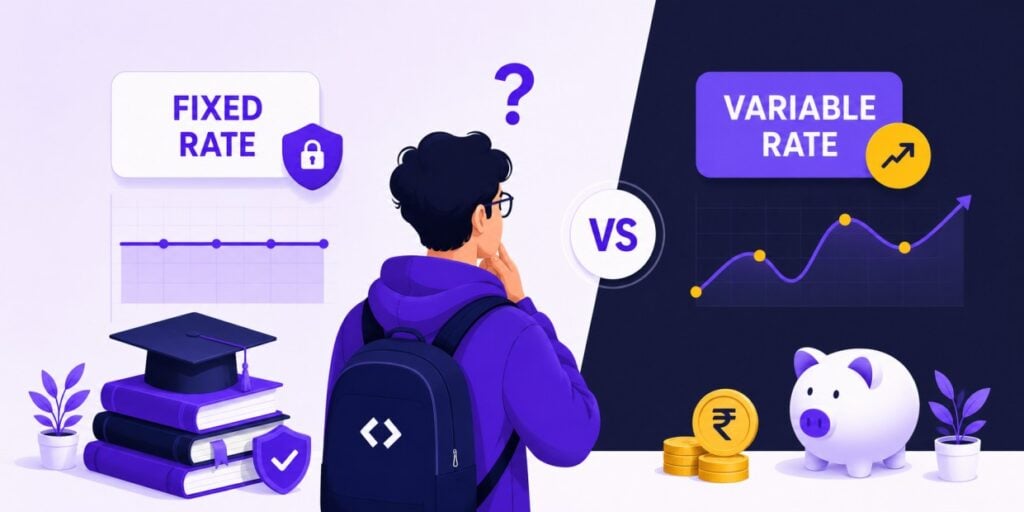
- Choose fixed rate: variable rate adds another layer of unpredictability to an already uncertain situation. Lock the rate.
- Understand what happens if you return to India: some lenders allow repayment from Indian accounts. Confirm the process with the specific lender before signing.
- Do not wait indefinitely: the best situation to refinance is when you have stable employment and expect to remain in the USA for the medium term. But waiting for perfect certainty in visa status is not realistic given current policy environment. A reasonable threshold: stable employment for 3+ months, FICO 650+, and a career plan that keeps you in the USA for at least 2 years.
Make the right refinancing choice with confidence. GradRight matches you with lenders appropriate to your visa status and career plan – free. Start Refinancing with GradRight
Current Refinancing Rates for International Graduates – 2026
As of 2025-26, refinance rates for international graduates range between 5.5% and 9%, significantly lower than typical Indian education loan rates of 11-14%. The final rate depends on visa status, employment, credit score, and whether a cosigner is involved. Always compare multiple lenders before deciding.
| Lender | OPT? | H-1B? | Starting Rate | Cross-border Payoff? |
| MPower Financing | Yes | Yes | 9.99% fixed | Yes – SWIFT to Indian banks |
| SoFi | Check sofi.com | Yes (H-1B, E-2, E-3, J-1, L-1, O-1) | From 5.90%+ | No – self-remit |
| Citizens Bank | With US cosigner | With US cosigner | 6.40%+ | No |
| Earnest / ELFI / Laurel Road | US residents mainly | Check current policy | 4-6%+ | No |
A growing number of lenders offer no-cosigner refinance products, particularly for borrowers with strong US employment and FICO above 680. GradRight’s platform screens for lenders that can legally and competitively handle your specific visa category and loan origin.
Also Read: Are You Eligible to Refinance Your Student Loans?
Don’t wait and don’t make financial mistakes. Make the right refinancing choice with GradRight – free, expert guidance, no commitment. Get Refinancing Guidance on GradRight
Related Guides
How the US SAVE Plan Changes Are Driving Indian Students to Refinance
Are You Eligible to Refinance Your Student Loans?
6 Expert Tips to Get the Best Student Loan Refinance Offer
SoFi vs Citizens Bank: Which Refinance Is Better?
Building Your US Credit History with Refinanced Education Loans
Pros and Cons of Refinancing Your Education Loan
Student Loan Refinance Timeline: How Long Does It Take?





 Australia
  Canada
  France
  Germany
  India
India  Ireland
  UAE
UAE  United Kingdom
  United States
