






When the SAVE (Saving on a Valuable Education) repayment plan launched in 2023, it was celebrated across the USA. News platforms labelled it life-changing. Millions of borrowers saw monthly payments drop, in some cases to USD 0. Graduates who had delayed home ownership or entrepreneurship began planning ahead with confidence. The program became a global talking point – proof that affordable loan repayment was no longer just theoretical.
In early 2025, US policymakers scaled back SAVE. Interest accrual resumed. Forgiveness timelines were pushed back. Monthly payments rose again for millions of borrowers. For those who had structured their finances around SAVE, the reversal was devastating. The emotional whiplash was stark.
For Indian graduates in the USA, this sequence carried a clear lesson: policy-driven solutions are fragile. And that lesson, more than the rate difference alone, is what is driving a surge in refinancing among Indian graduates right now.
First: Were Indian Students Ever Eligible for SAVE?
No. The SAVE plan was designed for federal Direct Loan borrowers – US citizens, green card holders, or certain protected categories. F-1 and OPT international students, including Indian students, were never eligible for SAVE.
The reason this still matters for Indian graduates: the SAVE reversal showed how fragile USA loan relief policies can be. Even programmes that seemed permanent and generous turned out to be conditional on political cycles. Indian graduates whose loans are from Indian banks – not US federal programmes – are not directly affected by SAVE’s changes. But they watched as colleagues who were on SAVE suddenly faced rising payments. That observation is pushing Indian graduates to seek solutions that are more stable and independent of US government policy.
| Loan Type | SAVE Eligibility | What This Means for Indian Graduates |
| US federal Direct Loans (for US citizens/PRs) | Was eligible for SAVE; benefits scaled back in 2025 | Not applicable to most Indian graduates |
| Indian bank/NBFC education loans (most common for Indian students) | Never eligible for SAVE – not US federal loans | Indian graduates were watching from outside; SAVE reversal is a lesson, not a direct hit |
| Prodigy Finance / MPower (private international loans) | Not eligible – private loans excluded from SAVE | Same as above – SAVE did not apply |
| US-refinanced Indian loans (after graduation) | Not eligible – private loans excluded | Once refinanced to US private lender, still outside SAVE |
What the SAVE Plan Was – and What Changed
SAVE was launched in 2023 as the most generous income-driven repayment (IDR) programme ever introduced in the USA. Its headline features:
- Borrowers paid only 5% of discretionary income for undergraduate loans and 10% for graduate loans
- For many students, SAVE cut monthly bills by half compared to older plans – in some cases to USD 0
- Any unpaid interest was waived, meaning balances did not spiral upward even if payments did not cover full interest
- Borrowers were promised forgiveness after 20 years (undergraduate) and 25 years (graduate)
The programme’s reversal in 2025 cancelled or suspended several of these features. Interest accrual resumed. Forgiveness timelines became uncertain. The policy lesson: even benefits written into law can be altered by political change.
Also Read: Pros and Cons of Refinancing Your Education Loan
Why Indian Graduates Are Turning to Refinancing Instead
The SAVE reversal highlighted how fragile US loan relief policies can be. For Indian graduates, it proved why they must look for more stable, independent loan repayment solutions. That is where student loan refinancing comes in.
Refinancing gives Indian graduates control that government programmes cannot. You negotiate your rate directly. You choose your lender based on their terms, not their political durability. And you lock in a private arrangement that is not subject to White House policy cycles.
| Driver of Refinancing Surge | Detail |
| Rate arbitrage: 11-13% INR vs 4-7% USD | Indian education loans carry rates of 11-13%. US refinancing lenders offer 4-7% APR. For someone repaying over 10 years, that shift means saving tens of lakhs. |
| Currency risk removal | Repaying an INR loan from USD salary means currency conversion friction and rupee depreciation risk. Refinancing into USD eliminates both. |
| Policy fragility lesson from SAVE | SAVE showed that policy-based relief is temporary. Refinancing is a private, contractual commitment that does not depend on government programme survival. |
| Cosigner release | Alumni who refinanced freed their parents from cosigner obligation and removed property liens – both impossible through government programmes. |
| US credit profile building | Each refinanced loan payment builds FICO score. SAVE payments did not create a US credit profile for Indian graduates. |
| Alumni success stories spreading | Stories of Indian graduates who saved thousands by refinancing are circulating in university WhatsApp groups, alumni networks, and LinkedIn. Social proof is accelerating adoption. |
The Broader Uncertainty Context – And Why Refinancing Still Makes Sense
The SAVE reversal is not the only source of policy uncertainty affecting Indian graduates in the USA. Recent reports showed 901 international student visas revoked across 128 American college campuses. Several proposals recommended restrictions on OPT. The H-1B visa lottery remains highly competitive – only approximately 1 in 3 applicants receive approval.
On one side, graduates face unstable visa and policy conditions. On the other, refinancing offers very real, measurable financial relief. This combination – financial stress from high Indian rates + awareness that government programmes are unreliable + demonstrated savings from refinancing – is what is driving the trend.
Refinancing is not just about the rate of interest. It is more about clarity, control, and confidence in times of unpredictability. Even though the future of OPT extensions and H-1B policies feels uncertain, thousands of Indian graduates are actively refinancing. Here is why it still makes sense despite the risks:
| Risk | How Refinancing Addresses It |
| Visa expiry before loan is repaid | Choose shorter tenure if visa situation is uncertain. Or refinance with lender offering forbearance options during visa gaps. |
| Job loss | SoFi offers unemployment protection – payments pause and job search support is provided. Citizens Bank does not. Choose lender accordingly. |
| Returning to India early | If returning in 1-2 years, India-based refinancing (NBFC to public bank) is better than US refinancing. US refinancing assumes multi-year USD income. |
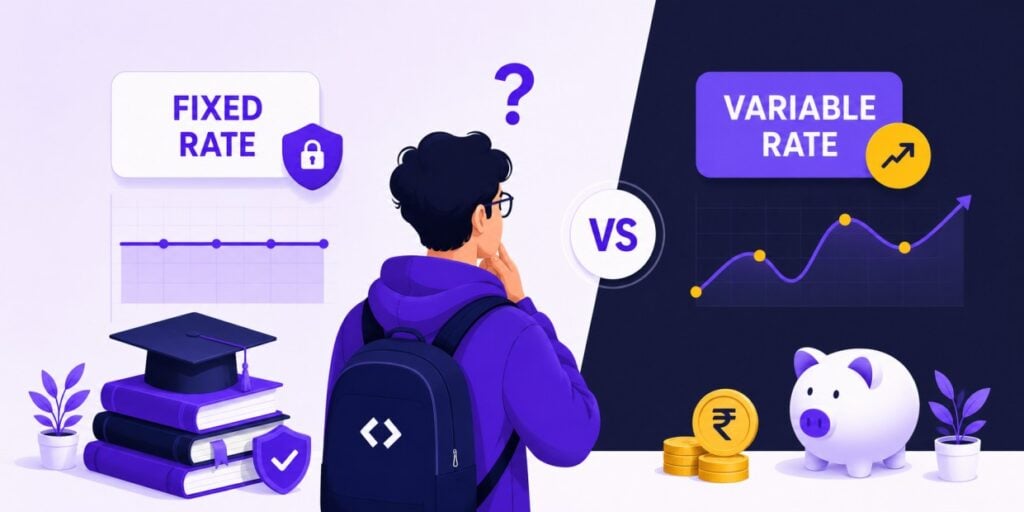
| Rate rises (variable rate) | Choose fixed rate (MPower, Citizens Bank fixed option) if uncertain about income stability. Variable rates can rise. |
| Policy risk (like SAVE reversal) | Private refinancing is contractual – not subject to government policy changes. Your rate and terms are locked in the signed agreement. |
GradRight does not sell loans – it guides you to the best option. Connect with a refinancing expert, free of charge. Get Refinancing Guidance on GradRight
What Refinancing Actually Delivers – Versus What SAVE Promised
| Benefit | SAVE Plan (when active) | Refinancing (private, stable) |
| Who qualifies | US federal loan borrowers only. Indian graduates on F-1/OPT never eligible. | Available to Indian graduates with stable US employment and FICO 650+ |
| Interest rate reduction | Lower payments through income-based formula, not rate reduction | Direct rate reduction from 11-13% INR to 4-7% USD through negotiation |
| Stability | Dependent on US government policy – reversed in 2025 | Private contract – politically independent |
| Cosigner release | No | Yes – original loan closes, parents released |
| US credit building | No | Yes – each payment builds FICO score |
| Currency protection | No | Yes – switches to USD for USD earners |
| Cash flow improvement | Yes – reduced payments (when active) | Yes – lower EMI through rate reduction |
| Long-term certainty | None – subject to reversal | Yes – contractual terms cannot be unilaterally changed |
GradRight’s Role: Not Selling Loans, Guiding Graduates
Refinancing is complex. Eligibility is tied to employment, visa status, and cosigners. There are a lot of considerations that need attention. And vendor selection is complicated. That is where GradRight helps Indian graduates.
GradRight does not sell loans – it guides you. By connecting you with lenders who handle international student refinances, it ensures transparency. Beyond refinancing, GradRight supports your full journey: from study loans in India, to repayment in the USA, to refinancing at better terms. The earlier you start the process, the more savings you unlock. Every month on a high-interest loan is money lost that could have been redirected to savings or investments. Source: GradRight original article.
Also Read: SoFi vs Citizens Bank: Which Student Loan Refinance Is Better?
Important: the earlier you start refinancing, the more savings you unlock. Every month at a high rate is money that could have gone to savings. Start Refinancing on GradRight
Related Guides
Why Indian Graduates Are Refinancing in the US Amid Visa and OPT Uncertainty
Pros and Cons of Refinancing Your Education Loan
SoFi vs Citizens Bank: Which Student Loan Refinance Is Better?
6 Expert Tips to Get the Best Student Loan Refinance Offer
Top Benefits of Refinancing Education Loans in India and the US
How International Students Can Refinance in the US
Building Your US Credit History with Refinanced Education Loans


 Australia
  Canada
  France
  Germany
  India
India  Ireland
  UAE
UAE  United Kingdom
  United States
