






Education abroad is getting more expensive by the day. The cost of college education in North America has risen substantially this century, and rupee depreciation against the dollar over the same period means the effective cost in INR terms has climbed further still. Hefty EMIs make financial planning difficult for young graduates just starting out.
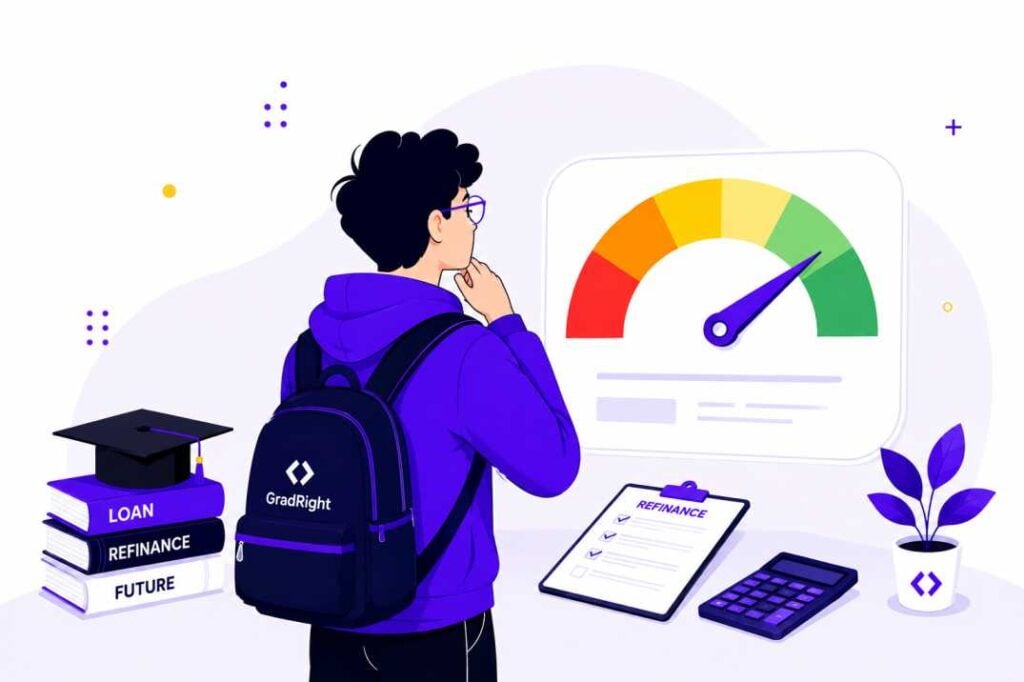
Rising education costs and a weaker rupee make Indian student loans expensive in effective terms. Refinancing into a lower-rate USD loan can meaningfully reduce EMIs for eligible borrowers. Eligibility depends mainly on five factors: credit score, stable income, visa or work status, debt-to-income ratio, and having a sufficiently large loan balance to justify the transition.
Run through the eligibility checklist below before applying to any lender.
Student loan refinancing eligibility checklist
| Criterion | Minimum Requirement | Strong Profile | If You Do Not Qualify Yet |
| Credit Score (FICO) | No universal minimum; each lender sets its own requirements | A stronger credit profile may improve approval odds and pricing, though this varies by lender | Build score over several months with a secured credit card and on-time payments |
| Visa / Work Status | Valid US immigration/work authorization accepted by the lender; requirements vary significantly by lender | Longer remaining work-authorization validity and, where relevant, permanent residency typically widen access | Wait for a stronger visa status if needed. Some lenders (for example, MPOWER) consider OPT holders. |
| Employment / Income | Stable, documented employment; offer letter or a few recent pay stubs | 6+ months at current employer; full-time salaried position | Gig work, internships, and OPT job-searching status generally don’t count as stable income |
| Debt-to-Income (DTI) Ratio | Some lenders may consider DTI in the 40-50% range, but requirements vary | A lower DTI generally indicates greater repayment capacity | Pay down smaller debts first. A cosigner’s income may help. Increasing salary helps over time. |
| Loan Balance | A meaningful outstanding balance; many lenders set a minimum around USD 5,000-10,000 | A larger balance can make refinancing more worthwhile, since even a modest rate cut may produce larger absolute savings | Very small remaining balance: calculate your break-even point using your own balance, rate, tenure, and costs |
Most refinancing lenders want to see reasonable strength across all five areas above. A weakness in any one area can narrow your options or affect the rate offered, and exact thresholds vary meaningfully by lender, so treat these as general guidance rather than a fixed pass/fail test.
Why refinancing matters more as education costs rise
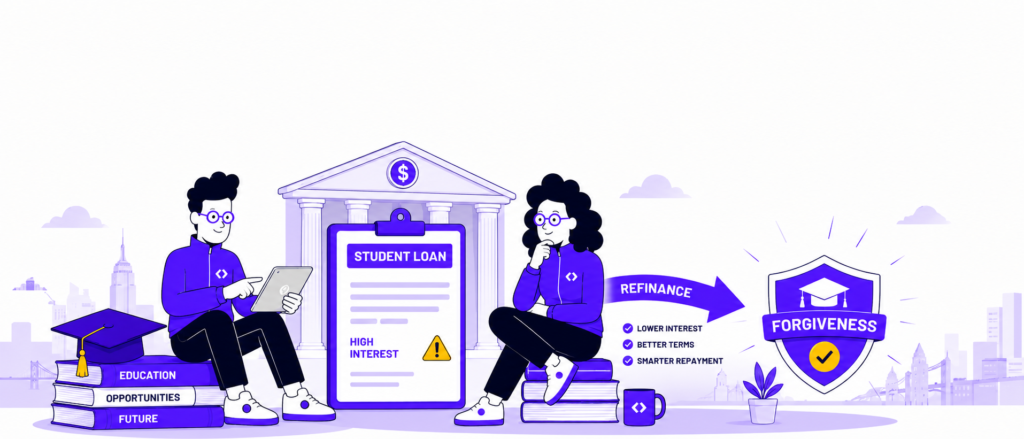
When you first borrowed your education loan, you were a student with no income and no credit history. The lender priced the loan based largely on your parents’ or cosigner’s profile and your future potential. Now that you’re employed, your profile has changed substantially, though your original loan rate typically hasn’t moved with it.
Refinancing is meant to correct that mismatch. You’re no longer a student; you’re an employed professional with documented income and a developing credit history. Lenders can price a loan accordingly once you apply with the right profile to a lender that’s actually a fit for your situation.
Understanding each eligibility criterion
1. Credit score
Your credit score is one of the most important factors in the refinancing process. Lenders use it to help decide whether you’re creditworthy and at what rate. In the US, this generally means your FICO score, not your Indian CIBIL score, which US lenders typically cannot access.
If you haven’t yet built US credit history: consider opening a secured credit card, setting up autopay on your accounts, keeping utilization well below 30%, and building a track record over several months before applying to most mainstream lenders. MPOWER Financing is one of the lenders that specifically serves international graduates and may consider borrowers with limited US credit history; its own published requirements currently ask for at least 12 months of remaining work authorization and at least 3 months of full-time US employment post-graduation, subject to its current eligibility criteria.
2. Visa and work status
Most US refinancing lenders require a valid, long-term work visa. H-1B tends to be the most widely accepted across lenders. SoFi has also accepted E-2, E-3, J-1, L-1, and O-1 visa holders under its published eligibility criteria; MPOWER Financing accepts OPT and STEM OPT holders, making it one of the more accessible options for recent graduates still on F-1 status. Citizens Bank has typically required a US citizen or permanent resident cosigner for non-citizen applicants. Policies change, so verify current requirements directly with each lender.
One practical tip: if a US citizen or permanent resident, such as a relative already established abroad, is able and willing to cosign, it can meaningfully widen your options while your own profile is still building. This isn’t the easiest ask to make of family, but it’s worth considering for early-stage eligibility.
3. Stable employment and income
Most lenders require proof of stable employment, typically a job offer letter or a few months of recent pay stubs. Gig work, internships, and OPT time spent job-searching (before you’ve started full-time work) generally don’t count as stable income for most lenders. The profile lenders look for is usually someone who has completed their degree, is past the early job-search phase of OPT, and holds a full-time employment offer or role.
Some lenders will consider applicants who have a signed offer letter but haven’t started payroll yet. Confirm this directly with the specific lender before applying, since policies vary.
4. Debt-to-income (DTI) ratio
DTI is the percentage of your gross monthly income that goes toward debt payments. Many lenders look for this to be under roughly 40-50%, though the exact threshold varies by lender. To calculate yours: add all monthly debt payments (education loan EMI, credit card minimums, any other loans) and divide by your gross monthly income.
Example: USD 7,500 gross monthly income and USD 2,000 in total monthly debt payments works out to a 26.7% DTI, generally considered comfortable. To lower DTI: pay down smaller debts first, avoid taking on new debt before applying, or add a cosigner whose income can lower your effective ratio.
5. Loan balance
There’s no single universal minimum, but very small remaining loan balances (often cited around under USD 10,000) may not justify the transition costs of refinancing at some lenders. Processing fees and the coordination effort involved mean you generally need a meaningful remaining balance to produce a worthwhile net saving. Many lenders set a minimum in the USD 5,000-10,000 range. Above roughly USD 25,000 outstanding, the math more often works in your favor if you can meaningfully reduce your rate, though you should still run your own numbers rather than assume this applies to your specific loan.
Also read: 6 Expert Tips to Get the Best Student Loan Refinance Offer
What is pre-qualification, and should you use it?
A pre-qualification is a preliminary indication from a lender that you might be eligible for refinancing, based on a soft credit check and basic details about your existing loan and employment. A pre-qualification is not a guarantee; a lender can still decline to proceed after a closer, formal review.
Pre-qualification is useful because it typically uses a soft credit check rather than a hard inquiry, so you can check your standing with multiple lenders without directly affecting your FICO score. A common approach is to pre-qualify with several lenders, then submit formal applications only to the ones where pre-qualification looked favorable, within a focused rate-shopping window recognized by the applicable FICO scoring model, so that related inquiries may be treated more favorably than scattered, unrelated ones.
| Stage | Credit Impact | Purpose |
| Pre-qualification (soft check) | Generally none; doesn’t affect your FICO score | Check whether you’re likely to qualify and roughly what rate range to expect |
| Formal application (hard inquiry) | A small, typically temporary dip | Required for an actual loan offer with a locked rate |
| Multiple formal applications within the FICO rate-shopping window | Can count as a single inquiry under FICO’s model, though this varies by scoring model | Lets you compare competing formal offers without stacking separate inquiry penalties |
| Multiple formal applications spread over months | Each is more likely to count separately | Generally worth avoiding; try to complete comparison shopping within a short window |
The exact rate-shopping window and how it’s treated can vary by scoring model and bureau, so treat the ranges above as general guidance rather than a guaranteed rule for every credit report.
An illustrative two-phase refinancing scenario
The following is an illustrative, anonymized scenario meant to show how a phased refinancing strategy can work, not a documented case study with independently verifiable figures. Treat the numbers as directional, not a promise of similar results.
Consider a hypothetical H-1B visa holder in the US with stable employment and strong income, whose existing Indian education loan carries a rate around 13%, a rate that reflects a lending profile built for a student with no US credit history. The loan is rupee-denominated, creating a structural mismatch for someone now earning and living in dollars.
In a case like this, jumping directly to the most competitive US rate usually isn’t realistic yet, since US credit history typically needs to be established first. A deliberate two-phase approach can work instead:
| Phase | Illustrative Action | Illustrative Rate Change | Key Idea |
| Phase 1 (early months) | Transfer from the original Indian lender to a lender that accepts India-originated loans and thin US credit files, such as MPOWER Financing | Potential reduction to a lower fixed rate, depending on the borrower’s profile and the lender’s current offer | Exit the high-rate Indian loan. Enter the US lending ecosystem. Begin building US credit history. |
| Phase 2 (later) | After building additional US credit and repayment history, the borrower could explore whether they qualify for other refinancing options with a mainstream US lender that can now refinance the US-originated loan | A further rate reduction is possible for some borrowers, but not guaranteed or on a fixed timeline | Potentially lock in a stronger rate over time. A US student-loan interest deduction may be available if the refinanced loan meets applicable IRS requirements; confirm with a qualified tax professional. Continued reduction in rate-change risk if the new rate is fixed. |
In a scenario like this, the potential outcome includes a meaningfully lower fixed rate than the original loan, a cosigner released from the original obligation, reduced exposure to rupee depreciation, and an established US credit profile. Actual outcomes depend heavily on your specific credit profile, income, the lenders you qualify with, and how rates move over the relevant period; use a refinance calculator with your own numbers rather than assuming this scenario applies to you.
US-based lenders for Indian student loan refinancing
Rates and policies below are illustrative reference points and change frequently. Verify current rates, visa policies, and whether a lender accepts India-originated loans directly on each lender’s own site before applying.
| Lender | Accepts OPT? | Accepts H-1B? | Direct Indian Loan Payoff? | Starting Rate (approx., check current) |
| MPOWER Financing | Yes (subject to 12-month work authorization and 3-month full-time employment requirements) | Yes (subject to the same requirements) | Yes, via wire to Indian banks (subject to current lending capacity) | Check current rate |
| SoFi | Check current policy. Note: visa eligibility is separate from loan-origin eligibility. | Yes (has accepted H-1B, E-2, E-3, J-1, L-1, O-1) | No; SoFi’s own eligibility page states it does not refinance loans originated outside the US, with Prodigy Finance loans as the stated exception. Meeting SoFi’s visa criteria does not by itself make an India-originated loan eligible. | Check current rate |
| Citizens Bank | Eligibility depends on US residency/citizenship status | For resident aliens, generally requires a qualifying US citizen or permanent-resident cosigner | No | Check current rate |
| Prodigy Finance | N/A | N/A | Prodigy Finance’s current offering is focused on new study loans; multiple sources indicate it does not currently offer a refinancing product | Not applicable to refinancing at this time |
| Earnest / Laurel Road / ELFI | Typically US citizen/PR only | Check current policy | No | Competitive; check current rates directly |
Check your refinancing eligibility with GradRight: one profile, multiple lending partners, free to use. Check Eligibility on GradRight
What refinancing can deliver once eligibility is met
Refinancing an education loan abroad involves real coordination, but for eligible borrowers the potential benefits are often worth the effort. Early in your career, refinancing can meaningfully reduce total loan cost. Depending on the new lender and loan structure, it may also release a parent or other existing cosigner from the original loan obligation once the old loan is fully repaid.
Potential benefits, where applicable to your situation, include a lower monthly EMI, lower total interest cost over the loan’s life, cosigner and collateral release on the original loan, a shift from INR to USD exposure, and the foundation of a US credit profile that can later help with things like mortgages or car loans. Not every borrower will see every benefit, and outcomes depend on your specific profile and the offers you qualify for.
Also read: How Much Can You Save? Real-Life Success Stories of Refinancing
Need guidance on your specific eligibility? You can write in or call to discuss options directly with GradRight. Contact GradRight Refinancing Experts
Sources and methodology
This guide references the following for context, current as of the last-updated date above:
- SoFi’s eligibility criteria (confirms it does not refinance loans originated outside the US, except Prodigy Finance loans): SoFi, Eligibility Criteria
- Discover’s exit from the student loan business: multiple 2024 filings and reporting confirm Discover stopped new student loan originations on February 1, 2024, and completed the sale of its private student loan portfolio in Q4 2024.
The two-phase refinancing scenario in this guide is an illustrative example built to show how a phased strategy can work; it is not a documented, independently verified case study, and actual outcomes vary by individual.
Disclaimer: Interest rates, eligibility criteria, and lender policies referenced in this guide are subject to change and vary by lender and borrower profile. This article is for general information only and is not financial or legal advice. Verify current rates, terms, and lender availability directly before making a decision.
GradRight compares refinancing options from 18+ lending partners, so you can see offers side by side. Start on GradRight
Related guides
- 6 Expert Tips to Get the Best Student Loan Refinance Offer
- SoFi vs Citizens Bank: Which Student Loan Refinance Is Better?
- Building Your US Credit History with Refinanced Education Loans
- Pros and Cons of Refinancing Your Education Loan
- How International Students Can Refinance Their Education Loan in the US
- Step-by-Step Guide to Refinancing Your Education Loan




 Australia
  Canada
  France
  Germany
  India
India  Ireland
  UAE
UAE  United Kingdom
  United States
