






India is now the top source of international students in the USA, and OPT participation recently hit a record 242,782. More Indian grads on OPT and H-1B means more people carrying high-interest Indian education loans while earning in dollars. For most of them, refinancing to a US private lender is the obvious next step. The two names that come up most often in that search are SoFi and Citizens Bank.
Refinancing is a tool, not a trophy. The right pick is the one that lowers your lifetime cost and fits your visa, income, and risk comfort. This guide compares both lenders on every dimension that matters for Indian graduates specifically.
SoFi vs Citizens Bank: Full Comparison for Indian Graduates
| Feature | SoFi | Citizens Bank |
| Lender type | Fintech / digital-first (founded 2011) | Traditional bank (founded 1828, Rhode Island) |
| Fixed APR range | 5.90% – 9.20% (for qualified visa holders, June 2026) | 6.40% – 10.30% (with US cosigner, June 2026) |
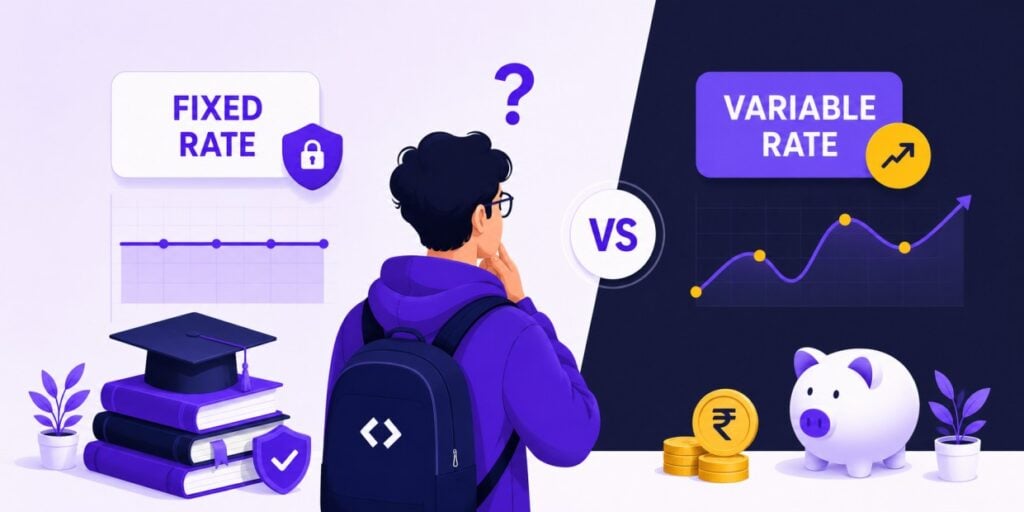
| Variable APR | Available; SOFR-linked | Available; can start lower but fluctuates |
| Repayment terms | 5, 7, 10, 15, 20 years | 5, 7, 10, 15, 20 years |
| Minimum loan amount | Not publicly specified | USD 10,000 |
| Maximum loan amount | Not capped (depends on profile) | Up to USD 500,000+ |
| Application/origination fee | None | None |
| Prepayment penalty | None | None |
| Autopay discount | 0.25% APR reduction | 0.25% APR reduction |
| Loyalty discount | None | 0.25% additional if existing Citizens account holder |
| OPT/H-1B eligibility | Yes – E-2/E-3, H-1B, J-1, L-1, O-1 visas accepted | Typically requires US citizen/PR cosigner for OPT/H-1B borrowers |
| Cosigner requirement | Not required for visa holders with strong credit/income | Required for OPT/H-1B holders; US citizen or PR cosigner |
| Cosigner release | Available (24 months of on-time payments) | After 36 consecutive on-time payments |
| Career support | Yes – career coaching, networking, interview prep | No equivalent program |
| Unemployment protection | Yes – payments paused during job loss; job search assistance | No equivalent program |
| Degree requirement | Must have graduated from accredited US university | Can apply without completing degree (12+ months on-time payments on existing loan) |
| Cross-border payoff (Indian loans) | Does not wire to Indian banks directly – self-remit model | Limited cross-border capability; typically not direct payoff to Indian banks |
| Process | 100% online, fast approval | Online and in-branch (Midwest/Northeast) |
Note: All rates are as of June 2026. SoFi rates for visa holders may differ from rates for US citizens/PRs. Citizens Bank rates assume a US cosigner. Always pre-qualify directly at sofi.com and citizensbank.com for your actual personalized APR before deciding.
The Visa Question – Most Important for Indian Graduates
For Indian graduates on OPT or H-1B, visa eligibility is the first filter – not the rate. A lender with a better rate that does not accept your visa status is not a real option.
| Visa Status | SoFi | Citizens Bank |
| F-1 OPT (standard, 12 months) | Check current eligibility at sofi.com – policy has evolved | Typically requires US citizen/PR cosigner |
| F-1 STEM OPT (24-month extension) | Accepted per GradRight article; confirm at sofi.com | Typically requires US citizen/PR cosigner |
| H-1B | Yes – accepted per original GradRight article | Accepted but typically requires US cosigner |
| H-4 EAD | Confirm with SoFi directly | Confirm with Citizens directly |
| E-2/E-3 | Yes – explicitly listed | Confirm with Citizens directly |
| J-1, L-1, O-1 | Yes – explicitly listed by SoFi | Confirm with Citizens directly |
| Permanent Resident (Green Card) | Yes | Yes – full eligibility, no cosigner needed |
| US Citizen | Yes | Yes – full eligibility |
The practical summary: SoFi is the more visa-friendly option for Indian graduates who have not yet secured permanent residency. Citizens Bank typically requires a US citizen or permanent resident cosigner for OPT/H-1B borrowers – which means you need someone in the USA willing to co-sign. Citizens does offer a cosigner release after 36 on-time payments, providing a path to independence. Source:
Also Read: How International Students Can Refinance Their Education Loan in the US
Rates in Practice: What Indian Graduates Actually Receive
Advertised rate ranges are wide. The rate you actually receive depends on your credit score, income, debt-to-income ratio, and whether you have a cosigner. Here is how to think about where you are likely to land:
| Profile | Likely SoFi APR | Likely Citizens APR | Notes |
| Excellent credit (750+ FICO), strong income, H-1B | 5.90% – 7.0% (fixed) | 6.40% – 7.5% (with cosigner) | SoFi competitive at top end; Citizens loyalty discount adds value if existing customer |
| Good credit (700-749 FICO), stable income | 7.0% – 8.0% | 7.5% – 9.0% (with cosigner) | SoFi may have slight rate advantage without cosigner requirement |
| Mid-range credit (650-699 FICO) | 8.0% – 9.2% | 9.0% – 10.3% (with cosigner) | Both require strong application; Citizens cosigner may lower rate significantly |
| OPT with thin US credit file | May not qualify without established credit | Requires cosigner; rate depends on cosigner profile | First build 12+ months of US credit before applying to either |
A 0.50% APR difference on a USD 50,000 loan over 10 years costs approximately USD 1,500 in additional interest. Before assuming one lender is better, pre-qualify at both on the same day. APR quotes are based on your specific profile – the winner for your neighbor may not be the winner for you.
Where SoFi Wins
- Visa flexibility: accepts E-2/E-3, H-1B, J-1, L-1, O-1 without requiring a US cosigner for strong profiles
- Digital experience: entire process online, fast approval, simple interface
- Member perks: career coaching, networking events, interview preparation – genuinely useful for early-career graduates
- Unemployment protection: payments pause if you lose your job; job search assistance provided
- Faster cosigner release: 24 months of on-time payments (vs Citizens’ 36 months)
- No degree completion requirement: graduated borrowers with any repayment history qualify
Where Citizens Bank Wins
- Stacked discounts: autopay 0.25% + loyalty 0.25% = 0.50% total discount if you bank with Citizens. On a USD 50,000 loan over 10 years, 0.5% saves approximately USD 1,500
- Traditional bank stability: regulated bank since 1828 – appeals to borrowers who prefer institutional banking
- Higher loan amounts available: useful for graduates with larger balances
- Branch access: Midwest and Northeast presence if you prefer in-person service
- Degree completion flexibility: can apply without completing degree (12+ months of on-time payments required on existing loan)
- Cosigner path: clear 36-payment cosigner release for OPT/H-1B borrowers who use a US cosigner
Get quotes from SoFi, Citizens Bank, and other refinancing lenders on GradRight. One profile, competing offers, free. Compare Refinancing Options on GradRight
Important: Cross-Border Payoff from Indian Loans
If your education loan is still with an Indian bank (SBI, HDFC Credila, Avanse, ICICI), neither SoFi nor Citizens Bank typically wires payoff funds directly to Indian lenders. This means:
- SoFi: deposits USD in your US checking account – you wire to India the same day to avoid FX swings
- Citizens Bank: limited cross-border payoff capability – check current policy with their team
- MPower Financing: wires payoff directly to Indian banks via SWIFT – the only mainstream option with direct Indian lender payoff as of June 2026
If your loan still sits with an Indian lender, the practical first step is MPower Financing (not SoFi or Citizens). Once the Indian loan is closed and you have 12-24 months of US repayment history, refinancing again with SoFi or Citizens at a lower rate becomes possible.
One Warning That Applies to Both: Federal Loans
If you hold any US federal student loans (Direct Loans, PLUS Loans), do not refinance them into either SoFi or Citizens Bank without fully understanding what you lose. Refinancing federal loans into private loans permanently removes:
- Income-driven repayment plans (SAVE, IBR, PAYE)
- Public Service Loan Forgiveness (PSLF)
- Federal forbearance and deferment
- Discharge protections in specific circumstances
For most Indian graduates whose loans are from Indian banks (not US federal loans), this warning does not apply. But if you also took US federal loans during your studies, separate them from your Indian loan and think carefully before refinancing the federal portion.
A Quick Decision Framework
| Your Situation | Recommended Starting Point |
| On OPT or early H-1B, no US cosigner available | SoFi – more visa-friendly without cosigner requirement. Pre-qualify first. |
| On OPT/H-1B with a US citizen/PR family member willing to cosign | Compare both. Citizens’ stacked discounts may make it competitive. 36-payment cosigner release path. |
| Permanent resident or US citizen | Compare both directly. SoFi’s member perks vs Citizens’ loyalty discount. Let actual APR quotes decide. |
| Existing Citizens Bank account holder | Start with Citizens – loyalty discount (0.25%) + autopay discount (0.25%) = 0.50% total. Compare SoFi too. |
| Indian loan still with SBI/Avanse/HDFC Credila | Start with MPower Financing for direct payoff. Consider SoFi or Citizens for a second refinance after 12-24 months. |
| Value career coaching and job protection | SoFi – member perks are genuine and not replicated elsewhere. |
| Want predictable fixed EMI, traditional banking | Citizens Bank for fixed-rate loan with clear cosigner release path. |
Also Read: Best US Lenders to Refinance Your Education Loan 2026
Pre-qualify at SoFi and Citizens Bank on the same day via GradRight. One profile, side-by-side APR quotes, free. Get Refinancing Quotes on GradRight
Related Guides
Best US Lenders to Refinance Your Education Loan 2026
How International Students Can Refinance in the US
Top Benefits of Refinancing Education Loans in India and the US
5 Mistakes to Avoid When Refinancing Your Education Loan
How Much Can You Save? Real-Life Success Stories of Refinancing
Do You Always Need Collateral to Refinance? Myths Exposed
Step-by-Step Guide to Refinancing Your Education Loan





 Australia
  Canada
  France
  Germany
  India
India  Ireland
  UAE
UAE  United Kingdom
  United States
