




Choosing the right professional course is crucial to a rewarding career in finance. Both CA (Chartered Accountancy) and CMA (Cost and Management Accounting) are excellent professional qualifications that can lead to lucrative jobs for qualified professionals both in India and globally.
I have compiled this guide to help you compare the CA course with the CMA course. We will discuss eligibility, curriculum, fees, duration, salary, and career scope so you can make an informed choice.
CA Vs CMA: quick comparison
The core difference between a CA and CMA is in the scope of the work of the individual who acquires one of these professional qualifications. A chartered accountant (CA) is expected to handle external financial reporting, audit, and compliance. A CMA focuses on cost control and optimization.
This table shows the key differences in scope, training, and career outcomes of the CA and CMA courses.
| Factor | CA | CMA |
|---|---|---|
| Governing body | ICAI | ICMAI |
| Main focus | Audit, tax, reporting, compliance | Costing, budgeting, management accounting, business performance |
| Typical duration (Intermediate and Final stages) | 4 years | 3–4 years |
| Practical training | 2 years | 15 months |
| Typical fresher salary | ₹7–12 LPA | ₹5–8 LPA |
| Auditing authority | Financial and tax audit | Cost audit |
Also Read: USA CMA Course: Eligibility, Fees, Syllabus, Salaries
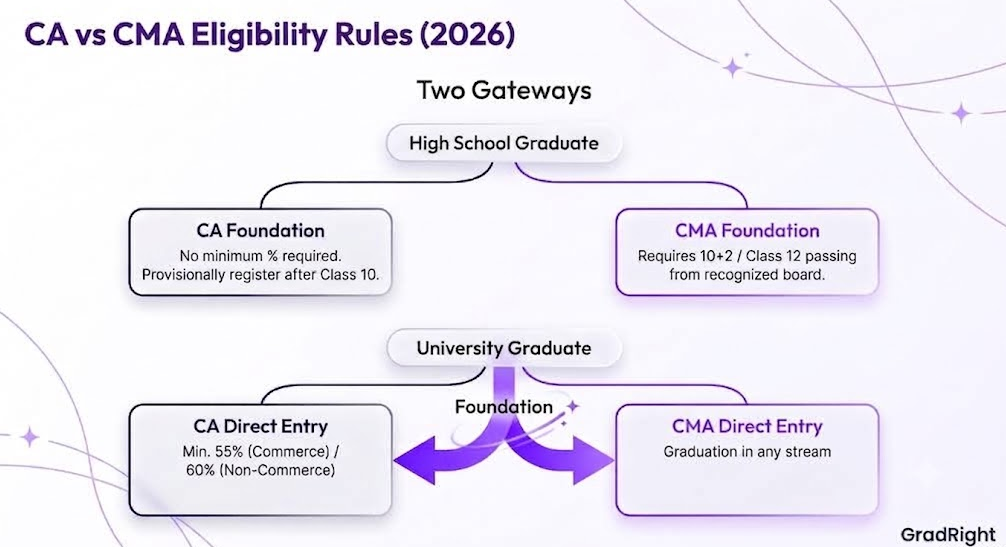
CA vs CMA eligibility after Class 12 and graduation
You can begin a CA or CMA course after Class 12 or after graduation. Both the courses pan out over three stages – Foundation, Intermediate, and Final.
Entry to CA and CMA Foundation Course after Class 12
You can provisionally register for either the CA or CMA Foundation exam while finishing your Class 12 boards. You need to actually pass Class 12 from a recognized board to then be able to take the exams. Both institutes require a mandatory 4-month study period before you can actually sit for the papers.
Entry to CA and CMA Intermediate Course after Graduation
If you already have a graduation degree, you can skip the Foundation stage entirely. However, there is a minimum cut-off marks criteria as below:
| Qualification | Eligibility Requirement |
|---|---|
| CA | Commerce graduates: ≥ 55% aggregate
Non-commerce graduates: ≥ 60% aggregate |
| CMA | Any recognized bachelor’s degree (No minimum percentage) |
Graduates who score less than the mentioned cut-offs have to enroll in Foundation courses.
Also Read: Best Courses After 12th Commerce in India
CA vs CMA curriculum and course structure
The curricula of both the CA course and CMA course focus heavily on accounting, taxation, and business laws.
CA Course Structure
| Level | Group | Subjects |
|---|---|---|
| CA Foundation | – | Accounting, Business Law, Quantitative Aptitude, and Business Economics |
| CA Intermediate | Group 1 | Advanced Accounting, Corporate and Other Laws, Taxation (Income Tax and GST) |
| CA Intermediate | Group 2 | Cost and Management Accounting, Auditing, Financial Management and Strategic Management |
| CA Final | Group 1 | Financial Reporting, Advanced Financial Management, Advanced Auditing |
| CA Final | Group 2 | Direct Tax Laws & International Taxation, Indirect Tax Laws, Integrated Business Solutions |
CMA Course Structure
| Level | Group | Subjects |
|---|---|---|
| CMA Foundation | – | Business Laws & Communication, Financial & Cost Accounting, Business Mathematics & Statistics, Business Economics & Management |
| CMA Intermediate | Group 1 | Business Laws and Ethics, Financial Accounting, Direct and Indirect Taxation, Cost Accounting |
| CMA Intermediate | Group 2 | Operations Management and Strategic Management, Corporate Accounting and Auditing, Financial Management and Business Data Analytics, Management Accounting |
| CMA Final | Group 1 | Corporate Laws and Compliance, Strategic Financial Management, Strategic Cost Management, Direct Tax Laws and International Taxation |
| CMA Final | Group 2 | Cost and Management Audit, Corporate Financial Reporting, Indirect Tax Laws and Practice, Elective |
Also Read: Best Online MBA Universities in India (2026): UGC-Approved Colleges Ranked
CA vs CMA course duration and practical training
How long does it take to complete a CA and CMA degree? Both CA and CMA courses combine multiple exam stages with compulsory training.
- CA Intermediate and Final stages usually take around four years.
- CMA Intermediate and Final stages generally take three years.
This, of course, assumes a perfect run where you complete each stage on the first attempt. If you do not make it on the first attempt, you get several more attempts.
Both qualifications combine theoretical examinations with exhaustive practical training.
- CA requires two years of practical training called articleship after passing both Intermediate groups.
- CMA requires 15 months of practical training. You can complete the training after Intermediate.
CA vs CMA fees and total cost of study
The institutional fees for the CA and CMA courses are statutory and fixed by ICAI (Institute of Chartered Accountants of India) and ICMAI (Institute of Cost Accountants of India) respectively. It is worth noting that both of these bodies are established by an Act of Parliament and operate under the Ministry of Corporate Affairs, Government of India.
| Stage | CA (ICAI) | CMA (ICMAI) |
|---|---|---|
| Foundation | ₹10,500 | ₹7,200 |
| Intermediate | ₹20,700 | ₹25,900 |
| Mandatory Trainings | ₹15,500 (ICITSS + Articleship) | ₹2,500 (Skills training included) |
| Final | ₹32,800 | ₹28,200 |
| Total Minimum Cost | ₹79,500 | ₹63,800 |
To budget for the expense of preparing for the CA and CMA exams, participants must also include the costs of private coaching, for which the fees can range from ₹50,000 to ₹180,000 depending on the mode (online or offline) and the teacher/coaching institute’s reputation.
Also Read: Professional Courses After 12th Commerce in India
CA vs CMA career scope and salary in India
Both the CA and CMA courses offer different outcomes for participants, even though the subjects are very similar.
Career Scope After CA
CA can work as an auditor, tax consultant, financial controller, or CFO. CAs can also be absorbed into the workforce that performs allied roles in banking, stock markets, and insurance. As an independent practitioner, a CA can audit their clients’ businesses and file various tax returns.
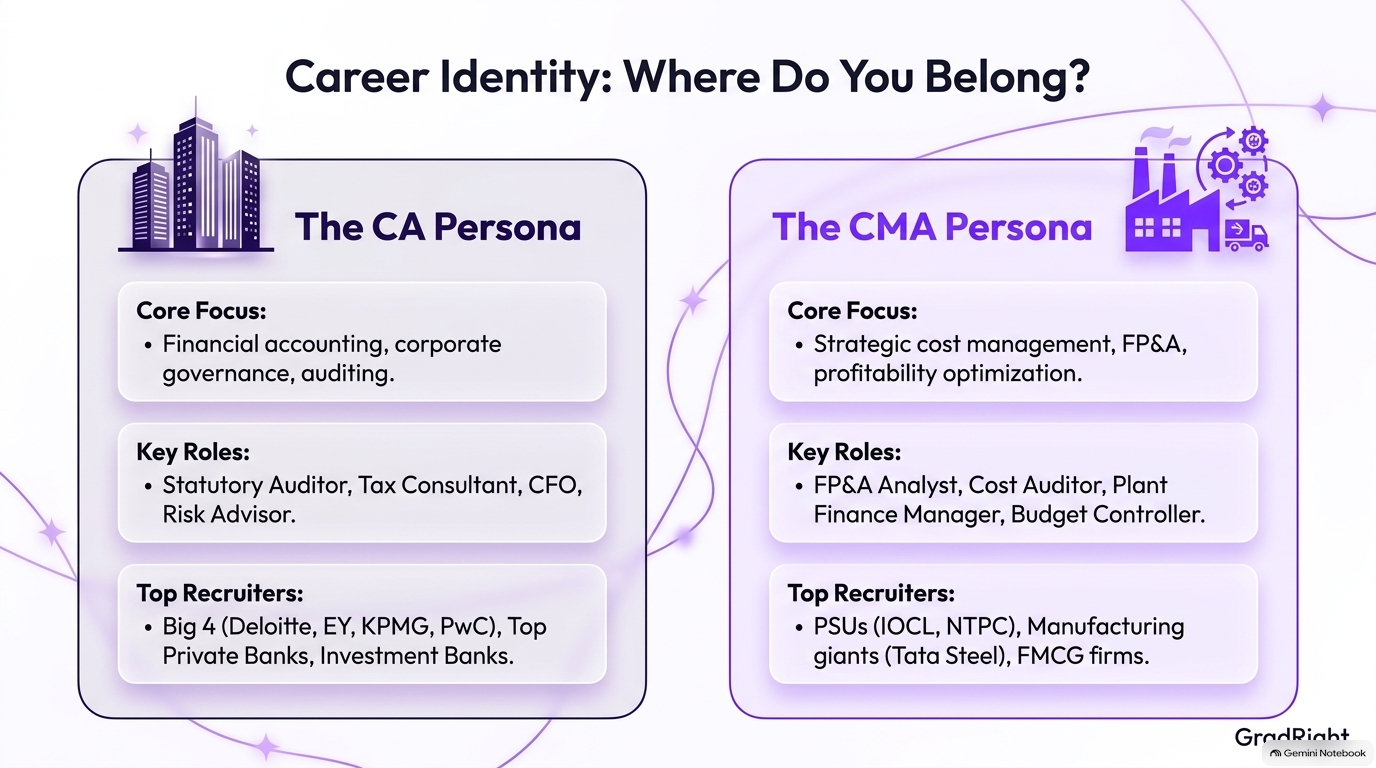
Career Scope After CMA
CMAs commonly work as a cost accountant, budget analyst, cost controller or management accountant. Their role is especially relevant in manufacturing, FMCG, infrastructure, energy, and engineering.
CA vs CMA Salary Comparison in India
| Career Stage | Experience | CA | CMA |
|---|---|---|---|
| Fresher | 0–1 year | ₹7–12 LPA | ₹5–8 LPA |
| Mid-level | 3–5 years | ₹12–20 LPA | ₹8–15 LPA |
| Senior | 7–10+ years | ₹20–50+ LPA | ₹15–30+ LPA |
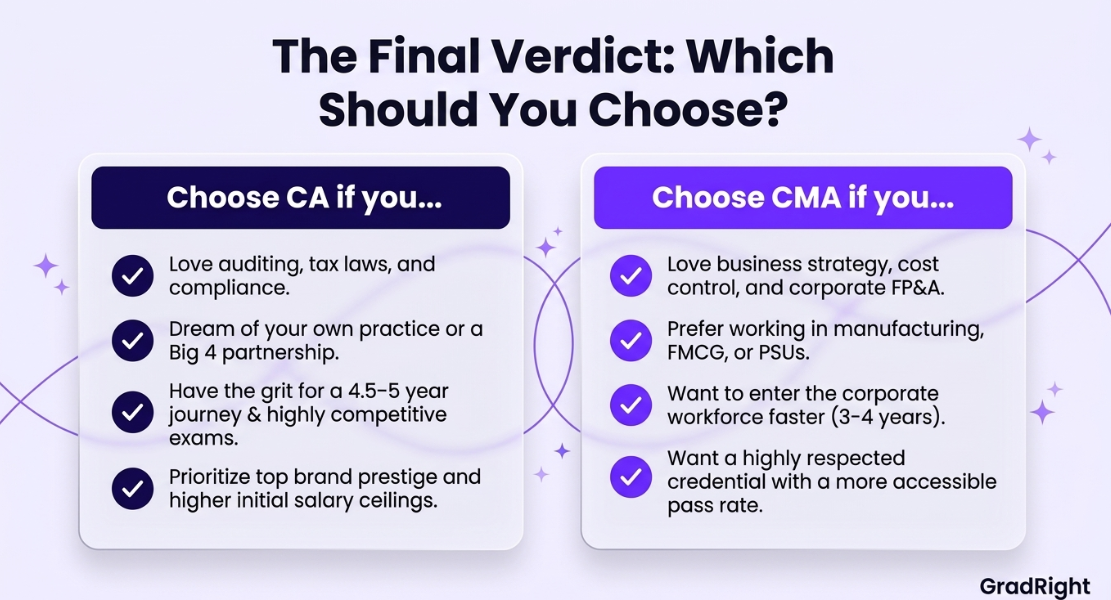
CA vs CMA: which should you choose after Class 12?
Since the curricula for the CA and CMA courses are similar, your choice should reflect the work you want to keep doing long after the exams are over.
- Choose the CA course if you want to work in auditing, taxation, reporting, compliance, or set up an independent practice. Many aspiring CA students consider it a more prestigious qualification.
- Choose the CMA course if you prefer costing, budgeting, FP&A, business performance, and internal financial decisions. It is ideal for those who are more focused on business operations than making numbers move around on a spreadsheet.
Also Read: Major International Universities Opening Campuses in India 2026: Programs, Fees and What to Expect
Related Articles
- CA vs CS: Which Should You Choose
- USA CMA Course: Eligibility, Fees, Syllabus, Salaries
- Best Courses After 12th Commerce in India
- Professional Courses After 12th Commerce in India
- Top Courses in Finance for International Students
How GradRight can help you plan your next step
To make the right decision as regards whether a CA or a CMA course is right, you need the right input. In all the noise and marketing buzz, that insight can be hard to find.
With GradRight, you always have access to the most up-to-date information. Easily compare higher-education options by fees, ROI, admission chances, and career outcomes.
If you are in need of funding, GradRight’s education loan marketplace lets you compare offers from 18+ lenders.
Graddie, the AI assistant, can help you explore courses, universities, careers, admissions, and financing based on your profile.
Download the GradRight app from Google Play or the App Store and explore the most suitable options for you.



 Australia
  Canada
  France
  Germany
  India
India  Ireland
  UAE
UAE  United Kingdom
  United States