





If you are looking to build a career in finance, banking or investment management, a BBA in Finance can be a good starting point. However, the value of the course in terms of the career opportunities it can offer depends majorly on the college from which you pursue the degree.
When done from the right college, BBA Finance can help you earn a starting salary of up to ₹10 LPA. So, in this guide, I will walk you through everything that you should know when considering BBA Finance after 12th.
Also Read: Best Courses After 12th Commerce in India
What is BBA Finance?
BBA Finance is a three-year undergraduate degree, but unlike a general BBA, you spend more time learning how the financial side of a business actually works.
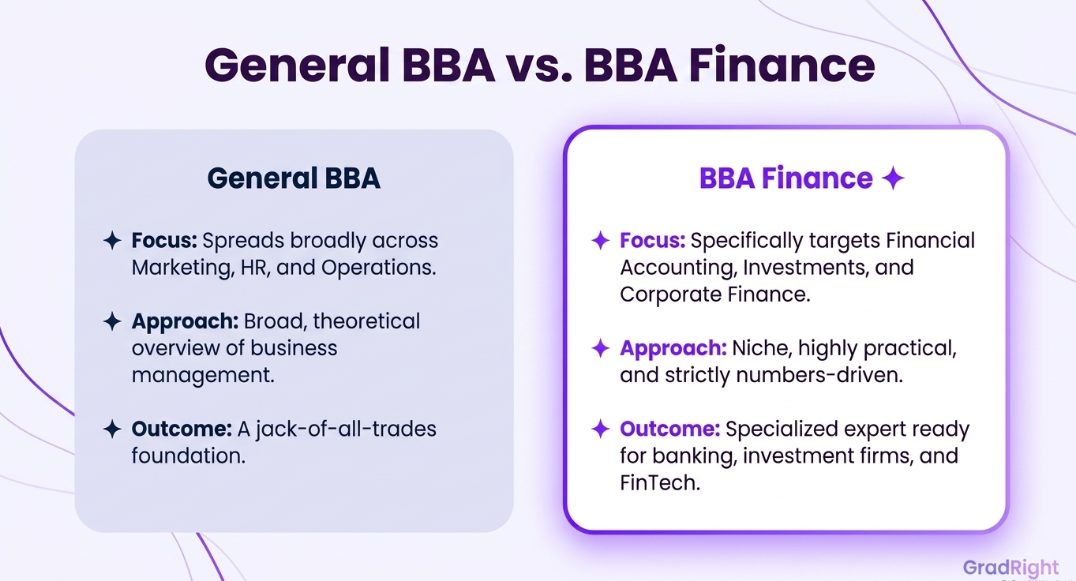
You will study areas such as financial accounting, corporate finance, investments, banking, taxation and risk management. You will still cover the basics of business, but finance will remain the main focus.
After the degree, you can look at roles in banks, fintech companies, investment firms, insurance companies and in corporate finance teams.
Also Read: Top Courses in Finance for International Students
BBA Finance eligibility and admission requirements in 2026
At most colleges, the BBA Finance eligibility criteria for applicants requires them to:
- Have passed Class 12 from a recognised board.
- Meet the required percentage, usually around 45%–60%.
- Take the entrance exam required by the college, where applicable.
Some common exams include:
- CUET UG for central universities
- NPAT for NMIMS
- SET for Symbiosis
- IPMAT for IIM integrated management programmes
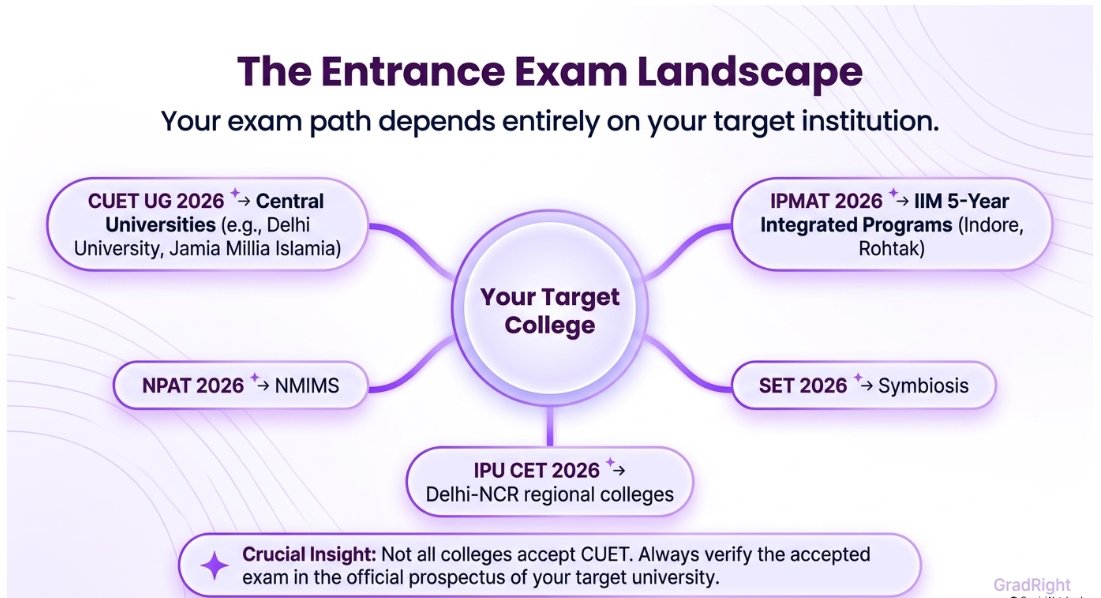
One thing I would strongly recommend: don’t prepare for an entrance exam before finalising your college list. A good shortlist will help you determine which exams you need, what marks you need in each, and when you need to apply.
Top BBA Finance colleges in India: Fees, entrance exams and placements
There are 250+ colleges in India offering BBA Finance. So, the challenge is not finding a college. It is finding college that makes sense for your budget and career goals.
Here are some colleges you can consider:
| College | Annual Fees | Entrance Exam | Avg. Starting Package |
|---|---|---|---|
| Delhi University (BFIA) | ₹30,000–₹50,000 | CUET | ₹6–₹8 LPA |
| NMIMS Mumbai | ₹3,00,000–₹3,50,000 | NPAT | ₹8–₹12 LPA |
| Christ University Bangalore | ₹2,60,000–₹2,80,000 | Christ Entrance Test | ₹6–₹9 LPA |
| IIM Indore (IPM) | ₹14,93,000* | IPMAT | ₹12–₹16 LPA |
| Symbiosis, Pune | ₹2,50,000–₹3,00,000 | SET | ₹6–₹10 LPA |
| UPES Dehradun | ₹4,00,000–₹4,50,000 | Merit/Test | ₹5–₹8 LPA |
| Nirma University Ahmedabad | ₹2,40,000–₹2,80,000 | Merit/Test | ₹5–₹7 LPA |
| Alliance University Bangalore | ₹2,80,000–₹3,20,000 | Alliance Test | ₹5–₹8 LPA |
| Jamia Millia Islamia Delhi | ₹40,000–₹60,000 | CUET | ₹4–₹6 LPA |
| IIM Rohtak (IPM) | ₹12,28,000* | IPMAT | ₹10–₹14 LPA |
*Figures given for IIM Indore and IIM Rohtak are for their five-year integrated programs, so they should not be directly compared with three-year BBA fees.
One thing I would strongly recommend: Don’t choose a college just because you recognise its name. Instead, look at these seven factors before making your decision:
- Total cost: How much does it cost including tuition, hostel, food, travel, etc?
- Course subjects: Does the course cover the areas of finance you want to learn?
- Placements: Which companies hired students, for which roles, and at what package?
- Internships: Does the college help you get internships?
- Location: Is the college close to major business hubs?
- Industry exposure: Do you get to work on live projects or attend guest sessions?
- Entrance requirements: What exam you need and what is its eligibility and application deadline?
Also Read: 7 Signs You Are Choosing the Wrong College
BBA Finance subjects and course structure: Semester-wise syllabus
The exact BBA Finance subjects vary across universities that offer the course. However, most programs follow a similar progression: you start with business fundamentals and gradually move into specialised finance topics.
| Semester | Major Subjects |
|---|---|
| 1 and 2 | Financial Accounting, Business Mathematics, Microeconomics, Management Basics, English Communication |
| 3 and 4 | Corporate Finance, Income Tax, Cost Accounting, Banking & Financial Services, Investments |
| 5 and 6 | Investment Analysis, Derivatives, Corporate Valuation, Financial Modelling, Internship and Electives |
Under the newer degree framework, some universities offer four-year BBA Honours programs, with an exit option after three years depending on the institution and program.
BBA Finance salary in India: Job roles and career opportunities
There is no single BBA Finance salary in India that you can hope to expect after graduation. It depends on your college, the role, the company and the city you work in.
Generally, graduates from tier-1 colleges (those with strong placement records) see starting packages of ₹8–₹12 LPA. For graduates from other colleges, ₹4–₹6 LPA is a more common starting range.
Here are some common roles you can expect to land after BBA Finance:
| Role | Starting Salary | Job Responsibilities |
|---|---|---|
| Financial Analyst | ₹4–₹8 LPA | Analyses company performance, financial statements and budgets |
| Credit Analyst | ₹3.5–₹7 LPA | Assesses loan applications, creditworthiness and credit risk |
| Investment Banking Analyst | ₹6–₹10 LPA | Supports M&A deals, valuations and corporate advisory |
| Equity Research Analyst | ₹3.5–₹7 LPA | Researches companies and analyses stocks |
| Business Analyst | ₹5–₹9 LPA | Evaluates data and supports business decisions |
| Banking Associate | ₹3.2–₹6 LPA | Handles banking operations, accounts and client requirements |
| FP&A Analyst | ₹4–₹8 LPA | Works on budgets, forecasts and financial planning |
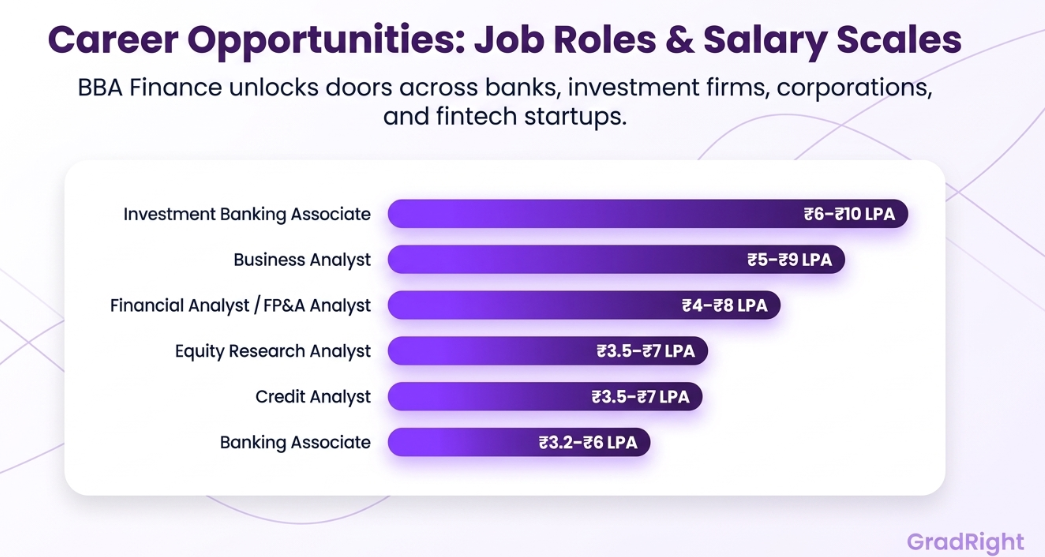
Note: Don’t look at the first year package alone. A ₹6 LPA role in financial analysis at a good company can give you better long-term exposure than a higher package in a role with limited finance work.
Also, most BBA Finance graduates can go from associates to managerial positions in 5-7 years.
Also Read: Best Career Options After 12th in India
Related Articles
- Best Courses After 12th Commerce in India
- Professional Courses After 12th Commerce in India
- Degree Courses After 12th in India 2026: Streams, Eligibility, and Careers
- Top Courses in Finance for International Students
- Best Career Options After 12th in India
How GradRight helps you choose a BBA Finance college
Choosing between several BBA Finance colleges in India can become confusing when you are comparing fees, eligibility, entrance exams, placements and career goals at the same time.
GradRight helps you make these decisions based on data, and not hope. GradRight has helped 300,000+ students navigate their higher education journey. Our course-matching algorithm considers your preferences, budget, entrance scores and career goals to help you find courses and colleges that fit your requirements.
You can also use Graddie to get answers to questions about colleges, courses, fees, eligibility, placements and other education decisions. You can download it from Google Play or the App Store.
And once you have shortlisted your college, you can also explore funding via our education loan marketplace. We connect you with 15+ lenders on one dashboard, and make it easier for you to compare loan offers instead of approaching lenders one by one.




 Australia
  Canada
  France
  Germany
  India
India  Ireland
  UAE
UAE  United Kingdom
  United States