





Studying and working in the US continues to be a strong aspiration for Indian students, driven by education quality and strong post-graduation career outcomes.
But with opportunity comes financial responsibility. For most people, an education loan is the ticket to studying in the US, and that ticket’s cost becomes very real once the first EMI is due.
That’s usually when thoughts about refinancing student loans in the USA start coming up. In 2026, refinancing isn’t just for long-settled professionals; it’s a common financial move for Indian graduates in the US within a few years of starting work. This guide breaks down what refinancing means, when it makes sense, and how to approach it thoughtfully, including the parts that are genuinely more complicated than they first appear.
Student loan refinancing: what it means and how it works
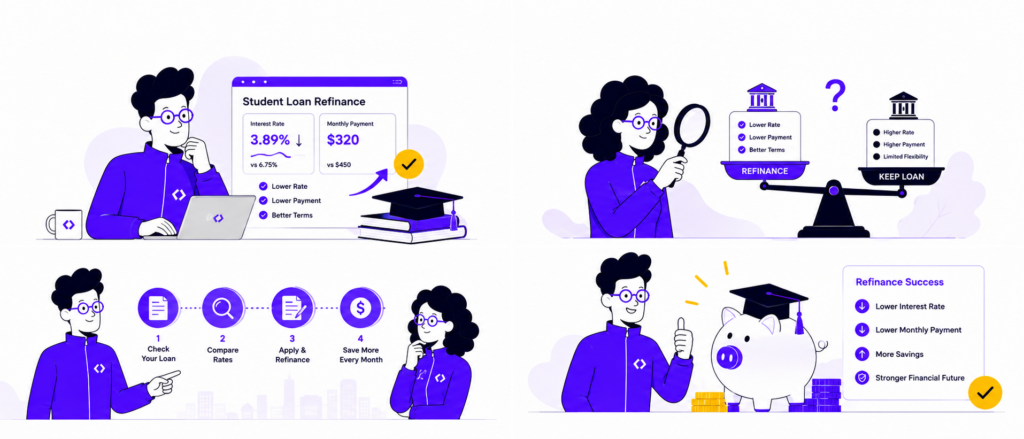
Refinancing means taking a new loan to replace your existing one, generally to secure more favorable terms: a lower interest rate, or a different loan duration to make monthly payments more manageable. A new lender pays off your old loan, and you begin repaying the new lender instead, under terms based on your current credit profile, income, employment stability, and visa status, not the circumstances you had when you first borrowed.
Broadly, here’s how it works:
- Review your existing loan terms and outstanding balance.
- Lenders assess your income, credit score, and visa status.
- You receive offers with new interest rates and loan terms.
- Once you pick a lender, they pay off your old loan.
- You begin making payments under the new terms.
Refinancing isn’t something that has to happen on a fixed timeline; it’s a strategic decision that should fit your actual financial situation and career plans, not just the fact that a lower rate is being advertised somewhere.
When does refinancing actually make sense?
Refinancing shouldn’t be a rushed decision. Many people apply simply because they see an attractively low advertised rate, without checking whether it genuinely improves their overall financial position once fees, currency exposure, and lost flexibility are factored in.
Rates and terms you’re offered generally depend on factors including your income stability, credit score, loan balance, and employment sector. Here’s a general way to think about the decision:
| When Refinancing Makes Sense | When It May Not Help |
| You have stable full-time employment | Your income is inconsistent |
| Your current interest rate is meaningfully high | Your current rate is already competitive |
| You plan to stay and earn in the US | You may return to India soon |
| You can commit to fixed repayments | You need flexible repayment options |
A practical note: current advertised refinance rates can look attractive, but timing your decision around your own financial stability matters more than chasing a rate trend. Refinance to reduce stress, not to add rigidity you might regret if your situation changes.
Refinancing options for Indian students in the US
There isn’t a single refinancing path; the right choice depends on where you plan to work, how stable your income is, and how much financial risk you’re comfortable taking.
Option 1: Refinancing with US-based lenders
US lenders generally refinance for graduates earning in dollars who intend to keep working in the US, weighing your credit score, income stability, and job history closely. Approval generally requires a solid credit score, stable employment, and a valid visa; some lenders may also require a US-based cosigner.
Important limitation worth understanding upfront: several prominent US refinancing lenders (including SoFi and Earnest, per their own current eligibility pages) currently only refinance loans that were originally taken out from a US-based institution, and generally exclude loans originated outside the US, such as an original Indian bank loan. Both name Prodigy Finance loans as their stated exception to this rule, but Prodigy Finance itself does not currently offer a refinancing product (per Prodigy’s own support page). In practice, this means a fresh, never-refinanced Indian bank loan may not be directly eligible with some of the most commonly cited US refinancing lenders; MPOWER is a more directly relevant option for an original Indian loan specifically, per its own current page. Always confirm your specific loan’s eligibility directly with each lender before assuming this route is open to you.
This option suits students planning to build their careers in the US for the foreseeable future and wanting their loan repayments to track their dollar income, where a genuinely eligible lender is available to them.
Option 2: Refinancing with India-based lenders
Indian lenders let you refinance a US education loan by moving repayments back to India, an option especially relevant if you intend to return home. These lenders typically weigh income proof and co-applicants more heavily than US credit history alone, which can reduce dependency on your US visa or job-market situation for loan approval.
The trade-off: moving repayment to India introduces currency exposure. If you continue earning in dollars but repay in rupees (or vice versa), exchange-rate movement can meaningfully affect your real cost of repayment over time.
Risks and trade-offs to understand
- Currency risk: unless your loan and income are in the same currency, exchange-rate movement can increase your effective cost over time, even if the headline interest rate looks lower today.
- Exit flexibility: refinancing again, or closing the loan early, may not be straightforward; check for restrictions or prepayment penalties on your new loan before signing.
- Tenure trade-off: a longer repayment period reduces your monthly EMI, but increases total interest paid over the life of the loan.
The right decision balances cost savings against flexibility, resilience to career or income changes, and long-term affordability, not just the headline rate.
Getting started with refinancing
- Check the specific requirements of your shortlisted Indian and US lenders directly, since these vary and change over time.
- Prepare accurate documentation upfront to avoid delays.
- Limit how many refinance applications you submit, since each can involve a credit inquiry that may affect your score.
- Use a repayment/EMI calculator to model how a specific new rate and tenure would actually affect your payments before committing.
Also read: Best US Lenders to Refinance Your Education Loans for a current, lender-by-lender comparison, and Refinancing Student Loans for Working Professionals in the USA for eligibility and documentation detail.
If you’d like to compare current refinance offers in one place, GradRight lets you check your options across multiple lenders from a single profile.
Sources
- SoFi and Earnest’s exclusion of loans originated outside the US (Prodigy Finance as the stated exception for each), and Prodigy Finance’s current non-refinancing status: confirmed directly via SoFi’s own eligibility criteria page, Earnest’s own help center, and Prodigy’s own support page, cross-referenced with GradRight’s own separate refinancing articles.
Disclaimer: interest rates, lender eligibility, and loan terms referenced in this guide change over time. This article is for general information only and is not financial advice. Verify current terms directly with each lender before making decisions.






 Australia
  Canada
  France
  Germany
  India
India  Ireland
  UAE
UAE  United Kingdom
  United States
