





Is Student Loan Refinancing Worth It? The Answer Depends on These Three Things
It is estimated that 1.8 million Indian students are studying abroad. A vast number of them have taken education loans from Indian banks or NBFCs at rates between 10% and 14%. For large loans of Rs 30-50 lakh, this creates a heavy repayment burden in the first few years of a career.
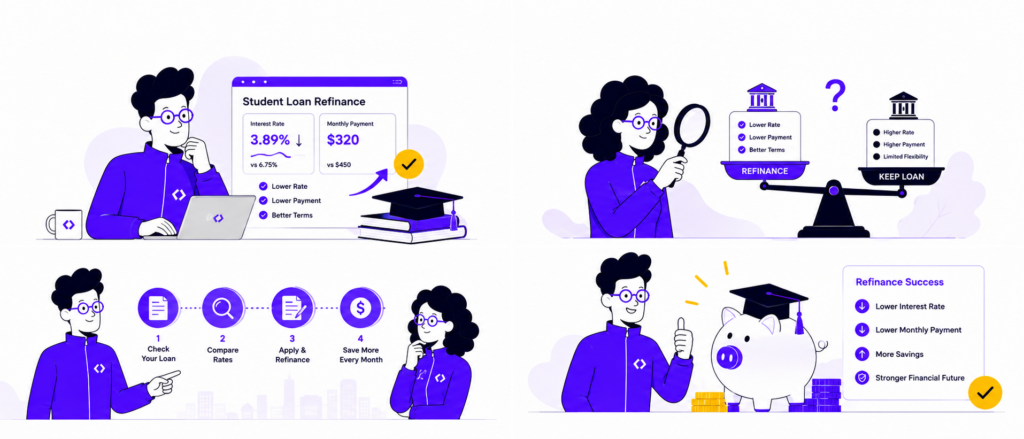
The key question every borrower asks is: is student loan refinancing worth it? The answer depends on three things: your career and employment profile, your financial situation, and where you plan to live after graduation. This guide explains how refinancing works, shows the math on a real case, and gives you a decision framework to apply to your own situation.
| Refinancing Is Worth It If… | Refinancing Is NOT Worth It If… |
| You have stable employment and documented income | Your credit score is below 650 – rates will not be competitive |
| Your current rate is 2%+ higher than what you can access | You hold US federal loans and rely on income-driven repayment or forgiveness |
| You plan to stay abroad for 2-4+ years | You plan to return to India within 12-18 months |
| Your FICO score is 680+ (or building) | Remaining loan tenure is very short (under 2 years) |
| You want to release parents as cosigners | Transition costs exceed savings within remaining tenure |
| You are earning in the same currency as the new loan | You are in an unstable employment or visa situation |
What Student Loan Refinancing Actually Means
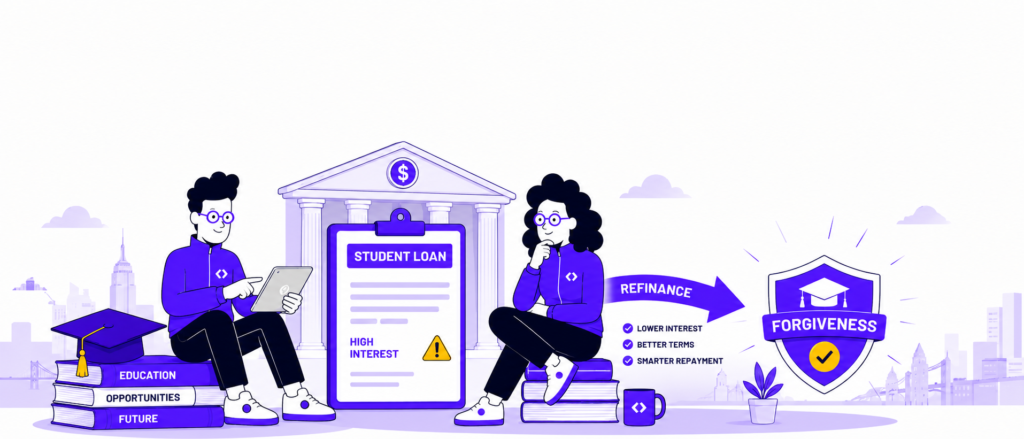
Refinancing involves taking out a new loan that replaces your existing education loan. This works to your advantage as long as the interest rate on the new loan is significantly lower. For Indian graduates, your debt moves from an Indian bank (SBI, HDFC Credila, Avanse) to an international lender (SoFi, Citizens Bank, MPower Financing). A 1% difference does not matter much – but a 5-9% difference saves a considerable amount over the life of the loan.
The mechanics: the new lender pays off your old education loan (directly to the Indian bank in the case of MPower, or via self-remit for SoFi). You then begin repaying the new lender at the new, lower rate. The old loan closes completely – your parents’ cosigner obligation ends, any collateral is released, and the CIBIL lien is removed.
A Real Case: Amit Mehra Saves Rs 12.26 Lakh
Amit Mehra took an education loan of Rs 50 lakh in 2023 to study MS in Computer Science at the University of Wisconsin. He graduated in 2025 and is on OPT, expecting to join a software development firm by end of 2025. His education loan was at 13.85% interest with an 8-year tenure.
He refinanced at 6.12% interest rate with a 12-year tenure. Here is what the numbers show:
| Metric | Original Loan | After Refinancing | Change |
| Loan amount | Rs 50 lakh | Rs 50 lakh | – |
| Interest rate | 13.85% | 6.12% | -7.73 percentage points |
| Tenure | 8 years | 12 years | +4 years |
| Monthly EMI (approx.) | ~Rs 83,500 | ~Rs 46,200 | -Rs 37,327/month |
| Total interest paid (approx.) | ~Rs 30.2 lakh | ~Rs 18.0 lakh | -Rs 12.26 lakh total saving |
| Cosigner status | Parents on loan | Released after refinancing | Parents freed from obligation |
Refinancing saved Amit Rs 37,327 per month in EMI and Rs 12.26 lakh in total interest. Source: GradRight original article (gradright.com/refinancing-explained-is-it-worth-it/). Note: extending from 8 to 12 years contributed to the EMI reduction alongside the rate drop. The total interest saving accounts for both the rate improvement and tenure extension.
Also Read: How Much Can You Save? Real-Life Success Stories of Refinancing
Why Indian Rates Are So Much Higher Than US Rates
Although education loans make it possible to acquire degrees from the best universities in the USA, UK, and Europe, they come at a steep cost. When you first borrowed as a student, the Indian lender assessed you as a high-risk borrower – no income, no US credit history, no employment certainty. The rate reflected that assessment.
Now that you are employed, building US credit, and earning in a strong currency, your risk profile has fundamentally changed. US lenders can see your income, credit score, and employment – and price the loan accordingly. The gap between 11-14% (Indian loan) and 5-9% (US refinanced loan) is the difference between your risk profile then and your risk profile now.
What Refinancing Actually Delivers
| Benefit | How It Works for Indian Graduates |
| Lower interest rate | Most Indian graduates can access 5-9% USD vs 11-14% INR. The difference on Rs 40 lakh over 10 years is approximately Rs 11 lakh in total interest. |
| Lower monthly EMI | Rate reduction immediately reduces the monthly payment. Amit’s Rs 37,327 monthly saving is real money for rent, savings, or investment. |
| Release of cosigner and collateral | Old loan closes. Parents’ cosigner obligation ends. Property lien removed from CIBIL. Families get financial independence back. |
| Currency alignment | Earning in USD, repaying in USD = no currency friction, no rupee depreciation risk. |
| US credit history | Each payment builds FICO score. Within 24 months, this opens access to US mortgages and car loans. |
| Flexibility to repay early | Most US refinancing lenders have zero prepayment penalty. If income grows, pay early and save more. |
What Refinancing Costs You
| Drawback | Who It Affects |
| Loss of federal loan benefits | US federal loan holders only (not applicable to most Indian graduates). Refinancing federal loans into private permanently removes IDR, PSLF, forbearance. |
| Temporary credit score dip | Everyone. Hard inquiry causes 5-10 point dip. Recovers within 3-6 months of on-time payments. |
| Transition costs | Processing fee on new loan + possible foreclosure charge on old loan. Calculate break-even before proceeding. |
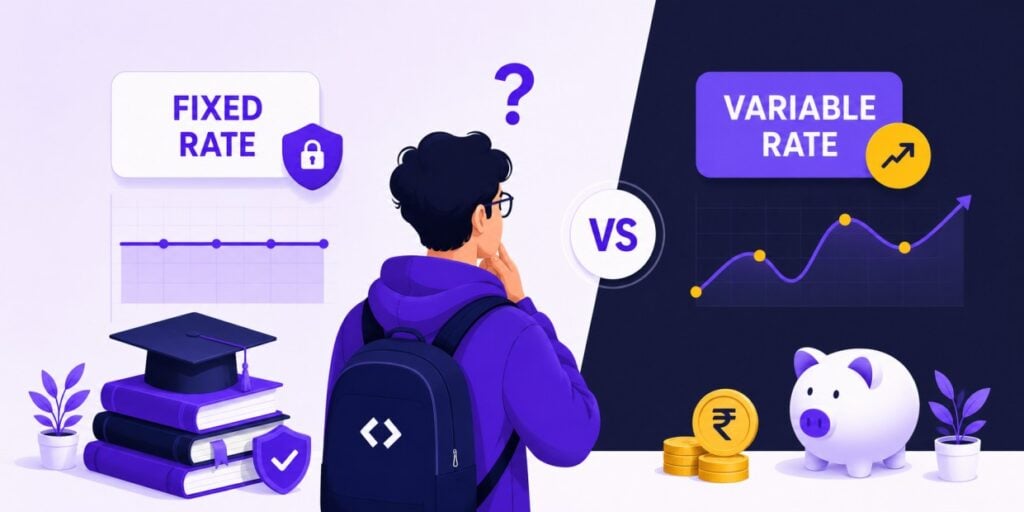
| Variable rate risk | If choosing variable rate, EMI can rise with market conditions. Fixed rate avoids this. |
| Currency risk in reverse | If you return to India and earn in INR while repaying USD loan, rupee depreciation increases repayment burden. Plan career trajectory before refinancing. |
Compare refinancing options on GradRight using a reverse auction where lenders bid for your profile. Free, one submission, multiple offers. Start Refinancing Comparison on GradRight
How to Actually Refinance Your Student Loan
The process is shorter than most graduates expect. The original GradRight article describes it as: ‘An international lender pays off the original loan and issues a new loan.’ Here is the full sequence:
| Step | Action | Typical Time |
| 1. Compare lenders | Use soft-inquiry pre-qualification at 4-6 lenders. GradRight reverse auction mechanism: lenders bid for your profile, eliminating repeated document submissions. | 3-7 days |
| 2. Select offer | Review APR, tenure, fees, cosigner release terms, prepayment policy. Accept the best overall offer. | 1-2 days |
| 3. Formal application | Submit final application. Hard inquiry happens here. | 15-20 minutes |
| 4. Underwriting | Lender verifies income, employment, visa, credit, existing loan. | 3-10 business days |
| 5. Sign promissory note | Review and sign the loan agreement. 3-day right-to-cancel window begins. | 1-2 days |
| 6. Payoff wire | Lender pays off your Indian bank loan (SWIFT transfer for MPower). Indian bank processes closure and issues NOC. | 1-3 weeks |
| 7. First EMI | Set up autopay with new lender. First payment due approximately 1 month after payoff confirmation. | Day 1 of new loan |
Which Lenders to Consider
For Indian graduates whose loans are still with an Indian lender:
- MPower Financing: Only mainstream option for direct Indian bank payoff via SWIFT. Accepts OPT, H-1B, H-4 EAD. No cosigner required. 9.99% fixed APR starting.
- SoFi: Popular for Indian graduates who have built US credit. Accepts H-1B, E-2, E-3, J-1, L-1, O-1. Self-remit model (wire funds to Indian bank yourself). Many international students who have built credit and secured a US job report successfully refinancing with SoFi.
- Citizens Bank: Major US bank offering fixed-rate refinancing up to 20-year tenure. Typically requires US citizen/PR cosigner for non-citizens.
- Earnest, Laurel Road, ELFI: Primarily for US citizens/PRs or those with established US credit and dollar-denominated loans already.
Before refinancing your student loan, compare offers from multiple lenders to find the best rates and terms. Using a platform such as GradRight’s reverse auction mechanism, lenders bid for your profile – increasing your chances of getting the most favorable deal and eliminating the time-consuming process of submitting the same documents multiple times.
The Federal Loan Caution
Students in the USA have access to federal loans not available to international students. Federal loans have a tax benefit of $2,500 (student loan interest deduction). But that does not apply to borrowing from private Indian banks and NBFCs – which is what most Indian graduates have.
If you hold US federal loans as well as Indian loans, do not refinance the federal portion to a private lender unless you are certain you do not need income-driven repayment, PSLF, or federal forbearance. Refinancing federal loans is a one-way door. Indian loans are private by nature – there are no federal protections to lose when refinancing those. Source: GradRight original article.
Also Read: Pros and Cons of Refinancing Your Education Loan
For students from India with stable employment abroad, refinancing is the smart financial move. Write to grad@gradright.com or call 09240209000. Connect with GradRight Refinancing Experts
Related Guides
Are You Eligible to Refinance Your Student Loans?
How Much Can You Save? Real-Life Stories of Refinancing
Pros and Cons of Refinancing Your Education Loan
SoFi vs Citizens Bank: Which Refinance Is Better?
Student Loan Refinance Rates 2026: How to Find the Lowest
6 Expert Tips to Get the Best Student Loan Refinance Offer
Building Your US Credit History with Refinanced Education Loans




 Australia
  Canada
  France
  Germany
  India
India  Ireland
  UAE
UAE  United Kingdom
  United States
