





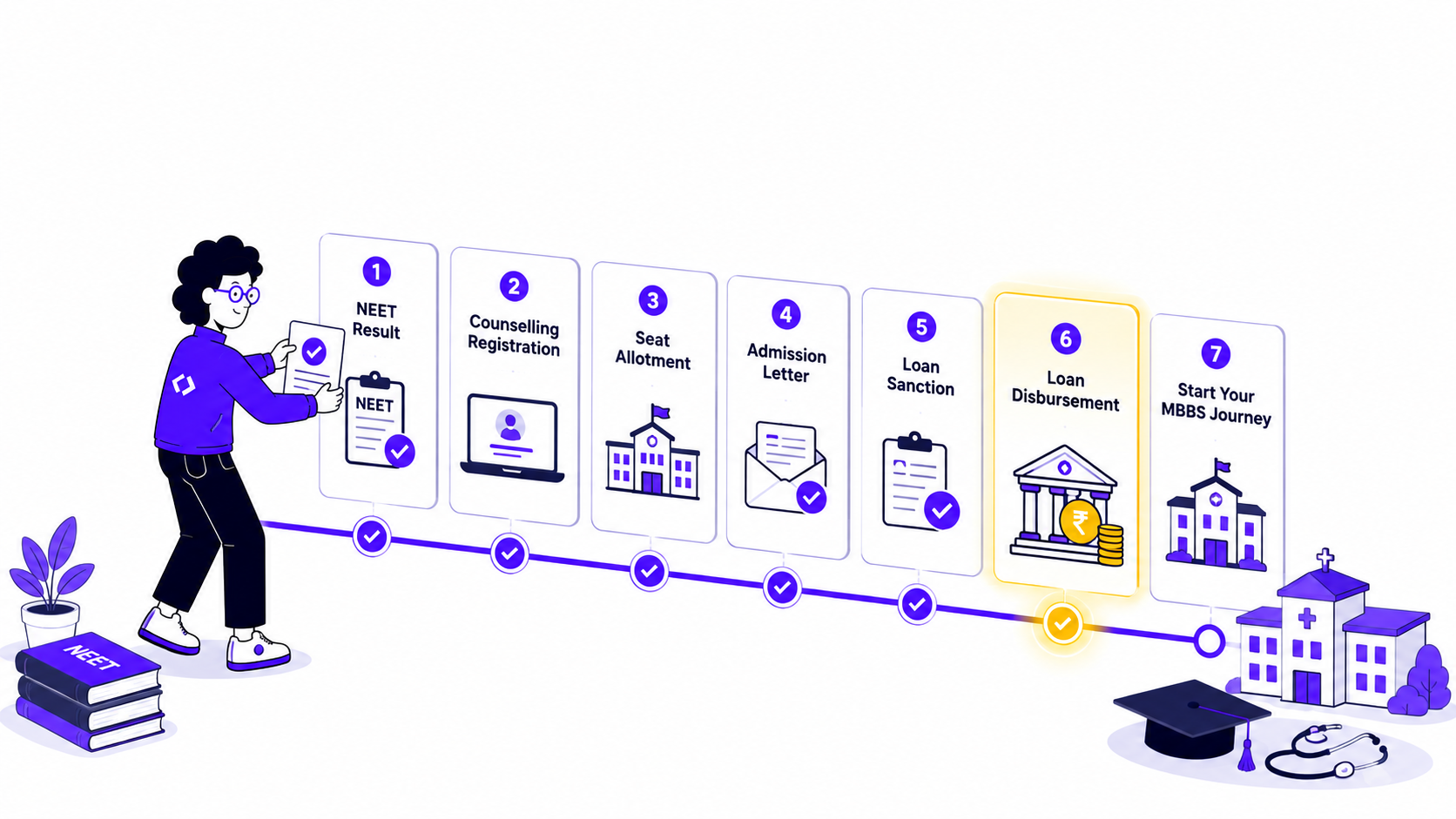
Quick Answer: Once your MBBS seat is allotted, you typically have only 7-8 days to pay your admission fee before the offer lapses. Starting your education loan process before seat allotment, right after your NEET result – is what actually protects you from missing this window. This guide walks through each stage, what to prepare, and when.
Every year, capable students risk losing a hard-earned MBBS seat not because they couldn’t afford it, but because they started the loan process too late. This guide lays out exactly what happens between your NEET counselling and your final fee payment, and why the timing of when you start your loan application matters as much as which lender you choose.
What are the stages between NEET counselling and fee payment?
MBBS admissions in India are conducted through the Medical Counselling Committee (MCC) for All India Quota seats, and by respective state authorities for state quota seats. Counselling typically runs across 4 rounds: Round 1, Round 2, a third round (called Round 3 by MCC for All India Quota seats, or Mop-Up Round by most state counselling authorities), and a final Stray Vacancy Round, with some states conducting an additional round in certain years. Each round follows the same sequence: seat matrix release → registration and choice filling → choice locking → seat allotment result → reporting to the allotted college.
Each round generally spans 10 to 15 days from registration to result, though this can vary by year and by whether it’s an AIQ or state-level round.
| Stage | What Happens |
| Seat Matrix Release | Available seats across colleges are published |
| Registration & Choice Filling | Candidates register and rank their preferred colleges/courses |
| Choice Locking | Final preferences are locked before the deadline |
| Seat Allotment Result | Seats are allotted based on rank, choices, and category |
| Reporting to College | Candidate reports to the allotted college with documents to confirm admission |
Why does starting your loan process early matter so much?
Here’s the part most students underestimate: once a seat is allotted and the admission letter is issued, most colleges give students only 7-8 days to pay the admission fee before the offer can lapse. That’s an extremely tight window to arrange ₹30-50 lakh (or more) in financing from scratch.
If a student waits until seat allotment to begin the loan process, two real risks show up at the worst possible time:
- Government bank unsecured loans are typically tied to a confirmed admission letter and an approved university list. If the allotted university isn’t on that particular bank’s list, the unsecured loan application cannot even be initiated with that bank. It isn’t a matter of approval or rejection, the university itself must be on the list for the process to start at all.
- Starting from zero after allotment means every step – eligibility check, document submission, lender comparison, sanction has to happen within that same 7-8 day window, alongside everything else involved in actually joining a new college.
The safer approach is to begin the loan process right after the NEET result, well before counselling even starts. A loan application that’s already in motion even if not tied to a specific college yet, converts much faster once a seat is confirmed, compared to starting fresh under deadline pressure.
How can you start your loan process before your seat is confirmed?
Several parts of the loan process don’t actually require a confirmed seat or admission letter. They only require your NEET score and your co-applicant’s income details. Starting these early is what protects the 7-8 day window later.
| Student Stage | What Happens | How It Helps |
| NEET Result | Loan eligibility is assessed and lenders are compared based on NEET score and co-applicant income | Gives a realistic borrowing range before college choices are even filled |
| Before Counselling | Loan application initiated with select lenders – no admission letter required at this stage | Groundwork is completed while colleges are still being shortlisted |
| During Counselling | In-principle approval obtained in 5-7 working days (subject to lender norms) | Choices can be filled with a clear sense of loan capacity already in hand |
| Seat Allotment | Admission letter is submitted to finalize the loan against the confirmed college | Converts an existing loan approval into final sanction quickly |
| Fee Payment | Faster disbursement support to meet the college’s admission deadline | Reduces risk of missing the 7-8 day fee payment window |
Students who follow this sequence usually only need to submit their admission letter and finalize documentation once a seat is confirmed, rather than starting the entire loan process from the beginning. You can start this process for free and compare lender options on GradRight.
What happens if your preferred lender rejects you or your university isn’t listed?
This is the exact scenario early preparation protects against. If the allotted university isn’t on a government bank’s approved list, an unsecured loan application cannot be initiated with that bank at all. This isn’t something discovered after applying, it’s a precondition for the loan to even be considered. In this case, students would need to explore private banks or NBFCs, which generally don’t require an admission letter upfront and assess eligibility based on NEET score and co-applicant income instead – meaning that option, ideally, should already be explored before this point is even reached.
What documents should you prepare before seat allotment?
Since several stages of the loan process don’t require an admission letter, students can prepare the following well in advance:
- NEET UG scorecard
- Co-applicant’s (parent’s) income proof – salary slips or ITR for the last 2–3 years
- KYC documents (Aadhaar, PAN) for both applicant and co-applicant
- Academic records (Class 10 and Class 12 marksheets)
- Co-applicant’s bank statements for the last 6 months
Having these ready in advance means that once the admission letter arrives, it’s often the only new document needed to move from in-principle approval to final sanction.









 Australia
  Canada
  France
  Germany
  India
India  Ireland
  UAE
UAE  United Kingdom
  United States
