




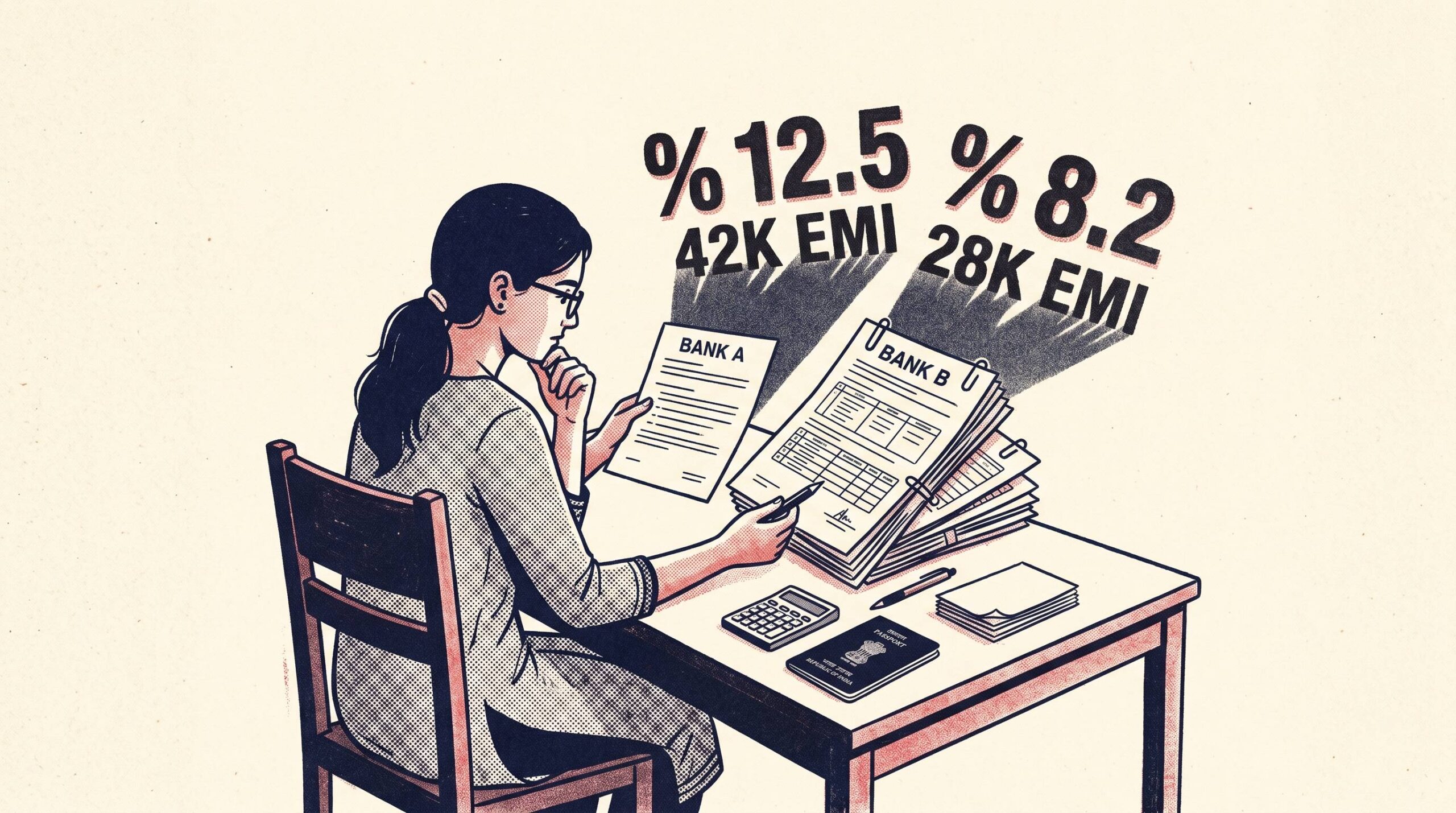
Nobody gets excited about interest rates. They are the fine print at the bottom of the dream, the part most students skip until they are sitting across from a bank officer and nodding along without fully understanding what they just agreed to.
Here is the problem with skipping that part: on a ₹50 lakh education loan, a 2 percent difference in interest rate changes your total repayment by ₹8 to ₹12 lakh over the life of the loan. That is not a rounding error. That is a real number that affects how long you spend repaying debt after graduation, and it is entirely preventable if you understand the basics before you sign anything.
This blog explains education loan interest rates in plain language, covers what every major Indian bank is currently offering for study abroad loans, and gives you the framework to figure out which education loan is actually best for your situation.
What an interest rate actually means in rupees, not percentages
Before comparing banks, it helps to understand what the rate number actually translates to in terms of money out of your pocket.
When a bank says your education loan interest rate is 10% per annum, it means the bank charges you 10% of the outstanding loan balance every year as the cost of borrowing. On a ₹50 lakh loan, that is ₹5 lakh in interest in the first year alone, before you repay a single rupee of the original amount.
The reason total repayment ends up so much higher than the loan amount is compound interest during the moratorium period. Almost every Indian education loan includes a moratorium period, which is the time during your course plus 6 to 12 months after graduation where you are not required to make repayments. However, interest keeps accumulating during this entire period. By the time you start repaying, the principal has grown.
Here is a concrete example. You borrow ₹50 lakh at 10% per annum. Your course is 2 years. The moratorium period is course duration plus 6 months, so 2.5 years total. During those 2.5 years, simple interest of ₹12.5 lakh accumulates. Your effective starting balance at repayment is ₹62.5 lakh, not ₹50 lakh. Your EMI and total repayment are calculated from that higher number.
| Loan Amount | Interest Rate | Moratorium Period | Balance at Repayment Start | Total Repayment (10-year tenure) |
| ₹50 lakh | 9% | 2.5 years | ~₹61 lakh | ~₹76 lakh |
| ₹50 lakh | 10% | 2.5 years | ~₹62.5 lakh | ~₹81 lakh |
| ₹50 lakh | 11% | 2.5 years | ~₹64 lakh | ~₹86 lakh |
| ₹50 lakh | 12% | 2.5 years | ~₹65 lakh | ~₹91 lakh |
The difference between a 9% and a 12% loan on ₹50 lakh is approximately ₹15 lakh in total repayment. This is why the interest rate comparison matters, and why spending a week researching lenders before committing is one of the most financially valuable things you can do in the entire study abroad process.
Floating vs fixed rate: the decision most students don’t think about
Before comparing specific banks, there is one concept that changes how you interpret every rate you see: the difference between a floating rate and a fixed rate.
A fixed interest rate stays the same for the entire duration of the loan. The rate you are offered at the time of disbursement is the rate you pay for the next 10 to 15 years, regardless of what happens to the broader economy.
A floating interest rate moves with a benchmark rate, typically the RBI’s repo rate in India. Most public sector bank education loans are floating, linked to the bank’s MCLR (Marginal Cost of Funds-based Lending Rate) or RLLR (Repo Rate Linked Lending Rate). When the RBI cuts rates, your interest rate drops. When the RBI raises rates, your interest rate rises.
| Feature | Fixed Rate | Floating Rate |
| Predictability | High — EMI stays constant | Low — EMI can change |
| Starting rate | Usually slightly higher | Usually slightly lower |
| Benefit when rates fall | None — you pay the original rate | Rate automatically drops |
| Risk when rates rise | None — you are protected | Rate can increase |
| Best for | Students who want certainty | Students comfortable with some variability |
As of 2026, the RBI has been in a rate-cutting cycle, having cut the repo rate in April 2025. Consequently, floating rate loans have become more attractive in the current environment because borrowers benefit automatically as rates decline. However, this can reverse. A student signing a 15-year floating rate loan today is making a bet on monetary policy over a decade and a half.
Most public sector banks in India offer floating rates. Most NBFCs offer either fixed or a blend. HDFC Credila, for instance, offers floating rates that adjust periodically. Always confirm the rate type before accepting a loan offer, because the headline rate alone does not tell you the full story.
Current education loan interest rates in India: bank-by-bank breakdown (2026)
Here is a current comparison of what the major banks and lenders are offering for study abroad education loans in 2026. Note that rates are floating and subject to change based on RBI policy. Always verify directly with the bank before finalizing any decision.
Government banks: lowest rates, collateral usually required
SBI’s Global Ed-Vantage scheme offers education loans for abroad studies with interest rates starting at approximately 9.15% per annum, making it one of the most competitive government bank options for Indian students studying abroad.
| Bank | Scheme Name | Interest Rate (2026) | Max Loan Amount | Collateral Required? |
| SBI | Global Ed-Vantage | 9.15% to 11.15% p.a. | ₹1.5 crore (up to ₹3 crore select cases) | Above ₹50 lakh |
| SBI | Scholar Loan | 8% to 10% p.a. | ₹40 lakh | No (for premier institutions) |
| PNB | PNB Udaan | 8.10% to 11% p.a. | No upper limit | Above ₹7.5 lakh |
| Canara Bank | Vidya Turant | 8.50% to 10.10% p.a. | ₹40 lakh | Above ₹7.5 lakh |
| Bank of Baroda | Baroda Scholar | 8.45% to 12.45% p.a. | ₹80 lakh | Above ₹7.5 lakh |
| Bank of Maharashtra | Education Loan | 8.05% to 10.05% p.a. | ₹30 lakh | Above ₹7.5 lakh |
Note: All these figures are subject to change, please confirm with the said bank.
Public sector banks like Punjab National Bank, Bank of Maharashtra, and Union Bank of India offer the lowest interest rates for long-term loans in India in 2026. Furthermore, most government banks offer a 0.25% to 0.50% concession for female students, and an additional 0.50% concession for students who take an insurance policy linked to the loan.
The SBI Scholar Loan scheme deserves special attention. The SBI Scholar Loan Scheme offers one of the lowest education loan interest rates in India in 2026, ranging between 6.90% and 7.65%, and is specifically designed for students admitted to top-ranked institutions. If you are admitted to an IIT, IIM, ISB, or select foreign universities on SBI’s approved list, this scheme is the most cost-effective option available from any Indian lender.
Private banks and NBFCs: faster processing, higher rates
HDFC Credila interest rates start from 9.75% per annum, with unsecured student loans available up to ₹80 lakh. As a dedicated education loan company, Credila processes applications faster than most public sector banks and offers pre-approval before university admission confirmation, which is a practical advantage for students applying to multiple universities simultaneously.
| Lender | Type | Interest Rate (2026) | Max Unsecured Loan | Processing Time |
| Credila | NBFC | 9.95% to 13.5% p.a. | ₹80 lakh | 5 to 7 days |
| Avanse | NBFC | 10.25% to 14.00% p.a. | ₹75 lakh | 5 to 10 days |
| InCred | NBFC | 10.5% to 14.00% p.a. | ₹1.5 crore | 5 to 10 days |
| Auxilo | NBFC | 11.00% to 13.50% p.a. | ₹65 lakh | 7 to 14 days |
| Prodigy Finance | International NBFC | 10.75% to 16.00% p.a. | Varies | 2 to 4 weeks |
Note: All these figures are subject to change, please confirm with the said bank.
Private banks and NBFCs are more appropriate for students who need unsecured loans above the public bank limit, need faster disbursement, or are applying to institutions that public sector banks do not cover. However, the rate premium is real. At 12% versus 9%, the total repayment difference on ₹50 lakh over 10 years is approximately ₹10 to ₹12 lakh.
Government education loan schemes: the option most students overlook
India’s PM Vidya Lakshmi portal, operated through NSDL, is the most underutilized financing option for Indian students. The PM Vidya Lakshmi scheme offers interest rates of 8.5% to 10% with an interest subsidy for families earning under ₹4.5 lakh per year, zero processing fee, and government backing that reduces bank risk and lowers rates.
For families in the economically weaker section category, the government covers 1% to 3% of the interest burden, which over a 10-year repayment on a ₹30 lakh loan can save ₹3 to ₹7 lakh in total interest. Applications are submitted through vidyalakshmi.nsdl.com, and nodal banks include SBI, Bank of Baroda, Canara Bank, and Union Bank of India.
How to use an education loan EMI calculator before you borrow
An education loan EMI calculator is one of the most practically useful tools in the entire loan research process, and it costs nothing to use. Most major bank websites — SBI, HDFC Credila, PNB, Canara Bank — have one built directly into their education loan pages.
The calculation it runs is this: given a principal amount, an interest rate, and a repayment tenure, what is your monthly EMI? More importantly, what is your total repayment over the life of the loan?
Here is how to use it in a way that actually informs your decision, rather than just generating a number.
Step 1: Enter your realistic loan amount. Use total cost of attendance, not just tuition. Include living expenses, health insurance, visa fees, and one-time relocation costs. Most students underestimate this by 30 to 40 percent.
Step 2: Enter the interest rate from the lender you are considering. Run the same calculation for two or three different lenders to see the total repayment difference side by side.
Step 3: Try different tenures. A 10-year repayment produces a higher monthly EMI but lower total interest. A 15-year repayment produces a lower EMI but significantly higher total interest. Ten years is the sweet spot for most students because it balances monthly affordability with total interest minimization.
Step 4: Add the moratorium interest. The EMI calculator usually asks for the principal at repayment start, not the original disbursed amount. To get that number, calculate the simple interest that accumulates during your moratorium period and add it to the original loan amount. That is your real starting principal.
| Original Loan | Rate | Moratorium (2.5 yrs) | Starting Principal | 10-Year EMI | Total Repaid |
| ₹40 lakh | 9% | ₹9 lakh | ₹49 lakh | ~₹62,000/month | ~₹74 lakh |
| ₹40 lakh | 10.5% | ₹10.5 lakh | ₹50.5 lakh | ~₹67,000/month | ~₹80 lakh |
| ₹60 lakh | 9% | ₹13.5 lakh | ₹73.5 lakh | ~₹93,000/month | ~₹112 lakh |
| ₹60 lakh | 11% | ₹16.5 lakh | ₹76.5 lakh | ~₹1.05 lakh/month | ~₹126 lakh |
Which bank education loan is best? A framework for deciding
The honest answer to the question of which bank offers the best education loan is that it depends on your profile, your loan amount, and what you are optimizing for. However, there is a clear decision framework that works for most Indian students.
Choose a government bank (SBI, PNB, Canara Bank) if: You have collateral property worth at least equal to your loan amount, your co-applicant has a CIBIL score above 700, you have time to navigate a somewhat slower process (15 to 30 days), and you are borrowing above ₹20 lakh for a study abroad programme at a recognized institution. Public sector banks are the best choice for low effective interest cost in most cases, and are ideal for domestic loans or large education loans. SBI is better for high-value or large education loans.
Choose HDFC Credila or another NBFC if: You do not have collateral or are borrowing up to ₹75 to ₹80 lakh without property backing, you need faster disbursement (applications accepted before admission confirmation), or your target institution is not on the public bank approved list. The rate premium is real but the flexibility is also real.
Choose the PM Vidya Lakshmi scheme if: Your family income is below ₹4.5 lakh per year, and you want the government interest subsidy on top of a competitive base rate. This option is systematically underused and can save lakhs in total interest for eligible families.
| Your Profile | Best Lender | Why |
| Premier institution (IIT, IIM, ISB, top-50 global) | SBI Scholar Loan | Rates as low as 6.90% for premier institutions |
| Collateral available, ₹20 to ₹75 lakh needed | SBI Global Ed-Vantage or PNB Udaan | Lowest rates for secured loans abroad |
| No collateral, ₹20 to ₹75 lakh needed | HDFC Credila or Avanse | Highest unsecured limits at competitive NBFC rates |
| Family income under ₹4.5 lakh/year | PM Vidya Lakshmi + government bank | Interest subsidy available, zero processing fee |
| Large loan above ₹75 lakh, collateral available | SBI Global Ed-Vantage (up to ₹3 crore) | Highest loan limits among Indian lenders |
Note: All these figures are subject to change, please confirm with the said bank.
Three things that reduce your interest rate, regardless of which bank you choose
Before accepting any loan offer, check whether you qualify for these rate reductions. Most students do not ask, and most banks do not volunteer the information upfront.
Female student concession. Most public sector banks offer 0.25% to 0.50% interest rate reduction for female applicants. For SBI specifically, this applies across most schemes. On a ₹50 lakh loan over 10 years, a 0.50% concession saves approximately ₹2 to ₹3 lakh in total interest.
Insurance-linked concession. SBI offers an additional 0.50% concession for students who take the SBI Rinn Raksha insurance policy linked to their loan. HDFC Credila has similar insurance-linked rate benefits. The insurance itself has a cost, so calculate whether the net saving justifies the premium before opting in.
Section 80E tax deduction. This is not a rate reduction, but it reduces the effective cost of your loan. Under Section 80E of the Income Tax Act, the full interest paid on an education loan can be deducted from taxable income for up to 8 years after repayment begins. Section 80E deductions for education loan interest are not available under the New Tax Regime. You must choose the Old Tax Regime to claim these benefits. For students returning to India and in a 30% tax bracket, this deduction can offset a meaningful portion of the annual interest burden.
The bottom line
Education loan interest rates are not a detail to skim. On a ₹50 to ₹80 lakh loan, the difference between the best and worst rate available to your profile can be ₹10 to ₹20 lakh in total repayment. That gap is closed not by luck but by spending a few days comparing lenders, understanding floating versus fixed structures, and checking for concessions before signing.
The practical starting point is this: if you have collateral and are admitted to a recognized institution, SBI’s Global Ed-Vantage or Scholar Loan offers the lowest rates available from any Indian lender. If you need a fast, unsecured loan, HDFC Credila is the most established NBFC option. If your family income qualifies, the PM Vidya Lakshmi scheme is the most underused financing tool in Indian study abroad.
GradRight helps Indian students compare education loan options across 15 plus lenders, model their total repayment timelines, and identify the best rate structure for their specific profile. Start with a free GradRight profile to see all your loan options side by side before committing to any one lender.
Compare Education Loan Interest Rates – All Lenders 2026
Education Loan EMI Calculator
Is Taking a Rs 25-40 Lakh Education Loan Worth It?
Education Loan Tax Benefits – Section 80E
Education Loan Providers in India – Banks, NBFCs, International
SBI Education Loan for Study Abroad
Education Loan Moratorium Period – Complete Guide









 Australia
  Canada
  France
  Germany
  India
India  Ireland
  UAE
UAE  United Kingdom
  United States