





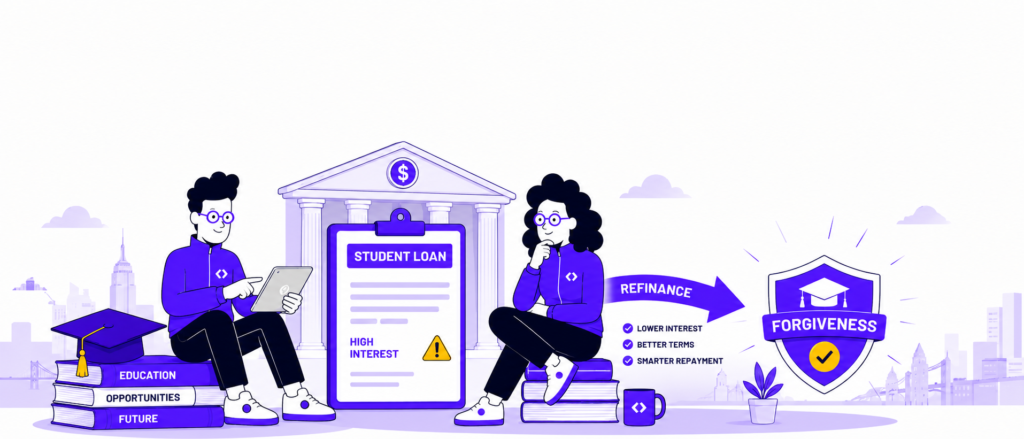
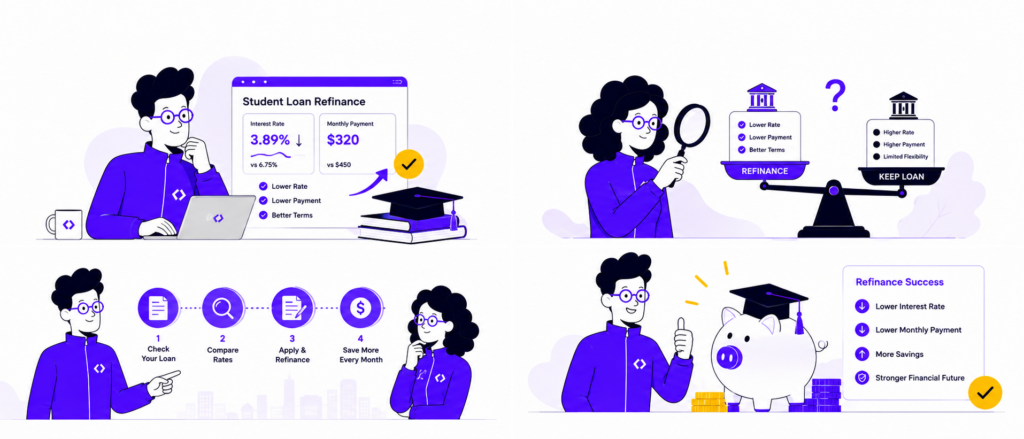
Vaibhav, an Indian graduate in the USA, refinanced his education loan and started saving $350 every month. Not a dramatic story – just a financial decision he made once his income was stable. More money for rent, savings, and eventually a home down payment. That monthly $350 is a good way to understand what refinancing education loans actually does: it adjusts debt repayment to match your current situation, not the one you were in when you were a student with no income and no credit history.
This guide covers the concrete benefits of refinancing, both for graduates working in India and those in the USA – along with the situations where refinancing is the wrong move.
Two Types of Refinancing: India Route vs USA Route
The refinancing path differs significantly depending on where you are currently working:
|
Factor |
Refinancing in India |
Refinancing in USA |
|
Who it suits |
Indian graduates who have returned to India or are working in India after studying abroad |
Indian graduates on OPT or H-1B working in the USA |
|
New lender type |
Indian bank or NBFC (transfer your loan to a better-rate lender) |
US-based private lender (SoFi, Citizens Bank, MPower, Earnest) |
|
New interest rate |
8-11% (INR) – lower than original if credit has improved |
5.5-9% APR (USD) – significantly lower than Indian rates |
|
Currency |
Stays in INR – no new currency risk |
Switches from INR to USD – removes rupee depreciation risk |
|
Section 80E benefit |
Preserved if new lender is also an Indian bank/NBFC |
Lost – US lenders are not eligible for Indian tax deduction |
|
Cosigner release |
Possible if you now have independent income and good CIBIL |
Yes – US refinancing typically requires no Indian cosigner |
|
Visa requirement |
None |
Valid work visa (OPT, H-1B) and stable employment proof required |
|
Best for |
Students who have repaid 1+ years and now qualify for better terms |
Students whose USD salary makes Indian EMI look expensive |
Also Read: 5 Mistakes to Avoid When Refinancing Your Education Loan
Benefit 1: Lower Interest Rate – The Primary Reason
Indian education loans carry rates of 10-14%. US private refinancing lenders offer 5.5-9% APR for eligible Indian graduates on stable employment. For graduates who remain in India and refinance with a better Indian lender, the improvement is smaller but still meaningful – moving from 13% to 9% on a remaining balance of Rs 20 lakh saves approximately Rs 2.6 lakh over 10 years.
|
Scenario |
Original Loan |
After Refinancing |
Estimated Saving |
|
India refinance: Rs 20L, 10 years remaining |
13% = Rs 13.06L total interest |
9% = Rs 10.40L total interest |
~Rs 2.66L over remaining tenure |
|
India refinance: Rs 40L, 10 years remaining |
13% = Rs 26.12L total interest |
9% = Rs 20.80L total interest |
~Rs 5.32L over remaining tenure |
|
USA refinance: $50,000, 10 years remaining |
11% INR equivalent APR = very high USD cost |
6% USD = significantly lower |
Depends on USD salary vs EMI ratio |
|
USA refinance (Vaibhav example) |
High Indian rate on Rs 40L equivalent |
~6% USD rate |
$350/month saving = $4,200/year |
A rate drop of 4% on a Rs 40 lakh loan over 10 years saves approximately Rs 11 lakh in total interest. Even a 1% improvement saves approximately Rs 2.7 lakh. The rate benefit is the foundation on which every other refinancing decision rests.
Benefit 2: Lower Monthly EMI
When you first took your education loan, you were a student with no income. The EMI was sized for a future income you could only estimate. Early in your career, a Rs 53,000 monthly EMI on a Rs 40 lakh loan at 10% is often 30-40% of take-home pay. Refinancing at a lower rate – or extending tenure to spread payments – can reduce that EMI meaningfully.
One important distinction: reducing EMI by lowering the rate is genuinely better than reducing it by extending tenure. A longer tenure reduces monthly payments but increases total interest paid. Always check what drives the EMI reduction before accepting a refinancing offer that shows a lower monthly number.
Use GradRight’s EMI calculator to compare your current loan EMI with what refinancing could offer. Try GradRight’s EMI Calculator
Benefit 3: Releasing Your Parent or Guardian as Cosigner
When you took your original education loan as a student, your parent or guardian co-signed the loan. Their income was pledged, their CIBIL was checked, and their property may have been mortgaged. They carry the risk of your loan on their financial record until it is repaid.
Refinancing – particularly US refinancing – replaces the original loan with a new one under your name alone. The old loan closes, the cosigner is released, and the property lien (if any) is removed from CIBIL records. Your parents’ financial obligations end the day the old loan closes.
In India, some lenders also allow refinancing without a cosigner if you now have stable independent income and a good CIBIL score. This is worth exploring if your parents’ credit profile was previously limiting the loan terms you qualified for.
Benefit 4: Building Credit History in the USA
Repaying an Indian education loan from the USA does nothing for your US credit profile. You could repay Rs 50 lakh perfectly over 5 years and start from zero when you apply for a US credit card, car loan, or mortgage.
Refinancing your Indian loan with a US lender creates a US loan account. Every on-time EMI payment builds your FICO score. Within 12-24 months of consistent repayment, your US credit profile becomes strong enough to unlock better financial products. This is described by several GradRight-guided graduates as one of the most underappreciated benefits of refinancing – not the monthly savings, but the foundation it creates for future borrowing in the USA at competitive rates.
Benefit 5: Removing Rupee Depreciation Risk
An Indian education loan repaid from a USD salary creates currency friction every month. Your salary arrives in dollars, your EMI leaves in rupees. The bank converts at the prevailing rate, and every time the rupee weakens (as it did when it reached Rs 91/USD in 2025), your USD cost of repaying the same INR EMI goes up.
When you refinance to a US-denominated loan, both income and EMI are in the same currency. The rupee’s movement becomes irrelevant to your repayment. For students who plan to stay in the USA for 5+ years, this is a structural simplification that removes a variable from their monthly budget.
Benefit 6: Switching to a Better Lender Experience
Not all benefits of refinancing are numerical. Some lenders offer slow responses, confusing interfaces, or unhelpful customer support. If your current lender has a poor digital experience – branch visits required for every transaction, unclear statements, delayed responses to queries – refinancing to a lender with a better platform is a legitimate quality-of-life improvement.
Some specific features worth comparing: automated billing with autopay discount (MPower offers 0.25%), clear digital statements showing principal and interest breakdown, zero prepayment penalty for aggressive repayment, and a mobile app that shows real-time loan balance.
When Refinancing Is the Wrong Move
|
Situation |
Why Refinancing Hurts Here |
|
US federal loan holder |
Refinancing a US federal loan with a private lender permanently removes access to income-driven repayment plans, loan forgiveness programs (PSLF), and forbearance. If you hold federal loans, do not refinance privately. |
|
Unstable visa or employment status |
US lenders require valid work visa through the loan term and stable employment. H-1B nearing expiry, recent job change, or OPT within 3 months of expiry may lead to denial or poor terms. |
|
Planning to return to India soon |
A US-denominated loan works against you if your income switches back to INR. The currency advantage reverses. Refinance in India instead. |
|
Section 80E benefit is significant |
If you or your co-applicant files taxes in India under the old regime and claims Section 80E deduction, switching to a US lender eliminates this deduction. Calculate whether rate savings exceed the lost tax benefit. |
|
Remaining tenure is very short (under 2 years) |
Processing fees for refinancing may not be recovered within the remaining repayment period. Calculate the break-even point before proceeding. |
|
Fees exceed savings |
Total transition costs (processing fee + foreclosure charge on old loan + legal costs) may exceed total interest savings if the rate difference is small. |
US Lenders That Work for Indian Graduates
As of 2025-26, only a small number of US lenders routinely consider non-citizens for refinancing. Most mainstream lenders (SoFi, Earnest, Laurel Road, ELFI) restrict refinancing to US citizens or permanent residents.
|
Lender |
Visa Eligibility |
Notes |
|
MPower Financing |
OPT, H-1B, H-4 EAD accepted |
Primary option for those still on OPT or early H-1B. Can refinance Indian loans directly. |
|
Citizens Bank |
H-1B and some other visas |
Requires good US credit score. Cannot always refinance Indian-serviced loans directly. |
|
SoFi |
H-1B (some cases) |
Generally requires more established US credit history. Better suited as a second refinance. |
|
GradRight referral network |
Varies by partner |
GradRight connects Indian graduates with lenders appropriate to their visa status. |
A two-step strategy often makes sense: refinance first with a lender like MPower who accepts OPT/early H-1B status. Build 12-24 months of US repayment history. Then refinance again with a mainstream lender at a lower rate once your credit profile qualifies.
Also Read: How International Students Can Refinance Their Education Loan in the US
GradRight helps Indian graduates compare refinancing options in India and the USA. Free, no consultancy fees, competing lender offers. Explore Refinancing Options on GradRight
Related Guides
5 Mistakes to Avoid When Refinancing Your Education Loan
How International Students Can Refinance in the US
Step-by-Step Guide to Refinancing Your Education Loan
Education Loan Repayment Tips That Actually Work
Section 80E Education Loan Tax Benefits
Education Loan EMI Calculator
Compare Education Loan Interest Rates – All Lenders 2026




 Australia
  Canada
  France
  Germany
  India
India  Ireland
  UAE
UAE  United Kingdom
  United States
