






About the author: Shivani Mani writes about education financing, student loans, and study-abroad financial planning for GradRight, with a focus on helping Indian students understand borrowing and refinancing options.
Reviewed for factual accuracy and current lender information by GradRight’s financing team. Last updated: August 2026. Lender eligibility, rates, and refinancing policies change periodically – always confirm current terms directly with the lender before applying.
Quick Answer
Refinancing your Indian education loan in the USA can lower your interest rate and EMI once you’re employed there, subject to eligibility. The key thing most guides miss: not every US lender can refinance a loan that originated with an Indian bank or NBFC. MPOWER Financing currently states it’s the only US lender with a dedicated program for this, wiring the payoff directly to your Indian lender, subject to its eligibility criteria. Other US lenders (SoFi, Earnest, Citizens Bank) generally refinance existing US-based loans, not an original Indian bank loan directly. Note: Discover exited the student loan business entirely in 2024 and is no longer a lending option.
This article is for general informational purposes and isn’t personalized financial advice. Loan terms, rates, and lender offerings change over time – verify current details directly with each lender, and consider speaking with a licensed financial advisor before refinancing.
Every year, many Indian students take out education loans in India to study abroad. These loans can carry meaningfully higher interest rates than what’s available in some developed markets, and repayment can feel steep once you’re just starting out in your first job.
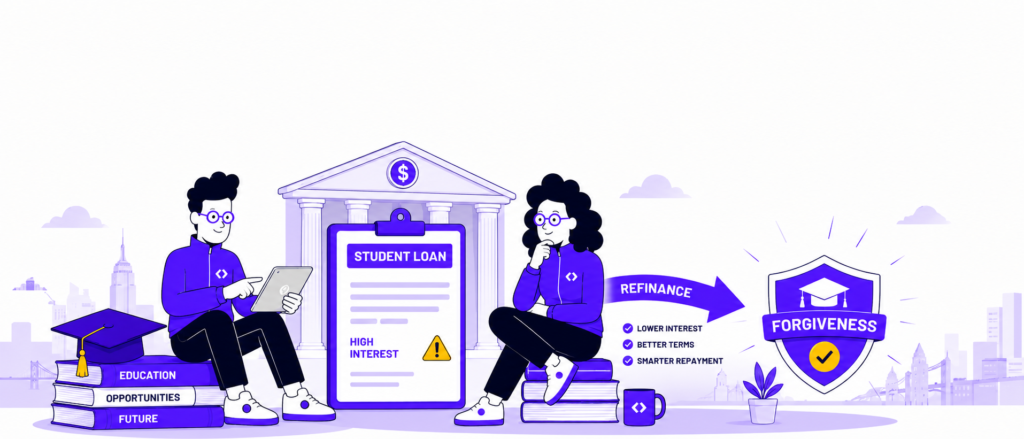
For this reason, student debt refinancing is worth exploring once you’re employed abroad. When you refinance an education loan, you may be able to access a lower interest rate, which can translate to a more manageable EMI.
This article provides a checklist for Indian graduates considering student loan refinancing in the USA – how to assess your current loan, check eligibility, and compare lenders.
Also Read: Can I Refinance My Indian Education Loan From the US?
Why Student Debt Refinancing Can Make Sense
Student loan refinancing means replacing your existing education loan from an Indian bank or NBFC with a new loan from a lender that specifically supports refinancing loans of Indian origin. Its purpose is to make repayment easier and more affordable.
Reasons refinancing may make sense:
Potentially lower interest rates:
As an employed graduate with an income, you may have more negotiating position than you did as a student when you first took the loan. It’s genuinely possible to qualify for a lower rate, though this depends on your specific profile and the lender.
Flexible repayment terms:
After completing your degree, you may have a clearer view of your career trajectory. You can weigh a shorter tenure (lower total interest, higher EMI) against a longer one (lower EMI, more total interest) based on your actual situation.
Releasing the cosigner:
If your original loan required a cosigner (often a parent), refinancing with a lender that doesn’t require one can release your cosigner from that original obligation, once the old loan is confirmed closed by the original lender – subject to the new lender’s specific eligibility and process.
Student Loan Refinancing Checklist for Indian Graduates Abroad
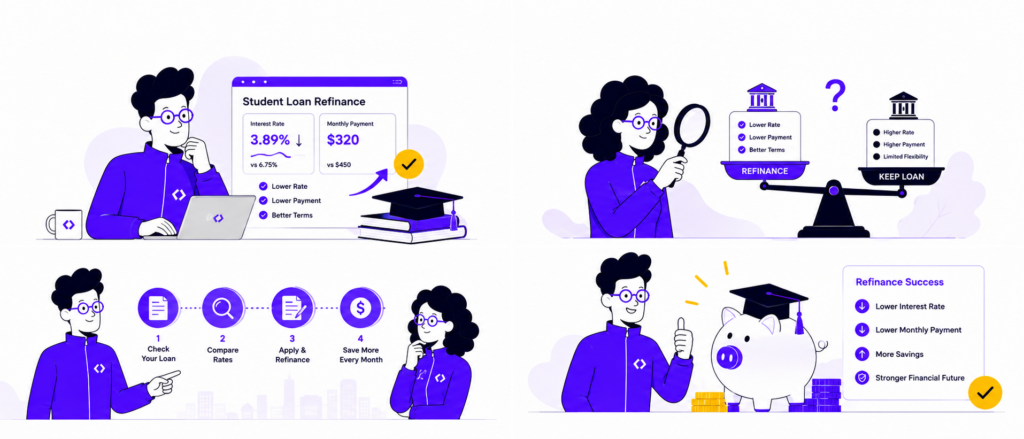
Refinancing can feel complicated – you’re paying off one loan and entering a new agreement with new terms. Here’s a step-by-step checklist.
☐ 1. List your current loans and loan details
Collect the details of your existing loans – your Indian education loan, plus any other loans you’re carrying. For each one, record the total EMIs, EMIs paid, EMIs outstanding, and amount outstanding. This gives you a clear view of what you actually owe before restructuring anything.
☐ 2. Separate education loans from other loans
If part of your study-abroad funding came from a personal loan rather than a formal education loan, separate these out. Lenders offering education loan refinancing specifically require the original loan to be reported as an education loan – a personal loan generally won’t qualify for this specific product, even if you used it to fund your studies.
☐ 3. Check whether your specific loan type can be refinanced by a given lender
This is the step most guides skip, and it’s the most important one. Not every US lender can refinance a loan that originated with an Indian bank or NBFC:
– According to MPOWER Financing’s own published information, it currently states it’s the only US lender with a dedicated program that refinances loans directly from Indian banks and NBFCs (SBI, ICICI, Axis, HDFC Credila, Avanse, and others), wiring the payoff directly to your Indian lender. This is MPOWER’s own claim – independently verify current details on MPOWER’s official site.
– Mainstream US lenders such as SoFi, Earnest, and Citizens Bank primarily refinance existing US-based (USD) student loans – useful later if you already hold a US loan, but generally not a direct path for an original Indian bank loan. Note: Discover exited the student loan business entirely in 2024 and no longer accepts new applications or offers refinancing – don’t include it in your comparison.
– Prodigy Finance has been associated with international student lending in the past, but its current refinancing availability is unclear as of this writing – confirm directly on its official site rather than assuming a refinance option is active.
Confirming this upfront saves you from applying to lenders that were never going to be able to refinance your specific loan.
☐ 4. Check your general eligibility
Common factors lenders may consider include US work authorization, employment and income, credit history, your outstanding loan balance, and the type and origin of your existing loan. Requirements vary meaningfully by lender – the list below is illustrative, not universal:
– Work authorization status (e.g., H-1B visa, OPT with employment, or permanent residency) – accepted categories vary by lender.
– Proof of stable employment and income – most lenders want to see an actual job, not just an internship or training placement, though exact requirements vary.
– Your creditworthiness, assessed differently by different lenders – some weigh a US credit score heavily, while others may weigh income, employment, and repayment history more heavily.
– Your existing loan documents and repayment history, generally with no outstanding missed payments.
According to MPOWER Financing’s current published criteria, its refinancing program for Indian-origin loans considers factors including US employment, work authorization, and the type of original loan – MPOWER states it doesn’t generally require a US cosigner for eligible applicants. Confirm MPOWER’s current eligibility criteria directly on its official site before applying, since these can change.
Whether a cosigner is required, and whether they need US citizenship or permanent residency, depends on the specific lender and your financial profile.
☐ 5. Understand your credit profile (and build it responsibly if needed)
Indian and US credit reporting systems operate separately – Indian credit bureaus (like CIBIL) and US credit bureaus (Equifax, Experian, TransUnion) don’t share data with each other. Your CIBIL history isn’t the same as a US credit report, and a US lender may have limited or no visibility into your Indian credit history. Some lenders serving international borrowers may use additional information or alternative data when assessing your application. A strong US credit profile is built over time through disciplined, genuine financial habits, not a specific formula. General, non-prescriptive tips:
– Consider applying for a US credit card once you’re eligible and have a stable address and income – this is one common way to start building US credit history over time.
– Use the card for regular, planned purchases you can afford, rather than treating it as extra spending power.
– Keep your credit utilization reasonably low relative to your limit – many general credit guides suggest staying meaningfully below your limit, though there’s no single number that guarantees a specific outcome.
– Pay your full statement balance by the due date consistently. There’s no specific repayment “cycle” (e.g., a fixed number of days) that guarantees a particular credit score – responsible, on-time repayment over time is what genuinely builds credit, and outcomes vary by individual.
Be cautious of any advice promising a specific credit score from a specific repayment pattern – credit scoring models weigh many factors together, and no single tactic guarantees a particular number.
☐ 6. Compare lenders carefully
Lenders offering refinancing vary considerably in their terms. When comparing, look beyond the headline interest rate:
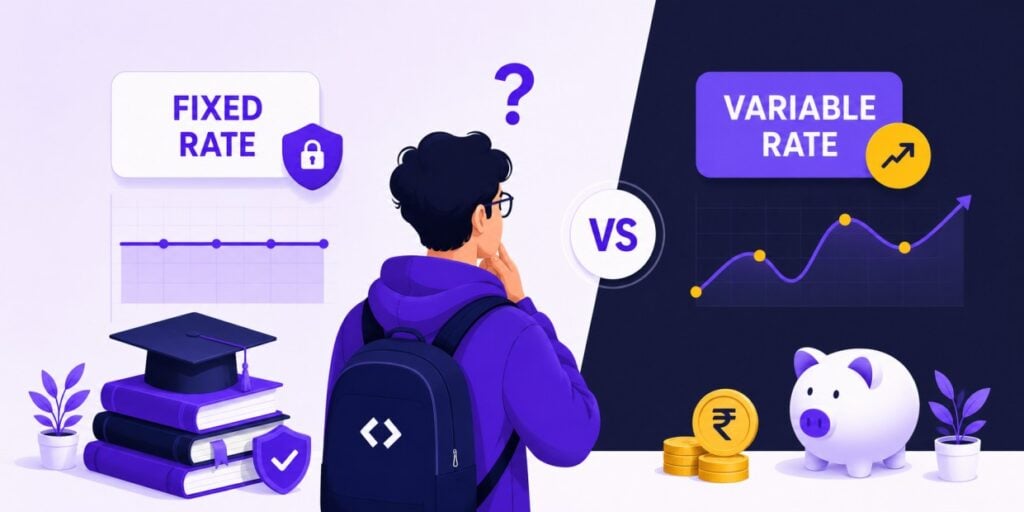
– Fixed vs. variable interest options
– Available repayment tenure – compare monthly payment and total interest across the options a specific lender actually offers you
– Fees for late payment and early repayment
– Eligibility criteria and any lender-specific relaxations
– Discounts for automatic payments, where offered
– Cosigner policy (whether a US-based cosigner is required)
– Whether the lender specifically supports refinancing an original Indian bank/NBFC loan, or only existing US loans
☐ 7. Prequalify and compare offers
Some lenders let you check estimated rates before a full application. Where available, confirm whether this uses a soft or hard credit inquiry, and whether the quoted rate is guaranteed or just an estimate – this varies by lender. Use an EMI calculator to compare your actual new monthly payment and total interest across offers, since a lower EMI doesn’t always mean lower total cost – it depends heavily on the tenure.
Run the numbers with GradRight’s Education Loan Refinance Calculator before comparing offers.
Illustrative Example: Comparing Tenure and Rate Trade-offs
Illustrative example only – not a current lender offer, rate quote, or prediction of savings. Assume a student has a Rs. 50 lakh loan from an Indian bank, originally at 14% over 8 years, and is comparing hypothetical refinance scenarios. Actual refinancing costs depend on the interest rate, tenure, fees, exchange rate, prepayment costs, and lender-specific terms you’re actually offered:
| Tenure (Years) | Illustrative Rate (%) | Tenure (Months) | Monthly EMI (INR) | Total Interest (INR) | Total Paid (INR) |
|---|---|---|---|---|---|
| 8 (original) | 14 | 96 | 78,973 | 25,75,808 | 75,75,808 |
| 10 | 12 | 120 | 71,735 | 36,08,260 | 86,08,260 |
| 15 | 9 | 180 | 50,713 | 41,28,400 | 91,28,400 |
| 20 | 6 | 240 | 35,822 | 35,97,170 | 85,97,170 |
In this hypothetical, the original loan has the lowest total cost overall, but the highest monthly EMI. The 20-year option at a lower illustrative rate has a much smaller EMI, with total cost close to (but not lower than) the original. This illustrates a genuine trade-off: a lower rate with a longer tenure can reduce your monthly burden without necessarily reducing total cost, and sometimes increases it. Always compare actual offers using a calculator with your real numbers, not assumptions based on this example.
☐ 8. Review terms and complete the process
Read the full agreement carefully before signing – take your time rather than rushing. If you’re unsure about any terms, consider consulting a financial advisor or accountant familiar with cross-border loans.
Confirm the new lender will pay off your old loan directly. After repayment, get a formal closure/No Outstanding Dues confirmation from your original Indian lender, and ensure any collateral documents (like property deeds or FD certificates) held by them are returned or released according to their standard closure process.
Refinancing Process Timeline (Illustrative)
This is a general illustrative sequence, not a fixed schedule – actual timelines vary by lender and your specific situation.
| Step | Description | Key Goal |
|---|---|---|
| 1 | Gather your financial and loan documents | Prepare documentation for a smooth application |
| 2 | Understand your current credit profile | Know where you stand before applying |
| 3 | Research and confirm which lenders can refinance your specific loan type | Avoid applying to lenders that can’t refinance an Indian-origin loan |
| 4 | Get prequalified and compare offers | Compare rates without unnecessarily affecting your credit |
| 5 | Read the loan agreement fully | Understand every term before committing, seek advice if needed |
| 6 | Submit your formal application | Provide complete documentation |
| 7 | Review and accept your final offer | Confirm terms match what you expected |
| 8 | Confirm the payoff and closure process | Ensure your old loan is properly closed and documented |
Practical Tips
– Don’t waste time applying to lenders whose eligibility criteria clearly don’t match your visa/residency status.
– Weigh a fixed vs. variable rate carefully, especially in a changing interest-rate environment – a variable rate that looks attractive today could rise later.
– Understand what happens to your refinanced loan if your visa status changes or you move back to India, before you commit.
– Make sure your new monthly repayment fits comfortably within your actual budget, with room for other expenses.
Comparing Lenders
Lender eligibility, rates, and product offerings change frequently – always confirm current details directly with the lender before applying. This is a starting point for your own research, not a recommendation or a guarantee of current terms.
| Lender | Indian-Origin Loan Refinancing | What to Verify Yourself |
|---|---|---|
| MPOWER Financing | According to MPOWER’s own published information, yes – MPOWER states it has a dedicated program for this | Current eligibility criteria, work authorization requirements, accepted loan types, and maximum loan amount |
| Other US lenders (e.g., SoFi, Citizens Bank, Earnest) | Eligibility varies – generally understood to focus on existing US-based loans, but confirm directly rather than assuming | Whether the specific lender accepts loans originally issued by an Indian bank or NBFC, and current visa/residency requirements |
A note on Prodigy Finance: it has been associated with international student lending, but we could not independently confirm its current refinancing product status at the time of writing. Check directly on Prodigy’s official site rather than relying on this or any other article.
Instead of approaching multiple lenders individually, GradRight’s refinance comparison platform lets you share your details once and see offers from participating lending partners in one place. Disclosure: GradRight may earn a fee from lenders when you use this comparison tool – always compare against your own independent research too, rather than relying solely on any single platform’s results.
Related Articles
Can I Refinance My Indian Education Loan From the US?
Student Loan Refinance for Indian Graduates in the USA
Education Loan in India: Interest Rates, Process, Best Banks & More
How to Get an Education Loan with a Low CIBIL Score
Best Education Loan Providers in India: Banks, NBFCs & Comparison
Take the First Step
Refinancing can offer real financial relief when you qualify for meaningfully better terms – but it’s worth evaluating your options carefully rather than rushing. Confirm which lenders actually support your specific loan type, compare real offers with a calculator, and read every agreement before signing.
GradRight’s refinance comparison platform can help you compare offers in one place. Start at refinance.gradright.com.





 Australia
  Canada
  France
  Germany
  India
India  Ireland
  UAE
UAE  United Kingdom
  United States
