





Imagine saving a meaningful amount every month, money that could go toward rent, savings, or a step closer to a bigger goal. That’s the kind of difference refinancing an education loan can make once you’re working in the USA.
Thousands of Indian graduates in the USA carry education loans taken out in India, often at higher interest rates than what’s available to them once they have US income and credit history. Many simply don’t refinance, assuming the process is complicated. In reality, it’s a fairly standard financial move once you understand how it works.
Understanding student loan refinancing
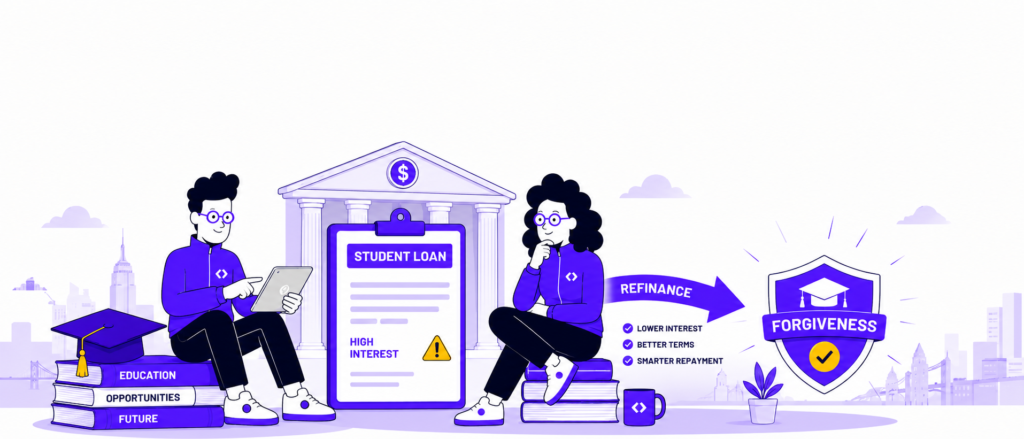
Refinancing is the process of taking a new loan to pay off your existing education loan(s). The new loan typically comes with better terms:
- A lower interest rate
- Reduced monthly payments
- More flexible repayment periods
- Release of your cosigner’s obligation
- Release of any collateral pledged on the original loan
For example: say you borrowed roughly Rs 40 lakh (about USD 50,000) from an Indian bank at 11% interest. Your EMI is steep, and repayment stretches over years. A US-based lender offering to refinance at 6% would meaningfully shrink your EMI and, over the life of the loan, save you a substantial amount in total interest.
In short, refinancing lets Indian graduates move away from relatively rigid Indian bank loans and into the US financial ecosystem, often on more favorable terms once your US income and credit profile support it.
Why refinancing matters for Indian graduates in the USA
Indian education loans, while they serve their purpose getting you through your degree, come with real limitations that weigh more heavily once repayment begins:
Higher interest rates
Indian education loan rates can be higher than some US refinance offers, depending on the specific lender and borrower profile; on a large loan, a meaningful rate gap can mean paying substantially more in total interest over the tenure. Check your current loan’s actual rate against current refinance quotes rather than relying on a generic range.
Collateral requirements
Many Indian banks require family property, fixed deposits, or other assets as security, exposing your family to financial risk if repayments falter.
Limited flexibility
Loan tenures can be rigid, and prepayment terms sometimes include penalties.
Pressure on families
Since many Indian banks require a parent as co-borrower, the formal responsibility rests partly with your family, even after you begin working abroad, until the loan is fully repaid or refinanced.
Refinancing can address each of these, though whether it’s the right move depends on your specific rates, timeline, and risk tolerance.
Key benefits of student loan refinancing
Lower interest rates
This is the headline benefit. As a purely illustrative EMI/amortization calculation, not a claim about what rate you personally would get: a Rs 50 lakh loan at 12% interest over 10 years results in roughly Rs 36 lakh in total interest paid; at a hypothetical 6% over the same term, total interest would drop to roughly Rs 16-17 lakh, a difference of roughly Rs 19-20 lakh. Not every borrower will qualify for a 6% rate; your actual refinance rate depends on your credit profile, lender, and market conditions at the time. Run your own numbers with a current EMI calculator using rates you’ve actually been quoted before deciding.
Lower monthly payments
With a lower rate, your monthly EMI drops too. For graduates starting out in expensive cities, this can meaningfully ease monthly cash flow.
Flexible repayment terms
You can generally choose a tenure that matches your goals: a shorter term with higher EMIs to be debt-free faster, or a longer term with smaller monthly payments for more near-term cash flow flexibility.
Improved financial planning
Lower EMIs free up disposable income you can direct toward retirement accounts (401(k) or IRA), other investments, or near-term savings goals.
No collateral or cosigner needed, in many cases
Refinancing may release the original collateral or your cosigner’s obligation, but whether and how depends on the specific new lender and your original loan’s terms; confirm this explicitly with both your current and prospective lender rather than assuming it happens automatically.
Building US credit history
A US-dollar loan in your own name may contribute to your US credit history, if your specific lender reports the account to US credit bureaus (most mainstream lenders do, but confirm this isn’t assumed by default); this can matter later for credit cards, car loans, or a mortgage.
Eligibility criteria for refinancing in the USA
Employment
Most lenders prefer full-time, steady employment; some also accept applicants on OPT with proof of income. It’s generally advisable to wait until after your probation period ends before applying, so your job stability is clearer to the lender.
Visa and residency status
Lenders commonly consider H-1B visa holders, green card holders, and permanent residents. Some lenders extend options to students on OPT, though choices are typically more limited at that stage.
Credit score
A stronger US credit profile can improve your eligibility and the rates you’re offered, though exact thresholds and underwriting criteria vary significantly by lender; there’s no single universal credit-score cutoff that applies across all refinancing lenders. If your credit history is thin or your score is on the lower side, building it through responsible credit card use and on-time payments before applying can improve your options.
Documents commonly required
- Passport and visa copies
- Social Security Number
- Employment proof (offer letter, pay stubs, or tax returns)
- Original loan sanction letter
- Repayment history from your current lender
OPT eligibility is genuinely limited, not a general rule: some lenders may consider OPT applicants with proof of income on a case-by-case basis, but this isn’t standard across most refinancing lenders, and many require H-1B, permanent residency, or specific other visa categories. Check your specific target lender’s current visa criteria directly rather than assuming OPT status qualifies you.
Checking your eligibility
Several lenders offer online prequalification tools using a soft credit check to show estimated rates. GradRight’s refinance eligibility checker is one option that lets you compare this across multiple lenders from a single profile rather than checking each lender separately.
Top student loan refinancing options in the USA
The refinancing market for international graduates has a handful of established names, though not every lender commonly mentioned alongside refinancing actually offers it currently.
For a deeper, regularly-updated lender-by-lender comparison, see our dedicated guide: Best US Lenders to Refinance Your Education Loans.
| Lender | Best For | Notes |
| MPOWER Financing | International graduates, no cosigner | No collateral or US credit history required; has periodically paused new originations when it hits funding capacity (most recently in 2026), so confirm it’s actively lending before applying. |
| SoFi / Earnest | Loans originated in the US, H-1B/other qualifying visas | Important limitation: both currently state they generally do not refinance loans originated outside the US, with Prodigy Finance loans as the stated exception for each. If your loan is an original Indian bank loan (not previously refinanced via Prodigy), confirm directly whether you’re eligible before applying, since you may not currently qualify. |
| Laurel Road | US credit history, competitive rates | Confirm current eligibility for non-US-originated loans directly, since policies on this vary by lender and change over time. |
| Citizens Bank, ELFI, and similar | US credit history, competitive rates | Worth comparing alongside the above once you have established US credit. |
Important correction: Prodigy Finance is sometimes mentioned alongside refinancing lenders, but per Prodigy’s own support page (dated March 2026) and multiple current third-party reviews, it does not currently refinance loans from other lenders, focusing instead on new study loans for international graduate students. This creates a genuine practical gap worth knowing about: SoFi and Earnest both name Prodigy Finance loans as their stated exception to “we don’t refinance loans originated outside the US”, but if Prodigy itself currently isn’t refinancing, that exception-path may not be usable in practice. For an original Indian bank loan, MPOWER (per its own current page) is the more directly relevant option; don’t assume SoFi, Earnest, or similar mainstream US refinancers are automatically available to you without confirming your loan’s origin meets their current criteria.
A separate, important warning: if any portion of what you’re refinancing includes US federal student loans (for example, if you also have federal loans from US undergraduate study), refinancing them with a private lender permanently forfeits federal protections and programs (such as income-driven repayment and Public Service Loan Forgiveness), per Federal Student Aid’s own guidance. This doesn’t typically apply to Indian bank education loans, but if your situation includes any US federal loans, understand this trade-off clearly before refinancing them.
How to compare refinancing lenders
Interest rates
Fixed rates give you payment certainty; variable rates often start lower but can rise later. Decide how much rate-movement risk you’re comfortable with.
Loan amounts
Every lender has a minimum and maximum loan size; confirm your target lender’s range covers your full outstanding balance.
Repayment tenure
Repayment terms vary by lender; check your specific target lender’s currently offered range rather than assuming a standard window, and match the tenure to your debt-free timeline goals.
Cosigner rules
Some lenders require a US-based cosigner; others, including some options aimed specifically at international graduates, don’t. Confirm current requirements directly, since these can change.
Visa status requirements
Some lenders serve only H-1B holders or permanent residents, while others extend to OPT holders. Pick lenders that currently serve your specific visa status.
Fees and hidden charges
Watch for processing fees, prepayment penalties, or late-payment charges, since these can quietly increase your effective cost.
Customer support and flexibility
Lenders offering deferment, forbearance, or flexible repayment options may provide more flexibility if your circumstances change during a multi-year commitment.
Comparing all of this manually across multiple lenders is time-consuming. GradRight lets you enter your details once and compare multiple refinance offers side by side.
Refinancing in India vs. refinancing in the USA
You can also refinance your education loan with an Indian lender rather than a US one. The right choice depends on several factors specific to your situation: your future country of residence, which currency your income will be in, the interest rate and fees on each option, and which lenders you’re actually eligible for given your loan’s origin and current status. Neither path is universally better; compare your specific options on their actual terms.
Also read: Best US Lenders to Refinance Your Education Loans
Common considerations to watch out for
Visa and job dependency
Your refinancing eligibility and ongoing repayment capacity depend on staying employed in the USA on a qualifying visa status. If your visa situation is uncertain, proceed cautiously, since a change in status could affect your loan terms or ability to refinance further.
Prepayment penalties
Indian lenders sometimes levy prepayment penalties on your original loan; factor this into your savings calculation. Many US refinance lenders don’t charge prepayment penalties, but this varies, so confirm the specific terms of your new loan agreement directly rather than assuming.
Fine print
Read the full loan agreement carefully, particularly terms on late payments, grace periods, and prepayment, before finalizing any refinancing loan.
Step-by-step: how to refinance your student loan in the USA
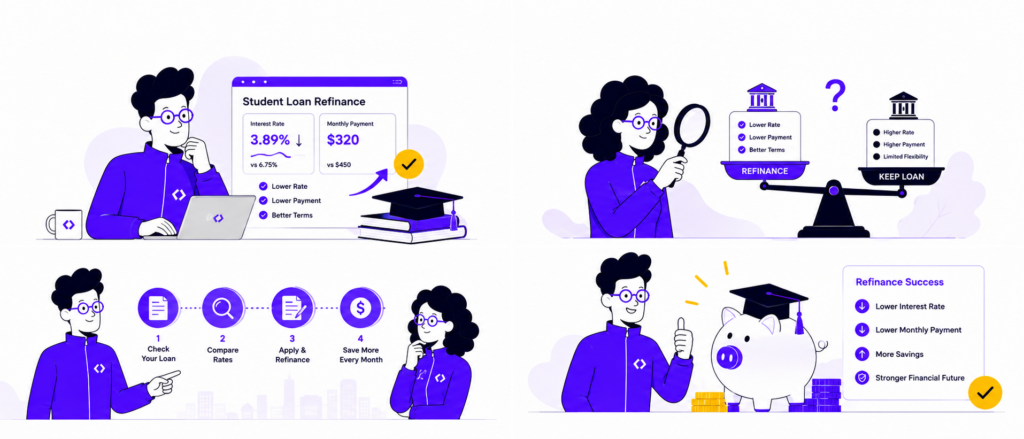
- 1. Apply for prequalification: get estimated rates via a soft credit check that doesn’t affect your credit score.
- 2. Submit documents: share employment, visa, and loan proof as requested by your chosen lender.
- 3. Close your old loan: your new lender pays off your original loan, and you begin repayment fresh under the new terms.
The process can take time and involves genuine decisions (fixed vs. variable rate, tenure length, which lender), so it’s worth comparing multiple offers rather than accepting the first one you qualify for.
Sources
- Prodigy Finance’s current refinancing status (new study loans only, no refinancing product as of Prodigy’s own March 2026 support page): confirmed via Prodigy’s own support documentation and multiple current third-party lender reviews, cross-checked against GradRight’s own separate article on US refinancing lenders.
- SoFi and Earnest’s exclusion of loans originated outside the US (Prodigy Finance as the stated exception for each): confirmed directly via SoFi’s own eligibility criteria page and Earnest’s own help center article.
- Federal Student Aid’s warning on losing federal protections when refinancing federal loans with a private lender: confirmed via multiple current lender disclosures (including SoFi’s own site) that reference this Federal Student Aid guidance.
Disclaimer: interest rates, lender offerings, and eligibility criteria referenced in this guide change over time. This article is for general information only and is not financial advice. Verify current rates and terms directly with each lender before making decisions.





 Australia
  Canada
  France
  Germany
  India
India  Ireland
  UAE
UAE  United Kingdom
  United States
