






What refinancing actually means here
You took a loan in India, from a public sector bank or an NBFC, before you left. You’re now in the US, earning in dollars, but still servicing that loan in rupees from an Indian account. For eligible borrowers, a specialized lender may pay off that Indian education loan and replace it with a new USD-denominated loan, so you repay in dollars instead, ideally at a lower rate, from the same account your salary goes into. This is the single most important thing to verify first: most traditional US student-loan refinance lenders do not accept loans that originated outside the US. For instance, SoFi’s own eligibility page states it does not refinance student loans originated outside the United States, with Prodigy Finance loans as the one specific exception. Lenders that do work with India-originated loans, such as MPOWER Financing, are a narrower, specialized category, not the broader US refinance market.
Indian loan rates for study-abroad education loans commonly range roughly from 9% to 15% depending on the lender type (public banks tend to sit at the lower end, NBFCs at the higher end), though your specific rate depends on your lender, collateral, and profile. Rates from specialized lenders that actually accept India-originated loans, such as MPOWER Financing, have historically started in the high single digits, though the exact rate depends on your profile and moves with market conditions. Broader US student-loan refinance rates (from lenders like SoFi, which generally only serve borrowers whose loans already originated in the US) are a different, wider market and are not a reliable benchmark for what you’d actually be offered on an India-originated loan. Always check current rates directly with a lender that explicitly confirms it accepts India-originated loans before assuming a specific number applies to you.
Who it tends to work for
Broadly, refinancing is worth exploring if you have most of the following:
- A valid US visa: OPT, STEM OPT, or H-1B are the clearest cases; F-1 with a confirmed job offer is often assessed case by case, since policies vary by lender.
- Stable US income: many lenders want to see a few months of pay stubs, though the exact requirement varies by lender.
- Some US credit history, typically reflected through credit reports and scores from US credit bureaus and scoring models. US lenders generally assess your US credit profile rather than relying on your Indian CIBIL score; whether an individual lender considers additional international credit information depends on its own underwriting process.
- A manageable debt position relative to income: some lenders may assess your fixed monthly debt obligations relative to income, while others use their own debt-to-income or affordability measures, so existing US debt like car loans or credit cards can reduce how much new debt a specific lender is willing to approve.
- A clean or explainable repayment history on the original Indian loan.
If your US credit history is thin, or your existing debt obligations are high relative to income, approval gets harder, though not automatically impossible. Outcomes can vary meaningfully between applicants with similar-looking profiles on paper, since individual lenders weigh these factors differently and don’t always disclose their exact criteria.
What the savings can look like
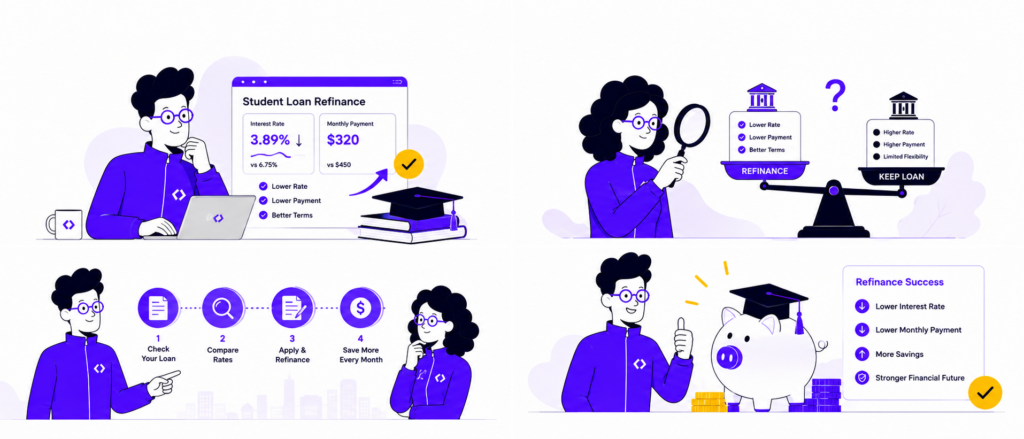
The actual savings depend on your loan amount, remaining tenure, and the USD rate you’re offered. Here is an illustrative scenario, not a documented case or a typical outcome, to show how the math works: on a Rs 72 lakh outstanding balance at 13% (original loan), refinanced into a USD loan at approximately 6.4% over a comparable remaining tenure, at an illustrative exchange rate of roughly Rs 88 to the dollar, and assuming a fixed rate with fees excluded from this simplified comparison, the reduction in monthly EMI works out to roughly Rs 32,000. Change any one of these assumptions, the outstanding balance, remaining tenure, exchange rate, whether the new loan is fixed or variable, or whether fees are rolled in, and the actual number will differ. On a smaller loan, or with a smaller rate differential, the saving would be proportionally lower, and if USD rates move against you before you lock in a fixed rate, the gap can narrow further.
Because the numbers depend so heavily on your specific loan and offer, it’s worth running your own figures through a refinance calculator rather than assuming a case study applies directly to you.
Risks and trade-offs worth weighing
- Rate variability: many USD refinance offers are variable rather than fixed, so a rate that looks attractive today can move with US benchmark rates. Ask specifically whether an offer is fixed or variable before comparing it to your current INR rate.
- Currency and visa risk: a change in your US employment, visa status, or income can affect your ability to comfortably meet USD repayments, so it’s worth having a contingency plan before refinancing. Your repayment obligation itself doesn’t disappear if your status changes.
- Loss of INR-specific protections: some Indian lender terms (like moratorium extensions in specific circumstances) may not have a direct equivalent with a US lender, so compare the full terms, not just the headline rate.
- Processing and closure logistics: your Indian lender needs to issue a payoff letter, and its loan-closure and collateral-release process (documents and timeline vary by lender) typically adds a few weeks beyond the US lender’s own processing time.
One thing worth saying upfront
This is a case-by-case decision, not a guaranteed win. A lower headline USD rate does not automatically mean a better outcome once you account for variability, fees, and your own risk tolerance around visa and employment continuity. The most useful first step is usually an honest read on your specific profile: what’s realistically achievable, what the risks are, and whether the timing makes sense right now, rather than assuming refinancing is automatically the right move simply because dollar rates look lower on paper.
Sources and methodology
This guide references the following for context, current as of the last-updated date above:
- SoFi’s eligibility criteria (confirms it does not refinance loans originated outside the US, except Prodigy Finance loans): SoFi, Eligibility Criteria
- US credit reporting context: credit scores and reports from US credit bureaus and scoring models are distinct from India’s CIBIL system, and the two do not share data.
The savings example in this guide is drawn from a single illustrative case and is not a typical or guaranteed outcome. Actual savings depend on your outstanding balance, remaining tenure, the specific rate and fees a lender offers you, and whether that rate is fixed or variable.
Disclaimer: Interest rates, eligibility criteria, and lending policies referenced in this guide are subject to change and vary by lender and borrower profile. This article is for general information only and is not financial or legal advice. Verify current rates and terms directly with the lender before making a decision.
Want a read on your specific profile? Share your loan details, visa status, and income, and GradRight can help you see what’s realistically possible, comparing offers across 18+ lending partners, with no obligation.
Related Articles
- How International Students Can Refinance Their Education Loan in the US
- Best US Lenders to Refinance Your Education Loan
- Refinancing UK vs USA Education Loans for Indian Students
- Fixed vs Variable Rate Student Loan Refinancing
- Does Refinancing Student Loans Hurt Your Credit Score?






 Australia
  Canada
  France
  Germany
  India
India  Ireland
  UAE
UAE  United Kingdom
  United States
