





Once you get your PTE results, you are one step closer to your dream foreign university.
Whether you’ve already received your scorecard or not, it helps to know how to interpret your score.
Find out in this guide. Let’s dive right in.
Getting your PTE results
PTE has one of the fastest results turnarounds among all English language proficiency tests.
You will receive an email notification when your results are ready. This ensures that you can quickly download or share your scores as needed.
Here’s the breakdown of how fast your PTE results will come in:
- Standard results: within 48 hours of taking the test
- Delayed cases: up to 5 working days in exceptional circumstances
The conducting body of the PTE exam, i.e. the Pearson PLC Group, notifies students when their results are ready via email.
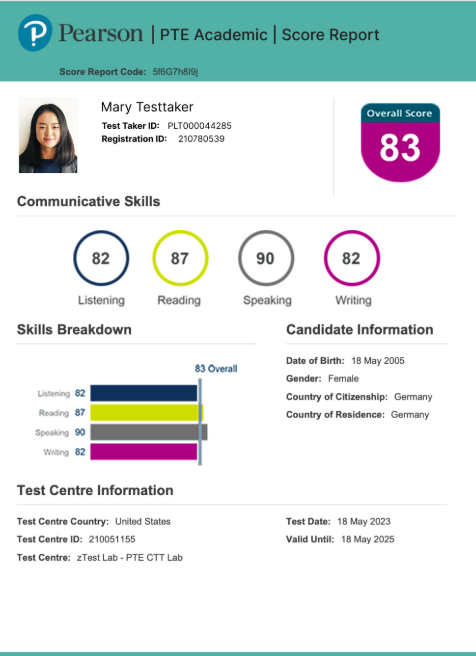
How to access your PTE scores
Upon receiving the email, you will be required to log into your My PTE account and go to the ‘My Activity’ or ‘View Score’ section.
Here’s a step-by-step guide to accessing your PTE scores:
- Go to pearsonpte.com and log in to your account.
- Click on ‘My Activity’ or ‘View Score’ section.
- Your PTE score report will be displayed.
- You can download your score report in PDF format.
- To share your score with universities, select the institution directly from the portal – this is free and unlimited.
Also Read: PTE Exam Pattern 2026 – New Format & 22 Tasks
How does PTE scoring work?
Your PTE exam result will provide you with an overview of your performance by giving the total score and a communicative skill score. Universities abroad refer to these scores while assessing your application.
PTE test score card also contains scores on each of your four English language skills separately – indicating the areas where you are really good and the areas where you need to improve.
Let’s break down how the PTE exam will assess your English language skills in 2026.
Note: From August 2025, PTE uses a hybrid scoring model – AI scores all responses, with human reviewers monitoring for memorised templates. Natural, task-specific responses score better.
What are communicative skills in PTE?
The overall or total PTE score ranges between 10 and 90. However, the communicative score evaluates a test-taker’s ability to read, speak, write, and listen to the English language.
The scoring system rates the answers on correctness/incorrectness. Some answers are scored depending on the quality of the response (e.g., fluency and pronunciation), and the remaining questions are based on the word limit of the task.
Communicative skills are divided into four components:
- Speaking: Oral fluency, pronunciation, and content of spoken responses
- Writing: Grammar, vocabulary, written discourse structure, and spelling
- Reading: Comprehension of written academic texts
- Listening: Understanding of spoken academic English
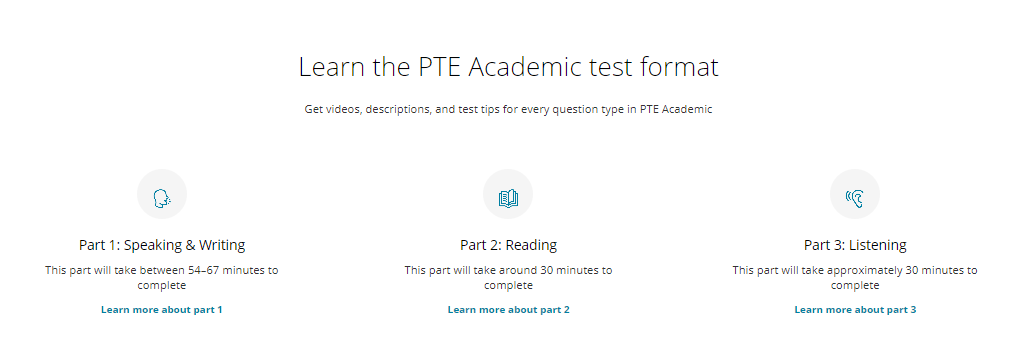
Speaking and Writing
This is the longest part of the PTE exam and tests your ability to speak and write in English. Here are the tasks with their description, number of questions, and marks:
| Task | Description | Marks |
| Personal Introduction | Introduce yourself briefly (unscored – warm up only) | Unscored |
| Read Aloud | Read a passage of up to 60 words aloud | Speaking + Reading |
| Repeat Sentence | Repeat a sentence after hearing it once | Speaking + Listening |
| Describe Image | Describe an image (graph, chart, diagram) in detail | Speaking |
| Re-tell Lecture | Re-tell a lecture you have heard in your own words | Speaking + Listening |
| Answer Short Question | Answer a short question about everyday topics | Speaking + Listening |
| Respond to a Situation | [object Object] – Respond naturally to a real-life everyday situation | Speaking |
| Summarize Group Discussion | [object Object] – Summarize the key points of a group discussion | Speaking |
| Summarize Written Text | Read a passage and write a one-sentence summary (5-75 words, 10 minutes) | Writing + Reading |
| Essay | Write a 200-300 word essay on a given topic (20 minutes) | Writing |
Tasks 7 and 8 above are new from August 7, 2025. If your preparation materials are from before August 2025, they will not include these tasks.
Reading
The Reading section tests your ability to understand written English in an academic setting. Tasks include:
| Task | Description | Marks |
| Multiple Choice, Single Answer | Answer a single-answer question based on a reading passage | Reading |
| Multiple Choice, Multiple Answers | Select multiple correct answers based on a reading passage | Reading |
| Re-order Paragraphs | Arrange text boxes in the correct order to form a coherent passage | Reading |
| Reading: Fill in the Blanks | Fill in the blanks in a reading passage by selecting from a list | Reading |
| Reading & Writing: Fill in the Blanks | Fill in the blanks using words from a dropdown list | Reading + Writing |
Listening
The Listening section tests your ability to understand spoken English in an academic setting:
| Task | Description | Marks |
| Summarize Spoken Text | Listen to a lecture and write a 50-70 word summary | Listening + Writing |
| Multiple Choice, Multiple Answers | Listen and select multiple correct answers | Listening |
| Fill in the Blanks | Listen and fill in the missing words in a transcript | Listening + Writing |
| Highlight Correct Summary | Listen and select which summary best describes what you heard | Listening + Reading |
| Multiple Choice, Single Answer | Listen and select a single correct answer | Listening |
| Select Missing Word | Listen and choose the word that completes a recording | Listening |
| Write from Dictation | Listen and type exactly what the speaker says | Listening + Writing |
What are enabling skills in PTE?
In addition to the four communicative skills, your PTE scorecard also shows six enabling skills. These are the underlying language skills that contribute to your communicative skill scores:
- Grammar – Correct use of English grammar
- Oral Fluency – Natural rhythm and pace of spoken English
- Pronunciation – Clarity and accuracy of spoken sounds
- Spelling – Accurate spelling in written responses
- Vocabulary – Range and accuracy of vocabulary use
- Written Discourse – Coherence and structure of written responses
Each enabling skill score ranges from 10 to 90. These scores help you identify your specific strengths and weaknesses within each communicative skill.
Also Read: How to Prepare for PTE Exam 2026 – Complete Study Plan
What is a good PTE score?
Any score that lies between 70 and 85 out of 90 is considered good. However, benchmarking of scores differs among universities.
Here are the typical score ranges required by institution type:
| Institution / Course Level | Typical PTE Score Required |
| Foundation courses | 36-50 |
| Undergraduate programs | 42-58 |
| Postgraduate programs (most universities) | 58-65 |
| Top-ranked universities (research programs) | 65-79+ |
| Medicine / Nursing / Law (top unis) | 79+ (all skills) |
Different educational institutions set their own minimum PTE scores for admission. Always verify the specific score requirement directly with your target university.
How does your PTE score compare with IELTS and TOEFL?
Pearson has comparison tables to compare your PTE scores to those of IELTS and TOEFL. It helps you understand how internationally competitive your PTE results are.
Note: Pearson updated its IELTS-PTE concordance table in July 2025 based on research reflecting the updated PTE Academic test format. The table below reflects the latest published concordance. The CEFR mapping remains unchanged.
| PTE Score | IELTS Academic (approx.) | TOEFL iBT (approx.) | CEFR |
| 10-29 | Below 3.0 | Below 35 | Below A2 |
| 30-41 | 3.0-3.5 | 35-45 | A2 |
| 42-49 | 4.0-4.5 | 41-52 | A2-B1 |
| 50-57 | 5.0-5.5 | 53-60 | B1 |
| 58-64 | 6.0-6.5 | 61-78 | B2 |
| 65-71 | 7.0 | 79-93 | B2-C1 |
| 72-78 | 7.5 | 94-101 | C1 |
| 79-85 | 8.0-8.5 | 102-113 | C1-C2 |
| 86-90 | 9.0 | 114-120 | C2 |
Source: pearsonpte.com/pte-academic/scoring/ – check the official site for the most current concordance tables.
How long is PTE score valid?
Like many standardized tests, PTE scores come with an expiration date. Knowing the validity period of your PTE results is essential for effectively planning your studies, work, or migration applications.
PTE Academic results are valid for 2 years from the date of your test. During this period, you can share your scores with any number of institutions free of charge through the My PTE portal.
How to send PTE scores to universities
Candidates can share their PTE results with their chosen universities through the ‘My PTE’ portal. There is no limit to the number of universities with which you can share your PTE results – and it is free of charge.
To share your PTE exam scores:
- Log in to your ‘My PTE’ account at pearsonpte.com
- Access your scores in digital format
- Select the institution you want to send your score to
- Click submit – your scores will be sent within 24 hours
This is a significant advantage over IELTS and TOEFL, which charge a fee for each additional score report sent to an institution.
Also Read: PTE Exam Dates 2026 – How to Book Your Slot
How can SelectRight help you shortlist universities?
This helps you understand the target PTE score you need to aim for. However, the PTE score is just one of many criteria you will use to shortlist your universities. The best way to create your shortlist is by using SelectRight.
Here are three reasons why you should use SelectRight:
- Search through over 40,000 programs across more than 4,000 universities.
- Talk to an expert advisor at any stage of your application process.
- Connect with faculty from your desired university and build a community with alumni and peers headed to the same university.
How can FundRight help you finance your education?
Once you’ve applied to the university, you’ll need a suitable education loan. For that, you can use FundRight. Here are three reasons why you should use FundRight:
- Access to over 15 lenders, including top Indian and international banks and NBFCs.
- Competitive loan offers that help you get the best interest rate possible.
- Expert advisors who guide you through the entire loan application process.
PTE Exam – Complete Preparation Guide (GradRight)









 Australia
  Canada
  France
  Germany
  India
India  Ireland
  UAE
UAE  United Kingdom
  United States