





UC Berkeley has an overall acceptance rate of approximately 11.4% for the Fall 2025 entering class. The university received a record 126,798 first-year applications and admitted 14,451 students. Over the past few years, the acceptance rate at UC Berkeley has been steadily reducing, and the increasing number of applicants has made it tougher than ever to secure admission.
In the early 2000s, UC Berkeley received around 40,000 applications per year and had an acceptance rate of around 25%. Today, with over 125,000 applications and an 11% acceptance rate, it is one of the most selective public universities in the USA. UC Berkeley is widely considered the #1 public university in the world.
Trailing closely behind UCLA, UC Berkeley is recognised as one of the most selective UC campuses in the country. Berkeley is a wonderful school with a great number of extremely strong academic programs possessing global reputations. Getting into UC Berkeley has never been more challenging, particularly for out-of-state and international students.
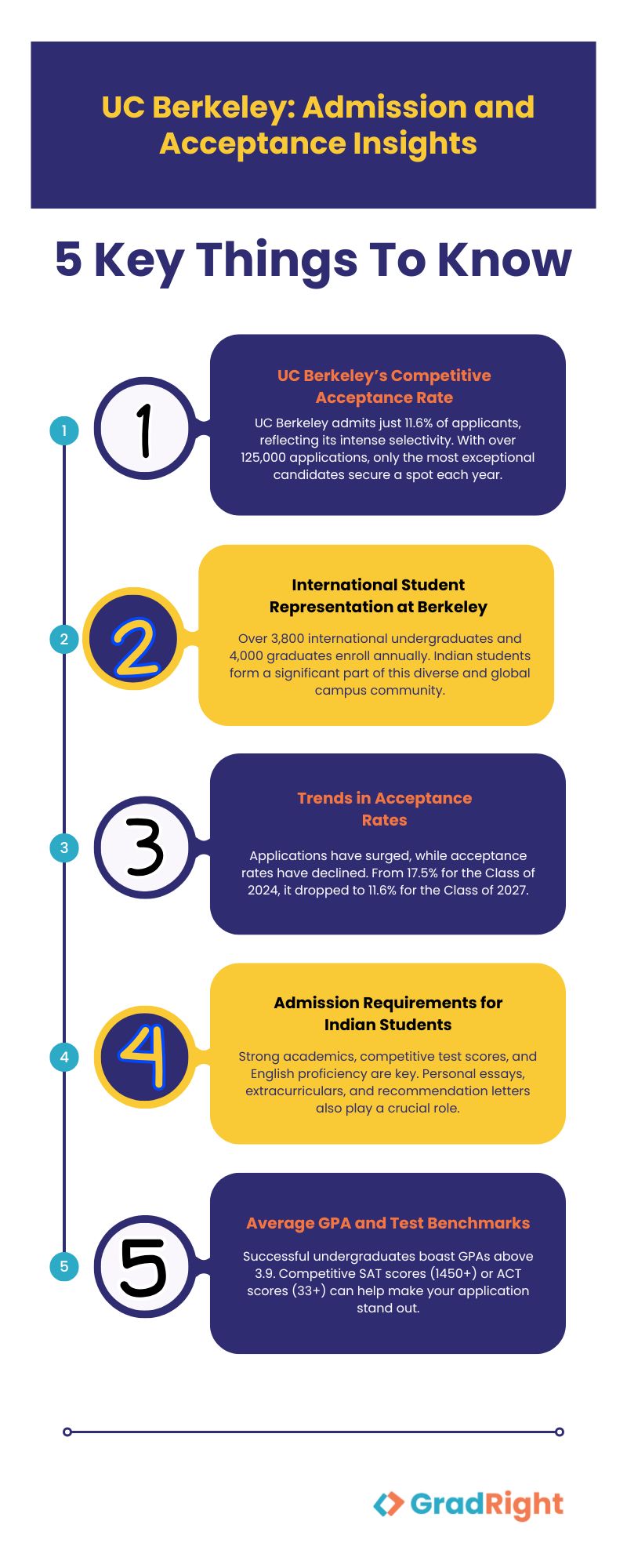
UC Berkeley Acceptance Rate 2026: Historical Trend and Breakdown
| Year/Category | Applications | Admitted | Acceptance Rate | Key Note |
| Fall 2025 (Class of 2029) – Overall | 126,798 | 14,451 | ~11.4% | Record applications; slight decline from 128,197 (Class of 2026 peak) |
| Fall 2025 – California residents | Data not separately released | Higher proportion | ~15% (approx.) | In-state applicants have higher acceptance rate than OOS/international |
| Fall 2025 – Out-of-state/International | Data not separately released | Lower proportion | ~8-11% (approx.) | International applicants face stronger competition due to limited seats |
| Class of 2026 – Overall | 128,197 (peak) | Approx. 14,300 | ~11.2% | Peak application year |
| Early 2000s baseline | ~40,000 | ~10,000 | ~25% | Historical comparison showing how much more competitive Berkeley has become |
| Yield rate (approx.) | Admitted students | Enrolled students | 40-46% | High yield reflects Berkeley enduring appeal competing nationally and globally |
Acceptance rates vary by applicant category. California residents have a higher acceptance rate of about 15%, while out-of-state US and international applicants face lower rates. Some majors at UC Berkeley are significantly more competitive – programs like Computer Science, Business (Haas School), and Engineering (EECS) are the most competitive.
Why UC Berkeley Acceptance Rate Keeps Declining
| Factor | Detail |
| Increasing number of applicants | Stellar reputation continues to attract more applications every year; applications have more than tripled from the early 2000s to today |
| Global reputation | UC Berkeley is widely considered the #1 public university in the world; 350+ degree programs; particularly famous for technology, business, and social sciences |
| Silicon Valley proximity | Located near the San Francisco Bay Area; access to the world leading technology and startup ecosystem |
| Limited enrollment capacity | Berkeley maintains a fixed undergraduate enrollment cap; more applicants compete for the same number of seats each year |
| Diversity initiatives | Berkeley has increased admissions for underrepresented groups over recent years; available seats for other applicants have correspondingly adjusted |
| Test-optional policy context | Berkeley has adopted a test-optional stance; but this attracts more applications from students who might not have applied when tests were mandatory |
UC Berkeley Acceptance Rate by Major (Approximate)
Some majors at UC Berkeley are significantly more competitive than others. Programs in technology, engineering, and business are the most selective:
| Major/Program | Approximate Acceptance Rate | Notes |
| Computer Science (L&S or EECS) | 3-8% | One of the most competitive programs nationally; EECS (via College of Engineering) is extremely selective |
| Electrical Engineering and Computer Science (EECS) | 5-10% | Top-ranked EECS program globally; lower acceptance than overall Berkeley rate |
| Business (Haas School of Business – UG) | 8-12% | Haas UG Direct is among most selective business programs in USA |
| Data Science | 10-15% | Growing program; highly in demand |
| Biology / Pre-Med | 12-18% | Competitive due to pre-med demand; strong research opportunities |
| Engineering (other disciplines) | 10-18% | Civil, Mechanical, Chemical – varies by specific major |
| Social Sciences and Humanities | 15-25% | Less competitive than STEM; acceptance rates closer to or above overall average |
| Graduate programs (general) | 10-20% (varies widely by department) | Graduate school acceptance rates vary significantly by department and research fit |
All questions in the application are equal and given equal consideration in the application review process. The minimum GPA requirement is the minimum – students should aim for a higher GPA than what is listed on the official website to ensure their admission to UC Berkeley.
Also Read: Stanford University Acceptance Rate 2026: Insights, Trends and Admission Tips
UC Berkeley Admission Requirements 2026
| Requirement | Undergraduate | Graduate/Postgraduate |
| Standardised tests | UC Berkeley has adopted a test-optional stance. Submitting strong scores can strengthen application. SAT 1450+ competitive; ACT 28+ recommended. | GRE/GMAT (for postgraduate programs): aim for GMAT around 730 or competitive GRE scores. Requirements vary by department. |
| Academic record | Top academic performance; no more than one or two blemishes on transcript; rigorous coursework including APs or IB | Strong undergraduate GPA; typically 3.5-3.9+ for competitive programs; research experience critical for PhD |
| Personal Insight Questions (PIQs) | 8 PIQ prompts; choose 4; 350 words maximum each; be authentic, reflective, and unique; answer the question directly without beating around the bush | Statement of Purpose (SOP): articulate academic interests, research agenda, and career goals; explain fit with Berkeley faculty and programs |
| Letters of Recommendation | Not required for undergraduate; strongly optional | Required for graduate; 3 letters from faculty who know your academic/research work well |
| Resume/CV | Not required for undergraduate; extracurricular list required | Required for graduate; highlight academic, research, and professional achievements |
| English proficiency | TOEFL or IELTS for international students | Same; plus specific minimum scores per department |
| Financial documentation | Proof of sufficient funds for tuition and living expenses required | Same |
UC Berkeley’s Personal Insight Questions (PIQs): The Most Important Undergraduate Application Component
The UC system uses Personal Insight Questions (PIQs) instead of the Common App essay. Berkeley presents 8 PIQ prompts and applicants choose 4, writing 350 words maximum for each. The PIQs are the most important and most personalised part of the UC Berkeley application.
- Be authentic, reflective, and unique in these essays – this is the core guidance
- Answer the PIQ questions directly – many students beat around the bush and never reach the point; avoid this
- Be mindful of character counts – PIQ responses are a maximum of 350 words; every word counts
- The UCs seldom change their PIQ questions; review them early and give yourself ample time to draft and revise
- All 8 PIQ questions are equal and given equal consideration; choose the 4 that allow you to show the most distinctive and authentic version of yourself
- Common PIQ topics: leadership, creative challenge, greatest talent, academic topic, community service, significant challenge, academic subject interest, something important the school should know about you
UC Berkeley Admission Tips for Indian Students
| Tip | How to Execute It |
| Emphasise your cultural background | As an Indian applicant, emphasise your cultural background and how it can contribute to UC Berkeley diverse community. Share your interest in learning from and contributing to a global student body. |
| Talk about hurdles overcome | Share any hurdles you faced in your academic journey and how you overcame them. Berkeley values resilience and the ability to turn challenges into strengths. |
| Show strong academic consistency | In-state applicants need pristine academic transcripts; out-of-state and international students need even stronger academic records. Aim higher than the minimum GPA requirements listed. |
| Submit test scores if competitive | UC Berkeley has adopted a test-optional stance. However, submitting strong scores (SAT 1450+; ACT 28+) can strengthen your application. If your scores are competitive, include them. |
| Research Berkeley specifically | Engage with Berkeley open resources like academic webinars to gain a deeper understanding of their ethos and offerings. Mention specific programs, labs, or faculty you want to engage with. |
| Prepare PIQs thoroughly | The 4 PIQs you choose are your main chance to tell your story. Draft multiple versions. Seek feedback. Ensure each PIQ answers the specific question asked, clearly and authentically. |
| Plan finances early | Studying abroad is a significant investment. Demonstrate your ability to fund education through valid documentation. Explore scholarships and financial aid. Use FundRight by GradRight for cost-effective education loans in a hassle-free manner. |
UC Berkeley Cost and Financial Planning for Indian Students
| Cost Component | Annual Amount (USD approx.) | Notes |
| Tuition and fees (international students) | USD 44,000-47,000+ | Significantly higher than California resident tuition (~USD 14,000); verify at registrar.berkeley.edu |
| Room and board | USD 22,000-26,000 | On-campus or nearby off-campus; Berkeley/Bay Area living is expensive |
| Books, supplies, personal | USD 4,000-6,000 | Varies by program and personal choices |
| Total estimated annual cost (international) | USD 70,000-80,000+ | One of the lower-cost globally ranked universities relative to private universities; comparable quality programs at Harvard/Stanford cost USD 88,000-95,000+ |
| Financial aid for international students | Limited; some need-based aid available | UC Berkeley offers limited need-based financial aid for international students; less generous than private universities like Harvard or Columbia which meet 100% of need |
| Scholarships | Regents and Chancellor Scholarship (merit); departmental scholarships; external scholarships | Explore all scholarship options before applying; merit scholarships are competitive |
Planning your finances effectively can make all the difference in your study abroad journey. Once you have explored scholarships and financial aid, using a reliable platform like FundRight (by GradRight) ensures that the remaining funding process is stress-free.
FundRight by GradRight: cost-effective education loans in a hassle-free manner for Indian students applying to UC Berkeley. 15+ lenders, best rates through competitive bidding. Apply on FundRight by GradRight
Also Read: Decoding the World’s Best Universities: How to Pick Yours
GradRight helps you build a balanced university list with UC Berkeley as your aspirational choice and well-matched schools alongside. Free, data-driven. Find Your University List on GradRight
Related Guides
Stanford University Acceptance Rate 2026
Best Colleges for MS in Computer Science Engineering
Columbia University Financial Aid for International Students
Decoding the World’s Best Universities: How to Pick Yours
Education Loan Eligibility Criteria Guide for Indian Students
Is Taking a Rs 25-40 Lakh Education Loan Worth It?
GradRight FundRight – Education Loan Platform








 Australia
  Canada
  France
  Germany
  India
India  Ireland
  UAE
UAE  United Kingdom
  United States