





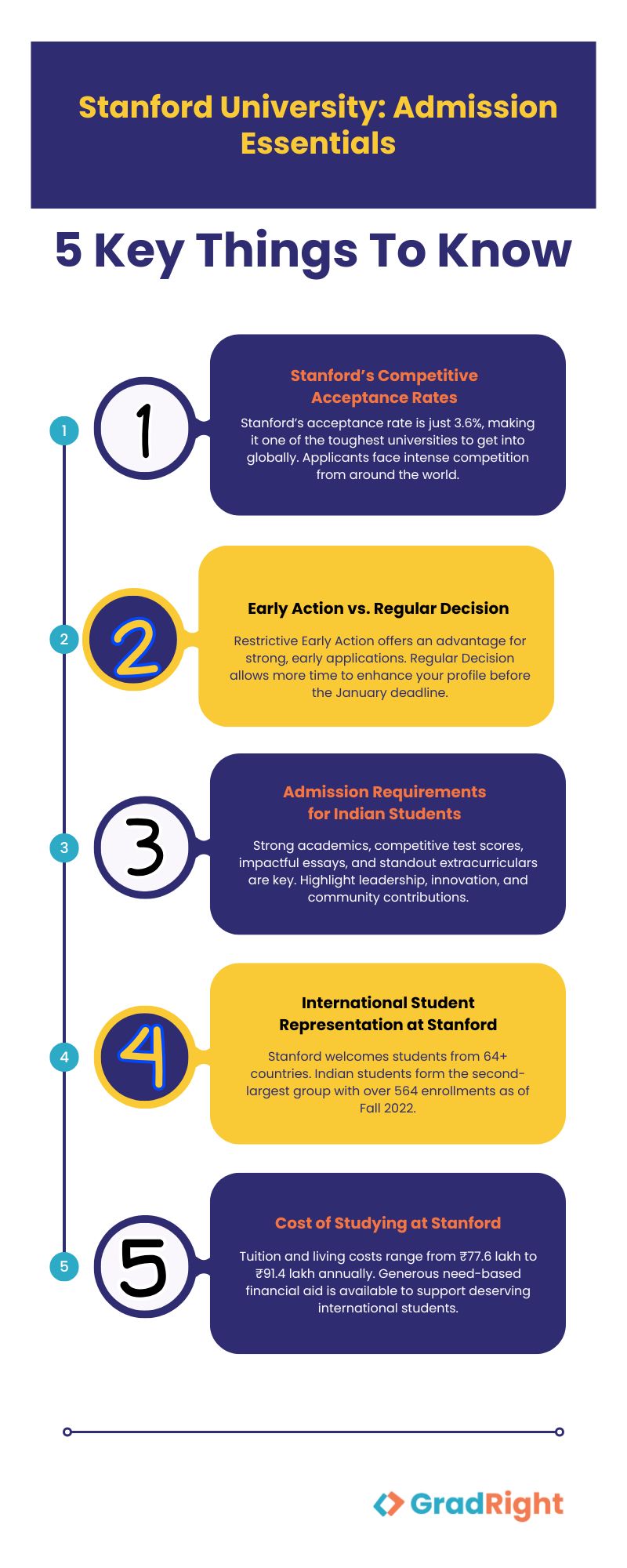
Stanford University’s acceptance rate has fallen to 3.61% for the Class of 2028 – the lowest acceptance rate in the university’s history. Of 57,326 applications received, only 2,067 students were admitted. The yield rate (admitted students who chose to enroll) was 82%, underscoring the university’s exceptional appeal globally.
For Indian students aspiring to Stanford, understanding the trends behind this number – and what the admissions process actually evaluates – is essential to making a realistic, well-prepared application. Strong academic scores alone are not enough. Your profile must stand out holistically.
Stanford University Acceptance Rate: Historical Trend
| Class | Application Year | Applications Received | Admitted | Acceptance Rate | Key Note |
| Class of 2025 | 2020-21 | 55,471 | 2,190 | 3.95% | COVID surge; record applications at that time |
| Class of 2026 | 2021-22 | ~56,000+ | 2,075 | 3.68% | Lowest ever at that point; 54% of admitted students women |
| Class of 2027 | 2022-23 | ~56,000+ | 2,145 | 3.91% | Slight increase; reflects admissions strategy adjustment |
| Class of 2028 | 2023-24 | 57,326 | 2,067 | 3.61% | LOWEST EVER – confirmed most recent data; 82% yield rate |
| Class of 2029 | 2024-25 | Not released | Not released | Not released | Stanford withholds data per standard practice; release with 2025-26 Common Data Set |
| Class of 2030 | 2025-26 | Not released | Not released | Not released | Data anticipated later in 2026 |
Stanford has not released official acceptance rates since 2018 through its own channels. Reliable figures are sourced from national data reporting (Common Data Set), the Stanford Daily, and institutional reports. The long-term trend shows increasing applications but consistently declining acceptance rates – from 5.2% in 2021 to 3.61% in 2024.
Why Is Stanford’s Acceptance Rate So Low?
Stanford’s competitiveness comes from a combination of factors:
| Factor | Detail |
| Global reputation for research and innovation | Stanford faculty include Nobel laureates and founders of companies like Google, Yahoo, NVIDIA, LinkedIn, and Hewlett-Packard. This reputation attracts applications from every country. |
| Silicon Valley proximity | No other top university is situated in the world’s leading technology and venture capital hub. The career access this provides is unique. |
| Limited undergraduate intake | Stanford maintains a small undergraduate class of approximately 2,000 students despite enormous demand. This intentional cap keeps acceptance rates low. |
| Holistic admission review process | Stanford evaluates academics, extracurriculars, essays, recommendations, and character together – not just test scores. This makes the process harder to game but also more nuanced. |
| Growing number of global applicants | International applications to Stanford continue to grow as the university’s reputation expands and standardised applications simplify the process for international students. |
| 82% yield rate | A yield rate of 82% means that nearly every student admitted to Stanford accepts. This exceptional yield is evidence of how much students want to attend, which in turn justifies the high selectivity. |
REA vs Regular Decision: Stanford’s Application Timelines
Stanford offers two application options:
| Feature | Restrictive Early Action (REA) | Regular Decision (RD) |
| Deadline | Approximately November 1 | Approximately January 5 (verify at admission.stanford.edu) |
| Decision notification | Mid-December | Early April |
| Binding? | No – REA is non-binding; you are not required to enroll if admitted | No – standard non-binding Regular Decision |
| Restriction | You cannot apply Early Action or Early Decision to other private universities while applying REA to Stanford | No restrictions; can apply simultaneously to multiple universities |
| Acceptance rate advantage | Stanford does not release specific REA acceptance rates. However, historical trends suggest early applicants have a higher chance of admission. | Standard pool; more competitive overall |
| Advantage of REA | Signals Stanford as your top choice; demonstrates genuine interest; more preparation time (decision in December allows spring semester improvement) | More time to strengthen profile; option to apply simultaneously to other universities |
| Advantage of RD | More time to complete pending achievements, improve grades, or add a significant extracurricular achievement | Standard |
Stanford doesn’t release specific REA acceptance rates. However, historical trends suggest that early applicants have a higher chance of admission. That’s primarily because applying early shows that Stanford is your top-choice university.
Stanford Admission Requirements for Indian Students
Stanford’s admissions process is very holistic. They evaluate applicants based on a combination of academics, extracurriculars, SOP (essays), and recommendations.
| Requirement | What Stanford Looks For | Indian Student Notes |
| Standardised test scores | SAT: 1510-1580 (middle 50% of admitted students); ACT: 34-35 | Test-optional policy ended. SAT/ACT required again from 2025-26 admissions cycle. Indian students must submit scores. |
| Class 12 / academic transcript | Top performance in the most rigorous curriculum available; A-levels, CBSE, ICSE, or IB all accepted | Aim for 95%+ in CBSE/ICSE or equivalent. Consistent performance across all subjects matters more than a single strong year. |
| Essays / Statement of Purpose | Authentic, reflective writing; unique personal experiences; meaningful challenges; intellectual curiosity; vision for future contribution | Write multiple drafts. Seek feedback. Reflect your best self. Generic essays are rejected. Stanford-specific content matters. |
| Letters of Recommendation (LORs) | Strong LORs from teachers or mentors who know you well; provide insight into personality, work ethic, and academic potential | Share your achievements, goals, and experiences with your recommenders to help them write an impactful letter. Source: GradRight original article. |
| Extracurricular activities | Depth over breadth; focus on excelling in 1-2 areas rather than trying to be well-rounded; leadership, impact, innovation | Showcase innovative projects, startup ventures, or unique initiatives you have led. Highlight community contributions. |
| Interviews | Not mandatory for all applicants. If selected for a Stanford interview, you speak with an alumni volunteer. | Prepare thoughtful, honest answers. Alumni interviews are conversational but substantive. Source: GradRight original article. |
| Financial need (for aid applications) | Stanford is need-blind for US domestic students; need-aware for some international students | Research opportunities offered by Indian organisations. Explore FundRight by GradRight for competitive loan options. |
Also Read: Columbia University Financial Aid for International Students
What Stanford’s Admissions Process Actually Evaluates
Stanford looks beyond grades. Leadership, impact, intellectual curiosity, and authenticity matter deeply in the selection process. Stanford’s admissions philosophy is built around identifying students who demonstrate:
- Academic excellence: High grades, strong curriculum, and exceptional performance in rigorous subjects
- Intellectual vitality: Curiosity, passion for learning, and evidence of going beyond the classroom – research, independent study, unusual areas of interest
- Impact and leadership: Initiative shown through community work, innovation, research, entrepreneurship, or arts – not just participation but leadership and measurable impact
- Authenticity and personal depth: Honest, reflective writing; unique personal experiences; meaningful challenges overcome
- A vision for the future: Students who show purpose, direction, and the potential to create change in their field or community
- Contribution to Stanford’s community: Show how Stanford aligns with your goals and how you intend to contribute, not just benefit
Due to the declining acceptance rates, applicants need more than just excellent grades and test scores. Stanford’s holistic admissions process means every component of the application matters. The trend shows increasing applications but consistently low acceptance rates – meaning strong academic scores alone are not enough. Your profile must stand out holistically.
Admission Tips for Indian Students Applying to Stanford
| Tip | How to Execute It |
| Depth over breadth in extracurriculars | Focus on excelling in 1-2 areas rather than accumulating a long list of activities. Stanford looks for future leaders and innovators, not a well-rounded student who did many things superficially. |
| Demonstrate intellectual vitality | Share stories of intellectual curiosity that go beyond coursework. Research projects, science competitions (Olympiad, KVPY, NTSE), or self-directed learning in an unusual area are strong signals. |
| Show community impact | Highlight contributions to your local community – organizing educational workshops, leading fundraisers, creating something that helped others. Impact matters more than prestige of the activity. |
| Showcase innovative projects | If you have led a startup venture, research project, open-source contribution, or innovation initiative, feature it prominently. Stanford explicitly values this. Source: GradRight original article. |
| Write authentic, specific essays | Write multiple drafts. Seek feedback. Refine until the essays reflect your best self. Stanford essays should be specific to Stanford – show you know what the university offers and why it matches your particular goals. |
| Strong LORs – brief your recommenders | Share your achievements, goals, and experiences with your recommenders so they can write specifically about you rather than generically. A LOR that tells a specific story outperforms generic praise. |
| Apply REA if Stanford is your clear first choice | Historical trends suggest early applicants have a higher admission chance. Applying REA also signals genuine interest and commitment. Only apply REA if Stanford is genuinely your first choice. |
| Prepare for the alumni interview | Although not mandatory for all applicants, if selected, prepare thoughtful, honest, substantive answers. The interview is conversational but provides valuable context for your application. |
Cost of Attending Stanford and Funding Options for Indian Students
The cost of attending Stanford University varies depending on specific programs. The estimated total cost of attendance, including tuition, fees, housing, and meals, can range from INR 77.60 lakh to INR 91.46 lakh per year.
| Cost Component | Annual Amount (USD approx.) | Notes |
| Tuition and fees | USD 62,000-65,000+ | Verify current rate at registrar.stanford.edu |
| Room and board | USD 21,000-24,000 | On-campus housing options; San Francisco Bay Area living costs |
| Books and supplies | USD 1,500 (approx.) | Varies by program and personal choices |
| Personal expenses and travel | USD 3,000-5,000 | Varies significantly |
| Total estimated annual cost | USD 88,000-95,000+ | Excluding international travel to/from India |
| Stanford Financial Aid | 100% of demonstrated need met (need-blind for US citizens; need-aware for some international students) | Stanford has one of the best endowments in the world; financial aid is generous |
| Stanford external scholarships | Research Indian government and private scholarships; USIEF Fulbright; ADB scholarships | Explore all options alongside financial aid application |
| FundRight by GradRight | Education loans from 15+ lenders; students have saved up to Rs 23 lakh with FundRight | Best education loan rates through competitive bidding; FundRight by GradRight. Source: GradRight original article. |
Be prepared to demonstrate your ability to cover tuition and living expenses through savings, family support, or loans. While financial planning might seem daunting, the right tools and resources can make it manageable. Source: GradRight original article.
FundRight by GradRight helps Indian students fund their Stanford dream. Students have saved up to Rs 23 lakh with FundRight. 18+ lenders bid for your profile. Apply on FundRight by GradRight
Related Guides
Columbia University Financial Aid for International Students
Tata Scholarship Cornell University 2026
Decoding the World’s Best Universities: How to Pick Yours
Best Colleges for MS in Computer Science Engineering
Education Loan Eligibility Criteria Guide for Indian Students
Is Taking a Rs 25-40 Lakh Education Loan Worth It?
GradRight FundRight – Education Loan Platform









 Australia
  Canada
  France
  Germany
  India
India  Ireland
  UAE
UAE  United Kingdom
  United States