





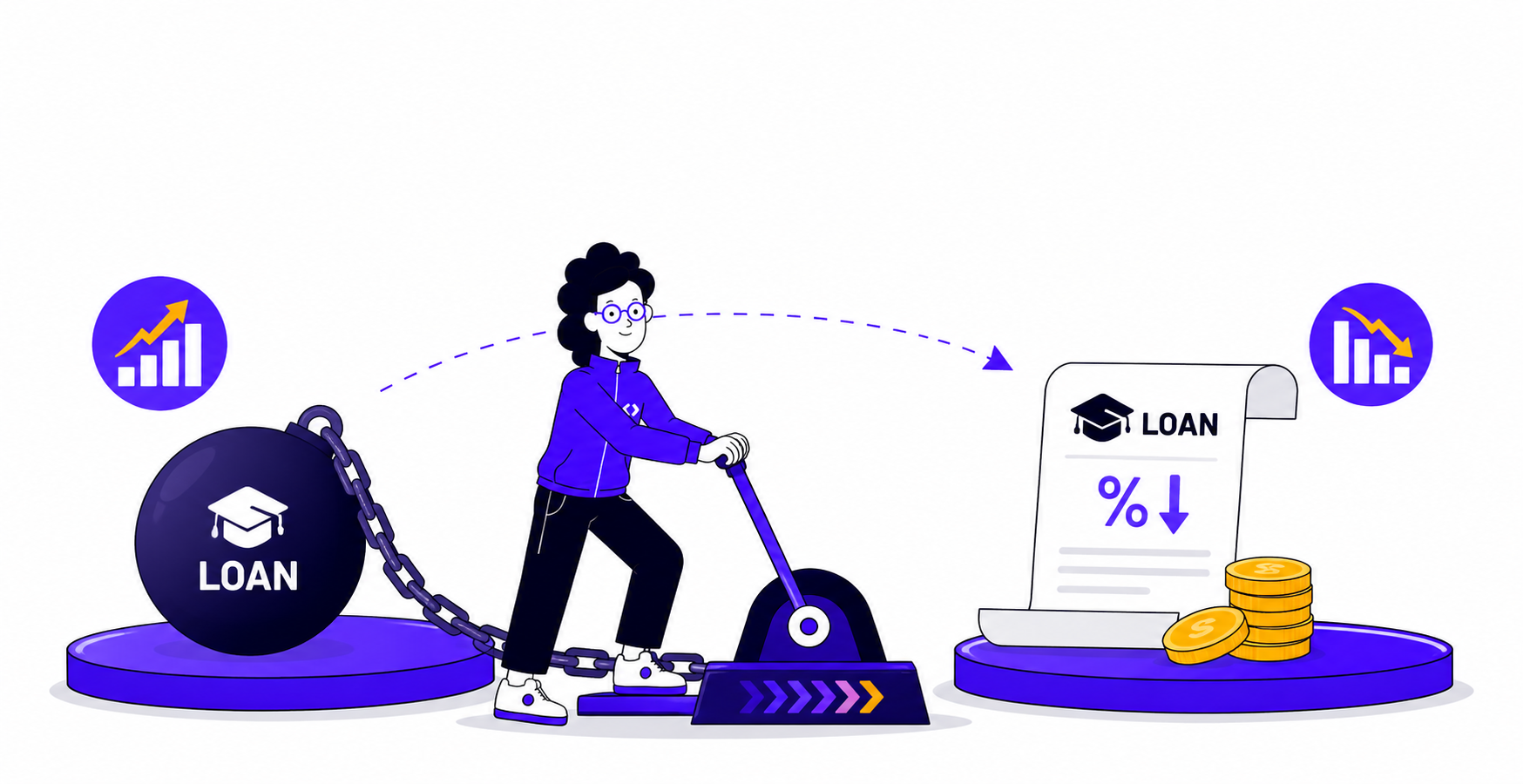
If your education loan EMI is eating into every paycheck, you’re not imagining it. Indian students who take out loans of ₹30–50 lakhs to study abroad often end up paying interest rates between 10% and 14% – a burden that can follow them for a decade or more. This is exactly the problem student loan refinancing is built to solve.
In simple terms, student loan refinancing means replacing your current education loan with a new one – usually from a different lender, and often at a significantly lower interest rate. The new lender pays off your old loan in full, and you start making payments under fresh, better terms. Done right, it can shave lakhs off your total repayment and cut your monthly EMI by a third or more.
This guide breaks down exactly what student loan refinancing is, how it works, who qualifies, what it costs, and how to actually go about it, whether you’re refinancing within India or converting your rupee loan into a US-dollar loan after landing a job abroad.
What is student loan refinancing?
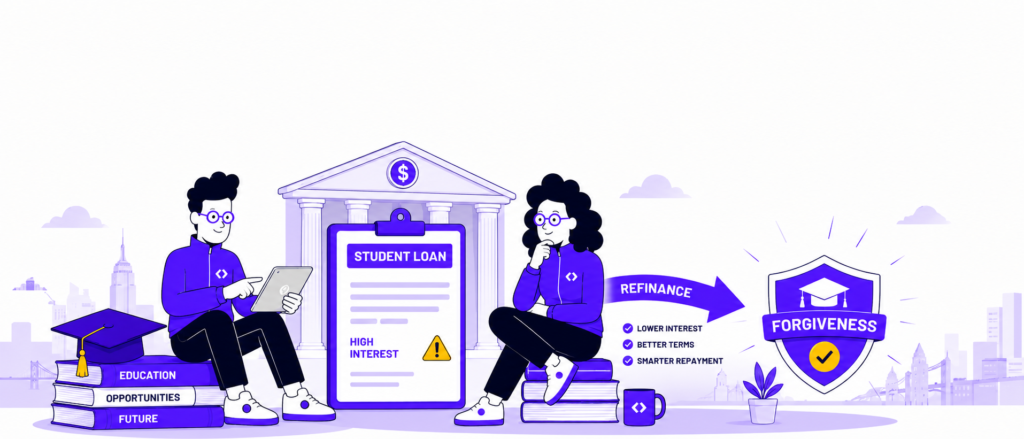
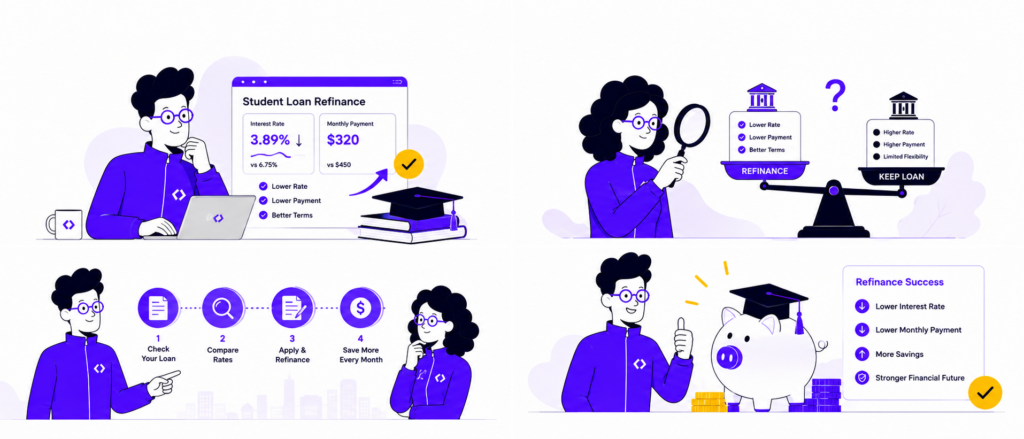
Student loan refinancing is the process of taking a new loan to pay off an existing education loan, typically to secure better terms. Those better terms usually come in one (or more) of these forms:
- A lower interest rate
- A longer or shorter repayment tenure, depending on your goals
- Reduced EMIs, freeing up monthly cash flow
- Different service terms, such as removing a cosigner or releasing collateral
For Indian students who studied abroad, refinancing typically plays out in one of two ways:
- INR-to-INR refinancing in India: switching your existing rupee loan from one Indian bank or NBFC to another that offers a better rate.
- INR-to-USD refinancing abroad: converting your Indian rupee loan into a US-dollar (or other foreign currency) loan through a US-based lender, once you’re employed abroad.
The second option is especially popular among graduates working in the USA on OPT or H-1B status, since developed-market lenders generally offer far lower interest rates than Indian lenders, and repaying in the same currency you earn in removes exchange-rate risk.
How does student loan refinancing work?
The mechanics of refinancing are more straightforward than most people expect. Here’s the typical sequence:
Step 1: Check Your Current Loan Details
Pull your latest loan statement. You’ll need your outstanding principal, current interest rate, remaining tenure, and lender name.
Step 2: Compare Lenders and Prequalify
Most lenders offer a prequalification tool that runs a soft credit check (no impact on your score) and gives you an estimated rate based on your income, visa status, and loan balance. Platforms that let you compare multiple lenders at once, rather than applying to each individually, save significant time here.
Step 3: Submit Documentation
Once you shortlist a lender, you’ll need to submit formal documents: proof of income, government ID, current loan statements, and proof of graduation (more on this below).
Step 4: Compare Formal Offers
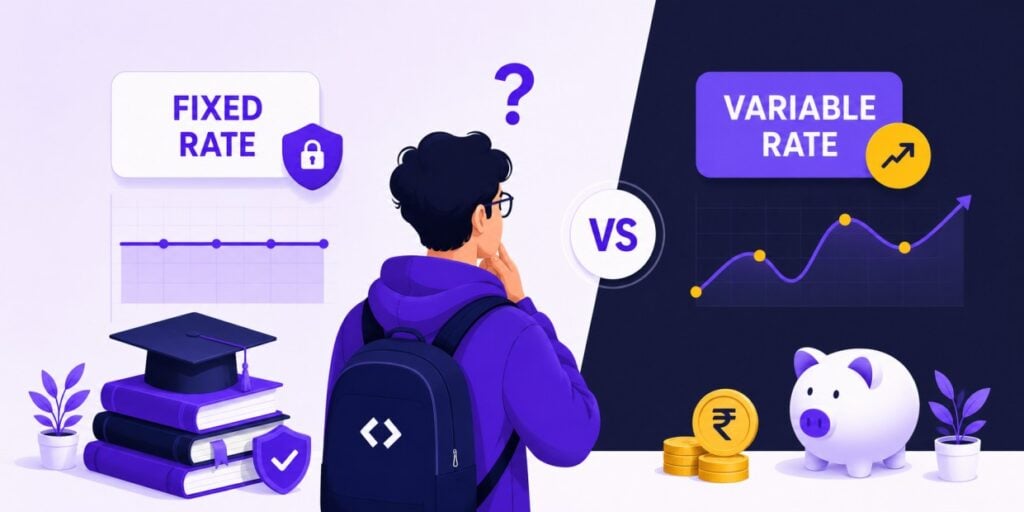
Lenders will return firm offers with fixed or variable APRs, tenure options, and any fees. Compare these side by side rather than settling for the first offer.
Step 5: Close the Old Loan
Once you accept an offer, the new lender pays off your old loan directly. You’ll want a loan closure certificate or No-Objection Certificate (NOC) from your original lender to confirm the debt is fully settled.
Step 6: Start Repaying Under New Terms
From this point on, you make payments to your new lender under the new rate, tenure, and terms.
The full process, from application to disbursal, typically takes 2 to 4 weeks, though initial approval can come through in as little as 48–72 hours once documents are submitted.
Who qualifies for student loan refinancing?
Eligibility criteria vary by lender, but most look for a similar profile:
- Stable income with a steady job (usually salaried, sometimes with a minimum income threshold)
- A good credit score – in the USA, a FICO score of 650+ is generally the baseline for competitive offers
- Valid visa status with sufficient time remaining (H-1B, permanent residency, or in some cases OPT), or Indian residency for INR-to-INR refinancing
- A cosigner, in some cases, if your credit history or income doesn’t yet meet the lender’s bar on its own
- A clean repayment record on your existing loan, with no pending or missed EMIs
If you’re on OPT, note that some lenders do accept applications, but stronger offers typically open up once you move to H-1B status or become a permanent resident – both signal longer-term stability to the lender.
What you’ll need to apply for refinancing
Having your paperwork ready upfront can shave days off the approval timeline. Here’s the standard checklist lenders ask for.
- Loan sanction letter and latest loan statement
- Foreclosure/payoff letter from your current lender
- Government-issued ID and proof of address
- Proof of income (pay stubs, offer letter, or employment verification)
- Academic degree certificate or proof of graduation
- Visa documentation (where applicable)
Benefits of student loan refinancing
Once you understand how the process works, the next natural question is what you actually stand to gain from it. Here are the biggest advantages worth weighing.
1. Lower Interest Costs
This is the headline benefit. If your current loan sits at 13–14% and you refinance down to 6–9%, the savings compound fast. On a ₹40 lakh loan over 10 years, even a 4% rate drop can save upwards of ₹10–12 lakh in total interest.
2. Lower Monthly EMIs
A lower rate, combined with an adjusted tenure, directly reduces your monthly outgo, which matters a lot in the early years of a career when cash flow is tight.
3. Currency Alignment
If you’re earning in USD but repaying an INR loan, you’re exposed to exchange rate risk every single month. Refinancing into a USD loan means your income and your EMI move in the same currency.
4. Building Foreign Credit History
A USD loan under your name helps build a USA credit file, which becomes valuable later when you want to finance a car, apartment, or home in the USA.
5. Removing a Cosigner or Collateral
Many original education loans require a parent as cosigner or family property as collateral. Refinancing once you have independent income and credit history can release that obligation, reducing risk for your family.
What to watch out for before you refinance
Refinancing isn’t automatically the right move for everyone. A few things to weigh carefully:
- You lose access to your original loan’s protections. If you currently have a federal or subsidized loan (rare for study-abroad loans but relevant for domestic borrowers), refinancing into a private loan usually means giving up income-driven repayment or forgiveness options permanently.
- Career trajectory matters. If you’re likely to move back to India within 2–4 years, converting to a USD loan may not make financial sense; you’d be taking on dollar-denominated debt without dollar income long-term.
- Watch for hidden fees. Processing fees, prepayment penalties, and late-payment charges can offset the benefit of a lower headline rate. Always read the fine print.
- Your credit score dips temporarily. A hard credit inquiry at the application stage can cause a small, short-term dip. Consistent, on-time payments on the new loan typically recover, and eventually improve, your score.
- The 2% rule is a useful gut-check, not a hard rule. A common guideline is to only refinance if your new rate is at least 2% lower than your current one. It’s a helpful starting filter, but factor in tenure length, fees, and currency risk too – not just the rate difference.
When is the right time to refinance?
Most students become eligible to refinance once loan disbursement has started or after repayment begins. In practice, the ideal window opens once you:
- Have secured stable employment (in India or abroad)
- Have built at least a few months of credit and repayment history
- Have a visa with sufficient runway remaining (for cross-border refinancing)
Many graduates apply within their first one to two years of employment to lock in savings early, since this is typically when the gap between their original loan rate and available refinance rates is widest. And if rates drop further down the line, there’s no cap on how many times you can refinance, though each application does involve a fresh credit check, so it’s worth weighing the cost of repeated hard pulls against the marginal savings.
Refinancing in India vs. refinancing in the USA: A quick comparison
| Factor | Refinancing in India | Refinancing in the USA |
| Currency | INR to INR | INR to USD |
| Best suited for | Returning to India, want lower EMIs | Working abroad, plan to stay long-term |
| Typical rate range | Lower than original but higher than USD options | Often significantly lower than Indian rates |
| Credit impact | Builds Indian credit history | Builds USA credit history |
| Currency risk | None | Removed once income is in USD |
| Visa dependency | Not applicable | Requires valid work visa/PR |
How to compare refinancing offers the smart way
Manually reaching out to five or six lenders, filling separate forms, and tracking different document requests is genuinely exhausting, and it’s the single biggest reason people delay refinancing even when it would save them money. This is where marketplace-style platforms have changed the process.
Instead of approaching lenders one at a time, you submit your loan and income details once, and multiple lenders compete for your profile through a reverse-auction model. You then compare fixed vs. variable APRs, tenure, fees, and cosigner requirements side by side on a single dashboard, and pick the offer that actually fits your financial goals, not just the one with the lowest headline number.
At GradRight, we take this a step further by pairing the comparison tool with human expert guidance – useful if you want your visa status, SSN nuances, or payoff sequencing double-checked before you commit.
How to get the best student loan refinancing offer
Knowing the benefits is one thing – actually landing a competitive offer takes some preparation. Keep these six tips in mind as you shop around.
- Build your credit score before you apply. It’s the single biggest lever on the rate you’re offered. Pay bills on time and keep credit utilization low in the months leading up to your application.
- Apply to prequalify with multiple lenders, not just one. Soft-check prequalification tools let you shop rates without any impact on your score.
- Don’t chase the lowest rate blindly. Factor in tenure, fees, and flexibility (deferment or forbearance options) alongside the interest rate.
- Check for autopay and loyalty discounts. Many lenders shave 0.25% or more off your rate for enrolling in autopay.
- Time your application to your visa runway. Lenders want to see enough time left on your work authorization to comfortably cover the loan term.
- Get your payoff letter and NOC lined up early. Delays in closing the old loan are one of the most common bottlenecks in the refinancing timeline.
Ready to refinance? Let GradRight do the heavy lifting
Shopping for the best student loan refinancing offer on your own means juggling multiple lender websites, repeating the same paperwork, and trying to compare fixed vs. variable rates without a side-by-side view. GradRight removes that friction. Submit your loan and income details once, and multiple Indian and international lenders bid on your profile – so you see every offer, rate, and fee on a single dashboard instead of chasing quotes one at a time.
Our team also brings the kind of guidance a comparison tool alone can’t: sanity-checking your visa timeline, sequencing your payoff and NOC paperwork correctly, and flagging lenders that fit your specific career trajectory – all at no consultancy fee.
If you’re paying double-digit interest on an education loan today, that’s real money leaving your paycheck every month for no reason. Head to GradRight’s refinance eligibility checker, see your personalized rate in minutes, and start the switch to a loan that actually works in your favor.




 Australia
  Canada
  France
  Germany
  India
India  Ireland
  UAE
UAE  United Kingdom
  United States
