





Financing your studies abroad requires careful planning, and understanding your loan repayments is crucial for it. This article equips you with the knowledge and tools to navigate this aspect effectively, including an education loan calculator you can use to compare different scenarios based on changing variables like loan term, rate of interest, etc.
What is an education loan EMI calculator?
Planning for your studies abroad can be overwhelming. However, when you focus on the most important parts, you can keep the chaos away.
For instance, most students can make better decisions when they know what exactly they’d need to repay, if they go for an education loan.
This monthly repayment, of course, is the education loan EMI. Calculating it manually is time consuming.
This is where an education loan EMI calculator helps.
An education loan EMI calculator simplifies the process by factoring in:
- Loan Amount: The total sum borrowed to finance your education.
- Interest Rate: The percentage charged on the loan amount.
- Repayment Tenure: The duration (in years) over which you’ll repay the loan.
By inputting these details, the calculator uses a formula to determine your exact EMI. This provides a clear picture of your monthly repayment commitment.
Advantages of using the educational loan EMI calculator
Imagine setting off to study abroad and fulfilling your academic dreams. Then, reality hits – tuition fees can be high, ranging from ₹50 lakhs to ₹1.5 crore depending on your chosen country, program, and college.
This can feel overwhelming, especially when it comes to understanding how you’ll manage the loan repayments.
Here’s where an education loan EMI calculator brings order to chaos.
Think of it as a financial translator. It takes that large loan amount and breaks it down into easy-to-understand monthly payments (EMIs). This way, that seemingly huge sum starts to feel a lot more manageable.
But the benefits go beyond simply translating numbers.
An education loan EMI calculator also lets you experiment with different scenarios. You can try out various loan amounts, interest rates, and repayment durations. This helps you answer crucial questions like:
- How much can I comfortably afford to pay each month?
- What’s the total interest I’ll end up paying?
- What’s the maximum loan amount I should consider?
Manually calculating these different options can be complex and time-consuming. An education loan EMI calculator does the heavy lifting for you, making it a fantastic tool for understanding your loan options.
In the next section, we’ll understand how this calculator works, and how an education loan is calculated.
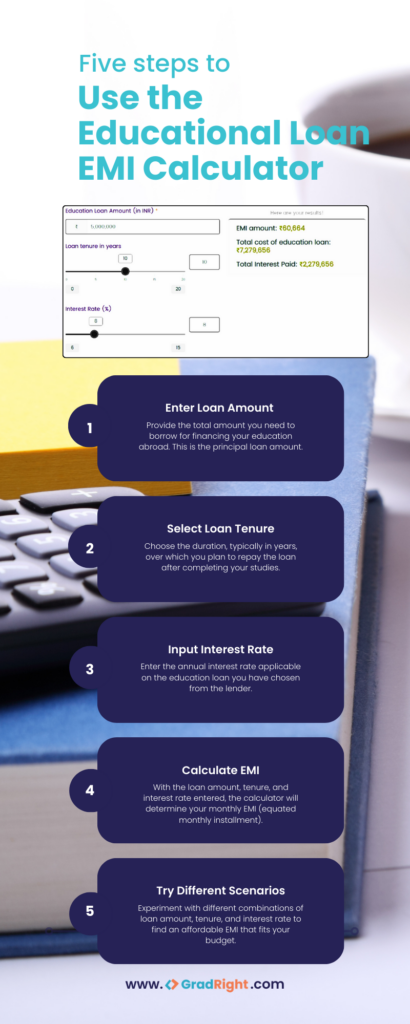
How to use the educational loan EMI calculator?
Now that you know how an education loan EMI calculator simplifies things, let’s see how it works.
Worked Examples – Real EMI Numbers Across Loan Amounts
Here is how the math plays out for a Rs 10 lakh education loan at 10% interest across three different tenures:
|
Tenure |
Monthly EMI |
Total Interest Paid |
Total Repayment Amount |
|
5 years |
Rs 21,247 |
Rs 2,74,823 |
Rs 12,74,823 |
|
10 years |
Rs 13,215 |
Rs 5,85,809 |
Rs 15,85,809 |
|
15 years |
Rs 10,746 |
Rs 9,34,289 |
Rs 19,34,289 |
Notice the pattern: going from 5 years to 15 years roughly halves your monthly EMI (Rs 21,247 to Rs 10,746) – but it more than triples your total interest paid (Rs 2.75 lakh to Rs 9.34 lakh). The ‘cheaper monthly payment’ is significantly more expensive in total cost terms.
For Larger Loans – Rs 20 Lakh and Rs 40 Lakh
|
Loan Amount |
Tenure |
Approx. Interest Rate |
Approx. Monthly EMI |
|
Rs 20 lakh |
10 years |
10% |
~Rs 26,431 |
|
Rs 20 lakh |
15 years |
10% |
~Rs 21,491 |
|
Rs 40 lakh |
10 years |
11% |
~Rs 55,164 |
|
Rs 40 lakh |
15 years |
11% |
~Rs 45,466 |
Figures are indicative and scale proportionally with loan amount at the same rate and tenure. Always use a precise calculator with your exact loan terms before finalizing your budget, as small rate differences compound meaningfully at larger loan amounts.
Compare education loans from 18+ lenders, then plug their exact rates into an EMI calculator to see your real monthly cost. Compare Education Loans on GradRight
Why Moratorium Period Calculators Show the “Real” Cost
Many students worry about repayment starting before they get a job. This is where the moratorium period helps – during this time (typically course duration + 6-12 months), EMIs do not start. However, interest may still accumulate, even though you are not making payments.
A basic EMI calculator that ignores moratorium will significantly understate your true loan burden. A calculator that factors in the moratorium period shows you the real cost of your loan – not just the surface numbers – by capitalizing the accrued interest into your principal before calculating your post-moratorium EMI.
|
Calculation Approach |
What It Shows You |
|
Basic EMI calculator (no moratorium factored) |
EMI based on original loan amount only – understates your true monthly payment |
|
EMI calculator with moratorium period |
EMI based on original loan + interest accrued and capitalized during moratorium – shows your real, accurate monthly payment |
Some lenders charge simple interest during the moratorium period, while others apply compound interest – which can make the total repayment amount significantly higher. Confirm which method your specific lender uses before relying on any calculator’s moratorium-adjusted output.
Also Read: Compare Education Loan Interest Rates – All Lenders 2026
How Each Variable Affects Your EMI
|
Variable |
Effect on Monthly EMI |
Effect on Total Interest |
|
Higher loan amount |
Increases EMI |
Increases total interest |
|
Longer tenure |
Reduces EMI |
Increases total interest paid |
|
Shorter tenure |
Increases EMI |
Reduces total interest paid |
|
Lower interest rate |
Reduces EMI |
Reduces total interest paid |
|
Higher interest rate |
Increases EMI |
Increases total interest paid |
Even a 1% change in interest rate can shift your EMI noticeably, especially on larger loans. This is exactly why comparing offers from multiple lenders before finalizing your loan – rather than accepting the first offer – has such a meaningful financial impact.
Using the EMI Calculator to Compare Lender Offers
One of the most practical uses of an EMI calculator is comparing competing loan offers side by side. For example:
|
Lender |
Loan Amount |
Interest Rate |
Tenure |
Monthly EMI |
|
Bank A |
Rs 35 lakh |
9.4% |
10 years |
Lower monthly EMI, shorter tenure |
|
Bank B |
Rs 35 lakh |
10.2% |
14 years |
Different EMI due to rate + tenure combination |
Running both scenarios through an EMI calculator immediately shows you which option is more affordable – both in monthly terms and total repayment terms – rather than judging based on the headline interest rate alone. A lender with a slightly higher rate but shorter tenure can sometimes cost less in total interest than a lower rate stretched over a much longer period.
Get competing offers from 18+ lenders, then use an EMI calculator to identify your most affordable option. Compare Education Loans on GradRight
Other Education Loan Calculators You Might Need
- Education loan eligibility calculator: estimates how much you may qualify to borrow based on factors like co-applicant income and credit score
- Education loan tax exemption calculator: estimates your potential Section 80E tax savings based on annual interest paid
- Education loan calculator with moratorium period: factors in the temporary repayment pause during your studies, showing your true post-moratorium EMI
Under Section 80E of the Income Tax Act, you can deduct the interest paid on your education loan from your taxable income for up to 8 years after you start repaying – with no upper limit on the deduction amount. This tax benefit applies to both domestic and international education loans under the old tax regime.
Also Read: Education Loan Tax Benefits – Section 80E
What Affects Your Education Loan Eligibility and Rate
Beyond the EMI math itself, lenders look at multiple factors before approving an education loan and deciding your specific rate:
- Loan amount requested relative to total program cost
- Co-applicant’s income and credit history (CIBIL score)
- The university you are applying to – some banks prefer students at higher-ranked universities given better job prospects
- Whether you can offer collateral (property, fixed deposits, LIC policies) – this typically results in lower interest rates and better terms
Unsecured education loans (no collateral required) are widely available from many lenders, but typically come with higher interest rates because the lender takes on more risk without an asset to fall back on. If you can provide collateral, you are more likely to secure a lower rate.
Check your eligibility and compare education loan rates from 18+ lenders for your specific profile. Compare Education Loans on GradRight
Related Education Loan Guides
Education Loan Moratorium Period – Complete Guide
Compare Education Loan Interest Rates – All Lenders
Education Loan Tax Benefits – Section 80E
Education Loan Repayment Tips That Actually Work
Education Loan Without Collateral
Step-by-Step Education Loan Guide
Education Loan Refinancing









 Australia
  Canada
  France
  Germany
  India
India  Ireland
  UAE
UAE  United Kingdom
  United States