




Quick Answer
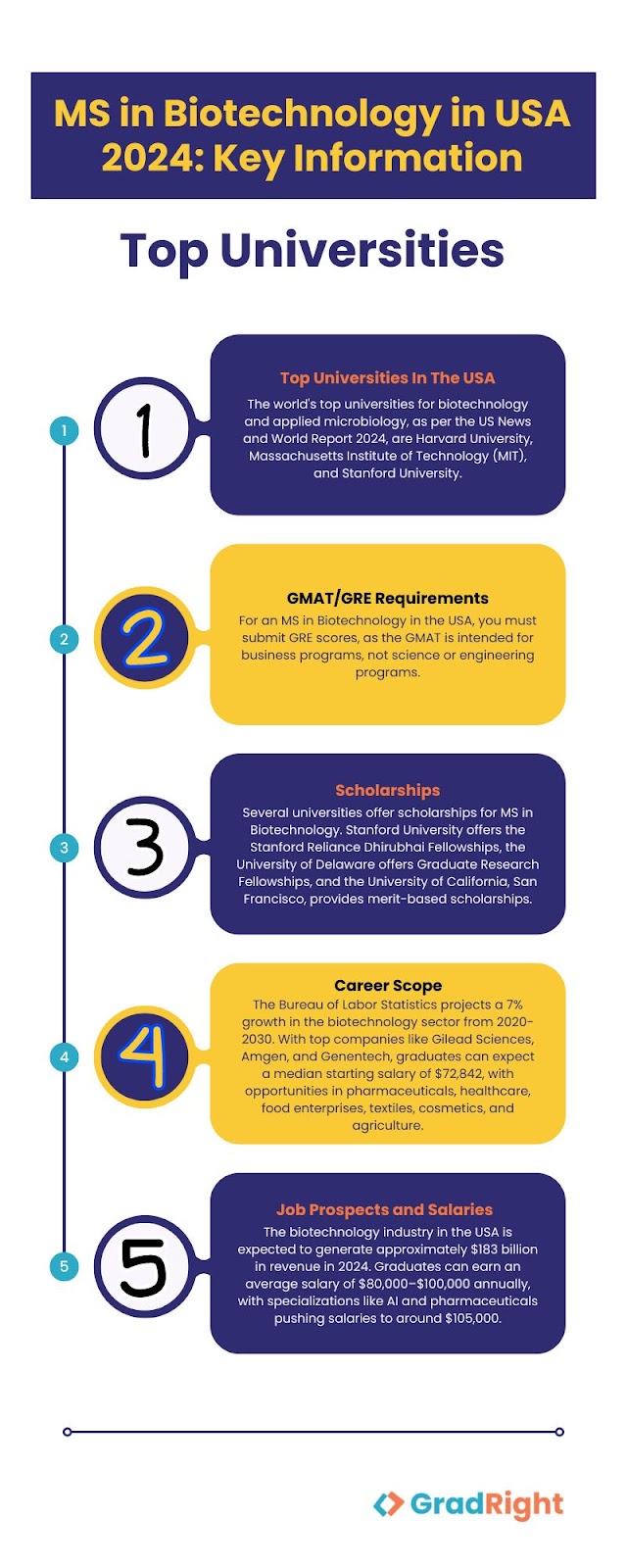
The USA’s biotechnology sector is large and growing, anchored by hubs in Boston and San Francisco and top-ranked programs at Harvard, MIT, Stanford, and Johns Hopkins. An MS in Biotechnology is STEM-designated at most universities and typically requires GRE (though a growing number of schools have made it optional or waived it). Entry-level graduates commonly earn $65,000-$91,000, with mid-career and specialized roles (AI-driven biotech, gene therapy) reaching $110,000-$140,000+.
The United States is a major global player in biotechnology, with a large and consistently growing industry anchored by top research universities and the world’s largest biotech hubs.
The USA is home to leading universities in the bioscience field – MIT, Harvard, Stanford, UC Berkeley, Johns Hopkins, and Yale among them – alongside a dense ecosystem of biotech companies and research institutions that gives graduates a genuine path to hands-on experience within months of finishing their degree.
This guide covers the top universities for an MS in Biotechnology in the USA, curriculum, eligibility, career prospects, and realistic salary expectations.
Also read: Study Abroad Guide for Indian Students
Top Universities for MS in Biotechnology
Rankings below are from the US News & World Report’s Biotechnology and Applied Microbiology Sciences ranking – always check the current-year ranking before finalizing your list, since these shift annually.
|
University |
US News Rank (Biotech & Applied Microbiology) |
|---|---|
|
Harvard University |
1 |
|
Massachusetts Institute of Technology |
2 |
|
Stanford University |
3 |
|
Johns Hopkins University |
6 |
|
University of Pennsylvania |
10 |
|
UC San Francisco |
21 |
|
UC Berkeley |
22 |
|
University of Illinois, Chicago |
53 |
|
Ohio State University |
57 |
|
Columbia University |
67 |
Also read: Best Exams to Study in USA for Indian Students 2026 (Masters & UG)
Course Curriculum
Core Courses:
- Advanced Cell Biology
- Molecular Genetics
- Biochemistry and Metabolism
- Biostatistics and Experimental Design
- Bioinformatics and Computational Biology
- Biotechnology Techniques and Instrumentation
- Bioethics and Regulatory Affairs
Electives:
- Bioprocessing
- Regulatory Affairs and Compliance
- Quality Control and Assurance
- Drug Discovery and Development
- Biotech Entrepreneurship
- Environmental Biotechnology
Common Specializations:
- Biomedical Engineering
- Bioprocessing and Biomanufacturing
- Genomics and Bioinformatics
- Regenerative Medicine
- Pharmaceutical Biotechnology
- Industrial Biotechnology
Eligibility
Biotechnology is STEM-designated in the USA, making it a highly sought-after graduate program. Typical requirements:
- A bachelor’s degree in a relevant field (Biology, Chemistry, Biochemistry, or similar) from an accredited institution.
- A minimum GPA of around 3.0 on a 4.0 scale (varies by university).
- GRE scores, where required (see below).
- Academic transcripts for all semesters of your last degree.
- English proficiency scores (IELTS, PTE, or TOEFL) for non-native speakers.
- Statement of Purpose.
- 2-3 letters of recommendation.
- Relevant work experience, project work, or internship documentation, where applicable.
- An updated resume/CV.
GRE Requirements
The GMAT is designed for graduate business programs, not science or engineering – so it isn’t accepted for an MS in Biotechnology. The GRE is the relevant standardized test, though policies vary significantly by university.
Some universities – including Caltech, Georgetown, University of Michigan-Ann Arbor, and USC – have dropped the GRE requirement for MS programs in recent cycles. Others, including UC Berkeley, Florida International University, and George Mason University, have made it optional. Harvard, Stanford, and Johns Hopkins still require it, typically expecting scores in the 60th-70th percentile range for competitive consideration.
GRE score validity is time-limited, so make sure your scores will still be valid when your program starts.
Also read: GMAT vs GRE: Differences and How to Choose
Scholarships
|
University |
Scholarship |
|---|---|
|
Stanford University |
Stanford Reliance Dhirubhai Fellowships |
|
University of Delaware |
Graduate Research Fellowship |
|
UC San Francisco |
University of California merit-based scholarships |
|
University of Pennsylvania |
Penn’s GSE merit-based scholarships |
|
Illinois Wesleyan University |
Illinois Wesleyan University Scholarships |
Beyond university-specific awards: the Fulbright Foreign Student Program, AAUW International Fellowships, National Science Foundation (NSF) grants, the Narotam Sekhsaria Foundation Scholarship, Inlaks Shivdasani Foundation Scholarships, and the Tata Scholarship (Cornell University) are all worth exploring.
Scholarships typically cover only part of total costs – most students still need an education loan for the remainder. GradRight lets you create one profile and receive competitive offers from 18 lending partners within two days, with support from independent financial experts to compare terms and negotiate, and approval possible in as little as 10 days.
Also read: 10 Best Scholarships for Master’s for Indian Students in 2026
Career Scope and Salary
The US biotechnology sector is a significant and growing part of the economy, with the Bureau of Labor Statistics projecting continued above-average employment growth through 2030. Employment in the sector has grown steadily over the past several years, driven by demand across pharmaceuticals, healthcare, agriculture, and environmental applications.
Given the leading research infrastructure in the USA and major employers like Gilead Sciences, Amgen, and Genentech, the country remains a top destination for biotechnology graduates worldwide.
Salary ranges genuinely vary by source, role, and experience level – here’s a consolidated view rather than scattered, inconsistent figures:
|
Career Stage / Role |
Typical Salary Range (USD) |
|---|---|
|
Entry-level (Research Associate, Biotech Sales) |
$65,000-$91,000 |
|
Mid-level (Microbiologist, Biomanufacturing Engineer) |
$87,000-$105,000 |
|
Specialized/Senior (Gene Therapy Researcher, AI Specialist, Biotech Consultant) |
$113,000-$139,000 |
Specializations in high-demand areas – AI-driven biotech, gene editing (CRISPR), pharmaceutical R&D – command the higher end of this range; general entry-level roles in quality assurance or compliance sit at the lower end.
Top Recruiters by Industry
Pharmaceutical:
Gilead Sciences, Amgen, Genentech (Roche Group), Biogen, Pfizer, Bristol Myers Squibb, AbbVie, Eli Lilly, Merck & Co., Johnson & Johnson.
Agricultural:
Bayer (Monsanto), Syngenta, Corteva Agriscience, BASF, Cargill, Archer Daniels Midland, Novozymes, Bio-Rad Laboratories.
Healthcare and Diagnostics:
Illumina, Thermo Fisher Scientific, Quest Diagnostics, Agilent Technologies, Qiagen, Siemens Healthineers, Abbott Laboratories.
Bioinformatics and Computational Biology:
Illumina, Thermo Fisher Scientific, 10x Genomics, Regeneron Pharmaceuticals, Ginkgo Bioworks, DNAnexus.
Related Articles
Study Abroad Guide for Indian Students
Best Exams to Study in USA for Indian Students
GMAT vs GRE: Differences and How to Choose
10 Best Scholarships for Master’s for Indian Students
High-ROI STEM Masters in US for 2026 Intake
Find the Right Biotechnology Program for You
With strong programs spread across a wide ranking range – from Harvard to Ohio State – the right fit depends on your GRE status, budget, and target specialization. GradRight’s AI-powered platform can help you shortlist, and its loan comparison tool connects you with 18 lending partners once you’re ready to finance your degree. Start your free profile at https://gradright.com/selection/.





 Australia
  Canada
  France
  Germany
  India
India  Ireland
  UAE
UAE  United Kingdom
  United States