





Quick Answer
A co-op (Cooperative Education) master’s program alternates academic terms with full-time, paid work in your field – typically extending your degree to 2-3 years but giving you 6-24 months of real industry experience. Pay generally runs $15-30/hour or $2,000-4,000/month. Georgia Tech, Northeastern, Drexel, and Purdue are among the strongest US programs. Unlike work-study, co-ops are open to international students.
Learning the practical side of a job before graduating can meaningfully shape your employment prospects – most employers actively look for fresh graduates with some real-world experience.
Co-op programs at many US universities fill that gap, building your resume and opening doors to interviews that a purely academic record often can’t. This guide covers how co-op master’s programs work, what they pay, the top universities offering them, and how they differ from internships and work-study.
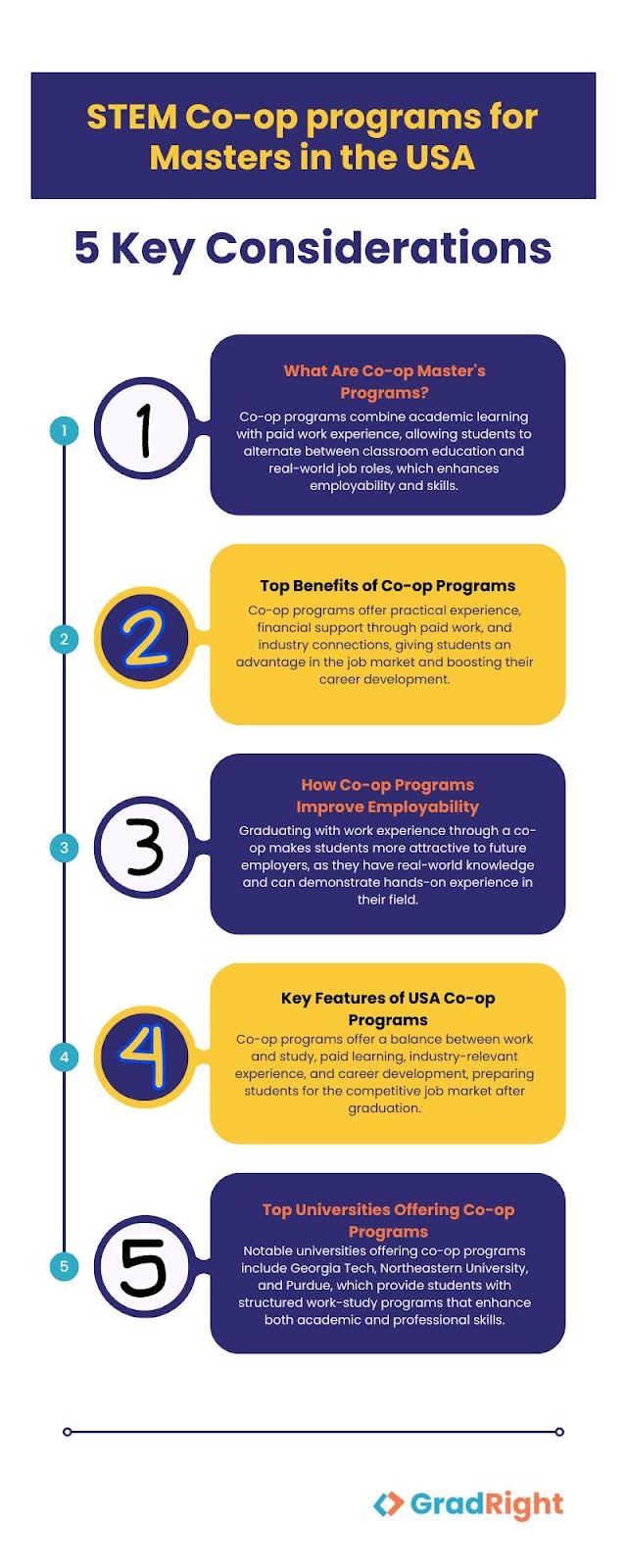
How Co-op Master’s Programs Work
A Co-op Program (short for Cooperative Education Program) merges academic study with hands-on work experience, alternating between classroom terms and paid work in your field.
You become part of the team at your chosen company, paired with a dedicated manager who provides training and guidance. Projects are matched to your skills and interests, letting you apply classroom knowledge in a real-world setting – whether leading your own project or contributing to a larger initiative. A university co-op advisor checks in regularly throughout your work term to track your progress.
- Work-study balance – students alternate between full-time work and study terms throughout their program, creating a structured bridge between theory and practice.
- Paid learning experience – co-op placements pay a real salary, easing the financial burden of tuition and living costs.
- Industry-relevant experience – work is matched to your field of study, developing practical problem-solving skills alongside classroom learning.
- Professional networking – co-ops build direct connections with employers and managers that can lead to job offers and references.
- Extended timeline, real payoff – co-ops typically extend graduation by a semester or more, but the traded-off is a genuine degree-plus-experience combination valued by employers.
- Career clarity – many students use their co-op term to clarify career goals and understand what employers are actually looking for.
Also read: Study Abroad Guide for Indian Students
Compensation for Co-op Master’s Programs
Co-op students are paid for their work terms – employers understand the value students bring and compensate accordingly.
|
Type |
Typical Range |
|---|---|
|
Monthly salary |
$2,000-$4,000, depending on organization, location, and industry |
|
Hourly wage |
$15-$30/hour |
|
Stipend/allowance |
Varies – some employers offer a living-expense stipend instead of salary/hourly pay |
What Drives Pay Differences
- Industry type – engineering, computer science, and finance roles tend to pay more given specialized skill demand.
- Location – high cost-of-living cities like New York or San Francisco generally pay more to offset local expenses.
- Employer size – larger corporations often have more room in their compensation structures than startups or smaller organizations.
- Student level – postgraduate students typically earn more than undergraduates, given their advanced education and any prior work experience.
Compensation matters, but it shouldn’t be the only factor you weigh when choosing a co-op – the experience and network you build often matter just as much long-term.
Also read: 5 Most Affordable Universities in the USA for Indian Students
Benefits of a Co-op Program
- Practical experience – hands-on application of theoretical knowledge deepens your understanding of the field.
- Financial relief – being paid during co-op reduces reliance on financial aid and eases overall cost pressure.
- Enhanced employability – graduating with real work experience makes you more attractive to employers and improves your odds of a strong first job.
- Academic credit – many co-op programs offer credit or formal recognition for the skills built during your work term.
- Soft skill development – professional communication and collaboration skills built on co-op carry over directly into full-time roles.
Also read: Best Exams to Study in USA for Indian Students (Masters & UG)
Co-op vs Internship vs Work-Study
|
Co-op |
Internship |
Work-Study |
|
|---|---|---|---|
|
Duration |
6 months to 1 year |
A few weeks to a few months |
10-20 hrs/week during term |
|
Pay |
Generally well-paid |
Varies, often paid or unpaid |
Government-funded, need-based |
|
Employer |
Usually one employer throughout |
Often multiple employers across terms |
On- or off-campus jobs |
|
Academic credit |
Frequently offered |
Sometimes offered |
Not typically credit-bearing |
|
International student eligibility |
Yes |
Yes |
No – requires FAFSA/US citizenship, so not accessible to Indian students |
Co-op and internship terms are often used interchangeably, but the practical difference is duration and pay – a co-op is longer, typically better-paid, and stays with the same employer, while an internship is shorter and may involve multiple employers across your degree. Work-study, by contrast, is a US federal financial aid program applied for through FAFSA – since eligibility is tied to US citizenship or permanent residency, it’s effectively not available to Indian students.
Top Universities Offering STEM Co-op Programs
Rankings below are per U.S. News’ National Universities rankings – always check the current-year ranking, since these are reviewed annually.
|
# |
University |
U.S. News Rank |
Overview |
|---|---|---|---|
|
1 |
Georgia Institute of Technology |
33 (tie) |
Optional five-year co-op program for engineering students, alternating work and study. |
|
2 |
Purdue University – West Lafayette |
43 (tie) |
Three- to five-session co-op with the same employer, building responsibility over time. |
|
3 |
Northeastern University (MA) |
53 (tie) |
Optional co-op alternating full-time work with study; most students participate after a prep course. |
|
4 |
Worcester Polytechnic Institute |
82 (tie) |
Paid, non-credit co-ops lasting up to eight months. |
|
5 |
Clemson University (SC) |
86 (tie) |
Co-ops plus international internships in Australia, Ireland, Italy, Portugal, and Spain. |
|
6 |
Drexel University (PA) |
98 (tie) |
One to three co-ops depending on major, each lasting six months. |
|
7 |
Rochester Institute of Technology |
98 (tie) |
Co-ops required for many programs; 4,500+ students participate annually, working 35+ hrs/week. |
|
8 |
University of Cincinnati (OH) |
142 (tie) |
Co-op participation required for certain majors, usually three to five semesters. |
How to Choose the Right Co-op Program
- Alignment with your career vision – make sure the co-op program genuinely connects to your long-term career objectives, not just any relevant-sounding experience.
- Institutional reputation and connections – research the university’s industry ties and read what alumni say about the program before committing.
- Industry partnerships – look for strong company connections and diverse placement options – for postgraduates especially, the co-op employer needs to fit your specific domain.
- Support services – career counseling, resume workshops, and interview prep, backed by a strong faculty and alumni network, meaningfully improve your odds of success.
- Location – proximity to major industries affects both opportunity and cost of living – weigh both together.
- Student feedback – testimonials and reviews from current and past co-op students give you a realistic picture before you commit.
- Financial implications – compare stipends, pay rates, and any tuition credit across programs – the compensation structure genuinely affects your overall experience.
- Application process – understand requirements and deadlines early, and prepare properly for interviews to improve your selection odds.
With this many factors to weigh, narrowing down the right co-op program can get complex. GradRight’s university-search platform helps by analyzing 8 million+ data points across 40,000+ programs, factoring in career alignment, industry partnerships, financial implications, and location together – rather than leaving you to compare each factor manually.
Also read: Top Public Universities in the USA 2026-27: Rankings, Tuition Fees, Eligibility & More
Related Articles
Study Abroad Guide for Indian Students
5 Most Affordable Universities in the USA for Indian Students
Best Exams to Study in USA for Indian Students
Top Public Universities in the USA 2026-27
Best Education Loan Providers in India
Find Your Best-Fit Co-op Program
GradRight’s AI-powered platform can help you shortlist STEM co-op programs based on your profile and career goals, and its loan comparison tool connects you with 18 lending partners once you’re ready to finance your degree. Start your free profile at https://gradright.com/selection/.


 Australia
  Canada
  France
  Germany
  India
India  Ireland
  UAE
UAE  United Kingdom
  United States