






Applying for undergraduate courses abroad is a different challenge from postgraduate applications. You are 17 or 18 years old. You have limited work experience. You cannot talk about research or industry projects. And you are competing with thousands of other students who have similar Class 12 marks and similar extracurricular lists.
What you do have is a story about why this subject, why now, and where you see it taking you. That is what your UG SOP needs to tell. This guide gives you the format, the sample, and the advice that actually works for undergraduate applications abroad in 2026.
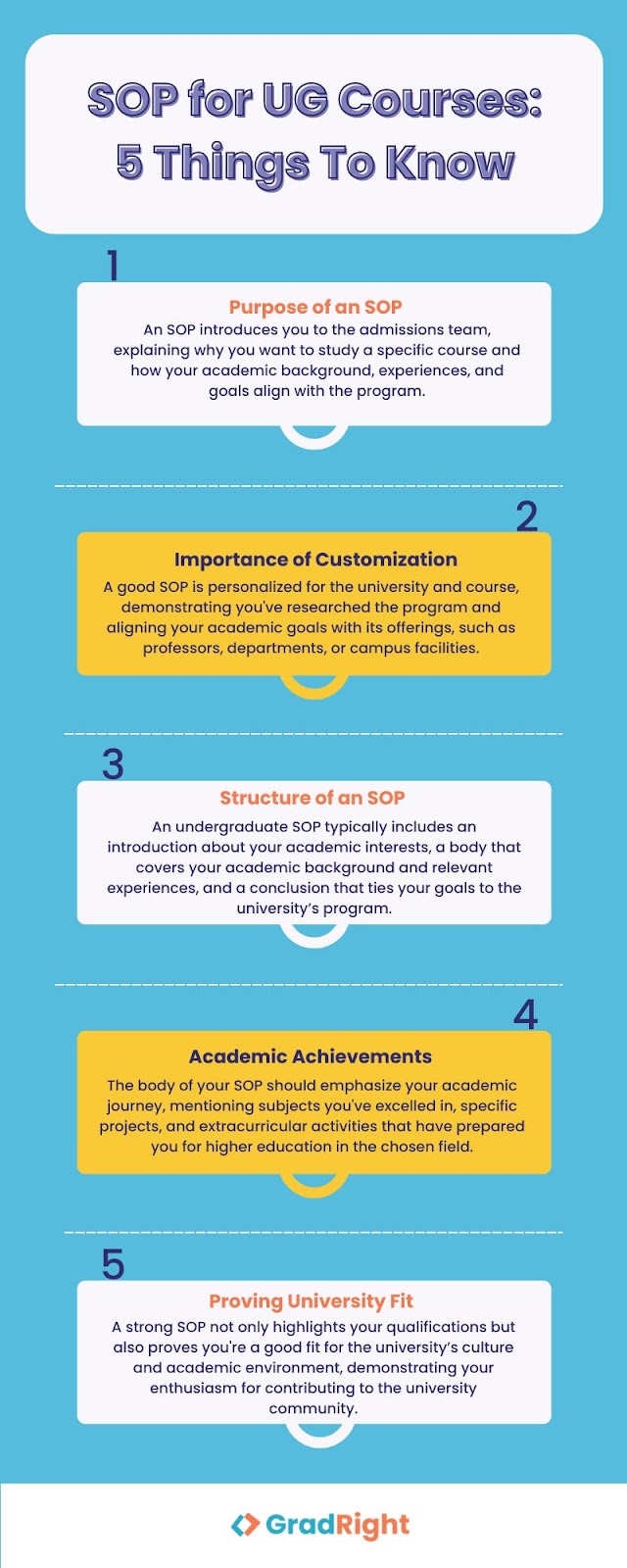
SOP for UG Courses – Quick Reference
|
Question |
Answer |
|
What is a UG SOP? |
A personal essay submitted with your undergraduate application abroad. It explains why you want to study this specific course at this specific university, and what you plan to do after graduating. |
|
How long should it be? |
500-800 words for most universities. UK UCAS applications use 4,000 characters (3 questions from 2026). Always check specific guidelines. |
|
UG SOP vs MS SOP – key difference? |
UG SOPs have no work experience section. They focus on academic interests, school projects, extracurriculars, and early career motivation. The tone is more personal and exploratory. |
|
Most important section? |
“Why this course” – it must be specific and genuine. Universities can immediately tell when a student has not researched the subject or the program. |
|
Do I need a different SOP per university? |
Yes – the “why this university” section must be unique for every application. |
What is an SOP for Undergraduate Courses?
An SOP for UG courses – also called a personal statement at some universities – is a written essay submitted as part of your undergraduate application abroad. It tells the admissions committee who you are beyond your Class 12 marks, what drew you to this subject, and what you plan to do with the degree.
Thousands of students apply to undergraduate programs abroad every year with similar academic profiles. The SOP is where differentiation happens. Two students with identical 90% boards results and identical extracurricular lists will be separated by the quality of their SOP.
Unlike an MS or MBA SOP, you are not expected to have work experience or research publications. What you are expected to show is genuine intellectual curiosity, specific subject knowledge, and a clear reason for choosing this course over all others.
Also Read: How to Write an SOP – Complete Guide, Format and Tips
UG SOP vs MS SOP – Key Differences
|
Element |
SOP for UG (Undergraduate) |
SOP for MS (Postgraduate) |
|
Work experience |
Not required – most applicants are Class 12 students |
Important – internships, industry roles, research |
|
Technical depth |
Based on school projects, Olympiads, competitions, self-study |
Based on degree-level coursework, publications, tools |
|
Primary evidence |
School academics, ECAs, competitions, personal exploration |
University projects, thesis, internships, professional roles |
|
Tone |
More personal and exploratory – you are choosing your path |
More professional and focused – you are deepening expertise |
|
Length |
500-800 words (600 ideal) |
800-1,200 words |
|
Career goals |
Broad and aspirational – acceptable to say “I want to work in…” without a specific role |
Specific role and industry required |
|
Faculty mention |
Optional but impressive at research universities |
Expected at most competitive programs |
2026 UCAS Update – New Personal Statement Format (UK Only)
Important for students applying to UK undergraduate programs: from September 2025, UCAS replaced its single free-form personal statement with three structured questions for all 2026 entry applications.
|
UCAS Question (2026) |
What to Write |
Character Limit |
|
Q1: Why do you want to study this course or subject? |
Your genuine academic interest – what sparked it, what you have read or explored, what specific aspect of this subject you find compelling. Subject-specific, not personal backstory. |
~1,200-1,500 characters |
|
Q2: How have your qualifications and studies prepared you for this course? |
Relevant Class 12 subjects (PCM, economics, etc.), any extended projects, coursework, or academic preparation directly connected to the program. |
~1,200-1,500 characters |
|
Q3: What else have you done to prepare outside of formal education? |
Work experience, volunteering, self-study, online courses, competitions, clubs – only if directly relevant to the subject. Not general activities. |
~1,000-1,200 characters |
Total character limit: 4,000 characters (including spaces), minimum 350 characters per question. Source: UCAS official guidelines, September 2025. This applies ONLY to UK UCAS undergraduate applications – not to US, Canada, or other country applications.
UG SOP Format for Non-UK Applications (USA, Canada, Australia)
For US, Canadian, and Australian undergraduate programs that require a free-form SOP or personal essay, use this six-part structure:
|
Section |
What to Write |
Word Count |
|
1. Opening / Hook |
A specific moment, experience, or question that sparked your interest in this subject. Not a childhood story about loving science in general – a real, specific moment that connects to this course. |
80-100 words |
|
2. Academic Interest and Background |
The subjects you have excelled in or explored deeply in school. Relevant projects, assignments, or independent reading that connect to this course. Class 12 marks if strong. |
120-150 words |
|
3. Extracurriculars and Exploration |
Competitions (Olympiads, hackathons, debates), clubs, volunteer work, online courses, or self-initiated projects directly related to the course. Not generic leadership activities. |
100-130 words |
|
4. Why This Course |
What specifically draws you to this subject over all others – a specific aspect of the field, a question you want to answer, a problem you want to work on. |
80-100 words |
|
5. Why This University |
Specific reasons for this university – a program feature, research opportunity, professor, or campus resource that connects to your goals. Must be unique per application. |
80-100 words |
|
6. Career Goals and Conclusion |
Where you see this degree taking you – broad but believable. Aspirational but grounded. Brief and confident close. |
60-80 words |
Total: 520-660 words. Add specific details to reach 600-700 words. This is shorter than an MS SOP – keep it focused and avoid padding.
Writing your UG SOP? GradSOP generates a personalized first draft based on your academic background and target program – free to use. Try GradSOP Free
How to Write a UG SOP – Step by Step
- Start with your ‘why this subject’ answer. Before you write a word, be clear about why you want to study this specific course. Not a general area – this specific subject. If you cannot answer this clearly, your SOP will be vague.
- List your evidence. What have you actually done that shows genuine interest in this subject? School projects, competitions, online courses, books you have read, problems you have tried to solve. Pick the 2-3 most relevant.
- Open with something specific. Your first sentence must grab attention without being dramatic. A real experience, a specific question you want to answer, or a moment that changed how you thought about the subject.
- Show, do not tell. Do not say ‘I have always been curious about mathematics.’ Show it: ‘Preparing for the Regional Mathematics Olympiad last year, I spent three weeks on a single problem in combinatorics – and the moment I solved it, I knew this was what I wanted to study.’
- Research each university before writing. For the ‘why this university’ section, visit the department website. Find a course, research group, professor, or program feature that genuinely connects to your interests.
- Keep career goals broad but real. At undergraduate level, you do not need a specific 5-year plan. But you need a believable direction: ‘I want to work on climate technology policy’ is better than ‘I want to make a difference.’
- Keep it under 700 words for free-form applications. Tight and specific always beats long and general for UG applications.
- Proofread ruthlessly. Grammar and spelling errors in a UG SOP signal carelessness – a significant red flag for academic programs.
Sample SOP for UG – Bachelor of Economics, UK University
Here is a sample personal statement for a UK undergraduate Economics application. This follows the new 2026 UCAS three-question format.
[SAMPLE – B.Sc. Economics, UK University, UCAS 2026 Format]
Q1: Why do you want to study Economics?
During my Class 11 Economics lessons, my teacher asked us to analyze why vegetable prices in our local market tripled during the 2022 monsoon season. The question seemed simple – floods damaged crops. But as I researched further, I found supply chain breakdowns, hoarding behavior, and information asymmetries between producers and consumers all played roles. The official price increase statistics told one story. The lived reality of market participants told another. That gap between economic data and economic behavior is what I want to study. I have since read Freakonomics and The Undercover Economist, explored Paul Romer’s work on knowledge economics, and participated in my school’s Model United Nations committee on global trade – all of which have deepened my conviction that economics is the lens through which I want to understand the world.
Q2: How have your qualifications and studies prepared you?
I am completing my Class 12 (CBSE) with Mathematics, Economics, Business Studies, and English. My Economics teacher introduced me to game theory in the context of Indian telecom competition, which led me to write an extended essay on oligopoly pricing in the Jio-Airtel price war for my school’s annual research journal. I scored 96/100 in Economics in my Class 11 finals and consistently perform in the top 3 of my cohort in Mathematics. I also completed the Yale University introductory Economics course on Coursera, which gave me exposure to formal mathematical modeling of economic behavior beyond the CBSE curriculum.
Q3: What else have you done to prepare outside formal education?
I represented my school at two MUN conferences in the International Economics Committee, where I researched and debated debt sustainability frameworks for developing economies. I also completed a two-week summer program in Financial Literacy at a local NGO, helping Class 8 students understand savings, interest, and basic banking. Both experiences reinforced my interest in how economic decisions are made under information constraints – at the individual, household, and policy level. I read The Economist regularly and have started following the RBI’s monetary policy reports to understand how theoretical frameworks translate into real policy decisions.
[End of sample – approx. 390 words across 3 sections. Each answer is well within the UCAS character limit. For free-form applications (USA, Canada), combine these into a flowing 600-700 word essay.]
UG SOP Requirements by Country
|
Country |
Format |
Tone |
Key Focus |
|
USA |
Common App essay (650 words) + supplemental essays per university |
Personal, reflective, narrative |
Who you are as a person, what shaped you, intellectual curiosity, what you will bring to campus community |
|
UK (UCAS) |
3 questions, 4,000 total characters (2026 format) |
Academic, subject-focused, analytical |
Why this subject, academic preparation, relevant outside activities. No personal hardships or generic stories. |
|
Canada |
Varies by university – free-form 500-800 words or specific prompts |
Balanced – academic + personal |
Academic interest, relevant preparation, why Canada, career direction |
|
Australia |
University SOP (500-700 words) + separate GTE statement for visa |
Professional and goal-focused |
Course relevance, career goals, GTE statement proves intent to return to India after graduation |
|
Germany |
Motivation letter (400-600 words), usually in English for English-taught programs |
Formal, structured, academic |
Academic background, technical preparation, specific motivation for the course and German university |
Also Read: SOP for UK Universities – Format, Sample and Tips
UG SOP Dos and Don’ts
|
Do’s |
Don’ts |
|
Open with a specific moment or question connected to the subject |
Start with ‘Since childhood, I have been fascinated by…’ |
|
Show genuine subject interest through specific reading or projects |
Say ‘I am passionate about economics’ without evidence |
|
Research each university and mention something specific |
Write ‘this university is known for its excellent programs’ |
|
Keep career goals broad but believable |
Give a detailed 10-year plan (unrealistic at UG level) |
|
Mention relevant ECAs only if connected to the subject |
List every extracurricular activity you have ever done |
|
Keep it under 700 words for free-form applications |
Pad the essay to fill space |
|
Write in your own voice |
Submit AI-generated content without rewriting it yourself |
|
Customize the university section for every application |
Send the same SOP to 10 universities |
Planning undergraduate study abroad? Find universities that match your Class 12 profile from 40,000+ programs worldwide. Explore Universities on GradRight
Related Guides and Resources
How to Write an SOP – Complete Guide
Statement of Purpose – All You Need to Know
SOP for UK Universities – Format, Sample and Tips
SOP for USA – Samples, Format and Examples
SOP Samples – Course and Country-wise Guide
GradSOP – Free AI SOP Writing Tool
UK University Acceptance Rates 2026
Study in UK – Complete Guide for Indian Students
Study in USA – Complete Guide for Indian Students
Education Loan for Study Abroad





 Australia
  Canada
  France
  Germany
  India
India  Ireland
  UAE
UAE  United Kingdom
  United States
