





Every strong study abroad application has one document that ties everything together – the Statement of Purpose. Your GPA is a number. Your GRE score is a number. Your SOP is where you explain what those numbers mean and what you plan to do next.
If you are just starting to research the SOP – what it is, why it matters, and what goes into it – this is the right place to start. For detailed writing guides, format breakdowns, and samples by course and country, the links throughout this article will take you there.
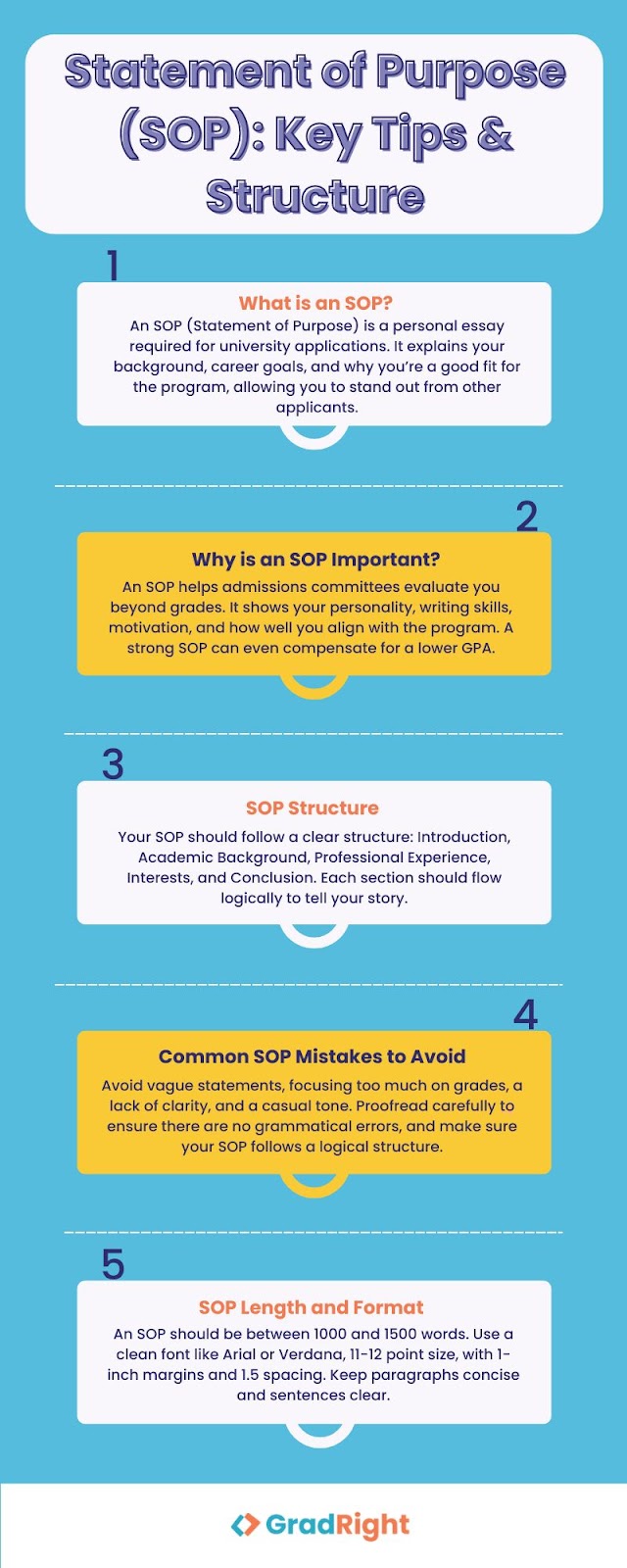
Statement of Purpose – Quick Answer
|
Question |
Answer |
|
What is an SOP? |
A 500-1,200 word personal essay submitted with your university application abroad. It explains who you are, why you want this program, and what you plan to do after graduation. |
|
Is it the same as a personal statement? |
Often used interchangeably. In the UK, “personal statement” is used for undergraduate UCAS applications. “SOP” is the standard term for postgraduate programs globally. |
|
How important is it? |
Very. For many top universities, it is the deciding factor between candidates with similar academic profiles. A strong SOP can compensate for a lower GPA. A weak SOP can hurt an otherwise strong application. |
|
How long should it be? |
800-1,000 words for most programs. Check each university’s specific requirements before writing. |
|
Do I need a different SOP for each university? |
Yes. The core narrative can stay consistent, but the “why this program” section must be customized for every university. |
What is a Statement of Purpose?
A Statement of Purpose (SOP) is a written essay that you submit as part of your application to a university abroad. It is your opportunity to introduce yourself to the admissions committee beyond your grades and test scores.
Through the SOP, you explain three things: where you have been academically and professionally, why you want this specific program at this specific university, and where you are going after the degree.
The SOP is one of the few documents in your application that you control completely. Your GPA is fixed. Your GRE score is fixed. Your SOP is yours to craft, and a well-written one can genuinely shift the outcome of your application.
Also Read: How to Write an SOP – Complete Guide, Format and Tips
Why Does the SOP Matter So Much?
Admissions committees at competitive programs receive thousands of applications from candidates with similar GPAs, GRE scores, and academic backgrounds. The SOP is where differentiation actually happens.
|
What the SOP Does for Your Application |
Why It Matters |
|
Shows how you think |
Admissions committees are evaluating your potential as a student and researcher, not just your past performance |
|
Explains your motivation |
Why this program, why now – helps the committee understand if you are genuinely committed or just collecting admits |
|
Connects your past to your future |
Makes your application a coherent story, not just a list of achievements |
|
Addresses weaknesses |
A lower GPA, a career gap, or a field change can be explained and contextualized in the SOP |
|
Shows program fit |
Signals that you have researched the program and have genuine reasons for choosing it over alternatives |
|
Demonstrates writing ability |
Graduate programs require strong written communication – the SOP is a direct test of this |
Dartmouth College’s admissions data from 2017-2020 shows that approximately 12% of applicants with strong GPAs and test scores did not receive an offer – because they failed to make a compelling case through the rest of their application, including the SOP. The numbers alone are not enough.
SOP vs Personal Statement vs LOR – What is the Difference?
|
Document |
Written by |
Purpose |
Typical length |
|
Statement of Purpose (SOP) |
You |
Explain your academic background, motivation for the program, and career goals |
500-1,200 words |
|
Personal Statement |
You |
Same as SOP for postgraduate. At undergraduate level in UK (UCAS), it answers 3 structured questions about why you want this course. |
500-1,000 words or 4,000 characters (UCAS) |
|
Letter of Recommendation (LOR) |
A professor, manager, or mentor who knows your work |
Provides a third-party evaluation of your abilities, character, and potential |
400-600 words (1 page) |
|
Resume / CV |
You |
Lists your academic and professional history in structured format |
1-2 pages |
Your SOP and LOR work together. The SOP tells your story in your voice. The LOR confirms that story from someone who has seen you work. Both should be consistent – contradictions between the two raise red flags for admissions committees.
Also Read: How to Write a Professional LOR for Study Abroad
What to Include in an SOP
A well-structured SOP covers six areas. Every section has a specific job to do:
|
Section |
What to Write |
Common Mistake |
|
Opening |
A specific experience or moment that connects directly to the program. The first two sentences determine whether the committee keeps reading. |
Starting with ‘Since childhood, I have been fascinated by…’ |
|
Academic Background |
Relevant coursework, projects, CGPA if strong, research or thesis. Focus only on what connects to this program. |
Listing every course you have ever taken |
|
Research or Work Experience |
Internships, professional roles, research projects. Use specific numbers and outcomes – what you did and what changed because of it. |
Vague descriptions: ‘I worked on various data projects’ |
|
Why This Program |
Specific reasons for this program at this university. Name faculty research, courses, labs, or industry connections. Must be customized per application. |
Generic: ‘This university is renowned for its excellence’ |
|
Career Goals |
Short-term role and industry. Long-term vision. Be specific enough to be credible. |
Vague: ‘I want to contribute to the field of technology’ |
|
Conclusion |
A brief, confident close connecting your past, this program, and your future. No new information. |
Summarizing everything already said |
Need help writing your SOP? GradSOP generates a personalized first draft based on your profile, program, and target university – completely free. Try GradSOP Free
How Long Should an SOP Be?
SOP length varies by program and country. Here is what to expect:
|
Program Type |
Standard Length |
Note |
|
MS programs (USA, Canada) |
800-1,200 words |
Check each program page – some have specific limits |
|
MBA programs |
500-1,000 words |
Top US schools like HBS and Wharton use their own essay prompts with separate word limits |
|
UK postgraduate (Masters) |
500-1,000 words |
Russell Group prefers 600-800 focused words over padded 1,000-word essays |
|
Germany (Masters) |
500-800 words |
Concise and structured – quality over length |
|
Undergraduate UCAS (UK) |
4,000 characters |
3 structured questions from 2026 entry onwards |
|
PhD programs |
1,000-1,500 words |
Research proposal and faculty fit carry more weight |
The most important rule: always check the specific program’s requirements before writing. Some universities specify exact word counts, page limits, or essay prompts. Generic word count advice is a starting point, not a rule.
What Admissions Committees Actually Look for in an SOP
Ross Gortner, Associate Director of Engineering Management at Dartmouth, describes what he looks for: ‘I am looking for the answers to two basic questions – who is this person and what is their story. The essay should talk about where you want to go from where you are presently and how this particular program will act as a bridge for you. I expect a customized essay over a generalized one. I first scan through SOPs and check if most aspects are covered, then spend more time on the selected ones.’
What most competitive programs look for in practice:
- Clarity of purpose – do you know why you want this degree and where it leads?
- Genuine program fit – have you researched this specific program or are you applying generically?
- Evidence behind claims – specific examples, not general assertions about your skills
- Intellectual engagement – does your SOP show you think seriously about your field?
- Writing ability – clear, direct, well-organized writing signals your potential as a graduate student
- Self-awareness – do you understand your strengths and weaknesses honestly?
Also Read: SOP Samples – Course and Country-wise Format Guide
SOP Requirements by Country
The biggest mistake Indian students make is writing one SOP and sending it everywhere. Country expectations are fundamentally different:
|
Country |
Tone |
Key Focus |
Length |
|
USA |
Personal, narrative |
Your story, leadership, research interests, program fit |
800-1,200 words |
|
UK |
Formal, academic |
Subject knowledge, research awareness, academic goals – no personal stories |
500-1,000 words |
|
Canada |
Professional |
Academic achievement, experience, career goals, Canadian industry connections |
700-1,000 words |
|
Germany |
Structured, technical |
Academic competence, specific motivation, structured reasoning |
500-800 words |
|
Australia |
Professional |
Career goals, program fit, post-graduation plans |
600-800 words |
|
Ireland |
Formal |
Academic background, course relevance, European career direction |
500-800 words |
Also Read: SOP for UK Universities – Format, Sample and Tips
10 SOP Writing Tips That Actually Make a Difference
- Answer ‘why this program’ specifically – not ‘why I love this field.’ The committee knows you love the field. They want to know why this program at this university.
- Open with a specific moment, not a general statement. Your first sentence determines if the committee keeps reading.
- Every claim needs evidence. ‘I have strong analytical skills’ is empty. ‘I built a model that reduced our team’s forecasting error by 23%’ is specific.
- Cut your resume from your SOP. If the committee can see it in your transcript, do not repeat it. Add context and meaning instead.
- Write short sentences. Long complex sentences in an SOP often signal unclear thinking, not intelligence.
- Customize the school-specific section for every application. Generic ‘why this school’ sections are immediately obvious and hurt your application.
- Address weaknesses directly. A brief, honest explanation of a gap or low grade is better than leaving the committee to draw their own conclusions.
- Start early. A good SOP needs 3-4 drafts. Plan for 6-8 weeks before your earliest deadline.
- Get feedback from someone outside your field. If they cannot follow your story and understand your motivation, revise.
- Do not submit AI-generated content without rewriting it. UK universities, UCAS, and many US programs now use detection tools. Flagged applications are rejected.
Found your target programs? Use GradRight to find universities that match your profile and compare education loans from 18+ lenders. Explore Universities on GradRight
Most Common SOP Mistakes to Avoid
|
Mistake |
Fix |
|
Opening with ‘Since childhood, I have been fascinated by…’ |
Start with a specific professional or academic moment directly connected to the program |
|
Generic “why this school” section |
Research each school specifically – faculty research, courses, labs – and write a unique section for each |
|
Listing skills without context |
Show what you built or solved using those skills, with specific outcomes |
|
Vague career goals |
Name a specific role, industry, and the impact you want to create |
|
Exceeding the word limit |
Edit until you are within the limit – tight writing always makes a stronger impression |
|
Same SOP for every country |
Rewrite for each country – USA narrative vs UK academic are fundamentally different |
|
Ignoring gaps or weaknesses |
Address them briefly and honestly – silence raises more questions than explanation |
|
Submitting AI-generated content unchanged |
Use AI for structure and ideas, write the final version in your own voice |
Your Complete SOP Resource Guide
Use these guides for full format breakdowns, samples, and country-specific tips:
By Writing Stage
Complete SOP writing guide
SOP samples by course and country
Free AI SOP writing tool
How to write a professional LOR








 Australia
  Canada
  France
  Germany
  India
India  Ireland
  UAE
UAE  United Kingdom
  United States