




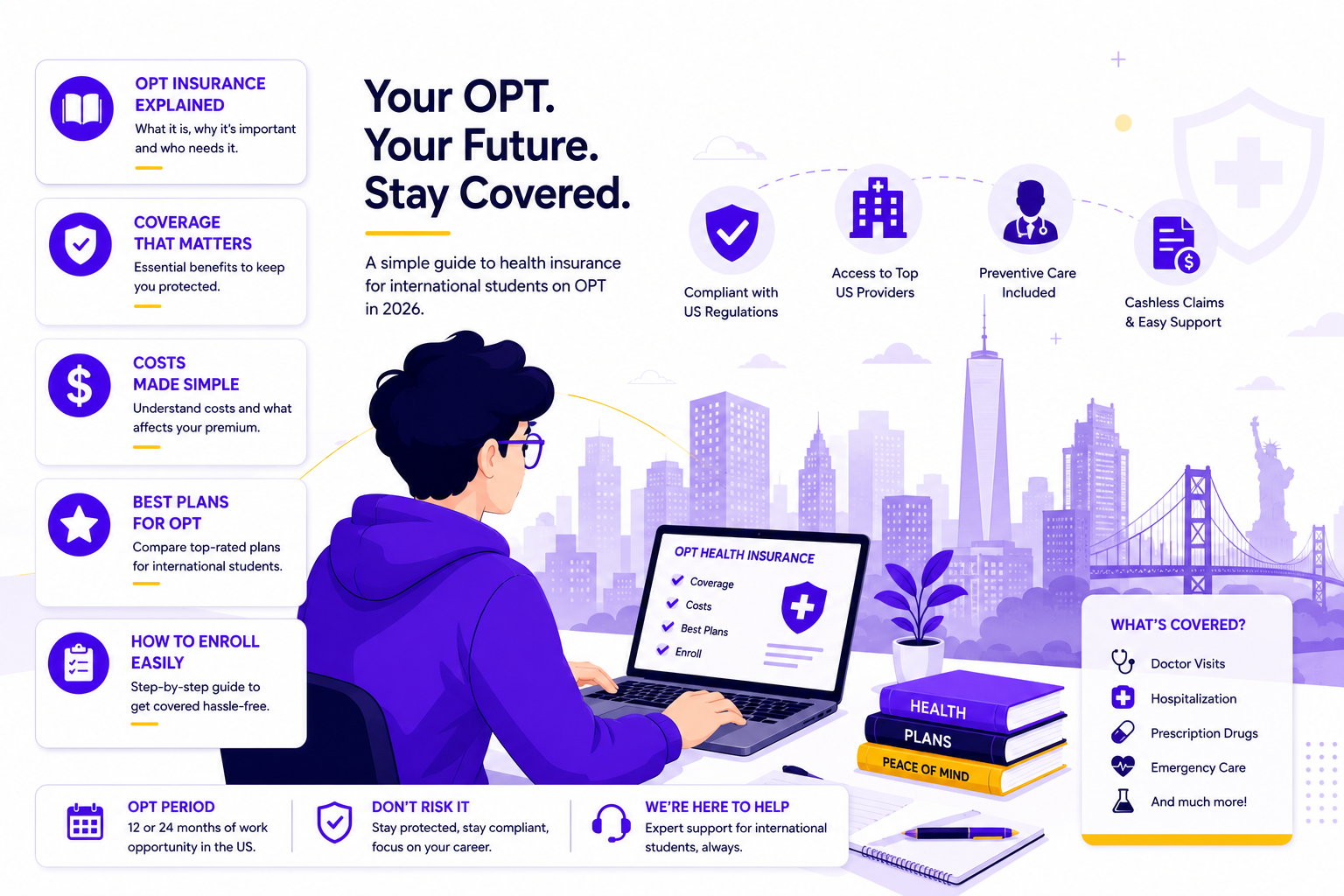
If you are moving from student status into Optional Practical Training, one question deserves attention before your first day on the job: what happens to your health coverage? Most F-1 students lose their university-sponsored plan the moment they graduate, which is exactly why OPT health insurance exists.
This guide explains what OPT health insurance actually covers, whether you are legally required to carry it, how much it costs in 2026, and how to pick the best health insurance for OPT students so you are never left exposed during your work authorization period.
What is OPT health insurance and why does it matter?
OPT health insurance is a health coverage plan built specifically for F-1 international students working in the United States under Optional Practical Training. Once you finish your degree, your school’s Student Health Insurance Plan (SHIP) typically ends 30 to 60 days after your graduation date or the end of your final semester. Since post-completion OPT is not automatically bundled with a university plan, and employer-sponsored insurance often has a waiting period before it kicks in, this coverage is designed to fill exactly that gap.
This matters more than it might seem at first glance. The U.S. does not have universal healthcare, and hospital pricing is not standardized the way tuition is. A single emergency room visit can run over $1,000, and an overnight hospital stay can reach $10,000 to $30,000 depending on the city and the treatment involved. Without OPT health insurance, one accident or illness during your work authorization period could undo years of savings.
Also Read: WellAway Health Insurance: Is It Worth It for International Students in 2026?
Who Needs OPT Health Insurance
Anyone transitioning from F-1 student status to post-completion OPT or the 24-month STEM OPT extension needs to think about coverage, especially if:
- Your university plan ends before your job’s insurance begins
- Your employer does not offer health benefits, or you are freelancing/on a contract
- You are between jobs while still on your OPT clock
- Your new employer’s plan has a 30, 60, or 90-day waiting period
Is OPT health insurance mandatory for F-1 students?
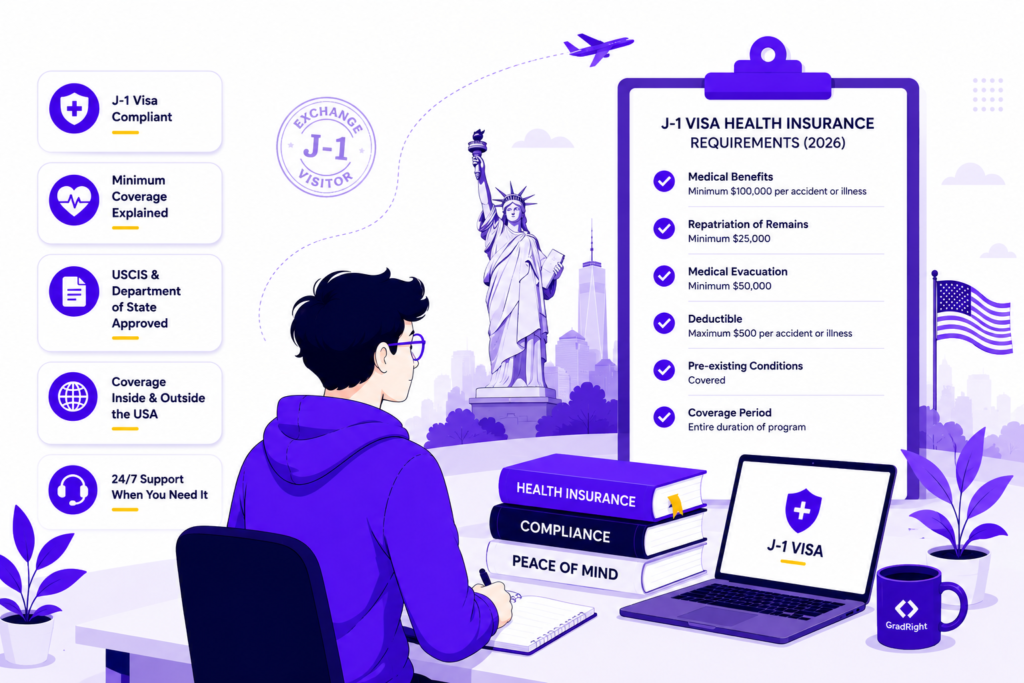
Here’s the honest answer: the U.S. federal government does not legally mandate this coverage for F-1 students. Unlike J-1 visa holders, who must meet U.S. Department of State insurance minimums, F-1 students on OPT are not bound by a federal insurance rule. Your university may also stop tracking or enforcing insurance requirements once you move into OPT status, since you’re no longer an enrolled student.
That said, “not mandatory” does not mean “not necessary.” Given how expensive unplanned medical care is in the U.S., going even a few weeks without coverage is a real financial risk. Most international education advisors, and most students who have been through it, treat OPT health insurance as functionally essential rather than optional, even though no visa officer will ask to see your policy at the airport.
What does OPT health insurance typically cover?
Plans built for this purpose are usually the same chassis as standard international student insurance, adjusted for people who are working rather than studying. Coverage generally includes:
Core Medical Benefits
Doctor visits, urgent care, emergency room treatment, hospitalization, surgery, diagnostic tests, and lab work. Most OPT health insurance plans set an annual or per-incident maximum, ranging from a defined dollar cap (such as $100,000) up to unlimited coverage on stronger plans.
Prescription Drug Coverage
Outpatient prescription medication is usually covered after a copay, though the exact percentage and drug formulary vary by insurer.
Mental Health and Preventive Care
Since ACA-aligned individual and group plans are required to include essential health benefits, most current plans in this category include mental health counseling, therapy sessions, and preventive screenings such as annual physicals and vaccinations.
Medical Evacuation and Repatriation
Some, though not all, OPT health insurance plans bundle in medical evacuation and repatriation of remains coverage. If yours doesn’t, this is worth adding as a low-cost rider, particularly if you travel internationally during your OPT period.
How much does OPT health insurance cost?
Pricing for OPT health insurance varies by age, state of residence, deductible, and plan depth, but as a general range, standalone international student and OPT plans run between roughly $30 and $200+ per month for students under 25, with older applicants paying more. Annual premiums for a solid mid-tier plan commonly land between $800 and $2,500 for the year, while a bare-bones catastrophic plan can cost less and a comprehensive, low-deductible plan can cost more.
Two cost factors matter more than most students expect:
- Deductible level – a plan with a $0 or low deductible costs more upfront but saves you money the moment you actually need care.
- Network size – plans built on a large national PPO network (rather than a narrow regional HMO) tend to cost a bit more but prevent surprise out-of-network bills if your job relocates you.
How to choose the best health insurance for OPT students?
Not every plan on the market is built the same way. When comparing the best health insurance for OPT students, run through this checklist:
Coverage Limits And Deductibles
Look for a policy maximum that is unlimited or at least high enough to absorb a worst-case hospitalization (six figures, minimum). Check the deductible and coinsurance split; a $500 deductible with 80/20 coinsurance is a common, reasonable baseline.
Network Size And Provider Access
Confirm the plan is tied to a recognized nationwide PPO network so you aren’t stuck searching for in-network doctors if you relocate for your job.
Waiting Periods For Employer Insurance
If your employer’s insurance starts after 30, 60, or 90 days of employment, buy OPT health insurance to bridge exactly that window rather than paying for a full year you don’t need.
Visa And Compliance Considerations
If you later switch to H-1B or another visa category, check whether your OPT student health insurance plan can be extended or whether you’ll need to transition to a different product.
When to buy OPT health insurance and how long you need it
Since OPT authorization itself can last up to 12 months, with an additional 24-month STEM extension for eligible majors, your coverage needs could span anywhere from a few months to nearly three years. Most insurers let you buy a plan in flexible terms, monthly, for a single semester-equivalent block, or for a full year, so you’re not forced into a longer commitment than your actual employment timeline requires.
A practical rule of thumb: buy coverage to start the day after your university SHIP ends, and set a calendar reminder two to three weeks before your policy’s renewal date so you never have an accidental coverage gap.
Also Read: How to Choose the Best International Student Health Insurance in 2026
Common Mistakes Students Make With OPT Health Insurance
- Assuming their university plan automatically extends into OPT (it usually doesn’t, unless you actively request an extension before it lapses)
- Not checking whether their employer’s insurance has a waiting period before their start date
- Buying the cheapest available plan without checking the annual coverage cap
- Forgetting to keep proof of continuous coverage, which some future visa or green card applications may reference
Making the right call on OPT health insurance
Choosing OPT health insurance isn’t just paperwork; it’s the financial safety net between your student life and your professional one in the U.S. GradRight’s platform was built to take the guesswork out of this decision: it compares university-approved and private plans side by side, flags waiver-eligible options, and gives you 24×7 guidance so you’re not reading fine print alone at midnight before a deadline.
If you’re heading into OPT and want a plan that’s actually matched to your coverage dates, employer timeline, and budget, GradRight can help you check your options and start saving before you ever need to file a claim.







 Australia
  Canada
  France
  Germany
  India
India  Ireland
  UAE
UAE  United Kingdom
  United States