




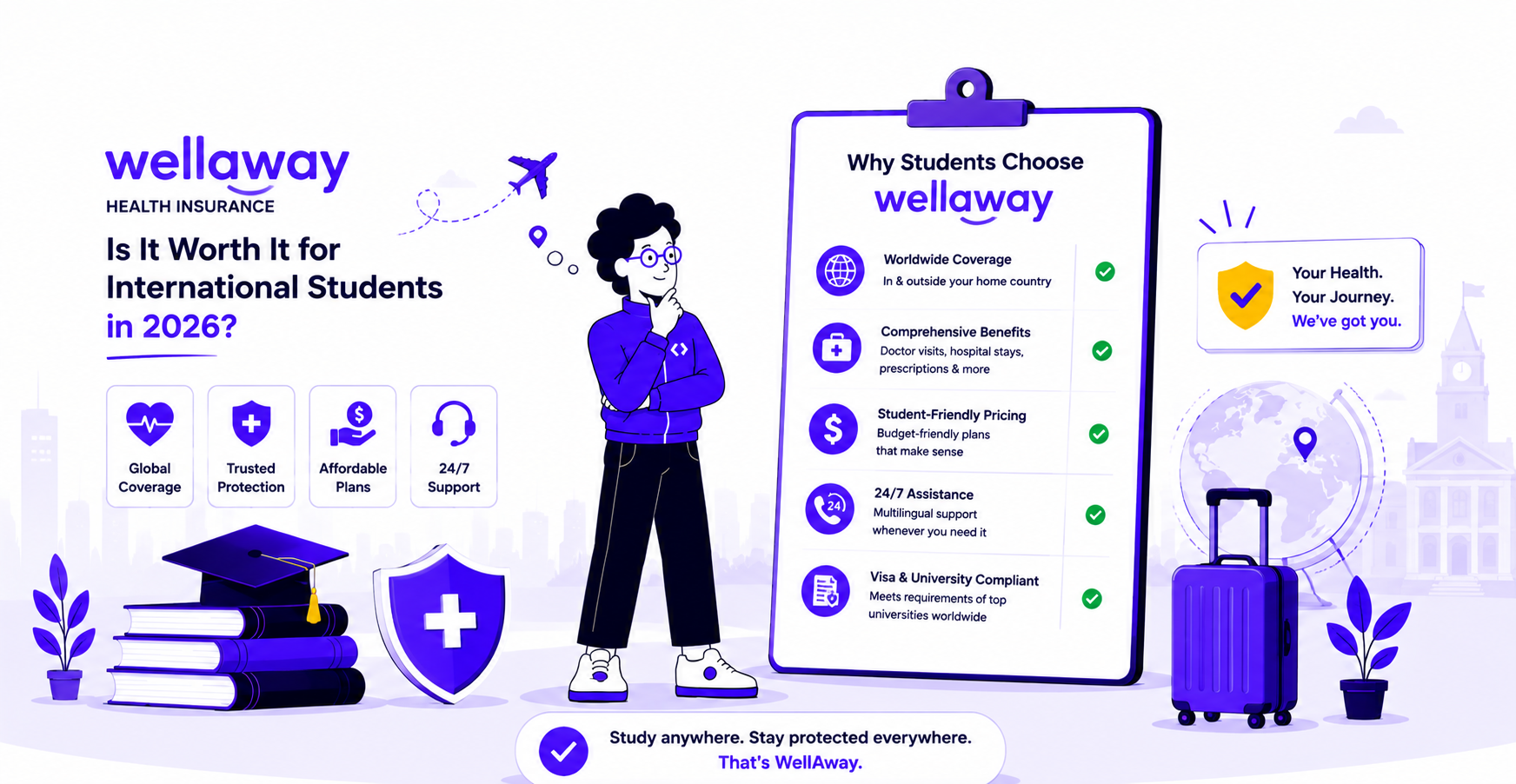
If you’re a few weeks from boarding a flight to the US, health insurance is probably one of the last things you want to think about – right after visa paperwork and packing lists. But your university will ask for proof of coverage before you can register for classes, and one name that shows up often in that search is WellAway.
This article looks closely at WellAway health insurance, what it actually covers, who it’s built for, where students have run into problems, and whether it’s a smart pick for your 2026 intake, so you can decide with facts instead of guesswork.
What is WellAway health insurance?
WellAway is an international private medical insurance provider based in Bermuda, operating as an agency and underwriter connected to Lloyd’s of London and regulated under the Solvency II framework. It offers health coverage to expatriates, professionals, and students across more than 180 countries. For its US-based policyholders, WellAway works with the United HealthCare (UHC) PPO network for hospitalization and direct medical billing, so members aren’t stuck paying out of pocket and filing for reimbursement every time they see a doctor.
In simple terms, WellAway is not a US domestic insurer like Aetna Student Health or UnitedHealthcare StudentResources; it’s an international insurer that has built specific plans to meet US visa and university insurance requirements for people coming from abroad.
Who is WellAway health insurance designed for?
WellAway’s plans are built around US visa categories rather than a one-size-fits-all student policy. The main groups covered include:
- Students on F-1 or J-1 visas pursuing undergraduate or graduate programs
- Students on M-1 visas
- Students on F-1 OPT (Optional Practical Training) status
- Scholars, visiting faculty, and researchers on J-1 visas
- Students at partner universities with custom-built plans, such as the University of Southern California
This visa-based structure matters because your university’s insurance waiver office will check your plan against specific ACA and Department of State requirements tied to your visa type, and WellAway has tried to build a plan for each bucket rather than selling a generic policy to everyone.
WellAway health insurance plans for international students
WellAway currently offers several distinct plans for the international student segment. Here’s how they differ.
World Elite Plus, 250, And 450
These are WellAway’s flagship ACA-compliant student plans, aimed at F-1 and J-1 visa holders whose universities specifically require ACA-compliant coverage. The three variants differ mainly by deductible:
- World Elite Plus — $0 deductible
- World Elite 250 — $250 deductible
- World Elite 450 — $450 deductible
All three run on the United HealthCare PPO provider network, include medical evacuation and repatriation, cover prescription medication and contraceptives, offer worldwide coverage (excluding your home country), and come with no medical exams or extra paperwork to get started.
Royal Plans
Royal plans are also built for F-1, M-1, and J-1 student visa holders and are positioned as a comprehensive but more affordable alternative for undergraduate and graduate students who don’t need every feature bundled into the World Elite tier.
Cromo Plans
Cromo plans sit at the lower end of the pricing spectrum, aimed at F-1, M-1, and J-1 students who want essential coverage at the lowest possible premium.
Scholar Plans
Designed specifically for J-1 visa holders, scholars, full-time visiting faculty, and researchers, Scholar plans are built to meet the U.S. Department of State’s insurance requirements for exchange visitors rather than degree-seeking students.
OPT Plans
For students who’ve graduated and moved into F-1 OPT status, WellAway offers a dedicated OPT plan, since standard student plans are often not designed for the post-graduation work authorization period.
University-specific plans
At some partner schools, such as USC, WellAway builds custom World Elite and Scholar variants that are tailored to that university’s specific hospital system and student health center, alongside the standard $0, $250, and $450 deductible options.
What does WellAway health insurance actually cover?
Across its student plans, coverage is generally structured to include:
- Doctor visits, hospitalizations, and surgeries
- Emergency treatment and urgent care
- Prescription medication (and contraceptives, on the World Elite plans)
- Mental health services, including counseling and therapy
- Medical evacuation and repatriation
- Telemedicine consultations through a virtual care partner
- Multi-lingual ConciergeCare support for claims, doctor searches, and general questions, at no extra cost
A few things worth flagging clearly: maternity coverage is generally excluded from WellAway’s student plans, and while some pre-existing conditions receive limited coverage, this varies by plan and should be confirmed against the specific Summary of Benefits and Coverage (SBC) document before you buy. Because the fine print differs plan to plan, don’t assume that what one WellAway plan covers automatically applies to another; always check the SBC for the exact plan you’re being offered.
Is WellAway health insurance ACA-compliant and university-approved?
This is where things get more nuanced than the marketing pages suggest. WellAway’s World Elite plans are built to comply with Minimum Essential Coverage (MEC) requirements under the Affordable Care Act, and the company holds CMS certification for ACA compliance on these plans. In the US, claims administration for the World Elite student policies runs through PayerFusion Holdings, LLC, a third-party administrator licensed across more than 35 US states.
At the same time, with any international insurer trying to satisfy US university requirements, there might be some risks. It’s a step worth double-checking directly with your international student office before you commit to a full year of premiums.
Also Read: How to Choose the Best International Student Health Insurance in 2026
The real benefits of WellAway health insurance
For students who do fit well within its structure, WellAway offers some genuine advantages:
- Visa-specific plan design: Rather than a single generic plan, there’s a specific product for F-1, J-1, M-1, OPT, and scholar categories
- Global coverage: Because WellAway is fundamentally an international insurer, its plans extend coverage outside the US too, which is useful if you travel home or elsewhere during breaks
- UHC PPO network access: Direct billing through a large, recognizable US provider network instead of pure reimbursement-only claims
- No medical exams: Enrollment is straightforward with no underwriting hurdles
- ConciergeCare support: A dedicated, multi-lingual point of contact for claims and provider searches, which matters a great deal when you’re new to the US healthcare system and possibly not fluent in medical terminology
- Deductible flexibility: The World Elite tier’s three deductible options let you match premium cost to your risk tolerance and budget
What does WellAway health insurance cost?
Cost depends on your age, chosen plan (World Elite Plus, 250, or 450; Royal; Cromo; Scholar; or OPT), deductible, and coverage dates, and is generated through their online quote tool. As a general pattern across international student insurers, premiums typically scale with lower deductibles and richer benefit tiers, so the $0-deductible World Elite Plus plan will usually cost more per month than the $450-deductible World Elite plan or the Cromo tier.
Because pricing is quote-based and changes with policy periods, the only reliable way to know your real cost is to run a quote for your specific university, visa type, and coverage start date, and to compare it side by side against your school’s own approved plan and any other ACA-compliant options your university accepts.
How to check if WellAway health insurance covers your university
Before buying any plan, confirm three things directly with your university’s international student services or health insurance waiver office:
- Does your school accept WellAway plans for the waiver process at all? Not every university’s waiver list includes it.
- Which specific WellAway plan and deductible does your school require or accept? Some schools mandate a $0-deductible plan; others accept $250 or $450 deductible options.
- Is the approval final for the full policy period, or subject to review? Given past cases of mid-year waiver reversals, it’s worth asking this directly rather than assuming approval is permanent once granted.
Getting these answers in writing from your school before purchasing a full year of coverage can save you from the stressful position of being mid-treatment when a waiver is suddenly pulled.
WellAway health insurance vs. comparing your options
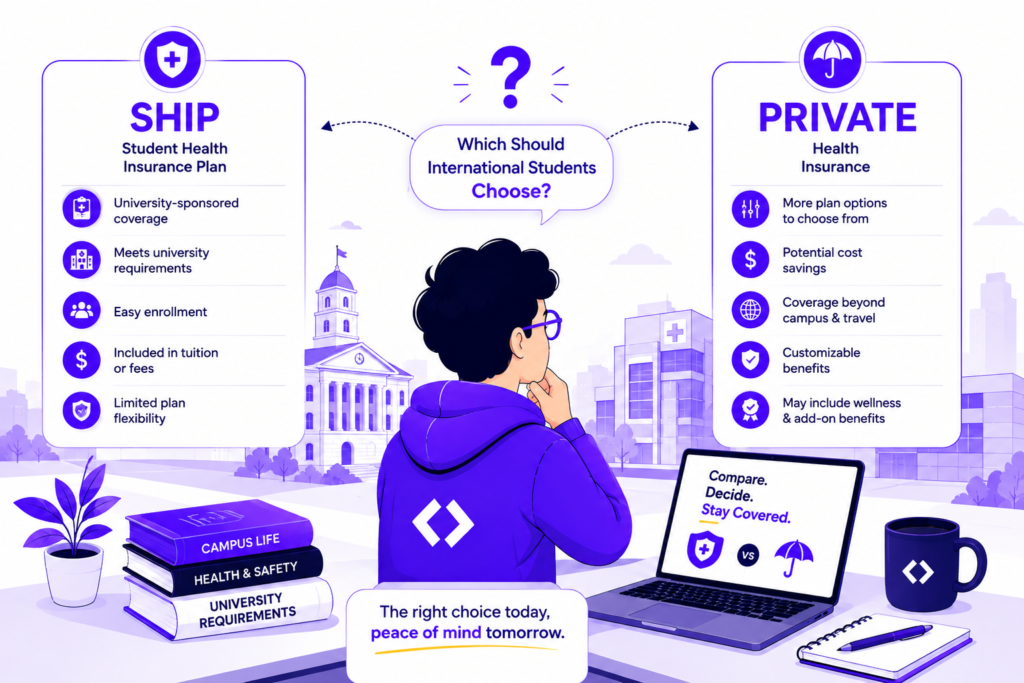
Because international student insurance requirements vary so much by school, some universities allow any ACA-compliant private plan, others push students hard toward their in-house plan, the smartest move is rarely to pick the first insurer that shows up in a search.
It’s to compare your university’s own plan, WellAway, and other ACA-compliant private options side by side on cost, deductible, network, and waiver acceptance before committing. GradRight lets you check whether your specific university supports a WellAway plan and compares savings against your school’s default option, which is a useful sanity check regardless of which insurer you ultimately choose.
Final verdict: Is WellAway health insurance worth it for international students in 2026?
WellAway health insurance is a reasonable option for international students if, and only if, three conditions are met: your university’s waiver office confirms in writing that it accepts the specific plan and deductible you’re buying, the premium comes in meaningfully lower than your university’s own plan for comparable benefits, and you’ve read the SBC closely enough to know what’s excluded (maternity coverage, in particular, and the fine print on pre-existing conditions).
For students on F-1, J-1, M-1, or OPT status who fit cleanly into one of its visa-specific plans and whose school has a track record of accepting WellAway, it can offer real savings and genuinely useful global coverage. For students at universities with a history of waiver disputes over non-domestic insurers, it’s worth weighing that risk against the savings before you commit to a full year of premiums.







 Australia
  Canada
  France
  Germany
  India
India  Ireland
  UAE
UAE  United Kingdom
  United States