




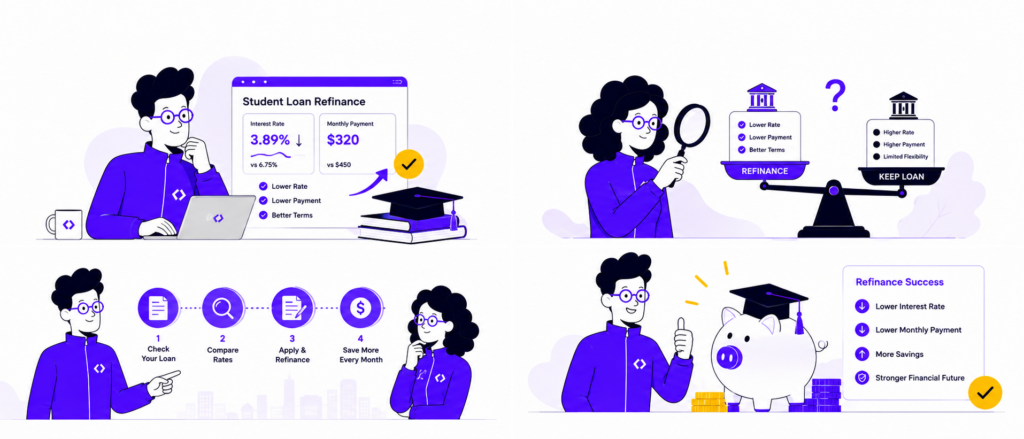
Refinancing an education loan sounds simple: find a lower rate, switch lenders, pay less. But borrowers can often save more by looking beyond the headline interest rate and comparing the total cost of the refinanced loan, since a seemingly good refinance can turn into a worse financial position than staying put if the details aren’t checked.
A quick illustration. Say you owe Rs 5 lakh on a student loan at 6% over 10 years. A new lender offers 4%, but over 20 years. Your monthly payment drops significantly. But over the life of the loan, you end up paying considerably more in total interest than you would have at 6% for 10 years. What looked like a better deal costs you more.
That gap between the monthly number and the total number is where most refinancing mistakes live. This article covers five of them.
What education loan refinancing actually means
Refinancing means replacing your existing education loan with a new one, usually from a different lender, usually at a lower interest rate. The new loan pays off the old one, and you repay the new lender under the new terms.
In India, refinancing is typically available for students who have completed their studies and are currently residing in India. Students currently studying abroad may have fewer refinancing options through Indian lenders and should check lender-specific eligibility; they may also need to explore refinancing options in the country where they’re studying (for example, US-based options if they’re in the US). Refinancing is an approval-based process: the new lender evaluates your creditworthiness, income stability, and existing debt before offering you terms.
Also read: Education Loan Repayment Tips That Actually Work
Mistake 1: Focusing only on the monthly EMI, not total cost
This is the most common and most expensive error. A lower EMI feels like relief, but if it comes from a longer tenure rather than a lower rate, the total interest paid can far exceed what you would have paid on your original loan.
|
Scenario |
Monthly EMI |
Total Repaid |
Total Interest Paid |
|
Original loan: Rs 5L at 6% over 10 years |
Rs 5,551 |
Rs 6,66,120 |
Rs 1,66,120 |
|
Refinance offer: Rs 5L at 4% over 20 years |
Rs 3,030 |
Rs 7,27,200 |
Rs 2,27,200 |
|
Difference |
EMI saves Rs 2,521/month |
Pays Rs 61,080 more total |
Rs 61,080 extra in interest |
The refinanced loan looks better every month. Over the full life of the loan, it costs more. Always calculate the total interest paid, not just the EMI, before deciding.
How to avoid it: use a loan comparison calculator. Enter the total repayment (principal plus interest) for both options side by side. If the total is higher for the refinanced loan, the tenure has eaten the rate savings.
Mistake 2: Not comparing multiple lenders
Many borrowers refinance with the first lender who offers a better rate than their current one. That leaves money on the table. A 0.5% difference that seems small adds up significantly over a 10-year remaining tenure.
|
Rate |
Monthly EMI (Rs 20L, 10 years) |
Total Interest Paid |
Difference vs 11% |
|
11.00% |
Rs 27,550 |
Rs 13,06,000 |
– |
|
9.00% |
Rs 25,335 |
Rs 10,40,200 |
Rs 2,65,800 saved |
|
8.50% |
Rs 24,798 |
Rs 9,75,760 |
Rs 3,30,240 saved |
On a Rs 20 lakh loan with 10 years remaining, the difference between 11% and 8.5% works out to roughly Rs 3,30,240 in total interest. The difference between 9% and 8.5%, half a percentage point, saves another Rs 64,440. That is real money from one additional lender comparison.
How to avoid it: compare at least 3 lenders. Factor in processing fees for each. A lender at 8.5% with a 2% processing fee (Rs 40,000) may cost more than a lender at 9% with nil processing fee on a short remaining tenure.
Mistake 3: Applying without checking eligibility first
Refinancing is an approval-based process; you cannot simply switch lenders on demand. A formal application may result in a hard credit inquiry, and multiple lender enquiries within a short period can affect your CIBIL Score. If you apply to a lender where you are unlikely to qualify and get rejected, you also waste time you could have spent on lenders who would approve you, so check eligibility before submitting applications.
|
Eligibility Factor |
What Lenders Check |
|
Income stability |
Salaried or self-employed with documented, stable income. A very recently started job (under 6 months) can be a red flag at some lenders. |
|
Credit score |
Lenders generally consider your credit history and score when assessing refinancing applications. Higher scores may improve your chances of approval or access to better pricing, but eligibility thresholds vary by lender. |
|
Existing debt level |
Too many ongoing loans relative to income raises your debt-to-income ratio and may disqualify you at some lenders. |
|
Repayment track record |
Missed EMIs on the existing education loan can hurt eligibility for refinancing. Lenders typically check the full repayment history. |
|
Employment type |
Salaried employees at established companies often find approval easier than self-employed applicants or freelancers with irregular income, though this varies by lender. |
How to avoid it: before formally applying anywhere, check the eligibility criteria for each lender you’re considering. Many lenders offer a soft-check tool that doesn’t affect your credit score. Apply only where you meet the stated criteria.
Compare refinancing options from multiple lenders on GradRight. Find the option that fits your income and credit profile. Compare Education Loan Options on GradRight
Mistake 4: Ignoring processing fees and hidden charges
A lower rate from a new lender can be entirely offset by processing fees, foreclosure charges on the existing loan, and other transition costs. The net saving after all these fees is what matters, not the rate in isolation.
|
Cost to Check |
Where to Find It |
|
Processing fee on new loan |
Check the lender’s current fee schedule directly. It may be charged as a percentage of the loan amount or as a fixed fee, and this varies by lender. |
|
Foreclosure/prepayment charge on old loan |
Check your existing loan agreement and the lender’s current charges. Applicable rules and charges can vary by lender and loan type. |
|
Legal/documentation charges |
Collateral-backed loans may require fresh valuation (roughly Rs 5,000-15,000) for the new lender. |
|
GST on processing fee |
18% GST typically applies on the processing fee, adding to the upfront cost. |
|
EMI gap during transition |
Some lenders have a gap between old loan closure and new loan activation. Missing an EMI during this window can affect your credit score. |
Calculate your break-even point: how many months of EMI savings does it take to recover the upfront refinancing costs? If total fees are Rs 30,000 and you save Rs 2,000 a month in EMI, the break-even is 15 months. If you plan to repay the loan in 12 months anyway, the refinancing fees are not recovered.
Mistake 5: Not reading the fine print on the new loan
Loan agreements have conditions that are not visible in the rate comparison. Borrowers who skip the fine print sometimes discover these conditions only when they create a problem:
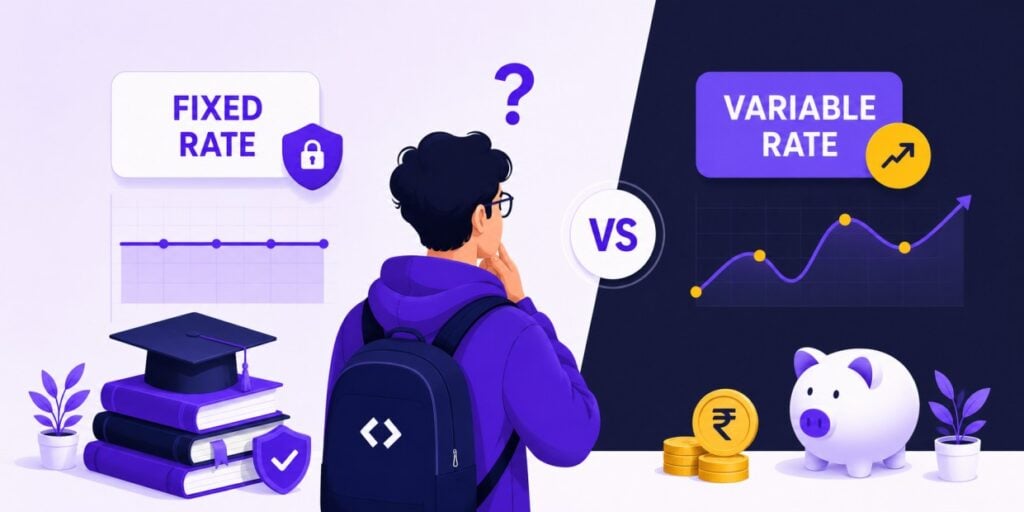
- Floating vs fixed rate: a refinanced loan at a floating rate can rise above your original rate if market conditions change. Confirm whether the new rate is fixed or floating and what benchmark it is linked to.
- Prepayment charges: check whether the new loan has any prepayment or foreclosure charges, and whether any RBI guideline or lender-specific exemption applies to your loan type. RBI has specific restrictions on foreclosure and prepayment charges for certain floating-rate individual loans, so this is worth confirming rather than assuming a penalty applies.
- Rate structure on floating loans: for floating-rate loans, check the benchmark it’s linked to, the reset frequency, the spread, and the circumstances under which the interest rate can change, so you know what you’re actually signing up for.
- Insurance: check whether any insurance is included in the loan and whether it’s optional or required under the lender’s specific terms.
- Changes to moratorium or grace period: if you refinance during a moratorium period on your original loan, the new loan may not carry the same moratorium terms. Clarify the repayment start date with the new lender explicitly.
How to avoid it: request the full loan agreement in writing before signing. Read every clause related to rate revision, prepayment, insurance, and default conditions. If any clause is unclear, ask the lender to explain it in writing.
Also read: Education Loan Moratorium Period: A Detailed Guide
A quick checklist before you refinance
|
Check |
Done? |
|
Calculated total interest on current loan (remaining tenure) |
|
|
Calculated total interest on refinanced loan at new rate and tenure |
|
|
Confirmed total refinancing cost is lower than staying with current lender |
|
|
Compared at least 3 lenders (rate plus processing fee combined) |
|
|
Calculated break-even point (months to recover transition costs) |
|
|
Checked foreclosure/prepayment charge on existing loan |
|
|
Verified eligibility before applying (soft check, not hard inquiry) |
|
|
Read new loan agreement fine print: rate type, prepayment clause, insurance |
|
|
Confirmed no EMI gap during transition that could affect credit score |
|
|
Checked current-year tax treatment of education loan interest with a tax professional |
A note on tax: education loan interest deductions in India have historically been claimed under Section 80E of the Income Tax Act, applicable only under the old tax regime. Tax provisions and section numbering are reviewed periodically, so confirm the current-year rule that applies to your refinanced loan with a tax professional or our Section 80E guide rather than assuming last year’s treatment carries over unchanged.
GradRight helps you compare refinancing options from 18+ lenders. Get competing offers in one place. Compare Refinancing Options on GradRight







 Australia
  Canada
  France
  Germany
  India
India  Ireland
  UAE
UAE  United Kingdom
  United States