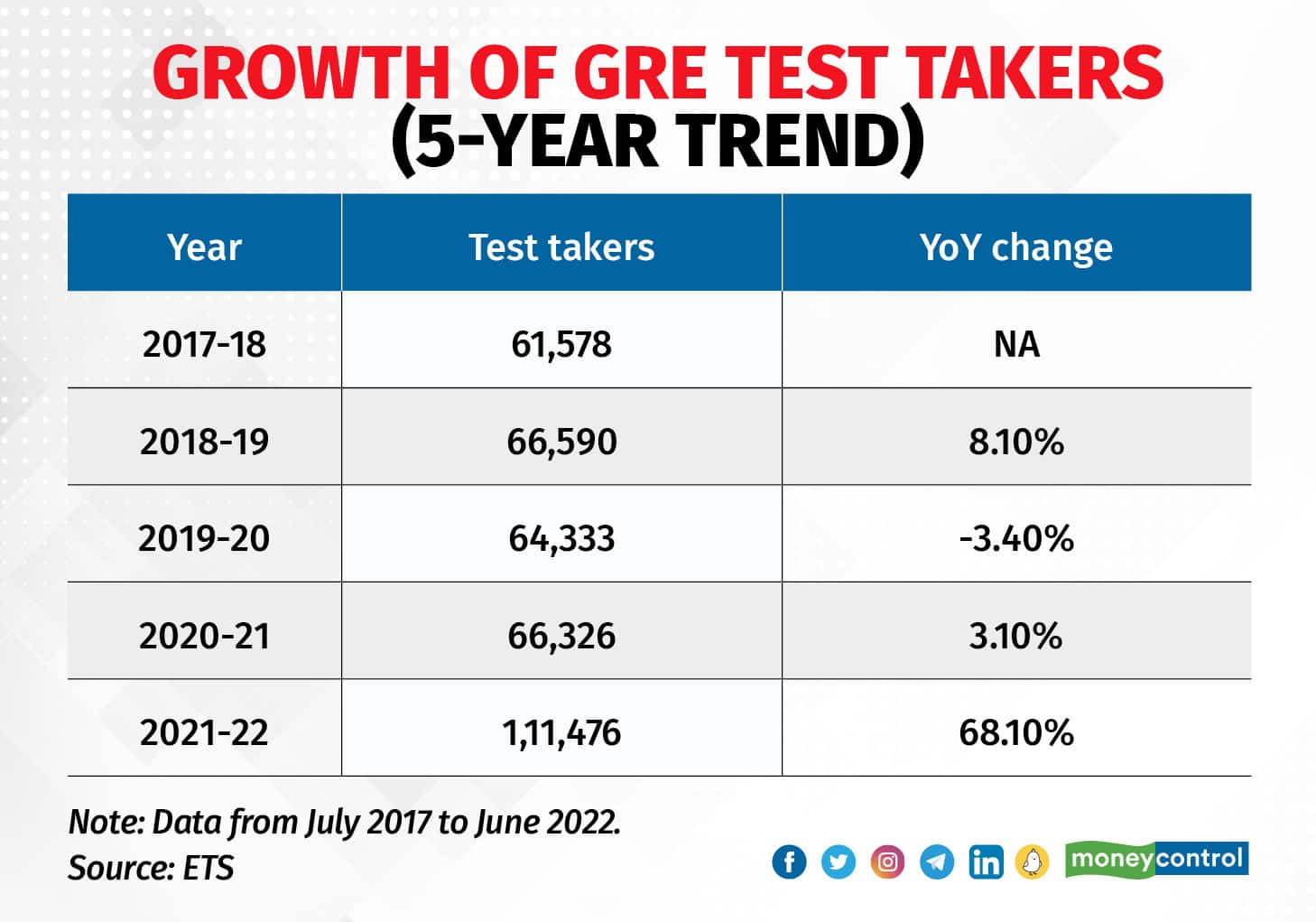





In the 2022-23 testing period, 113,304 Indians attempted the GRE – the first time in 80 years that the number of Indian test-takers exceeded that of the US.
But there’s still a lot of confusion around the GRE and who is eligible for it, along with concerns around GRE exam eligibility for Indian students.
What is the GRE exam?
The Graduate Record Examination (GRE) serves as a standardised admissions test. Key facts:
- GRE scores are used for admission into Master’s programs or doctoral degrees.
- The test is developed and administered by the Educational Testing Service (ETS).
- It measures verbal reasoning, quantitative reasoning, critical thinking, and analytical writing skills.
A lot of Indian colleges have started accepting GRE scores for admission now. However, most applicants attempt the GRE in the hopes of securing a seat at a foreign university. The scores, along with other factors, are used as qualifying criteria for more than 1300 B-Schools across the globe. Many other specialized tech, law, and medical schools also accept GRE scores. Once you ensure exam eligibility and get your scores, it also becomes easier to apply for an educational loan.
Resource: You can use the GradRight Education Loan Eligibility Calculator to find out your study abroad loan eligibility. GRE scores also affect scholarship eligibility – the better your score, the higher your scholarship eligibility.
Subject Tests:
Other than the General Test, Subject Tests are also available. These measure a test-taker’s knowledge and skill level in a specific field. Subject Tests are available for: Mathematics, Physics, and Psychology.
Note: The Chemistry Test was discontinued after April 2023. However, Chemistry Test scores remain valid for 5 years after the test date.
Also Read: GRE Exam 2026: Complete Guide – Format, Fees and Syllabus
GRE Eligibility Criteria – who is eligible for GRE ?
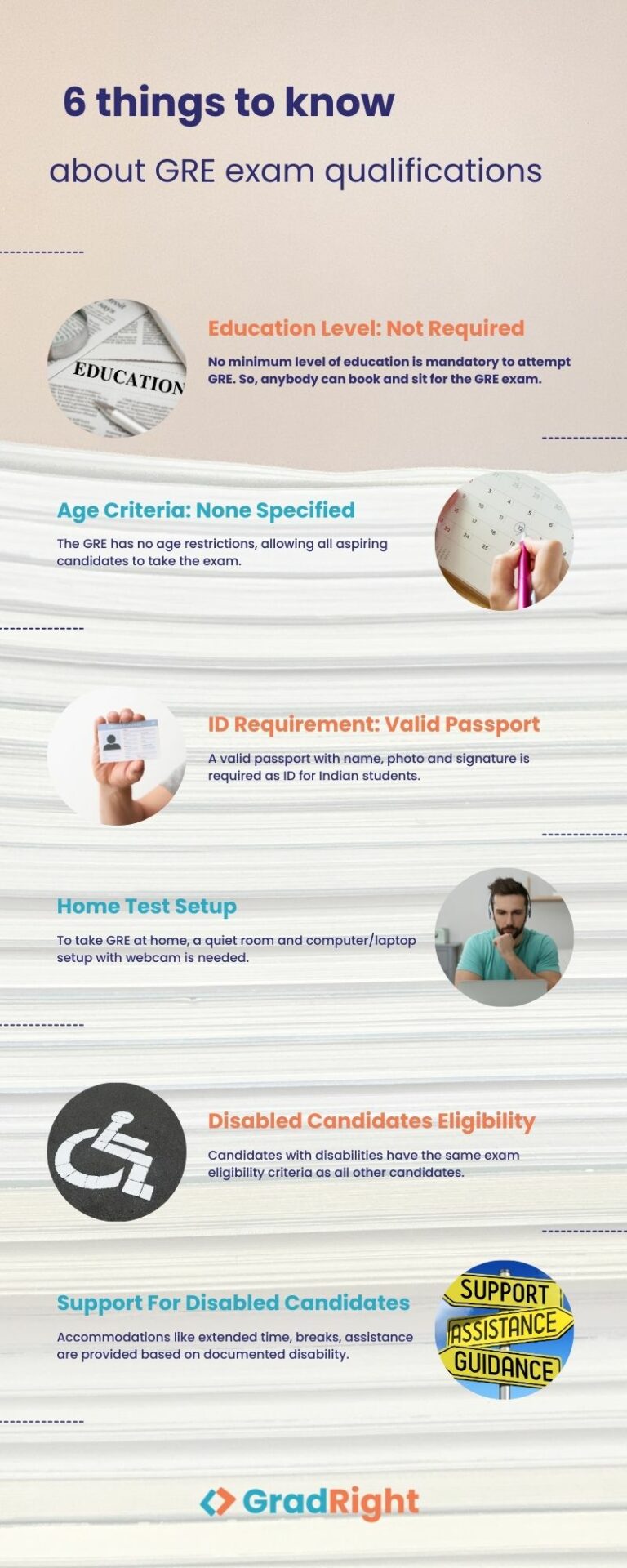
Contrary to common belief, the GRE has no minimum educational qualification for exam eligibility, nor does it set eligibility criteria specifically for engineers. Furthermore, it imposes no age restrictions, making it accessible to all aspiring participants.
Note: Eligibility to take the exam doesn’t guarantee admission to your preferred universities abroad. Universities have their own score cutoffs and other educational requirements.
Also Read: How To Prepare For GRE (Complete Strategy)
Documents required for GRE
Till April 15, 2023, an Aadhaar Card could be used as identification in India. Now, a valid passport with your name, photograph, and signature is required for GRE eligibility for Indian students.
- Use the original hard copy document – photocopies or electronic displays are not accepted.
- First and last names must match your test registration exactly.
- The document should include a recent, clear photograph along with your signature.
- The ID should be currently valid – expired documents won’t be accepted.
The eligibility for Indian students for Subject Tests is the same as that of the General Test.
What is the eligibility to take the exam at home?
The GRE at Home eligibility is the same as for the test center – no age limit or specific educational qualification required. However, you’ll need:
- A quiet room with a tabletop setup.
- A desktop or laptop.
- Windows 10 or macOS X 10.13 or newer.
- An ETS secure web browser for Windows or Mac.
- A built-in or external webcam.
- A built-in or external microphone.
- A valid government-issued ID ready to show to the proctor during the test.
Also Read: GRE Exam Syllabus (Section-wise) Latest & Updated
What is eligibility for disabled candidates?
ETS is dedicated to ensuring equal access for all candidates. There are no special (or subsidised) eligibility criteria for disabled candidates. However, disability accommodations are available based on documented disability or health-related condition.
Accommodations for disabled test takers include:
- Extended testing time (25%, 50% or 100%).
- Extra breaks.
- Assistance such as human readers or scribes.
- Alternative test formats like braille or large-print materials.
- Computer assistance such as screen magnification or ergonomic keyboards.
Important: The review process for disability accommodation typically takes around 6 weeks. Submit requests as early as possible.
How to prepare for the exam?
After familiarising yourself with the eligibility criteria, it’s time to get started on your preparation journey.
- Familiarise yourself with the format: Understand the sections (Verbal Reasoning, Quantitative Reasoning, Analytical Writing), question types, and time limits. The revised GRE format (Sept 2023) is ~1hr 58min with 1 AW essay.
- Invest in prep materials: Books, online resources, or prep courses – these include practice questions, sample tests, and study guides.
- Develop a study schedule: Fits your needs and allows enough time to review all sections.
- Take practice tests: ETS offers free POWERPREP tests. Free sample questions available at ets.org/gre/prepare.
Also Read: How to Prepare for GRE Exam 2026: Complete Strategy
Also Read: GRE Study Materials 2026: Best Books and Free Resources
Also Read: GRE Exam Syllabus 2026 (Section-wise)
Find universities that match your GRE score – AI-powered, 40,000+ programs, free. Explore on GradRight









 Australia
  Canada
  France
  Germany
  India
India  Ireland
  UAE
UAE  United Kingdom
  United States