





TL;DR: Student health insurance in Canada varies by province, with some offering public coverage and others requiring university plans like UHIP. Most plans cover hospital and doctor visits but exclude dental, vision, and extended mental health care. Costs range from CAD 600–1,000+ per year, with private insurance often needed during waiting periods or ineligible provinces.
If you’re planning to study in Canada, you’ve probably already mapped out your tuition, rent, and groceries. But there’s one line item that catches a surprising number of students off guard: health insurance. It’s not optional. It’s not a formality. And depending on which province you choose, it can cost you anywhere from nothing at all to well over CAD 800 per year.
This guide breaks down exactly what healthcare in Canada for students looks like, what you’re actually paying for, and how to avoid nasty surprises once you land.
How healthcare in Canada works for international students
There’s a common assumption that Canada has “free universal healthcare,” so international students assume they’re automatically covered. That’s only partially true.
Canada’s healthcare is publicly funded, but it’s managed at the provincial level, not the federal level. That means each of Canada’s 13 provinces and territories sets its own rules about who qualifies, when they qualify, and what’s actually covered. As an international student, your experience with healthcare in Canada will depend almost entirely on where you study, not just the fact that you’re in Canada.
Some provinces welcome international students into their public health systems. Others exclude them completely, requiring private insurance instead. And most have a waiting period of up to three months before coverage kicks in, even if you do qualify.
Private student health insurance vs provincial insurance in Canada
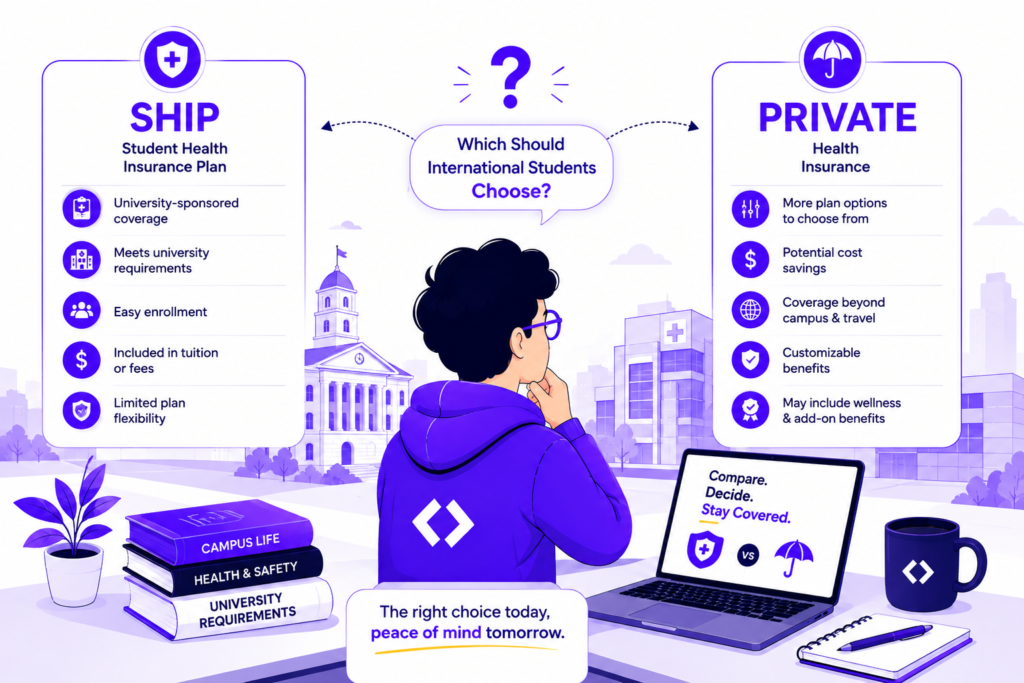
When it comes to student health insurance in Canada, students generally fall into one of two categories.
- Provincial coverage: Some provinces allow international students holding valid study permits to enroll in the same publicly funded health plan that Canadian residents use. This typically covers essential medical services like doctor visits, emergency care, and hospitalization. It does not cover dental, vision, or prescription medications.
- Private or university-based plans: In provinces where international students don’t qualify for provincial coverage, or during the waiting period before provincial coverage begins, students are enrolled in a private plan. Often this is mandatory and automatically charged through your tuition fees.
Many students end up using a combination of both: provincial insurance for the basics and a supplementary plan for everything else.
Also Read: Study Loan for Canada in 2026
Health insurance costs for international students by province
This is where things get genuinely interesting, because the variation is significant.
Ontario
Ontario is home to some of Canada’s most popular universities, including the University of Toronto, McMaster, Western, and Queen’s. International students studying here are not eligible for OHIP (Ontario Health Insurance Plan) and must instead enroll in UHIP, the University Health Insurance Plan.
For 2025-2026, UHIP costs CAD 792 per year at the University of Toronto. This covers hospital visits, physician services, and basic diagnostics, but typically excludes dental, prescription drugs, and mental health services unless supplementary plans are added.
British Columbia
International students studying full-time in BC can apply for the Medical Services Plan (MSP), the province’s public insurance. However, there’s a three-month waiting period after arrival. To cover that gap, most universities require students to purchase a short-term private plan.
At the University of British Columbia, full-year university plan costs ran approximately CAD 338 for the academic year in 2023-24. Once MSP is active, ongoing premiums for international students are around CAD 75 per month for six months, after which coverage becomes free for the rest of the year.
Alberta
Alberta is one of the most straightforward provinces for international students. If you’re studying for 12 months or more on a valid study permit, you’re generally eligible for the Alberta Health Care Insurance Plan (AHCIP), with no ongoing premiums charged directly to students once your application is processed. There’s no waiting period once approved, though you do need to apply promptly upon arrival.
Saskatchewan
Similar to Alberta, Saskatchewan allows international students studying full-time with a valid study permit to apply for a Saskatchewan Health Card, providing free basic coverage. A three-month waiting period applies, so private insurance is needed to bridge that initial window.
Manitoba
Manitoba offers international students access to a provincial health plan that mirrors the coverage offered to residents, and it’s provided at no direct cost to students.
Quebec
Quebec is one of the more complex provinces. Most international students are not eligible for the provincial plan (RAMQ) unless they’re from a country that has a social security agreement with Quebec. That means private insurance is the norm, and costs can be higher than other provinces.
Other provinces
Smaller provinces like Newfoundland and Labrador, New Brunswick, and Nova Scotia have varying policies. Some extend provincial coverage to international students after a waiting period; others require private plans for the duration of studies.
How much does private student health insurance cost in Canada?
If you’re going to rely on private insurance, either because your province doesn’t offer provincial coverage or because you want supplementary coverage, here’s a realistic sense of what you’re paying.
| Type of Plan | Cost Range | Approx. Annual Cost | Notes |
| University-administered group plans (e.g., UHIP, campus plans) | CAD 600 – CAD 900 per year | CAD 600 – CAD 900 | Mandatory in many universities; billed via student account |
| Standalone private student insurance | CAD 62 – CAD 255 per month | CAD 744 – CAD 3,060 | Varies by age, coverage level, and provider |
| GuardMe (campus-linked example) | ~CAD 1.93 per day | ~CAD 700 – CAD 750 | Typically covers academic year (Sep–Aug cycle) |
One important thing to keep in mind: even within the same province, college-administered plans and university plans can differ meaningfully in what they cover and what they cost. Always read the fine print before assuming your university plan covers everything.
What does Canada student health insurance cover?
Whether you’re on a provincial plan or a private one, most standard student health insurance in Canada covers the following:
- Emergency hospitalization and physician visits
- Diagnostic services like X-rays and lab tests
- Some prescription medications (varies significantly by plan)
- Emergency dental care (separate from routine dental)
What is not covered by student health insurance in Canada?
What’s typically not covered, or covered only partially:
- Routine dental care and orthodontics
- Vision care and eyeglasses
- Mental health therapy and psychiatry beyond a limited number of sessions
- Elective procedures
- Pre-existing conditions (often excluded or subject to waiting periods)
This is the gap that catches many students by surprise. Your basic plan may look comprehensive on paper, but a dental emergency or an ongoing prescription can add up quickly if your plan has low annual maximums. It’s worth paying attention to coverage caps when comparing plans, not just the premium.
Also Read: Mental Health Coverage in Student Health Insurance Plans
Provincial health insurance waiting periods in Canada
If you’re heading to BC, Saskatchewan, or Nova Scotia expecting to use provincial coverage, mark your calendar. Most provincial plans have a waiting period of approximately three months from the date you arrive in Canada. You are not automatically covered from day one.
During that window, you need private insurance. Many universities will automatically enroll you in a bridging plan, but some don’t. Confirm with your institution before you travel. Arriving without coverage and then needing medical care in that first month is an expensive situation that’s entirely avoidable.
Things international students should know before buying health insurance
Health insurance in Canada works best when you understand what you’re signing up for before you arrive, not after. Here are a few things that often get overlooked:
- Provincial plans don’t travel. If you’re on MSP in BC and you visit a friend in Ontario, your provincial plan may not cover non-emergency care outside BC. The same goes for trips back home during breaks. Emergency coverage usually applies within Canada, but routine care outside your home province is often out-of-pocket.
- Check opt-out policies. Some university plans allow you to opt out if you can prove equivalent coverage elsewhere. The opt-out windows are usually narrow (a few weeks at the start of term), and missing the deadline means you’re paying for a plan you might not need.
- Family members aren’t automatically covered. If you’re bringing a spouse or children to Canada, they need separate coverage. UHIP and most university plans charge additional premiums per dependent, and those costs add up quickly.
How GradRight can help
Navigating provincial insurance eligibility, private plan options, and university-level coverage differences is genuinely complicated, especially when you’re managing applications, visa paperwork, and housing at the same time. At GradRight, we help students think through the full picture of studying abroad in Canada, including the costs that tend to fly under the radar until it’s too late.
If you’re still at the decision stage, our platform helps you compare universities and programs across Canada while factoring in the complete cost of attendance, including health coverage, so you can make a truly informed choice about where to apply and enroll. We’ve worked with thousands of students navigating this exact process, and the health insurance conversation is one we have early and often because it matters.







 Australia
  Canada
  France
  Germany
  India
India  Ireland
  UAE
UAE  United Kingdom
  United States