




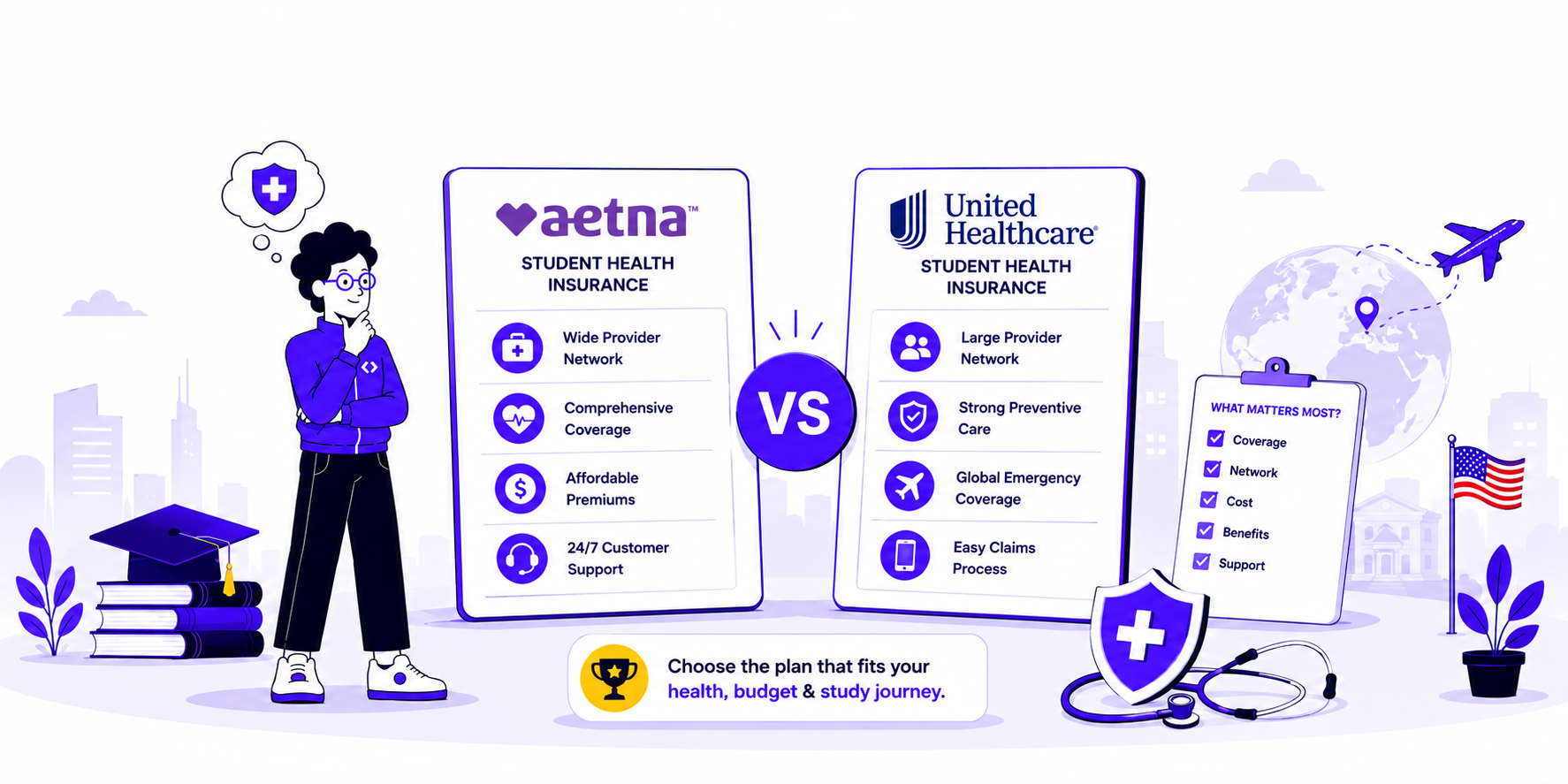
If you’re an F-1 or J-1 student prepping for the US, you’ve probably landed on this page after seeing your university mention one of two names: Aetna Student Health or UnitedHealthcare StudentResources (UHCSR). Both administer Student Health Insurance Plans (SHIP) for hundreds of American colleges, and both are what your school will most likely auto-enroll you in unless you qualify for a waiver.
The Aetna vs UHC student health insurance question comes up constantly in international student forums, WhatsApp groups, and pre-departure sessions, but very few resources actually break down what’s different, what’s the same, and what you can (and can’t) control about it.
This guide lays out the real, factual differences between the two plans, what actually matters for an international student’s day-to-day healthcare experience, and how to think through the decision if you have any choice in the matter at all. By the end, you’ll have a clear, practical answer to the Aetna vs UHC student health insurance question, not just a list of features.
What Aetna and UHC student health insurance actually are
Before comparing features, it helps to understand what these two companies actually do. Neither Aetna nor UHC sells you a plan directly the way you’d shop for car insurance. Instead, your university signs a contract with one insurer, and that insurer then administers the Student Health Insurance Plan for the entire student body, including international students on F-1 or J-1 visas, who are usually required to carry it unless they get an approved waiver.
Aetna Student Health
- Underwritten by Aetna Life Insurance Company; some university plans are self-insured, with Aetna handling claims administration only.
- National network of doctors, hospitals, and specialists.
- Aetna Health app for claims, provider search, and digital ID.
- International support runs through On-Call International: emergency evacuation, lost document help, and assistance during disasters or political emergencies abroad.
UnitedHealthcare StudentResources (UHCSR)
- An operating division of UnitedHealth Group, focused on student insurance since 1987.
- Built on the UnitedHealthcare Choice Plus PPO network.
- Partnered with HealthiestYou for remote doctor and mental health access, including while traveling outside the US.
- Managed through myaccount.uhcsr.com or the UHCSR app.
Also Read: How to Choose the Best International Student Health Insurance in 2026
Aetna vs UHC student health insurance: Key differences at a glance
| Feature | Aetna Student Health | UHC StudentResources (UHCSR) |
| Underwriter | Aetna Life Insurance Company | UnitedHealthcare Insurance Company |
| Network type | National Aetna provider network | UnitedHealthcare Choice Plus PPO network |
| Student insurance focus since | Aetna offers student plans as part of its broader health insurance business | 1987 (UHCSR is a dedicated student insurance division) |
| International/travel assistance | On-Call International (evacuation, lost documents, emergency travel help) | HealthiestYou telehealth, accessible internationally |
| Digital tools | Aetna Health app, member website, digital ID card | myaccount.uhcsr.com portal, UHCSR mobile app |
| Wellness discounts | Discounts on massage therapy, OTC vitamins, oral care products, acupuncture, weight-loss programs | Varies by school-specific plan design |
| Dependent/family coverage | Available depending on school plan | Available; spouse/dependent premiums often paid directly to UHC after primary enrollment |
| Who administers your specific plan | Determined solely by your university’s contract | Determined solely by your university’s contract |
This table captures the most consistent differences reported across university plan documents, but the exact deductible, premium, and co-pay numbers will always be set by your specific school’s contract, not by Aetna or UHC as a blanket policy.
That’s the single most important thing to understand before you go further into any Aetna vs UHC student health insurance comparison: the plan design is negotiated per university, so “Aetna vs UHC student health insurance” isn’t really a universal cost comparison; it’s a comparison of your school’s specific contract with one insurer or the other.
Provider network and access to care
Aetna Student Health Network
Aetna Student Health gives members access to its national provider network, which includes doctors, hospitals, and specialists across the country. This matters most if you travel between states for internships, breaks, or transfers — a large network reduces the odds you’ll end up paying out-of-network rates simply because you’re temporarily somewhere new.
UHC Choice Plus Network
UHCSR plans typically run on the UnitedHealthcare Choice Plus PPO network. You can generally see any provider you want, but only in-network Choice Plus providers offer negotiated discounts and simplified, no-claim-form billing. Go out-of-network, and you may face higher fees and have to submit your own claim for reimbursement. Before you enroll or waive, check whether your campus clinic and nearby hospitals are in-network for either plan — this single factor often decides the real-world Aetna vs UHC student health insurance experience more than any brochure comparison does.
Cost, deductibles, and out-of-pocket structure
Because premiums, deductibles, and co-pays are negotiated individually by each university, there’s no fixed national price for either Aetna or UHC student plans. What you can compare, however, is structure:
- Deductible: the amount you pay before insurance starts covering costs. Lower deductibles usually mean higher premiums, and vice versa.
- Co-pay: your flat fee for specific services, like an office visit.
- Out-of-pocket maximum: the most you’ll pay in a policy year before the plan covers 100% of further costs.
- In-network vs. out-of-network coverage percentage: for example, some UHC-administered university plans cover a large share of costs at in-network providers and a lower share out-of-network.
When you’re weighing Aetna vs UHC student health insurance purely on cost, ask your international student office for the actual plan brochure (both insurers publish detailed, school-specific PDFs) rather than relying on general marketing pages, since the real numbers differ from campus to campus even under the same insurer.
Coverage for mental health and telehealth
Mental health access is one of the more meaningful differentiators international students bring up. UHCSR’s partnership with HealthiestYou is built specifically to let students reach a doctor or mental health provider remotely 0 including while they’re traveling outside the US, which is useful during summer or winter break trips home.
Aetna Student Health also provides access to care coordination and its Aetna Health app, but its emphasis for international students leans more toward the On-Call International travel-assistance service for emergencies, evacuations, and logistics support rather than routine remote mental health visits. If ongoing access to teletherapy while traveling is a priority for you, this is a genuine point of difference worth raising with your school’s insurance office.
International travel and emergency assistance
Both plans build in support designed around the reality that international students travel. Aetna’s On-Call International service can help with emergency medical evacuation, lost passport or document assistance, and support during natural disasters or political instability abroad.
UHCSR’s HealthiestYou telehealth access, meanwhile, is designed so a student can still consult a doctor from outside the US. Neither service is a substitute for travel insurance if you’re taking an extended trip; they’re built around your SHIP coverage while you’re a registered, insured student.
Also Read: How Much Emergency Money Should an Indian Student Carry Abroad?
Dependents, spouse, and family coverage
If you’re bringing a spouse or child on an F-2 or J-2 visa, both Aetna and UHC-administered plans generally allow you to add dependents, but the process and cost structure differ by school.
In several UHCSR-administered university plans, you first enroll yourself, then pay the additional dependent premium directly to UnitedHealthcare. Aetna-administered plans typically follow a similar model, with dependent coverage cost and process set at the university level.
Always confirm dependent enrollment deadlines early – most schools set a hard cutoff shortly after each term begins, and missing it can mean your dependent goes uninsured for the whole term.
Claims process and customer support
Aetna Student Health routes claims and provider searches through the Aetna Health app and member website, while UHCSR members use myaccount.uhcsr.com or the UHCSR mobile app. Both plans encourage students to stick to in-network providers specifically because it reduces or eliminates the need to file your own claim form – in-network visits are typically billed directly to the insurer.
If you do end up needing to file a claim yourself (for an out-of-network or emergency visit), both companies provide phone and email support lines specific to student plans, and your school’s international student office is usually the fastest first stop for claims questions, since privacy rules often mean the insurer can only speak directly with you, the policyholder.
On this front, the Aetna vs UHC student health insurance experience tends to come down to how responsive your specific school’s insurance office is, more than which insurer is on the card.
Which one can you actually choose?
Here’s the part that trips up most students Googling “Aetna vs UHC student health insurance”: in the overwhelming majority of cases, you don’t get to pick between the two. Your university has already signed with either Aetna or UHC, and as an F-1 or J-1 student, you’re automatically enrolled in whichever plan your school offers, often before you’ve even landed in the US.
The only way to avoid that specific plan is to submit a waiver by demonstrating you have comparable coverage that meets your school’s specific waiver requirements (things like minimum coverage amounts, in-network access in the US, and repatriation/evacuation benefits are common conditions).
So the real decision isn’t usually “Aetna or UHC”; it’s “should I take my school’s plan, or waive out with a comparable one that fits my budget and coverage needs better.”
How GradRight helps international students navigate the choice
Comparing Aetna vs UHC student health insurance in the abstract only gets you so far – the plan that actually matters is the one tied to your specific university, term dates, and visa status. GradRight’s platform is built to cut through that by checking which university-approved plans you’re eligible for, showing your potential savings, and walking you through the waiver process step by step if you already have comparable coverage.
It’s designed to save international students the hours normally spent parsing insurer PDFs and university insurance office emails, with plans that are pre-approved by universities and guidance available on claims and waivers.








 Australia
  Canada
  France
  Germany
  India
India  Ireland
  UAE
UAE  United Kingdom
  United States