
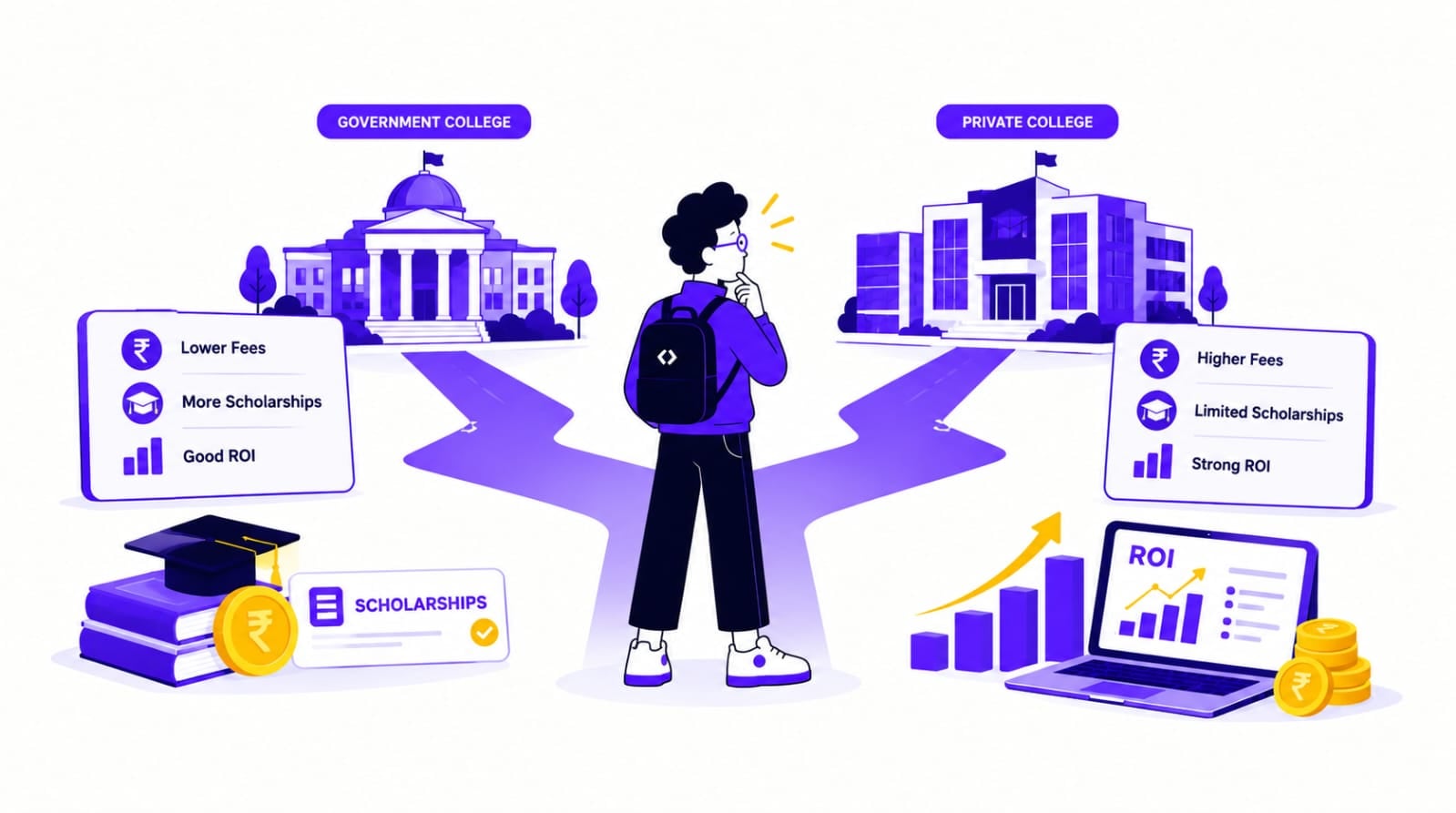
Data Science is becoming a popular undergraduate choice, but the cost of earning the degree can vary significantly from one institution to another. A government college may charge only a few lakh rupees for the full program, while some private universities can cost ₹15 lakh or more.
Tuition is only part of the calculation. Hostel and mess charges, a laptop, examination fees, and other institutional expenses can add substantially to what you actually spend. Scholarships, fee waivers, and lower-cost online programs can help bring that cost down.
So, what should you budget for a Data Science degree in 2026? This guide breaks down the fees across government and private institutions, additional expenses, scholarships, and the potential ROI of the degree.
Data Science Fee Range: Government vs Private Colleges
The cost of an undergraduate Data Science degree in India varies widely based on the type of institution, degree format, and fee structure. Government institutions generally have lower tuition, while private institutions typically have a wider range of fees.
Government vs Private Data Science Fees
| Institution Type | Approx. Annual Tuition | Approx. Total Tuition |
|---|---|---|
| Government Institutions | Under ₹10,000 to ₹2 lakh | ₹1 lakh to ₹8 lakh |
| Private Institutions | ₹1 lakh to ₹6 lakh+ | ₹4 lakh to ₹25 lakh+ |
These are broad indicative ranges. Actual fees vary by college, program, category, and admission route. Hostel, mess, laptop, examination fees, and other expenses are not included.
For example, the IIT Madras BS in Data Science and Applications costs ₹3.86 lakh to ₹4.5 lakh for the full program, depending on the credits completed. Private Data Science programs can range from around ₹4 lakh to ₹25 lakh or more, depending on the institution and fee category.
Year-Wise and Semester-Wise Data Science Fee Breakdown
Data Science fees are usually paid per semester or per year, depending on the institution. Tuition may increase annually, while admission charges and refundable deposits are usually concentrated in the first year.
| Cost Component | When You Pay | What to Budget For |
|---|---|---|
| Admission and one-time fees | First year | Admission fee, registration, caution deposit and other one-time charges |
| Tuition fee | Every semester | Core academic fee, which may increase in later years |
| Hostel fee | Every semester/year | Accommodation, depending on the institution |
| Mess and electricity | Every semester | Food and utility advances or actual usage charges |
| Examination and student fees | Each semester/year | Typically includes examination, student activities, technology and other institutional charges |
| Summer term | If applicable | Additional tuition if you take courses during the summer |
For example, IIT Hyderabad’s 2026 fee structure lists ₹1 lakh per semester in tuition for General, EWS and OBC students, along with about ₹19,000 in one-time fees. Hostel, mess and other institutional charges are billed separately, and SC, ST and PwD students are exempt from tuition.
At BITS Pilani, students entering a first-degree program in 2026-27 pay ₹2,91,500 per semester in tuition, plus a ₹64,100 admission fee in the first year. The published schedule increases tuition by 5% each year, taking the annual tuition from about ₹5.83 lakh in year one to ₹6.12 lakh, ₹6.43 lakh and ₹6.75 lakh in years two to four. This puts four years of tuition at roughly ₹25.1 lakh. Hostel and summer-term fees are charged separately and also increase over time.
The first year usually has extra one-time charges like admission fees and deposits, but later years can cost as much or more if tuition rises. When comparing programs, check the full four-year fee schedule instead of judging a course by its first-year tuition alone.
Also Read: Data Science Courses After 12th in India
Additional Costs Beyond Tuition for a Data Science Degree
Tuition is only one part of the total cost of a Data Science degree. Depending on the institution and where you study, you may also need to pay for accommodation, food, a laptop, examination and administrative fees, and additional learning resources.
| Expense Category | Typical Cost | What to Budget For |
|---|---|---|
| Hostel & Mess | ₹60,000 to ₹2.5 lakh / year | Accommodation, meals, and applicable utility charges. Costs vary by institution, room type, and location. |
| Laptop | ₹50,000 to ₹90,000 one-time | A reliable laptop for programming, data analysis, coursework, and project work. |
| Examination & Administrative Fees | ₹2,000 to ₹10,000 / year | Examination registration, student services, library, laboratory, and other institutional charges, where applicable. |
| Software & Cloud Computing | ₹0 to ₹8,000+ / year | Paid software, cloud computing, APIs, or additional storage when free or university-provided resources are not sufficient. |
| Summer Term | Varies by institution | Additional tuition if you take summer courses, clear backlogs, or complete extra credits. |
| Optional Certifications | ₹5,000 to ₹20,000+ | Certifications in areas such as Python, SQL, data analytics, cloud computing, or machine learning. |
What to Keep in Mind
- Hostel and mess: These costs can make a significant difference to the total price of a degree. Students living at home may avoid most of these expenses, while those studying away from home need to include them in their budget.
- Laptop: Most Data Science coursework involves programming, statistics, data analysis, and project work. A mid-range laptop with adequate RAM and SSD storage is generally sufficient for academic use. More demanding machine learning work may require access to higher-performance hardware or cloud computing.
- Software and cloud services: Many universities provide access to software, computing facilities, or student licenses. Before paying for additional tools, check what your institution already provides.
- Summer terms: Summer courses are not a standard expense for every student. They apply only when a university offers them and a student chooses or needs to take additional coursework.
- Certifications: These are optional and should not be treated as a compulsory cost of a Data Science degree. Consider them only if they add relevant skills or support your career goals.
The actual amount you spend will depend on your institution, location, living arrangements, and course requirements. For a realistic estimate, add these costs to tuition before comparing the total cost of different Data Science programs.
Data Science Scholarships and Financial Aid Options
Scholarships and fee waivers can make a significant difference to the cost of a Data Science degree. The support available depends on factors such as academic performance, family income, category, and the institution you attend.
| Financial Aid Option | Who It Can Help | What It Can Cover |
|---|---|---|
| Category-Based Fee Waivers | Eligible SC, ST, and PwD students at participating government institutions | Full or partial tuition fee waiver, depending on the institution |
| Income-Based Fee Support | Students meeting an institution’s family-income criteria | Partial or full tuition fee waiver, depending on the institution |
| Central Sector Scholarship (CSSS) | High-performing Class 12 students from eligible low-income families | ₹12,000 per year for the first 3 years and ₹20,000 in the fourth year for B.Tech/B.E. students |
| Institutional Scholarships | Students meeting a college’s merit, income, category, or other criteria | Partial or full tuition support, depending on the scholarship |
| Education Loans | Students who need additional funding for higher education | Tuition, hostel, books, equipment, and other approved education expenses, depending on the loan |
Government Scholarships and Fee Waivers
At institutions such as IIT Delhi, eligible SC, ST, and PwD students receive a 100% tuition fee exemption. IIT Delhi also offers Merit-Cum-Means scholarships and free studentship for eligible students based on academic performance and family income. The exact income limits and benefits can vary by institution.
The PM-USP Central Sector Scheme of Scholarship for College and University Students (CSSS) is another option for eligible students. For B.Tech and B.E. students, the scholarship provides ₹12,000 per year for the first three years and ₹20,000 in the fourth year. Eligibility includes being above the 80th percentile in Class 12, pursuing a regular degree course, and having annual family income of up to ₹4.5 lakh. Students cannot receive the CSSS alongside another scholarship or fee reimbursement scheme.
Applications for central scholarship schemes are handled through the National Scholarship Portal (NSP). The portal is currently open for the 2026-27 academic year, and students need an NSP One Time Registration (OTR) to apply.
Institution-Specific Fee Support
Some universities have their own fee-waiver systems. For example, the IIT Madras BS in Data Science and Applications program provides fee support based on category and family income. General and OBC students with family income between ₹1 lakh and ₹5 lakh can receive a 50% waiver, while those with family income of ₹1 lakh or less can receive a 75% waiver. Eligible SC, ST, and PwD students can also receive fee support under the program’s published criteria.
Education loans can cover the remaining cost when scholarships or fee waivers are not enough. The government-backed PM-Vidyalaxmi scheme also provides collateral-free and guarantor-free education loans for eligible students admitted to specified quality higher education institutions. Students from families earning up to ₹8 lakh annually may also qualify for a 3% interest subvention on loans up to ₹10 lakh under the scheme.
Important: A 100% tuition waiver does not mean the entire degree is free. Hostel, mess, laptop, examination, and other institutional charges may still apply. When calculating your funding requirement, check exactly which components the scholarship or fee waiver covers.
Also Read: The Rise of Data Science and Data Analytics Careers
Is a Data Science Degree Worth the Fees? ROI and Payback Period
A Data Science degree can be a worthwhile investment, but the value depends on what you pay and the career opportunities the program can realistically open up. Instead of comparing colleges based on their highest package, look at the total cost of the degree, median placement outcomes, and the loan burden you may take on.
How to Calculate the Payback Period
A simple way to estimate ROI is to compare your total degree cost with your first-year salary:
Simple Payback Period = Total Degree Cost ÷ First-Year Salary
For example, if your total degree cost is ₹8 lakh and your first-year salary is ₹8 lakh, the simple payback period is approximately one year.
| Total Degree Cost | Illustrative First-Year Salary | Simple Payback Period |
|---|---|---|
| ₹4 lakh | ₹6 lakh | 8 months |
| ₹8 lakh | ₹8 lakh | 12 months |
| ₹12 lakh | ₹10 lakh | 14.4 months |
| ₹20 lakh | ₹12 lakh | 20 months |
| ₹25 lakh | ₹15 lakh | 20 months |
These are mathematical illustrations, not expected or guaranteed salaries. Actual payback can take longer because of taxes, living expenses, loan interest, and salary growth over time.
What to Check Before Judging ROI
A lower fee does not automatically mean better ROI. Before choosing a Data Science program, compare:
- Median salary: Check the institution’s official median placement salary rather than focusing only on its highest package. NIRF data can be useful for comparing institution-level outcomes, although it may not represent Data Science graduates specifically.
- Placement outcomes: Look at the number or percentage of eligible students placed, the recruiters involved, and the roles offered where this information is available.
- Total cost: Add tuition, hostel, mess, laptop, examination fees, travel, and other recurring expenses to get a realistic estimate of your investment.
- Curriculum: Look for core skills such as statistics, Python, SQL, databases, data analysis, and machine learning. Cloud computing and newer AI topics can be useful additions, but they should not replace the fundamentals.
- Projects and internships: A strong program should give you opportunities to work on practical projects, build a portfolio, and gain industry exposure through internships or other hands-on work.
- Loan burden: If you are financing the degree through an education loan, include the interest and monthly EMI in your calculations. A program with a higher placement salary may still take longer to pay off if the initial investment is significantly higher.
Ultimately, the ROI of a Data Science degree depends on more than the salary figure. The right comparison is between the total cost of the program, the quality of career opportunities it provides, and the salary you can realistically expect after graduation.
Also Read: Data Science Eligibility in India
Related Articles
- Data Science Courses After 12th in India
- Data Science Eligibility in India
- Data Science vs Machine Learning
- The Rise of Data Science and Data Analytics Careers
- Best Career Options After 12th in India 2026: Complete Career Guide
Compare programs on OLRight: see data science programs with fees, duration and outcomes side by side.
Talk to a GradRight counselor free: get personalised guidance on choosing the right program for your goals and budget.
Compare education loans: check EMI and funding options before you enroll.







 Australia
 Canada
 France
 Germany
 India
 Ireland
 UAE
 United Kingdom
 United States