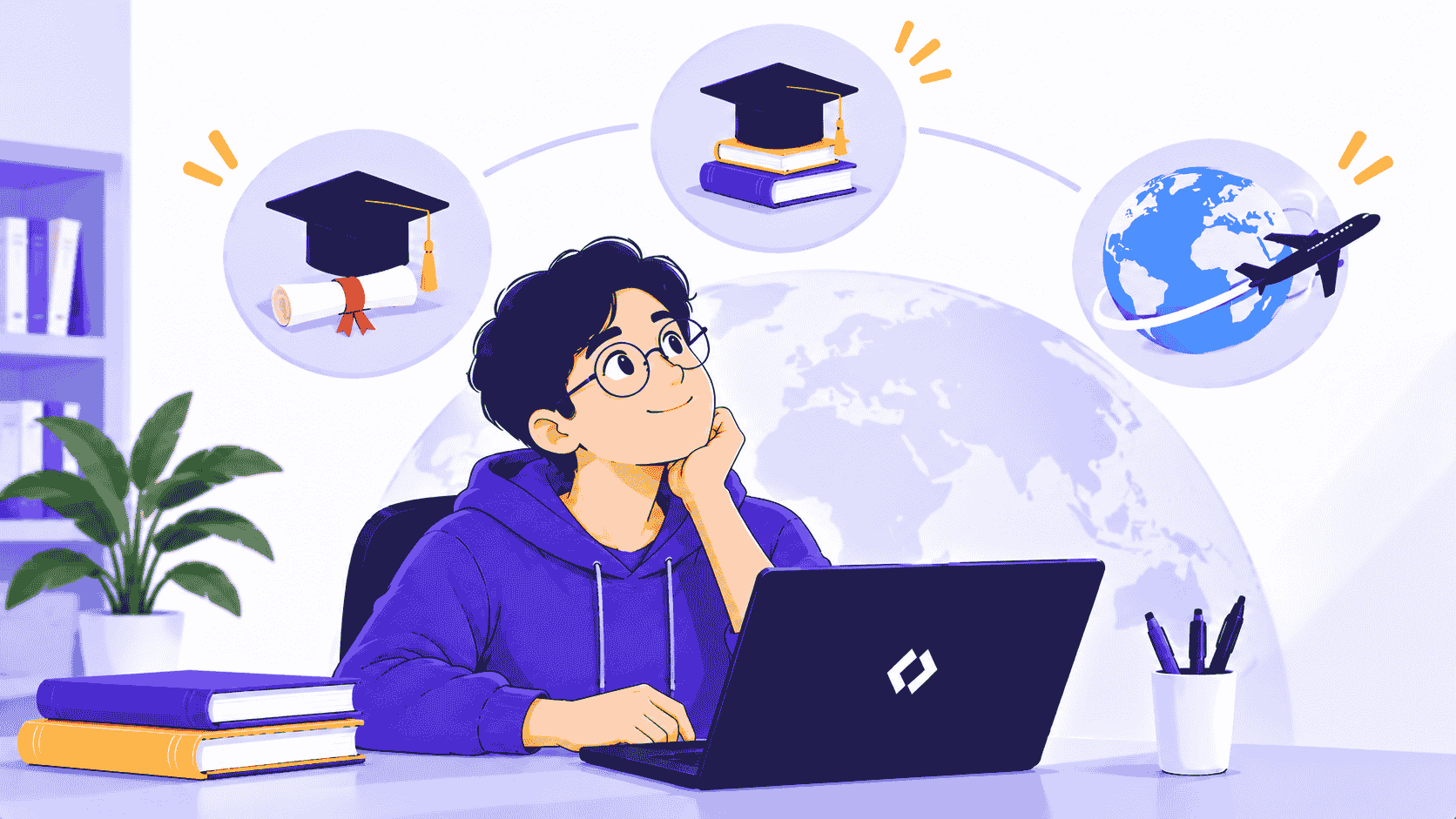
Does an online degree qualify you for further study?
The answer is yes, but with one condition: the university must be approved and accepted by the UGC to run online courses, as UGC has clarified that the degrees from online and distant universities are equivalent to regular degrees, which means online bachelor’s can be your pillar for an online master’s, and online master’s degree from a recognised institution can be your foundation for further study.
The word that truly matters is “recognised”. So before you enrol, check carefully if the institution is recognised by UGC and the programme is approved on the UGC Distance Education Bureau website. That one check protects everything that comes after, including the validity of your higher studies.
How different universities accept online degrees
Different university systems approach the application differently instead of assuming how admission panels will react. Here’s how the different types of university evaluate, evaluate the online degree in practice:
Central and state public universities
Institutions like Delhi University(DU), Jawaharlal Nehru University(JNU), Mumbai University, or Anna University operate under strict regulatory guidelines. Because the University Grants Commission’s Bureau (UGC-DEB) legally equates online curricula and programmes with conventional degrees. This university cannot discard your application simply because you have studied online. If your online degree comes from any approved institutions such as IGNOU, Amity Online, or Chandigarh University, you’re eligible to apply further. Here, the admission solely depends on the entrance exams (such as CUET-PG or state common entrance exams) and your written cut offs.
Private institutions and business schools
Top management institutions such as IIMs( through CAT) and private schools like XLRI, SPJMIR, and Symbiosis accept online bachelor’s degrees for eligibility criteria. However, their selection process moves beyond the basic criteria into the profile based shortlisting and the personal interviews. So if you have done your previous degree entirely online, you may face some hurdles during the interview stage. But if you had done the full-time job, meaningful internships or built any startup experience along with it, interview panels often value your practical experience and maturity over a standard on campus interview transcript.
Foreign and international universities
If you’re planning to move forward to universities abroad in the US, the UK, Canada, Australia, an online degree is sufficient, as long as the awarding college is formally accepted by the home country’s education board itself. International admissions offices rely on third party credential evaluators like World Education Services (WES) to verify if your syllabus and credits are matching with their standards requirements. Sometimes many Canadian and American masters programs expect a 4-year undergraduate degree, whereas most Indian university’s online programmes are usually for 3 years, like BBA BCA or BCom. In those cases, you may need an additional bridge course, such as a one year post-graduate diploma (PGD) to meet their basic requirements.
Technical programs
This is the hardest boundary. Premier research and technical schools such as IITs, IISc, or medical universities usually don’t accept an entirely online degree for courses that need mandatory practical laboratory experience. It includes biotechnology, clinical healthcare, and core experimental engineering. While software focus fields like MCA or MSc in computers science generally accept online bachelor’s degrees with adequate math credits, basic lab disciplines demand proof of physical hours at the bench that remote programs cannot replicate fully.
Also Read: Can an Online Master’s Get You a Job Abroad in 2026? Here’s What Actually Works
Online-to-online vs online-to-offline pathways
When transitioning from online undergraduate or masters degree into higher studies, yoga experience solely depends on whether your next program is also online or it takes place on a traditional offline campus.
Online-to-online pathway
(Example includes Online BCA to Online MCA)
This is by far the smoothest transition route.
- Admission & Eligibility: Entirely online and hassle free. As long as your prior degree comes from a UGC-DEB approved college with the minimum marks, requirements (usually 50%), you get a direct entry usually without any entrance exam.
- Time and Lifestyle Alignment: You can definitely have absolute flexibility here. If you are already working a full time job or managing other commitments, this Online-to-Online transition lets you continue your work without any disruption.
- Limitations: If your goal is to achieve academic success laboratory training or any traditional high frequency PR networking, stacking online degrees will not cover up the gap, as it will keep you inside of a self study boundary.
Online-to-offline campus pathway
( Example: Online MA to offline Ph.D.)
This pathway is legally valid, but it may involve some institutional scrutiny.
- Admission to Eligibility: Meeting the statutory eligibility is only step one. Unlike online programmes that prioritise open enrollment, top on-campus programmes usually take entrance exams such as CUET-PG, CAT, GATE, NET etc), and sometimes personal interviews.
- Theory and Humanities Evaluation: Central and state universities (like DU or JNU) evaluate you on entrance rank, your remote background is really an issue.
- STEM, Lab Fields and Clinical Studies: Technical institutions like IITs or IISc and clinical studies may need physical lab experience or field practicals, they may declare your online course work insufficient.
- Ph.D.: Under ug guidelines, faculty interview panels will closely examine your research methodology, background content and the academic writing ability.
- Poor interview or lack of experience can also be an issue for the Online-to-Offline campus transition.
The practical verdict: what you should choose
If your primary objective is to upskill for a corporate ladder, meeting formal requirements at work or keeping your education completely remote, while learning an income, you should choose Online-to-Online pathway.
If your goal is to achieve academic excellence, pursue research, need access to specialized campus infrastructure (wet labs, specialized hardware), campus placements and experience of a premier institution then you should choose the Online-to-Offline pathway.
Also Read: IIT Madras Online Degree for MS Abroad
Common rejection reasons and how to avoid them
Here are some most common pitfalls, and the ways how to dodge them:
The institution lacked proper recognition
This is the most common and devastating reason, because it cannot be fixed with a better interview or higher entrance score. If the online course you are pursuing is not officially approved by the statutory regulators (such as UGC-DEB in India, or recognised regional bodies in foreign countries), admission desks will automatically reject your application.
To avoid this mistake, you must check the official government portals (such as UGC-DEB) regarding the recognition of your respective institution before getting enrolled in any university. You should always avoid the colleges marketing brocher, or the face value, as it does not guarantee the validity of your course.
Missing basic requirements
A degree might be legally valid, but it can still fall short under the postgraduate department’s core requirements. For instance, if you did an online BBA or general degree and then apply for MCA or MSc in Data Science, the department might ask you to complete at least two semesters of higher levels, mathematics or programming at the undergraduate level.
To avoid this, an early audit of the eligibility criteria of your targeted master’s course will make you aware about the requirements beforehand.
An empty resume (the ghost problem)
While pursuing an entirely remote degree, some students make the common mistake of doing only the minimum course work and nothing else for three years. In the competitive on-campus master’s Program, or an MBA admissions, an academic course work alone does not stand out. If an interviewer asks, “What did you do with the time you saved by not commuting?”, having no answer can minimize your chance of getting selected.
To avoid this, you can simply back up your application with a good internship, freelancing work, side projects, certificates or open source contributions.
The 3-year vs 4-year credit gap (for studying abroad)
If you’re planning to head abroad in the US, Canada, or certain European Universities, for your master’s programs, then this year’s gap problem can trigger an automatic rejection.
To avoid this mistake, you can run your credential through an evaluation service like WES early to see how many credits your degree already has, and if it’s falling short, then you can simply complete that by doing an additional 1 year bridge course like post graduate diploma ( PGD).
Also Read: Study Abroad vs Studying in India in 2026: Which Is Better for ROI?
Related Articles
- UGC Degree vs Distance Education vs Certificate: What Indian Employers Actually Accept
- Can an Online Master’s Get You a Job Abroad in 2026? Here’s What Actually Works
- Is an Online MBA Valid Abroad? UGC and WES Explained (2026)
- Can Coursera and edX Degrees Be Used for Government Jobs in India?
- IIT Madras Online Degree for MS Abroad
Compare programs on OLRight: see online degree and master’s programs with fees, duration and outcomes side by side.
Talk to a GradRight counselor free: get personalised guidance on choosing the right program for your goals and budget.
Compare education loans: check EMI and funding options before you enroll.
 Australia
 Canada
 France
 Germany
 India
 Ireland
 UAE
 United Kingdom
 United States