Should you do a course right after graduation?
Not every graduate necessarily needs another academic program immediately. However, enrolling in targeted career courses makes sense in these three common scenarios:
- Your degree was mostly theoretical: If you have graduated in commerce, economics, or general science without any hands-on lab work or live project experience, recruiters often hesitate to hire without proof of applied competence.
- You want to pivot streams: If you have completed a B.Sc. or B.A. and want to transition into product design, tech development, or corporate marketing, an online program provides a credible bridge without sticking to another 3-year full-time degree.
- You are preparing for competitive exams or jobs: A self-paced certification lets you gain practical skills while allowing you to prepare for your entrance tests or interview for entry-level roles.
However, if you already have a concrete job offer in your field, starting work usually takes priority over taking another general course. In that case, you can always upskill part-time once you understand which tools and abilities your team relies on daily.
Also Read: 10 Jobs in India Where AI Has Already Replaced Entry-Level Work, and What to Learn Instead
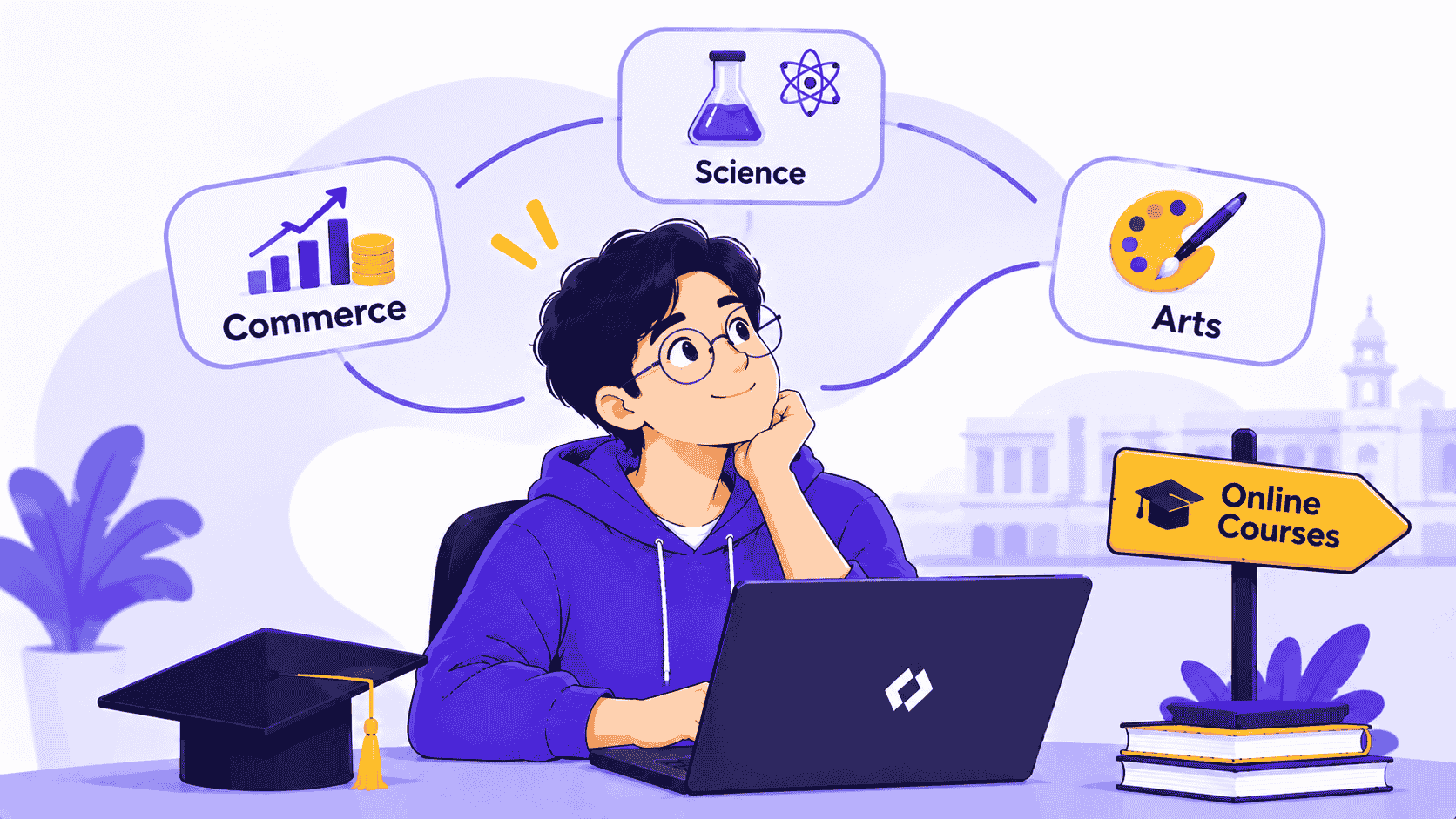
Top online courses after graduation by stream: commerce, science and arts
The most useful professional courses are those that align naturally with your undergraduate background while teaching demanding digital tools.
Commerce and management graduates
- Financial Modeling and Valuation: Teaches real-world DCF modeling, M&A basics, and advanced Excel usage. Primarily essential for entry-level corporate finance, investment analysis, and consulting.
- Business Analytics & Power BI: Connects accounting knowledge with business intelligence. Learning tools like SQL, Excel dashboards, and Tableau helps commerce graduates step into data reporting roles.
- CFA or ACCA Preparation Programs: For those aiming for core global finance, risk management, or portfolio advisory careers.
Science and engineering graduates
- Full-Stack Web Development: Covers frontend frameworks (React) and backend environments (Node.js, Python, or Java). Practical portfolios and GitHub repositories carry significant weight in tech hiring.
- Data Science & Applied Machine Learning: Builds on mathematics and statistics foundations using Python, pandas, and scikit-learn.
- Cloud Computing and DevOps: Focuses on AWS, Azure, Docker, and container management. Strong foundational skills here open pathways to infrastructure and systems administration roles.
Arts and humanities graduates
- UI/UX Design: Combines creative problem solving, psychology, and design software like Figma. Ideal for students with strong visual and research instincts.
- Digital Marketing & Performance Ads: Focuses on search engine optimization (SEO), social media strategy, paid advertising, and Google Analytics.
- Content Strategy and Technical Writing: High-demand writing roles in B2B software, media agencies, and corporate communications reward analytical thinking and clear communication.
Also Read: Top Courses in Demand for Commerce Students Abroad
Certificate vs degree vs diploma after graduation
Choosing between an online certificate, diploma, or degree largely depends on whether you need a quick skill addition or a concrete qualification.
| Online Certificate | Post-Graduate Diploma (PGD) | Online Master’s Degree (MBA, M.Sc, MCA) |
|---|---|---|
| 6 weeks to 6 months | 9 to 12 months | 2 years |
| Master specific tools(e.g., Python, Figma) | Comprehensive functional training | Broad managerial or specialised academic credential |
| 4-8 hours/week | 10-15 hours/week | 15-20 hours/week |
| Validates technical tool mastery | Shows focused domain competence | Accepted for institutional criteria & promotions |
| Freshers wanting portfolio projects | Career pivoters needing structured curriculum | Long-term corporate ladder growth |
Cost and time investment of online courses after graduation
Online education offers significant savings compared to traditional on-campus programs, but quality varies widely.
- Short Skill Certifications (1 to 4 months): Self-paced boot camps and platform courses (such as Coursera, Udemy, LinkedIn Learning) typically range from ₹2,000 to ₹35,000. These are best for picking up focused tools quickly.
- Executive & Professional PG Diplomas (6 to 12 months): Offered by multiple universities and specialized educational platforms, these programs cost between ₹40,000 and ₹1,50,000, usually providing weekly live lectures, mentor reviews, and capstone projects.
- Accredited Online Degrees (2 years): Online MBA or MCA programs from UGC-recognized universities generally range from ₹1,00,000 to ₹3,00,000 total.
Also Read: AI-Safe Jobs and Degrees for 2026
Related Articles
- Google vs upGrad vs Simplilearn Digital Marketing: Which to Choose
- Is Online MBA Worth It in India?
- UGC Degree vs Distance Education vs Certificate: What Indian Employers Actually Accept
- 10 Jobs in India Where AI Has Already Replaced Entry-Level Work, and What to Learn Instead
- Top Courses in Demand for Commerce Students Abroad
Compare programs on OLRight: see online certification and degree programs with fees, duration and outcomes side by side.
Talk to a GradRight counselor free: get personalised guidance on choosing the right program for your goals and budget.
Compare education loans: check EMI and funding options before you enroll.




 Australia
 Canada
 France
 Germany
 India
 Ireland
 UAE
 United Kingdom
 United States