MBBS is one of the most gruelling courses in India. Before the classes begin, you should know which subjects you will study and when. The course is split into several phases, and each phase has its own subjects, practicals, and exams.
This article covers the full MBBS subject list year-wise, how practical training works, and other details about how to make the most of your time.
MBBS subjects in India: Course structure, phases, and duration
Before you look at individual subjects, it helps to know how the whole course is laid out.
The MBBS course runs for 5.5 years (66 months). That is 4.5 years of academic study across 9 semesters, followed by a 12-month compulsory internship.
The National Medical Commission allows a maximum of 9 years from admission to complete the whole course, so clearing exams on time matters. Each year, the student needs to attend a minimum number of teaching days, which is why attendance rules are strict.
| Phase | Professional year | Duration | Main focus |
|---|---|---|---|
| Phase I | 1st Professional | 12 to 13 months | Pre-clinical sciences and Foundation Course |
| Phase II | 2nd Professional | 12 months | Para-clinical subjects and first clinical postings |
| Phase III Part 1 | 3rd Professional Part I | 12 to 13 months | Clinical theory, community medicine, specialty postings |
| Electives | Between Part 1 and Part 2 | 1 month | Two blocks of 15 days each |
| Phase III Part 2 | 3rd Professional Part II | 12 to 18 months | Major clinical subjects, bedside clerkship, final exams |
| Internship (CRMI) | After final MBBS | 12 months | Rotations across hospital departments |
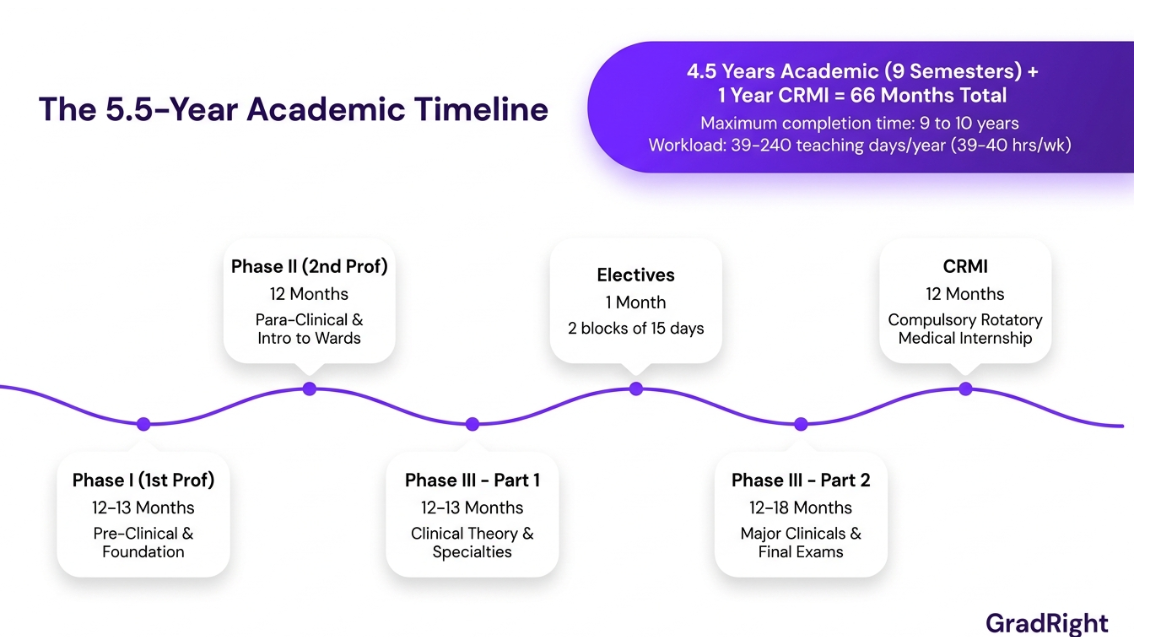
Keep this timeline in mind, because every subject in the next sections fits into one of these phases.
Also Read: How Much Does MBBS Really Cost in India? A Complete Fee Breakdown (2026)
MBBS subjects year-wise: Complete syllabus and subject list
Knowing your subjects year-wise helps you plan your studies from day one. The MBBS syllabus in India follows the Competency-Based Medical Education (CBME) curriculum set by the National Medical Commission (NMC).
Here is a brief but comprehensive breakdown of MBBS subjects year-wise.
First year: You start with Anatomy (gross anatomy, histology, embryology, neuroanatomy, genetics), Physiology, and Biochemistry. A Foundation Course of up to a month helps you settle in. You also get a first look at patients through Early Clinical Exposure, an introduction to Community Medicine, and village outreach under the Family Adoption Programme.
Second year: Pathology, Pharmacology, and Microbiology will take most of your time. Forensic Medicine and Toxicology also begin at this stage. Alongside these, you start receiving clinical postings in hospital wards.
Third year: The major area of study is Community Medicine, covering epidemiology, public health, biostatistics, and health administration. You also study Ophthalmology and ENT and rotate through Medicine, Surgery, OBG, Pediatrics, Orthopedics, Psychiatry, Respiratory Medicine, and Radiology.
Final year: This phase focuses on the major clinical subjects:
- General Medicine, with Psychiatry, Dermatology (DVL) and Respiratory Medicine
- General Surgery, with Orthopedics, Anesthesiology, Radio-diagnosis, PMR and Dentistry
- Obstetrics and Gynaecology, including family welfare
- Pediatrics, including neonatology and child growth
Each year builds on the last, so strong basics in the first year will help you later.
Also Read: Medical & MBBS Universities in Germany for Indian Students: Complete Guide
MBBS subjects: Core subjects, electives, and integrated modules
Apart from the main subjects, you will also work with electives and modules that connect everything together. The NMC groups MBBS subjects into three broad types.
| Category | Subjects |
|---|---|
| Pre-clinical | Anatomy, Physiology, Biochemistry |
| Para-clinical | Pathology, Pharmacology, Microbiology, Forensic Medicine and Toxicology, Community Medicine |
| Clinical | General Medicine and allied, General Surgery and allied, OBG, Pediatrics |
Electives: After your Phase III Part 1 exams, you will complete a one-month elective in two 15-day blocks. Block 1 is usually a lab or research project in a basic science department. Block 2 can be a clinical posting (ICU, casualty, blood bank), AYUSH, research methodology, AI in healthcare, or health management. You need 75% attendance and a completed logbook to be eligible for the final exams.
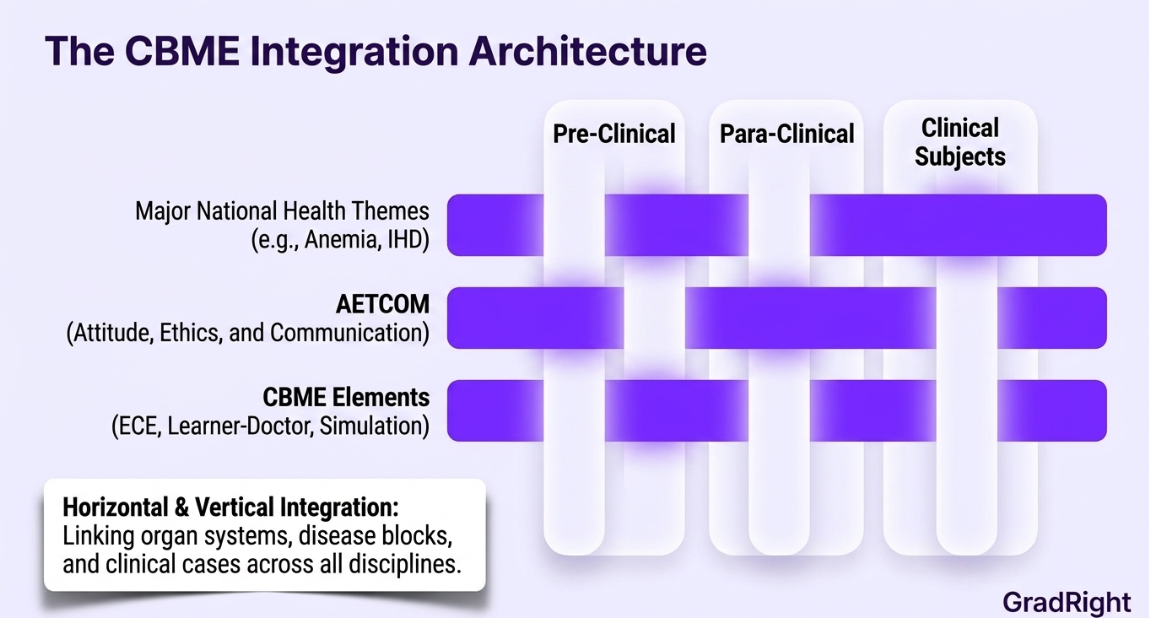
Integrated modules: CBME does not treat subjects as separate entities. Topics like anemia and ischemic heart disease are taught across departments, so you see the same disease from the anatomy, physiology, and clinical sides.
AETCOM. The Attitude, Ethics and Communication module runs through all four professional phases. It teaches you how to talk to patients, break bad news, and act ethically.
These extras shape how you think like a doctor, not just what you memorise.
Also Read: Deemed Universities in India for MBBS: Full List, Fees & Admission 2026
Practical training in MBBS subjects: Labs, clinical postings, skills, and projects
Practical training is a significant part of MBBS training from the very beginning. You will spend as much time in labs and wards as in lecture halls.
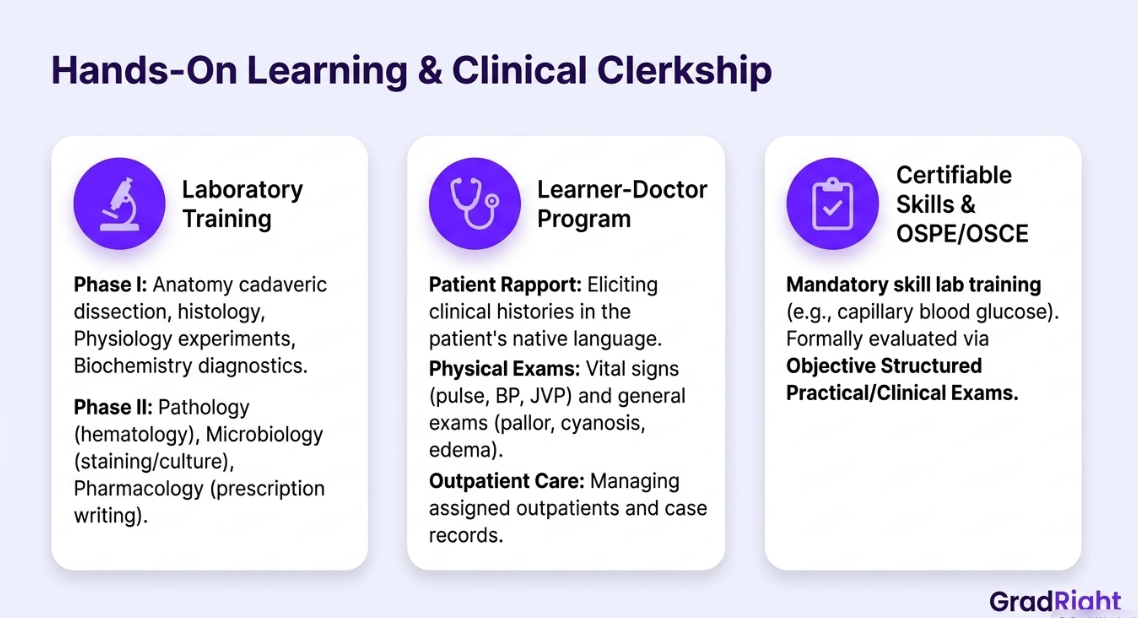
- Labs: In Phase I, you do cadaveric dissection and histology in Anatomy, experiments in Physiology, and diagnostic sessions in Biochemistry. In Phase II you work on hematology and histopathology in Pathology, staining and culture in Microbiology, and prescription writing in Pharmacology.
- Clinical postings: These begin in Phase II at about 15 hours a week (3 hours daily, Monday to Friday). In Phase III Part 2, they rise to about 18 hours a week (Monday to Saturday).
- Learner-doctor clerkship: You take histories in the patient’s own language, check vitals, and do general and systemic examinations. You also follow assigned outpatients and write case records.
- Skill labs: You practise certifiable skills, such as checking capillary blood glucose. Skills are tested through OSPE and OSCE exams.
- Logbooks: You record case discussions, seminars, AETCOM reflections and skills. You need regular submissions and 75% attendance to appear for the university exams.
Also Read: NEET Counselling to MBBS Loan Disbursement: A Timeline Guide for MBBS Students in India (2026)
Best books and study resources for MBBS subjects
The right books save you a lot of time, so choose them carefully. Your college and seniors will suggest books for each subject. These are standard references for some subjects:
| Subject | Recommended books |
|---|---|
| Forensic Medicine and Toxicology | The Essentials of Forensic Medicine and Toxicology (K.S. Narayan Reddy and O.P. Murthy), Textbook of Forensic Medicine and Toxicology (V.V. Pillay), Review of Forensic Medicine and Toxicology (G. Biswas) |
| Community Medicine | Park’s Textbook of Preventive and Social Medicine (K. Park), Textbook of Preventive and Social Medicine (B.K. Mahajan and M. Gupta), IAPSM’s Textbook of Community Medicine (A.M. Kadri) |
| Medical ethics | Medical Ethics for Students and Doctors (Borah) |
| Medical education | Principles of Medical Education (Dr. T. Singh) |
| Journals | The National Medical Journal of India, Indian Journal of Medical Research |
How MBBS subjects prepare you for internship and medical careers
There is a reason the curriculum moves in this particular order.
- Anatomy and Physiology help you understand the normal body. Pathology and Microbiology show you how disease develops. Pharmacology teaches you how treatment works. Clinical subjects then bring these areas together when you examine and manage patients.
- Along the way, AETCOM, clinical postings, community work, and practical training develop communication, professionalism, teamwork, and decision-making.
- By the time you enter the 12-month CRMI, you should therefore be prepared to apply your academic knowledge during supervised rotations across major hospital departments.
Also Read: Collateral-Free MBBS Loans in India
Related Articles
- How Much Does MBBS Really Cost in India? A Complete Fee Breakdown
- NEET Counselling to MBBS Loan Disbursement: A Timeline Guide for MBBS Students
- Medical & MBBS Universities in Germany for Indian Students: Complete Guide
- Private Universities in India for MBBS: Colleges, Fees & Admission 2026
- Deemed Universities in India for MBBS: Full List, Fees & Admission 2026
How GradRight can help you plan your MBBS education
Understanding the syllabus is only one part of your MBBS study. You need to understand what the best medical colleges offer, the exact structure of their program, and the relative strengths of each.
With GradRight, you can compare medical courses based on your academic profile, budget, and goals. Graddie, GradRight’s AI assistant, can help you work through questions about courses, universities, admission choices, costs, career direction, and higher-education planning.
If financing becomes part of your decision, you can also compare options through GradRight’s education loan marketplace.
You can access GradRight through Google Play or the App Store.




 Australia
 Canada
 France
 Germany
 India
 Ireland
 UAE
 United Kingdom
 United States