
You have cleared the NEET UG examination for admission to an MBBS or BDS seat. You now have to go through the NEET counselling process with its own registration and rules.
In this guide, I will help you understand the NEET UG counselling process 2026 simply. By the time you’re done, you’ll know exactly what to do at each stage.
NEET counselling 2026: Who conducts it and which seats are covered?
In India, admission to medical, dental, and nursing seats happens at both the central and state level.
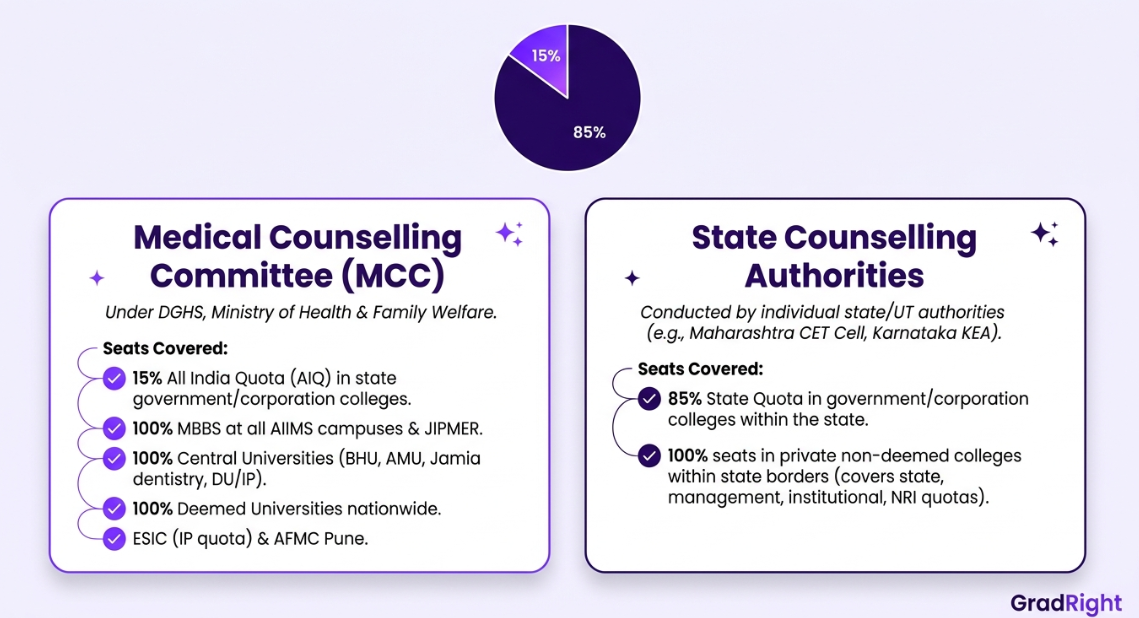
The Medical Counselling Committee, or MCC, conducts national-level counselling. MCC counselling 2026 covers:
- 15% All India Quota seats in participating government medical and dental colleges
- 100% MBBS seats in AIIMS and JIPMER
- Seats in central universities
- 100% seats in deemed universities
- ESIC Insured Persons quota seats and AFMC registration
Your state or Union Territory has a separate counselling authority. It generally handles the remaining 85% state quota seats in government colleges and seats in private non-deemed medical and dental colleges within that state.
Also Read: SBI Education Loan for MBBS 2026: Eligibility, Interest Rates & Loan Amount
MCC NEET counselling 2026 vs state counselling: AIQ and state quota explained
MCC NEET counselling and state counselling for MBBS and BDS seats run in parallel. The main differences are who can apply and which reservation rules apply.
| Feature | MCC All India Quota counselling | State quota counselling |
|---|---|---|
| Conducting authority | Medical Counselling Committee | Respective state or UT authority |
| Government college seats | Mainly 15% All India Quota seats | Mainly the remaining 85% state quota seats |
| Domicile requirement | Open AIQ seats generally do not require state domicile | State quota seats usually require you to meet that state’s domicile or eligibility rules |
| Reservation | Central reservation rules apply | State-specific reservation rules apply |
| Registration portal | mcc.nic.in | Separate state counselling portal |
You can take part in both MCC counselling 2026 and your state counselling at the same time. Joining one does not cancel your chance in the other, as long as you follow each round’s joining, resignation, and other rules.
Also Read: How Much Does MBBS Really Cost in India? A Complete Fee Breakdown
NEET counselling 2026 registration, fees, choice filling, and choice locking
Once you know which counselling routes apply to you, the next step is registration. The process has four main steps:
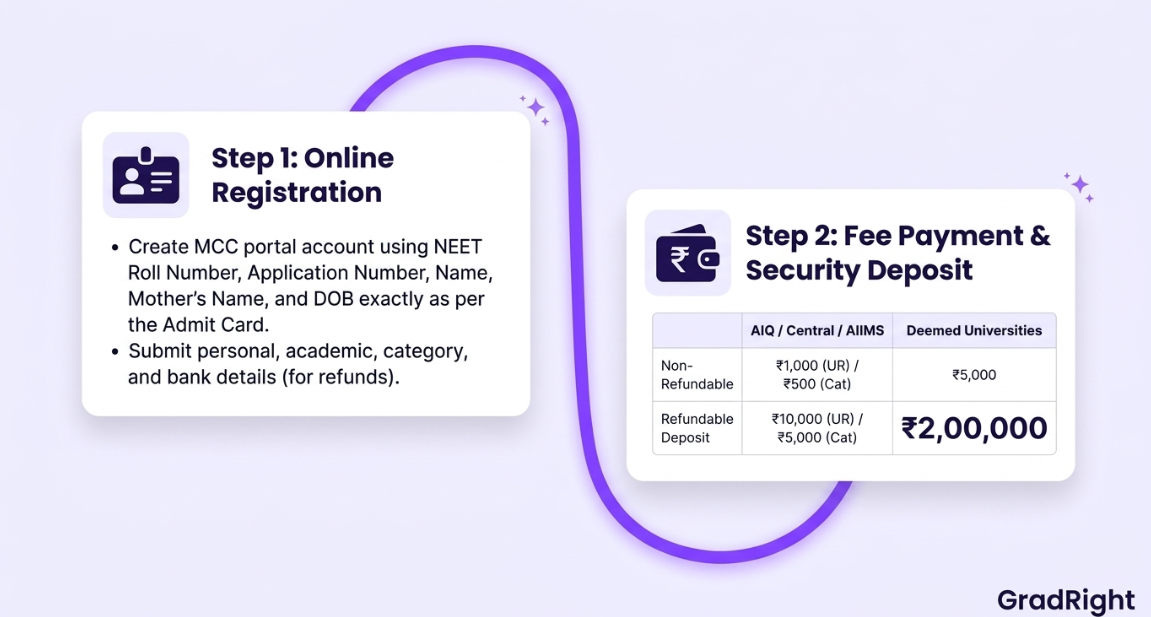
- Registration. Create an account on mcc.nic.in using your NEET roll number, application number, your name, your mother’s name, and your date of birth, exactly as printed on your admit card. Then fill in your personal, qualification, and category details, add bank account details for the deposit refund, and select the quotas you are eligible for.
- Fees. You pay two amounts before choice filling opens.
- Registration fee (non-refundable): ₹1,000 for UR/EWS and ₹500 for SC/ST/OBC/PwD candidates for AIQ, central universities, AIIMS, JIPMER and ESIC. For deemed universities, it is ₹5,000 for everyone.
- Security deposit (refundable): ₹10,000 for UR/EWS and ₹5,000 for SC/ST/OBC/PwD. For deemed universities, it is ₹2,00,000 for everyone.
- Choice filling. Filter seats by institute type, name, course, and quota, then add colleges in the exact order you prefer them. “Save and Continue” stores your list without submitting it.
- Choice locking. Before the deadline, go to Lock Choice, review your list, enter your password, and verify the OTP. If you saved choices but forgot to lock them, the system locks your last saved list automatically. If you saved nothing, you get no allotment. After locking, you cannot edit choices for that round.
Also Read: Medical & MBBS Universities in Germany for Indian Students: Complete Guide
NEET counselling 2026 round-wise process: Round 1, Round 2, Round 3, and Stray Vacancy Round
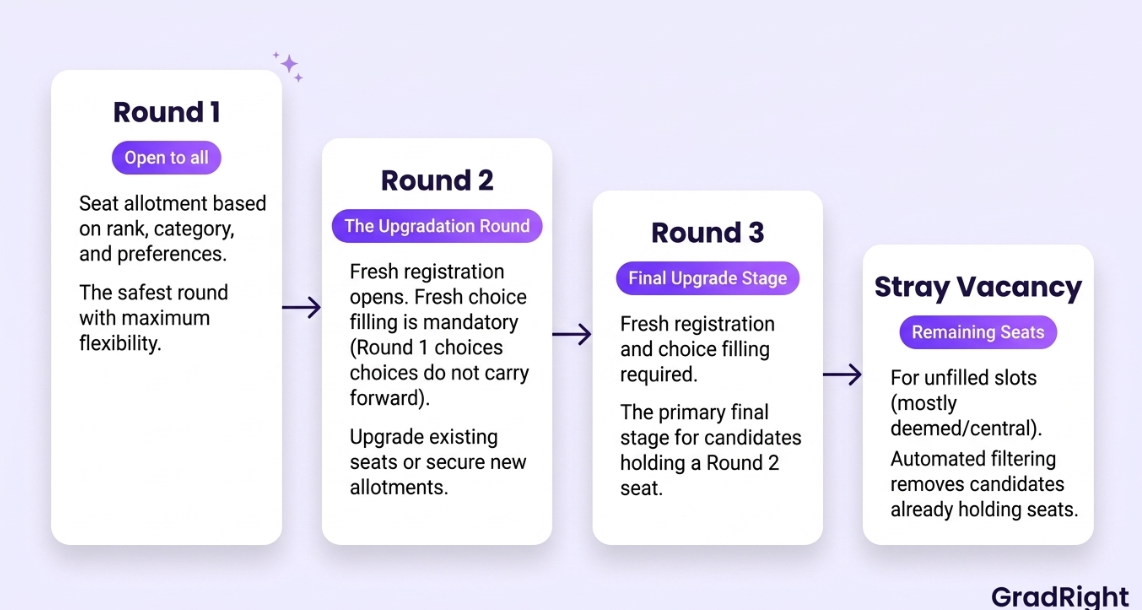
The NEET UG counselling 2026 process moves through four main MCC rounds. The rules become stricter as you move from one round to the next.
| Round | Who can participate | What you need to do | Main point to remember |
|---|---|---|---|
| Round 1 | Eligible NEET-qualified candidates who register | Register, pay fees, fill choices, and wait for allotment | You have the greatest flexibility at this stage |
| Round 2 | Candidates seeking a fresh seat or an upgrade, and eligible fresh registrants | Fill a fresh choice list | Round 1 choices do not automatically carry forward |
| Round 3 | Eligible candidates who have not secured a final seat or want an allowed upgrade | Register where required and submit fresh choices | Exit rules are stricter than in earlier rounds |
| Stray Vacancy Round | Eligible candidates for remaining vacant seats | Register and fill fresh choices under the applicable rules | This is the final opportunity for remaining seats |
The MCC counselling schedule 2026 gives separate dates for registration, choice filling, allotment results, and reporting in each round. You should check the official schedule before every round because deadlines can change.
One point is especially important. Do not assume that the choices you entered earlier will remain active. Fresh choice filling is required in later rounds under the counselling rules. If you want to participate, you need to submit your preferences again within the notified window.
The official MCC counselling schedule 2026 is published on mcc.nic.in, so check it regularly.
NEET counselling 2026 seat allotment, upgradation, exit, and reporting rules
Once you receive an allotment, you have to decide whether you want to keep the seat or try for a better one.
Round 1
- Reporting to the college is not compulsory. You can take a Free Exit, and your security deposit stays safe.
- If you are happy with the allotted seat, you report, verify documents, pay fees, and finish admission.
- If you want a better college, you select “Willing to upgrade” on the MCC portal. Now you move to Round 2 with your Round 1 seat as a backup.
Round 2
- If you get an upgraded seat, your Round 1 seat is cancelled at once and cannot be taken back.
- There is no free exit at this stage. If you are allotted a seat and do not join, your deposit is forfeited.
- If you join your Round 2 seat, you can ask for a further upgrade in Round 3.
Round 3
- Once you join, resignation is not allowed, and no more upgrades are possible.
- If you are allotted a seat and do not report, you lose your deposit and are removed from all later rounds.
Stray Vacancy Round
- There is no float option, and joining is mandatory.
- Not joining means deposit forfeiture and possible debarment from NEET UG counselling for 1 to 2 years.
Also Read: NEET Counselling to MBBS Loan Disbursement: A Timeline Guide for MBBS Students
Documents required for NEET counselling 2026 and college reporting
You need to submit several sets of documents during the NEET counselling process. You must have originals, several sets of self-attested photocopies, and scanned PDFs for uploads.
Exam and academic documents
- NEET UG 2026 admit card and scorecard
- Provisional allotment letter and registration confirmation slip
- Class 10 and Class 12 marksheets and passing certificates (Class 10 works as date of birth proof)
- Photo ID such as Aadhaar, passport, PAN card or driving licence
- 10 to 15 passport-size photos matching your NEET form photo
- Cancelled cheque, passbook or bank statement copy for the deposit refund
Category and quota documents
- SC/ST/OBC-NCL/EWS certificate in the Central Government format for AIQ seats, or the state format for state quota seats
- PwD certificate from an MCC-designated Disability Assessment Board
- Domicile certificate for state quota seats
Other documents
- Transfer certificate and migration certificate
- Character certificate and medical fitness certificate
- Gap certificate, which is a notarized affidavit on stamp paper if you took drop years after Class 12
- Proof of fee payment and signed bond and anti-ragging undertakings
Also Read: MBBS Loan in India 2026: Best Banks, Interest Rates & Eligibility Compared
Common NEET counselling mistakes that can cost you a seat
The NEET counselling process is lengthy, and mistakes occur all too often. Most NEET counselling mistakes are avoidable if you are careful and diligent. Here are some suggestions to keep in mind.
- Never fill too few choices. If your rank misses multiple colleges you aspired to get into, you will be stranded. Select both your dream medical colleges and safer options.
- Your choices do not carry over. This is a common error. For Rounds 2, 3, and the Stray Vacancy Round, you need to make fresh choices.
- A higher allotment takes away your previously allotted seat. You cannot gain admission to the Round 1 allotment seat after Round 2 allotment has been made.
- Do not ignore fee forfeiture deadlines. Skipping a Round 2 or Round 3 seat is expensive and can cost ₹10,000 to ₹2,00,000.
- Never skip state registration. Applying only on MCC means you are missing 85% of government seats and most private college seats.
Related Articles
- How Much Does MBBS Really Cost in India? A Complete Fee Breakdown
- Deemed Universities in India for MBBS: Full List, Fees and Admission
- Private Universities in India for MBBS: Colleges, Fees and Admission 2026
- Collateral-Free Loan for MBBS in India: A Complete Guide for Indian Students
- How to Apply for Education Loan for MBBS
How GradRight can help you compare medical colleges before choosing a seat
Your NEET counselling choice list should reflect more than just the college name.
You can take the help of GradRight to compare various MBBS and Dental college seat options. Look at colleges and narrow them down based on factors such as fees, location, and program information before making a choice.
Graddie, which is the AI-powered GradRight assistant, is available via an app and can help you think through college, course, affordability, and related decisions in one place.
If financing is part of your decision matrix, you can explore GradRight’s education loan marketplace. It offers you instant single-window access to multiple lenders and banks.
You can access GradRight through Google Play or the App Store.





 Australia
 Canada
 France
 Germany
 India
 Ireland
 UAE
 United Kingdom
 United States