




Unlike F-1 students, J-1 exchange visitors don’t get to treat health coverage as optional. J-1 visa health insurance is a federal requirement, written directly into U.S. immigration regulation, and falling short of it can put your program status at risk.
This guide breaks down exactly what the J-1 visa health insurance requirements are in 2026, what counts as compliant coverage, and how to avoid the most common mistakes that get exchange visitors flagged by their sponsors.
What are the J-1 Visa health insurance requirements
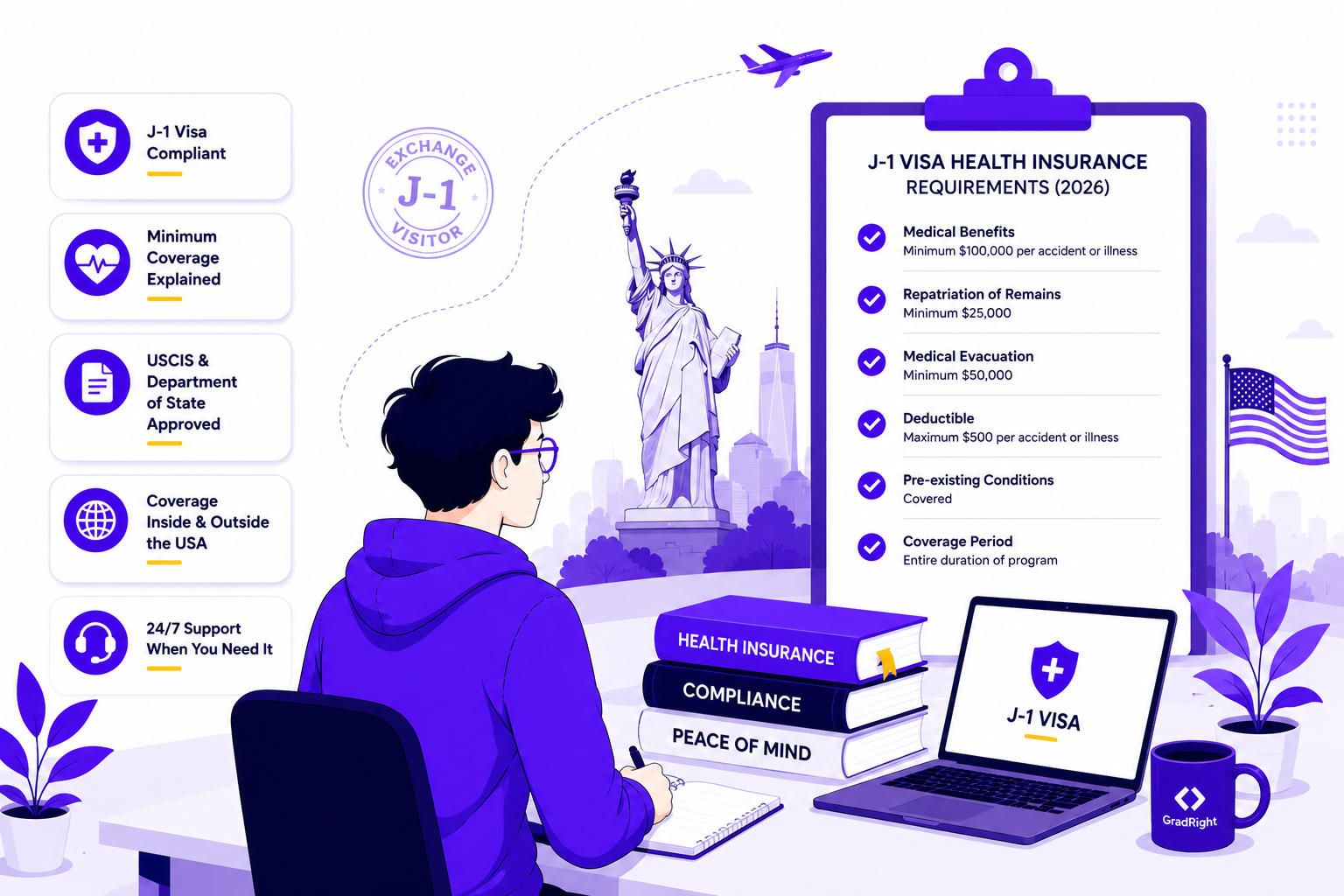
The J-1 Exchange Visitor Program is governed by U.S. Department of State regulation 22 CFR § 62.14, which lays out precise J-1 visa health insurance requirements that every J-1 participant, and every J-2 dependent, must meet for the full duration of the program. These are not suggestions; they are the minimum legal floor for insurance to be considered acceptable under federal rules.
As of 2026, a compliant policy must provide:
- Medical benefits of at least $100,000 per accident or illness (this threshold was raised from the earlier $50,000 minimum)
- Medical evacuation coverage of at least $50,000 (raised from a previous $10,000 minimum)
- Repatriation of remains coverage of at least $25,000, in the event of the exchange visitor’s death in the U.S.
- A deductible no greater than $500 per accident or illness
- Coinsurance that limits your out-of-pocket share to no more than 25% of covered charges
- Coverage of pre-existing conditions after a reasonable waiting period
- No exclusion of benefits for perils inherent to your specific exchange program activities
Why J-1 Visa health insurance is mandatory
The logic behind mandatory J-1 visa health insurance is straightforward: the U.S. healthcare system does not have price controls, and a single serious illness or accident can generate bills that would bankrupt most international visitors. The Department of State requires this coverage to protect exchange visitors, their dependents, and their sponsoring institutions from exactly that scenario, and to reduce the odds that a visitor without means to pay ends up needing emergency repatriation with no way to cover it.
Your program sponsor, typically your university or exchange organization, is legally responsible for verifying your compliance. If your coverage lapses or falls short of the minimums, sponsors can suspend or terminate your program, which directly threatens your SEVIS record and your visa status.
Also Read: OPT Health Insurance Guide for International Students (2026)
Who provides compliant J-1 Visa health insurance
You can satisfy J-1 visa health insurance requirements through a few different paths:
University-Sponsored Plans
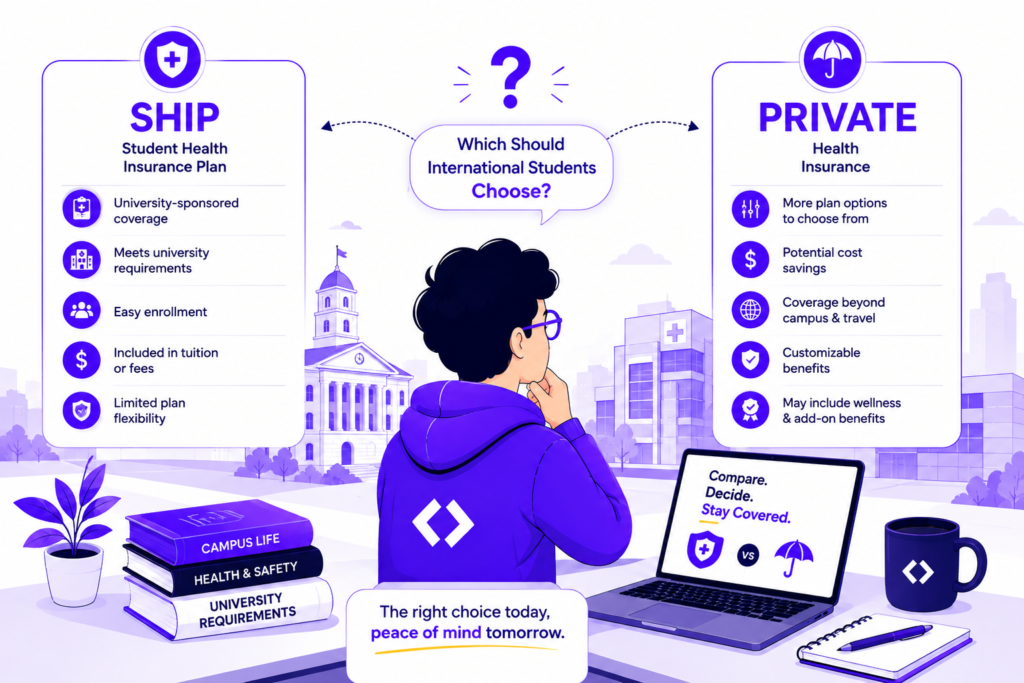
Many host institutions automatically enroll J-1 students and scholars in an institutional Student Health Insurance Plan (SHIP) that is pre-built to meet the federal minimums. This is often the simplest route, since compliance is handled for you.
Private U.S.-Based Insurance
You can also purchase a private plan directly, provided it explicitly meets every one of the coverage thresholds above. Not every commercially available student plan does; some popular budget plans cap the evacuation or repatriation benefit lower than the federal floor, which technically makes them non-compliant for J-1 purposes even if they’re marketed to international students generally.
Home-Country Or Employer-Sponsored Insurance
If you’re relying on a policy from your home country or an employer-provided plan, it must be backed by the full faith and credit of your home government, or issued by a company meeting specific U.S. rating standards (an A.M. Best rating of A- or better, for example). J-1 scholars on exchange programs through their employer should double-check this with their sponsor before assuming their existing coverage qualifies.
J-1 Visa health insurance for dependents (J-2)
The J-1 visa health insurance requirements extend fully to J-2 dependents – spouses and unmarried children under 21 accompanying the exchange visitor. Each dependent must be covered at the same minimum levels as the primary visa holder for the entire length of the program, including any approved extension of your DS-2019 form. Many university SHIP plans and private J-1 policies offer dependent add-ons specifically structured around this requirement.
How J-1 Visa health insurance differs from F-1 student insurance
This is where a lot of confusion happens on campus. F-1 international students are not bound by any federal insurance minimum; their university sets whatever standard it wants, and some schools don’t require insurance at all. J-1 visa holders don’t get that flexibility.
Even if your school’s waiver process is fairly relaxed for F-1 students, you as a J-1 exchange visitor generally cannot waive out of your institution’s group plan unless your alternative private policy independently satisfies the full federal minimums described above – coverage amount, evacuation benefit, repatriation benefit, deductible cap, and coinsurance limit, all at once.
What happens if your coverage falls short
If your sponsor determines that your insurance doesn’t meet the required J-1 visa health insurance requirements, you’ll typically be given a short window to purchase supplemental coverage or switch policies entirely. Ignoring the notice is the risky path: continued non-compliance can lead to termination of your program in SEVIS, which in turn jeopardizes your visa status and can complicate future U.S. immigration applications.
How To Check If Your Plan Is Compliant
Before assuming your policy is fine, verify these five line items against your actual policy document:
- Medical benefit maximum of at least $100,000 per accident or illness
- Medical evacuation benefit of at least $50,000
- Repatriation of remains benefit of at least $25,000
- Deductible capped at $500 or less
- Coinsurance structured so you pay no more than 25% out of pocket
If any one of these is missing or set lower than the minimum, your plan is not compliant, regardless of how comprehensive it looks otherwise.
Staying compliant without the stress
Meeting J-1 visa health insurance requirements isn’t just a formality; it’s a condition of maintaining your legal status in the U.S. GradRight’s platform helps international students and exchange visitors compare university-approved and private plans that are pre-checked against these federal minimums, so you’re not left guessing whether a policy’s fine print actually clears the bar. If you’re arriving on a J-1 visa and want a plan that’s compliant from day one, GradRight can help you check your options, compare costs, and get guidance on the waiver process where it’s actually available.






 Australia
  Canada
  France
  Germany
  India
India  Ireland
  UAE
UAE  United Kingdom
  United States