




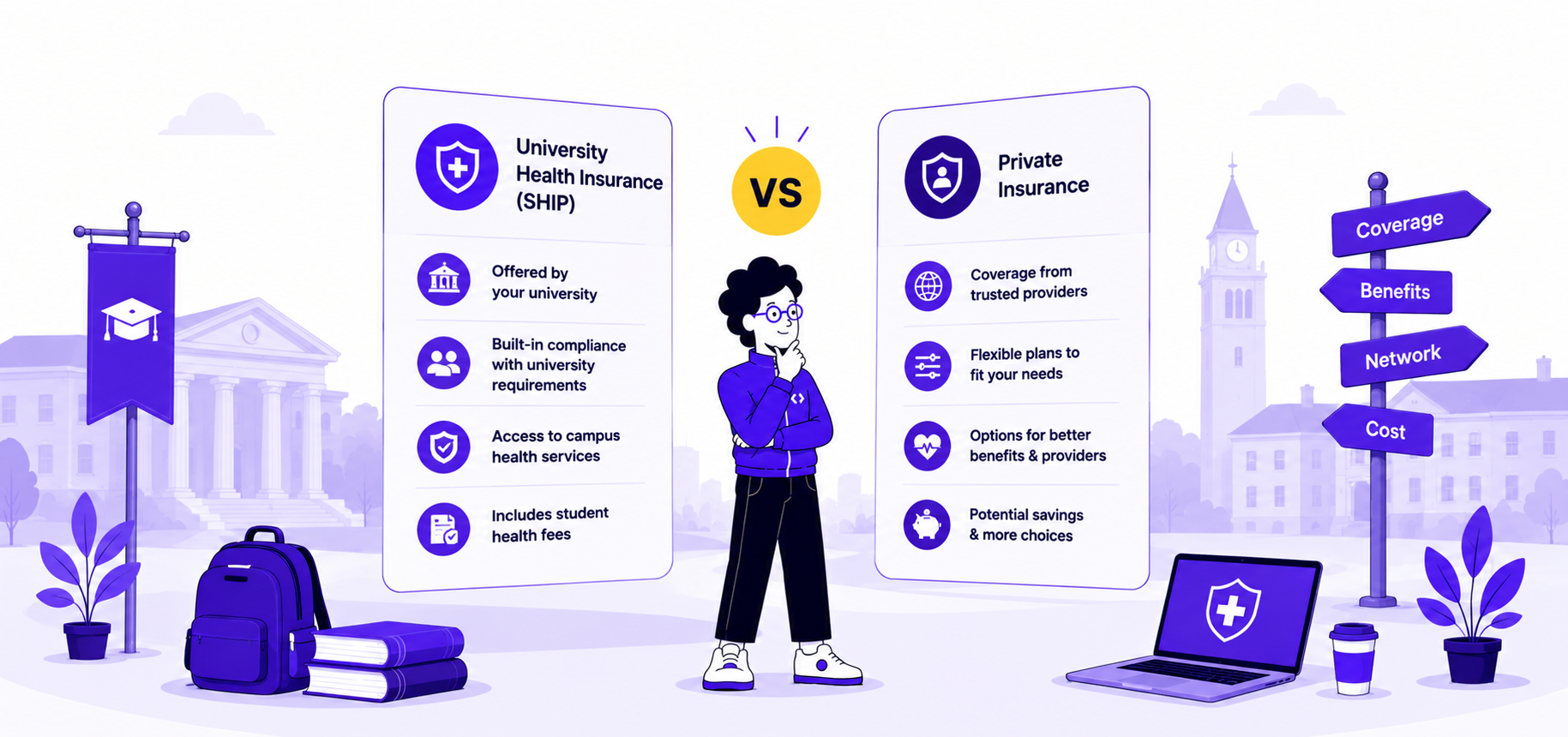
If you’re budgeting for a US degree, the university health insurance premium price is one line item that catches almost every international and domestic student off guard. Tuition gets planned for months in advance. Health insurance, on the other hand, shows up as an automatic charge on your student account, and at some schools, it can run into five figures a year.
This guide breaks down the actual annual premium at some of the top US universities, compares it against private student insurance plans, and explains why the gap between the two exists in the first place.
Why university health insurance premium price varies so widely across US colleges
There’s no national price for student health insurance in the US. Each university negotiates its own Student Health Insurance Plan (SHIP) with a carrier, usually Aetna, Blue Cross Blue Shield, Anthem, or UnitedHealthcare, and the premium you’re billed depends on:
- The local cost of healthcare: A university in Boston or San Francisco negotiates rates against some of the most expensive hospital systems in the country. A university in a lower-cost metro area pays less, and that’s reflected in your premium.
- The size and health profile of the student risk pool: Smaller schools or programs with fewer enrollees often see higher per-student premiums because costs are spread across fewer people.
- What’s bundled into the plan: Some schools separate a mandatory “health fee” (covering on-campus clinic visits) from the SHIP (covering off-campus, specialist, and hospital care). Others bundle everything into a single number, which makes the sticker price look higher even when total coverage is comparable.
- Degree level: Graduate, medical, and law students are consistently charged a higher premium than undergraduates at the same school, because they’re often enrolled in richer benefit tiers or different risk pools.
This is exactly why comparing one school’s headline number to others can be misleading unless you know what’s actually included.
What is SHIP, and how does it set your university health insurance premium price
SHIP stands for Student Health Insurance Plan. It’s the insurance policy a university sponsors, negotiates, and automatically enrolls you into unless you actively apply for a waiver. Almost every university with international students mandates SHIP or equivalent coverage, because federal and state law generally don’t require health insurance for international students, the university does, as part of its own compliance and duty-of-care policy.
Here’s what typically drives the annual premium on a SHIP plan:
- Underlying carrier costs: SHIP is medically underwritten insurance, not a subsidized campus service. The university negotiates a group rate, but you’re still paying actuarial cost for a PPO-style plan.
- Comprehensive, no-questions-asked coverage: SHIP plans generally have no medical underwriting, no health questionnaires, and often no or low deductibles. That flat, guaranteed-issue structure raises the average premium compared to plans that vary pricing by age and health status.
- On-campus health services bundled in: Many of the higher SHIP numbers you’ll see include a campus health fee that gives you free or low-cost access to a student health center – something a private plan wouldn’t include at all.
Because SHIP is automatic and billed directly to your student account, it’s easy to pay the full university health insurance premium price without ever comparing it to alternatives, which is the gap this guide is meant to close.
University health insurance premium price at top US universities
Below is the actual SHIP premium at several major US universities for this academic year. Always confirm current rates directly on your university’s student health portal, since prices are revised annually and vary by dependent status, degree level, and coverage tier.
| University | Annual Premium (USD) |
| UCLA | $7,517/year |
| UC Riverside | $5,577/year |
| UC Berkeley | $8,206/year |
| University of Chicago | $5,145/year |
| University of Southern California | $3,787/year |
Why the university health insurance premium price differs from private insurance cost
It’s tempting to assume SHIP is simply overpriced, but the gap in university health insurance premium price versus private plans usually comes down to structural differences, not just markup:
- Guaranteed issue vs. underwritten pricing: SHIP accepts every student regardless of age or health history at a flat group rate. Private plans, especially entry-level ones, often price more precisely by age band, which can make them cheaper for a 22-year-old but not necessarily for an older graduate student or a student with dependents.
- Bundled campus services: Part of what you’re paying for isn’t insurance at all – it’s guaranteed access to a physical clinic on campus.
- Network breadth and geography: A SHIP plan tied to a hospital system in a high-cost city like Boston, New York, or San Francisco will price differently than a nationally rated private plan.
- Compliance and waiver requirements: Universities set minimum coverage standards – deductible caps, maximum out-of-pocket limits, mental health parity, maternity coverage, and so on. A cheaper private plan that doesn’t meet those specific minimums won’t be accepted for a waiver no matter how good its price looks.
Also Read: Aetna vs UHC Student Health Insurance
How to lower your university health insurance premium price legally (the waiver process)
If a university-approved private plan meets your school’s minimum requirements, you can usually apply for a SHIP waiver and avoid the SHIP charge on your student account entirely. The process generally looks like this:
- Check your university’s minimum coverage checklist – most schools publish specific requirements (deductible maximum, coverage area, benefit maximum, mental health and prescription coverage, etc.) on their student health services website.
- Compare private plans against that checklist, not just against price. A private plan that’s cheaper than your SHIP premium but fails even one requirement will get your waiver rejected, and you’ll be billed for SHIP retroactively.
- Apply before the deadline. Waiver windows are typically open for a few weeks at the start of each term (often tied to the first three weeks of classes) and are rarely reopened once missed.
- Submit proof of continuous coverage for the full policy period your university requires, since a gap in coverage will also disqualify a waiver.
Because deadlines and requirements differ by school, and because a rejected waiver can end up costing more than simply staying on SHIP, this is the step where most students actually need a side-by-side comparison rather than a general price search.
SHIP vs private insurance: Coverage tradeoffs beyond the premium
Price is only half the decision. Before waiving out of SHIP to chase a lower premium, it’s worth weighing:
- Deductibles and coinsurance: A private plan might have a lower premium but a much higher deductible, meaning your actual out-of-pocket cost in a real medical event could be higher.
- Network access near campus: SHIP plans are usually built around the exact hospital and specialist network near your university. A national or international private plan may have thinner local coverage.
- Mental health and prescription benefits: These vary significantly between plans and matter for day-to-day student life, not just emergencies.
- Claims handling from outside the US: If you’re an international student, how easily a plan processes claims, and whether it has US-based customer support, can matter as much as the premium itself.
Also Read: WellAway Health Insurance: Is It Worth It for International Students in 2026?
How GradRight helps you compare university health insurance premium price and private options
This is precisely the comparison problem our platform is built to solve. Rather than manually cross-checking your university’s SHIP requirements against multiple private insurers, GradRight lets you check whether your specific university supports its pre-approved private plans, compare benefits side by side, and walk through the waiver process with guidance, so the decision isn’t just about the lowest university health insurance premium price, but the lowest price that will actually get your waiver approved.







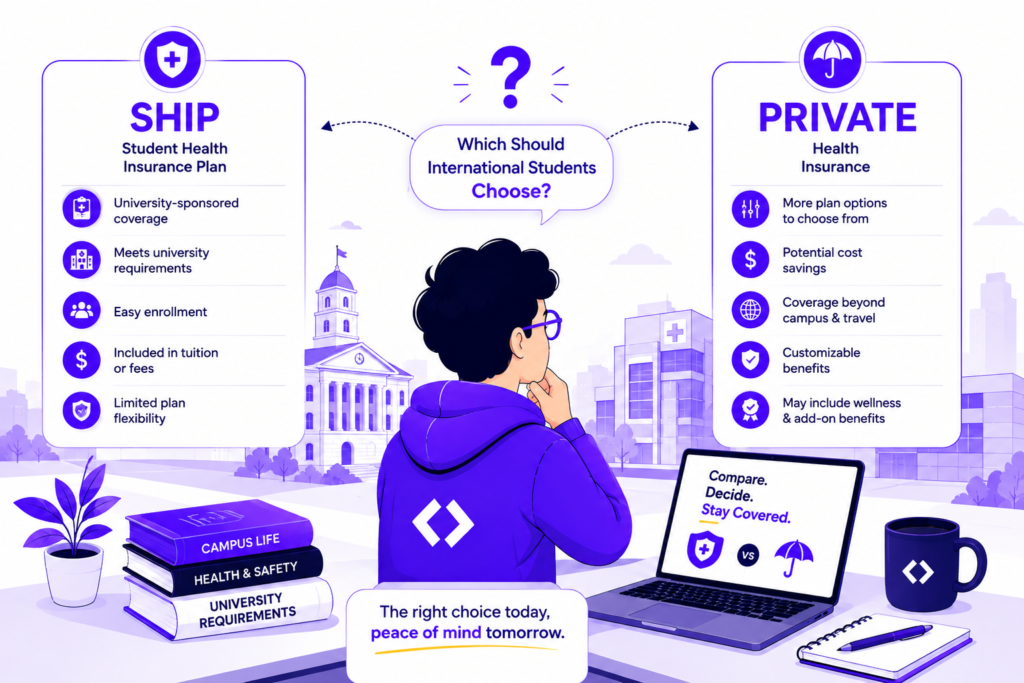

 Australia
  Canada
  France
  Germany
  India
India  Ireland
  UAE
UAE  United Kingdom
  United States