
For Indian students who’ve moved to the US for higher studies and landed a job after graduation, the loan they took out back home can start to feel like the wrong deal. Interest rates north of 12% don’t look great next to what US lenders are offering, and that’s exactly why SoFi student loan refinancing keeps coming up in every Indian student forum and finance subreddit.
But before you get your hopes up: SoFi’s refinancing product wasn’t built with Indian students at the center of the design. It’s a US-first product with US-first eligibility rules, and whether it works for you depends heavily on your visa status, your credit history, and critically, where your original loan came from.
This review breaks down exactly how SoFi student loan refinancing works, what it costs, who actually qualifies, and where Indian students tend to hit a wall.
What is SoFi student loan refinancing?
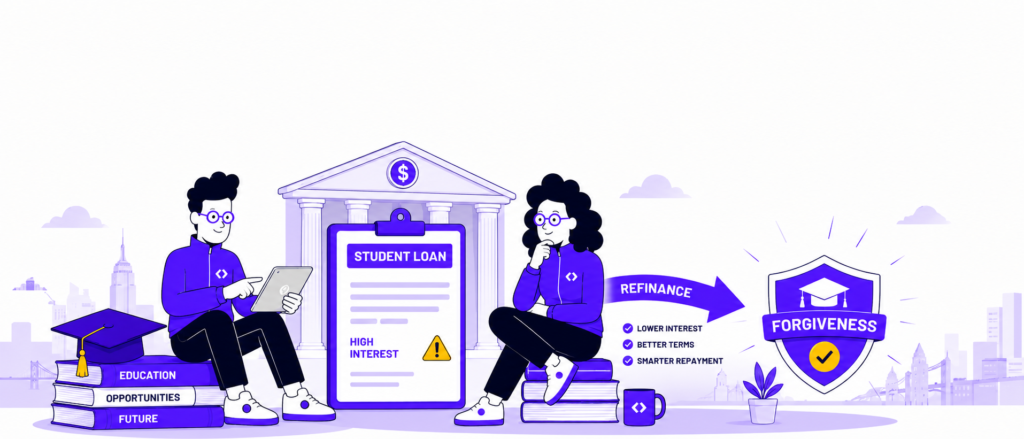
SoFi (Social Finance, Inc.) is a US-based online lender that lets borrowers pay off one or more existing student loans and replace them with a single new loan, ideally at a lower interest rate or with better terms. Instead of juggling multiple monthly payments across different loans, you end up with one payment, one rate, and one lender.
SoFi Student Loan Refinancing is one of the largest and best-known products of its kind in the US. The loans are private (not government-backed) and are originated by SoFi Bank, N.A., an FDIC member.
Refinancing is different from taking a fresh loan. You’re not borrowing new money for tuition; you’re swapping an existing loan for a new one that (hopefully) has better terms. It’s also different from “repricing,” where you renegotiate your interest rate with the same lender rather than switching lenders entirely.
How SoFi student loan refinancing works
The basic mechanics are simple:
- You apply online and SoFi runs a soft credit check (which doesn’t affect your credit score) to show you the rates you may qualify for.
- If you like the offer and move forward, SoFi runs a hard credit pull as part of the full application.
- Once approved, SoFi pays off your existing loan(s) directly.
- You begin making payments on your new SoFi loan, on new terms.
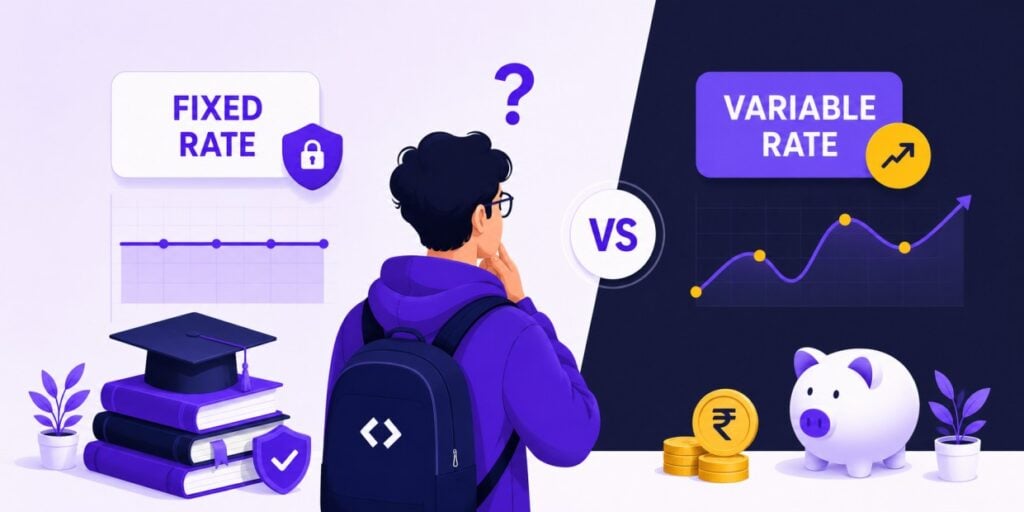
You can choose between a fixed-rate loan (where your rate and payment stay the same for the life of the loan) or a variable-rate loan (where your rate can move with the market). SoFi’s variable-rate refinance loans are capped at 13.95% APR across all its 5, 7, 10, 15, and 20-year terms.
SoFi student loan refinancing rates in 2026
SoFi advertises fixed rates starting as low as 3.99% APR with autopay enabled. The exact rate you’re offered depends on your credit profile, income, loan term, and whether you enroll in autopay (which comes with a 0.25% rate discount).
For context, Indian students refinancing an Indian education loan, where private lenders often charge 12–14% or more, into a US-based refinance can see rates fall into roughly the 4.49%–9% range, depending on creditworthiness. A credit score in the 580–669 band or higher generally puts you in a stronger negotiating position, and the strongest credit profiles get the lowest advertised rates.
Keep in mind: SoFi reserves its lowest advertised rates for the most creditworthy borrowers, and refinancing into a longer term, even at a lower rate, can mean paying more total interest over the life of the loan.
SoFi student loan refinancing eligibility criteria
SoFi’s eligibility requirements are specific, and several of them directly affect whether Indian borrowers can qualify.
Citizenship and Visa Requirements
According to SoFi’s own eligibility criteria, you must be one of the following:
- A US citizen
- A permanent resident
- A non-permanent resident alien with valid, current immigration documentation
For non-permanent resident aliens, SoFi accepts specific visa categories: E-2, E-3, H-1B, J-1, L-1, or O-1, along with valid Form I-797A or I-797B documentation. DACA recipients and asylum seekers can also qualify if they hold a valid Employment Authorization Document and have filed the relevant immigration applications.
Notice what’s missing from that list: the F-1 student visa. Most Indian students in the US are on F-1 status (often working under OPT) right after graduation, and F-1/OPT isn’t one of SoFi’s accepted visa categories for refinancing. In practice, this means many recent Indian graduates need to either secure H-1B status first, or apply with a creditworthy co-signer who is a US citizen or permanent resident, before SoFi will consider their application.
Employment and Income
You need to be employed, have another steady source of income, or have a confirmed job offer set to begin within 90 days of applying. SoFi doesn’t publish a minimum income figure, but you do need to demonstrate the ability to repay the loan.
Education Requirements
You must have previously enrolled in, or graduated from, a degree-granting Title IV-eligible school, and generally hold at least an associate degree or higher. Loans currently funding an actively enrolled student’s education are not eligible for refinancing; you can only refinance loans tied to programs you’ve already completed.
Loan Origin
This is the other major sticking point for Indian students: your student loan must not have originated outside the United States. If your original loan came from an Indian bank or NBFC (SBI, ICICI, Credila, Avanse, and similar lenders), SoFi will not refinance it directly. SoFi refinancing is only available once you already hold a loan from a US-based lender.
Loan Size
SoFi only refinances student loans totaling at least $5,000, and the funds must have originally gone toward tuition at an eligible Title IV accredited school where you were enrolled at least half-time.
Credit Score
SoFi doesn’t publish an official minimum credit score, and it evaluates your full credit history as part of underwriting. That said, applicants with scores below 700 are rarely approved, so a strong US credit history significantly improves your odds and your rate.
Is SoFi student loan refinancing right for Indian students?
Here’s where the pieces come together. Whether SoFi works for you as an Indian student comes down to two questions: What visa are you on, and where did your original loan come from?
Scenario 1
You took your original education loan from a US-based lender (like MPOWER or Prodigy Finance), and you’re now on H-1B, J-1, L-1, O-1, or E-2/E-3 status with a steady US income.
This is the profile SoFi is actually built for. If this describes you, SoFi is genuinely worth comparing – its rates and streamlined online process are competitive with the rest of the market.
Scenario 2
You took your original education loan from an Indian bank or NBFC, and you’re still on F-1/OPT status.
This is the more common starting point for Indian students, and unfortunately it’s the profile SoFi is least suited to serve – on two fronts at once. Your loan’s origin outside the US disqualifies it from direct SoFi refinancing, and F-1/OPT isn’t on SoFi’s accepted visa list.
In this case, the realistic path is a two-step “refinancing ladder”: first refinance your Indian loan with a lender that does accept Indian-originated loans, and once that gives you a US-based loan and you’ve transitioned to an eligible visa status like H-1B, you may then become eligible to refinance again with SoFi for a potentially lower rate.
A co-signer can bridge some of these gaps. Applying with a creditworthy co-signer who is a US citizen or permanent resident is one way around the citizenship/visa restriction. But that co-signer takes on full responsibility for the loan, and SoFi does not offer co-signer release, meaning your co-signer stays on the hook until the loan is paid off in full, with no built-in path to remove them later.
The honest takeaway: SoFi student loan refinancing can be an excellent option for Indian professionals who’ve already cleared the visa and loan-origin hurdles, but it’s not a first-step solution for most Indian students straight out of school with an Indian-originated loan.
Benefits of refinancing with SoFi for Indian professionals in the US
If you do qualify, here’s what refinancing can realistically do for you:
- Lower interest rate or better terms. Moving from a 12–14% Indian lender rate into a US-based refinance can mean substantial long-term savings, along with the flexibility to lower your monthly payment or extend your repayment period.
- Simpler repayment logistics. Paying an Indian lender from a US paycheck means dealing with international banking fees, currency conversion, and transfer delays every single month. Refinancing with a US-based lender like SoFi removes all of that friction, you’re paying in USD, to a US account, on a US billing cycle.
- Access to employer student loan assistance. Some US employers contribute up to $5,250 a year toward employees’ student loan debt, but that benefit is often only available for loans held with a US-based lender, not an international one. Refinancing can make you eligible for these programs.
- Releasing a co-signer or collateral. If your original Indian loan required a co-borrower or pledged collateral, refinancing once you have steady US income can free them from that obligation (note: this applies to your original Indian loan – SoFi itself does not offer co-signer release on its own loans, as noted above).
- Building US credit history. Every on-time payment on a US-based loan builds your domestic credit profile, which helps with everything from future loans to credit cards, and can improve your terms if you ever refinance again.
What you give up: Risks and trade-offs
Refinancing isn’t free of downsides, and it’s worth being clear-eyed about them:
- You may pay more interest over the life of the loan if refinancing extends your repayment term, even at a lower rate.
- Prepayment or foreclosure fees may apply on your original Indian loan when you pay it off early. Factor this into your savings calculation before switching.
- If you ever refinance a federal US loan (less relevant for most Indian student loans, but worth knowing) you permanently forfeit access to federal benefits like Income-Driven Repayment, deferment, forbearance, and Public Service Loan Forgiveness.
- No co-signer release from SoFi. Anyone who co-signs your SoFi loan is committed until it’s paid in full.
Documents you’ll typically need
Exact document requirements vary by lender, but for refinancing an education loan as an Indian professional in the US, expect to gather:
- Immigration status: proof of your current US visa status (or green card/citizenship documentation).
- Identification: a valid passport or other government-issued ID confirming your identity and citizenship.
- Existing loan documents: a payoff statement from your current lender (valid for at least 15 business days), your bank/routing details, and recent statements showing your name, interest rate, outstanding balance, loan terms, and lender information.
- School documents: your admission letter, and your final transcript or diploma showing your graduation date.
- Employment documents: your offer letter or employment verification, plus recent pay stubs (typically the last three months).
- Address proof: a utility bill, bank statement, signed lease, income tax return, or similar document confirming your US address.
How to apply for SoFi student loan refinancing
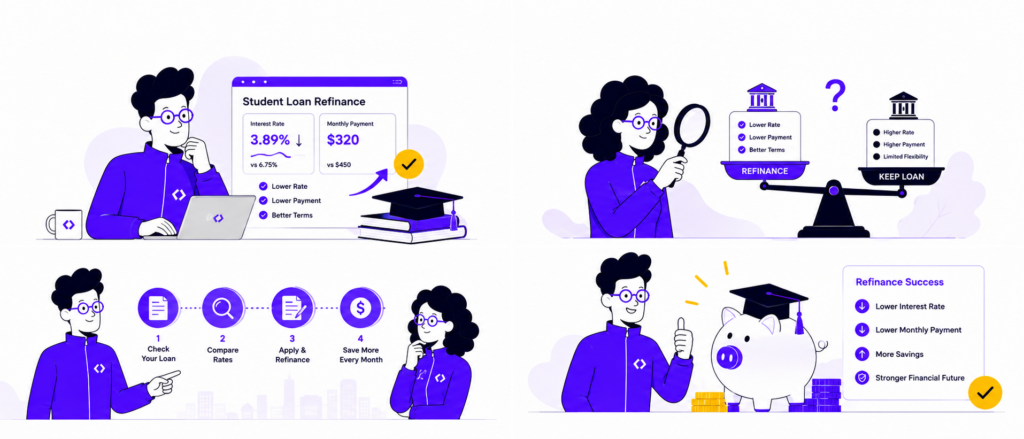
- Check your rate. SoFi’s online pre-qualification uses a soft credit pull, so checking your rate won’t affect your credit score.
- Compare your offer against other lenders before committing; rates can shift day to day, so it helps to gather quotes on the same day for a fair comparison. This is where GradRight is genuinely useful for Indian borrowers specifically. Instead of approaching each lender separately and hoping your visa and loan-origin profile fits, GradRight lets multiple domestic and international lenders, including options for Indian-originated loans, bid on your profile, so you can see where you actually qualify before committing to one lender’s application.
- Choose fixed or variable, and your term length, based on how much payment predictability you want versus how much you’re optimizing for the lowest possible rate.
- Submit your full application and documents. This triggers a hard credit pull.
- Get approved and let SoFi pay off your old loan. Your new loan and repayment schedule begin from there.
Final verdict
SoFi is a strong refinancing option for borrowers with a US-originated student loan who meet its visa and residency requirements. However, for many Indian students and professionals, eligibility depends on factors like visa status, loan origin, income, and long-term career plans. Choosing the right refinancing lender isn’t about chasing the lowest advertised rate. It’s about finding the one that fits your profile today while keeping future options open.
That’s where GradRight helps. Instead of comparing lenders one by one, you can evaluate multiple refinancing options side by side based on your unique profile. With free expert guidance and personalized lender matching, GradRight helps you make confident refinancing decisions and potentially save thousands over the life of your student loan.





 Australia
  Canada
  France
  Germany
  India
India  Ireland
  UAE
UAE  United Kingdom
  United States