





Most Indian students researching their move to Germany discover something anxiety-inducing somewhat late in the process: the health insurance requirements for students in Germany are stringent as well as confusing.
These requirements dictate whether your visa gets approved, whether your university enrolls you, and whether you can register your address after landing in Germany. At the same time, your purchase decision will seem full of choices that look minor at signup but can lock you in to a cost for the entire degree.
This guide walks through what actually matters most for anyone looking for international students health insurance for Germany.
Why health insurance is non-negotiable for students in Germany
German law requires every resident to hold valid health coverage from day one. For international students, this requirement sits at the center of three separate processes: the student visa application at the German consulate in India, the matriculation process at your university, and the residence permit issued by the local Ausländerbehörde after you arrive.
This is why you need to purchase the right health insurance for Germany before you leave, not after.
Why Travel Insurance Is Not Enough For International Students In Germany
Most students buy travel insurance (not the same as health insurance) to clear the visa interview, and that is acceptable for the consulate stage. But travel insurance is not a substitute for proper German health insurance once you arrive. Universities will not accept it for enrollment, and the foreigners’ office will not accept it for your residence permit when you apply for it. You must switch to a compliant German policy, which can be either public or private, within days of landing.
How Proof of Health Insurance Is Submitted to Your University
Since 2022, Germany uses a digital notification system. Your insurer transmits your health insurance coverage status directly to the university through an electronic message, and the registrar verifies it before completing your matriculation. You do not handle paperwork in between. This also means you must sign up with an insurer before your enrollment deadline, even if classes have not started yet.
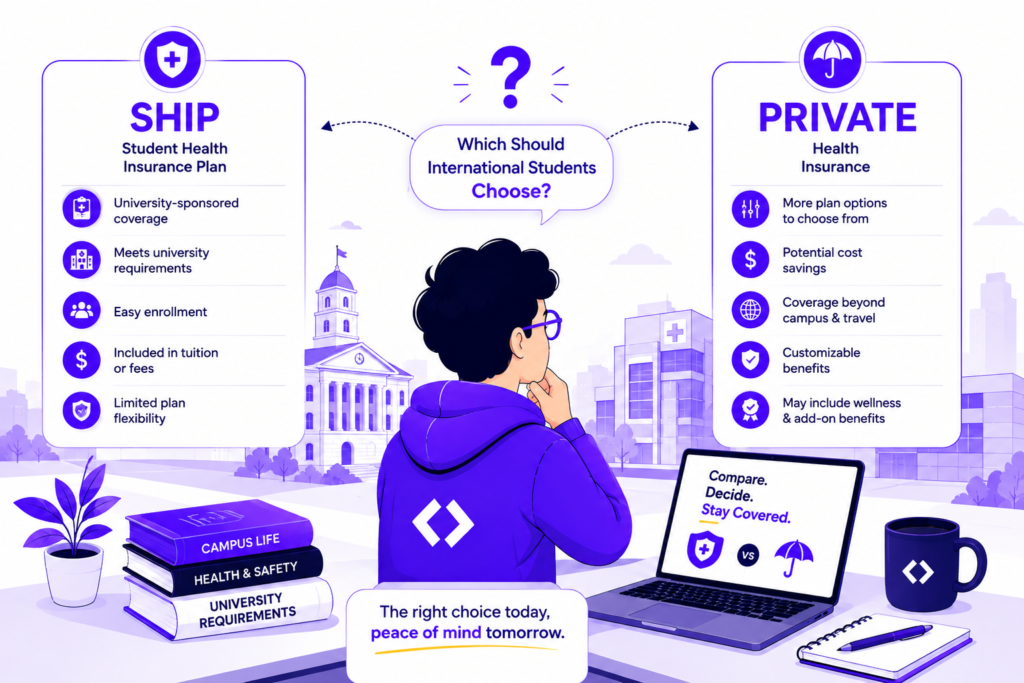
Public vs private health insurance in Germany: The real difference
Health insurance in Germany runs as a two-tier system, and the gap between the tiers is wider than the price tag might seem to suggest.
Public Health Insurance — Gesetzliche Krankenversicherung (GKV)
Public health insurance in Germany covers around 90 percent of residents and is also the default route for most international students under 30. The student rate (called Krankenversicherung der Studenten, or KVdS) is between €123 and €137 per month in 2026 and is fixed regardless of the student’s income.
Major providers of public health insurance in Germany include Techniker Krankenkasse (TK), AOK, and Barmer. Among these, TK is widely chosen by Indian students for its English-language service. You get a chip card once your public health insurance is active.
Under the public health insurance system, when you need to avail of medical services, you can simply walk into any participating doctor clinic, and the insurer is billed directly. The student makes no upfront payments for the medical services. Pre-existing conditions are covered from the first day, and a non-working spouse or child can be added at no extra cost.
Private Health Insurance (PKV) — Private Krankenversicherung (PKV)
Private health insurance in Germany is priced based on age, health status, and the benefits you select, not your income. Plans start for as low as €32 per month for budget expat policies and climb past €180 for comprehensive cover. Providers like ottonova offer fully digital, English-first service, while DR-WALTER and Mawista are commonly used by international students who are in Germany for language and preparatory courses.
Private cover can mean faster specialist appointments, private hospital rooms, and stronger dental benefits. The catch is the reimbursement model: you pay the doctor first and claim the money back. Each family member also needs a separate policy at their own premium.
Note: Your insurance choice is not purely a matter of preference. Eligibility rules decide what is even open to you in the first place.
Eligibility rules every international student must know
Which Students Can Qualify for the Public Student Rate
Germany’s public system offers a heavily subsidized student tariff (KVdS), but not every international student is eligible for it. The discounted public tariff is available if you are enrolled in a degree program (bachelor’s, master’s, or a recognized doctoral track) and are under 30. Students in Studienkolleg, foundation programs, or standalone language courses do not qualify and must take a private plan until they begin their degree.
The Age 30 Rule: A Deadline That Catches Most Students Off Guard
Your eligibility for the public student rate will end at the close of the semester in which you turn 30. After that, you either shift to Germany’s voluntary public health insurance system, wherein your health insurance will cost around €270 to €275 per month. You can also shift to a private student tariff. Plans designed for the 30-plus group (such as Provisit Student or ottonova’s student tariffs) typically range from €129 to €171 per month, which makes them the more affordable choice for someone in good health.
Also Read: How to Choose the Best International Student Health Insurance in 2026
Germany Health Insurance Rules for Language Course Students and PhD Candidates
Students enrolled in Studienkolleg, foundation programs, or standalone language courses cannot join the public student system and must hold a private incoming plan until their degree program officially begins.
PhD candidates fall into two groups.
- Those employed by the university (for instance, as research assistants or doctoral employees) are insured as regular workers through the public system.
- Self-funded or scholarship-holding doctoral candidates follow the same age-based rules as other students and must choose between public and private cover accordingly.
What German public and private health insurance cover (and what they don’t)
| Category | Public Health Insurance (GKV) | Private Health Insurance (PKV) |
| Doctor visits | Fully covered | Covered (varies by plan) |
| Hospital admission | Covered | Covered (plan-dependent room/doctor choice may vary) |
| Prescription medication | Covered with small co-pays | Covered, but limits may apply in budget plans |
| Dental care | Basic dental work covered | Broader coverage in premium plans; limited in budget expat plans |
| Mental health / psychotherapy | Covered | Often excluded or limited in budget expat plans |
| Preventive screenings | Included | Included (varies by plan) |
| Maternity care | Fully covered | Usually covered (depends on plan) |
| Pre-existing conditions | Covered by law | May be excluded or restricted in some plans |
| Family coverage | Familienversicherung: spouse/children can be added at no extra cost (if eligible) | Usually not included; each member needs separate policy |
| Extra benefits | Standard medical care only | Premium plans may include implants, vision aids, global travel coverage |
| Cost predictability | Stable income-based contributions | Varies by age, risk, and plan type |
The opt-out decision — why it’s almost always irreversible
Students under 30 have a three-month window from the start of their studies to opt out of the public system in favor of private insurance in Germany. To do this, you will need to obtain an exemption certificate called the Befreiungsbescheinigung. Please remember that this decision is almost irreversible once you take it.
Once you exempt yourself, you cannot return to public insurance for the entire duration of your studies, regardless of how your health, finances, or preferences change.
The only realistic route back is graduating, taking a regular job with an annual gross salary below the compulsory threshold (€77,400 in 2026), and re-entering the public system as an employee.
For most students, this means the choice made in their first semester shapes their healthcare for the next two to five years. So, treat this decision with caution.
Step-by-step: How to get insured before you arrive in Germany
You can follow this general process to sort out your health insurance for Germany:
- Decide between public and private based on your age, course type, and risk appetite.
- If you qualify for Germany’s public health insurance, apply online with TK, AOK, or Barmer. You can apply directly at each provider’s website. Signup is free and takes a few minutes, and your coverage begins on your enrollment date.
- If you need to buy a private health insurance plan for Germany, compare ottonova, DR-WALTER, and Mawista plans against your university’s accepted list. Confirm visa and residence permit compliance in writing.
- Receive your membership confirmation or exemption certificate.
- Share your insurance number with your university’s admissions office.
Common mistakes Indian students make with German health insurance
Most of the mistakes Indian students make with German health insurance happen at signup, when the stakes feel low and the paperwork feels routine. Five of these come up again and again:
- Assuming travel insurance is enough. The policy you bought for the visa interview will not be accepted by your university or the foreigners’ office for long-term stay.
- Picking the cheapest private expat plan without reading exclusions. Therapy, dental work, and chronic medication are commonly left out, and students only discover this when they need treatment.
- Opting out of public cover too quickly. The three-month window feels like a decision you can revisit. It is not — once you exempt yourself, the door closes for the rest of your degree.
- Missing the age 30 deadline. Students who do not arrange an alternative in advance are auto-shifted to the €275 voluntary tariff and lose the chance to switch to a cheaper private student plan in time.
- Choosing a private plan that the foreigners’ office later rejects. A plan can be valid for university enrollment but still refused at residence permit renewal. When that happens, you must buy a new policy mid-stay and may face back-dated premiums to cover the period your old policy was deemed non-compliant.
Each of these is avoidable with one careful afternoon of research before you sign.
Plan the rest of your German application with GradRight
The hardest part of moving to Germany is rarely just one decision. It is coordinating university shortlisting, financing, and paperwork without losing track of deadlines.
GradRight’s Higher-Ed Hub helps with exactly that. It has processed over ₹36,000 crore in education loan requests and served 260,000+ students, helping them compare loan offers from multiple lenders side by side instead of approaching one bank at a time.
GradRight has been recognized by the Economic Times for bringing universities, lenders, and students onto a single platform.
Graddie, the AI companion, helps you manage the rest (student loans, university shortlists, scholarships) without the confusion. One place to plan it all, at zero cost to you.







 Australia
  Canada
  France
  Germany
  India
India  Ireland
  UAE
UAE  United Kingdom
  United States