


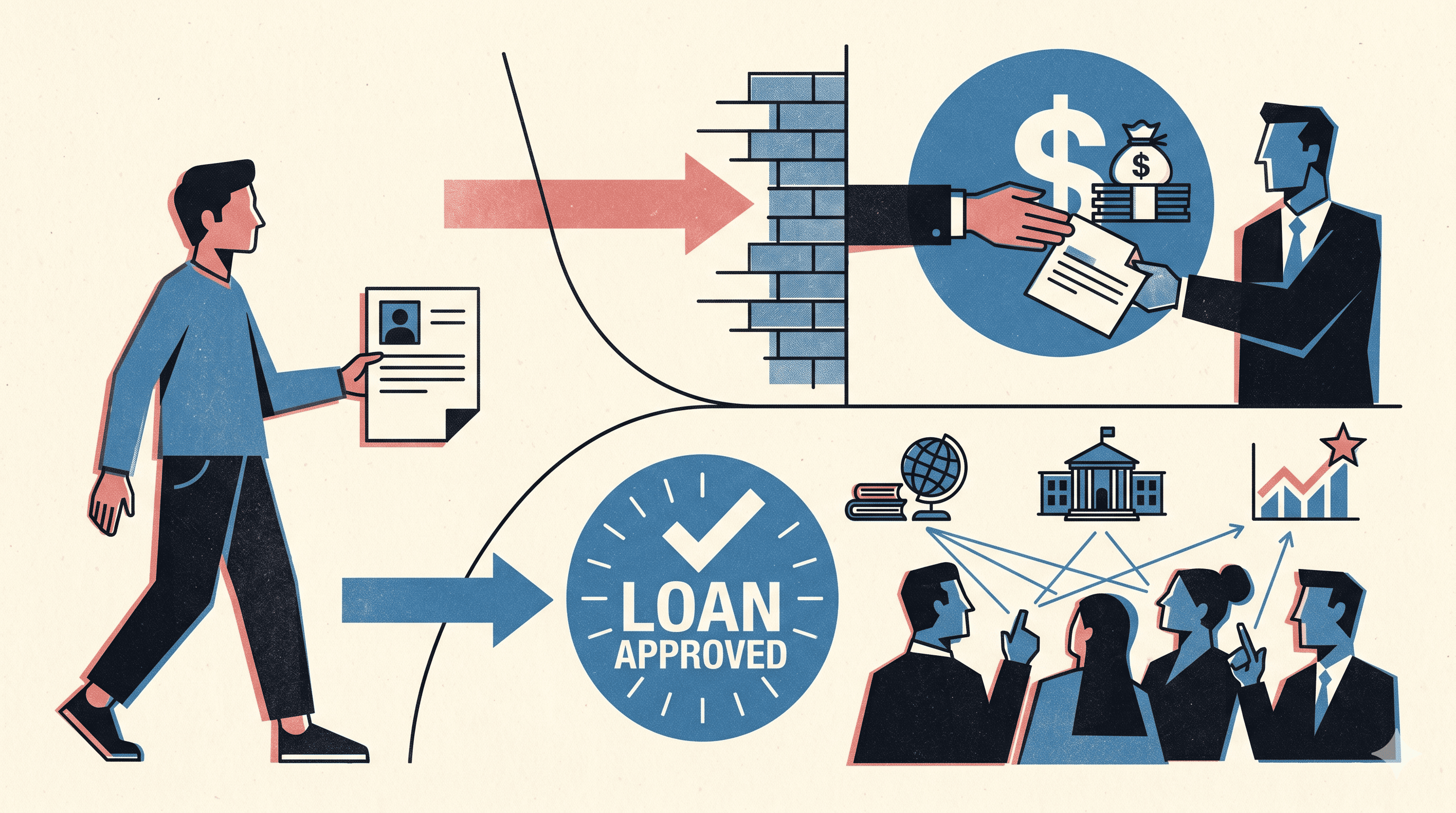
Most Indian families assume that an education loan requires property. A house, a plot of land, a fixed deposit, something tangible to pledge as security before a bank will disburse anything significant. For a long time, that assumption was largely correct.
In 2026, it is no longer accurate for a much larger group of borrowers than most families realize.
Non collateral education loans, also called unsecured education loans or collateral free education loans, now cover loan amounts up to ₹75 lakh at several lenders, without requiring the family to pledge any asset. NBFCs have become more aggressive in the unsecured segment, with several lenders offering education loans without collateral up to ₹50 to ₹75 lakh for strong academic profiles at top-ranked international universities. For families without property, or families who have property but do not want to risk it, this shift changes what is financially possible.
This blog explains exactly how non collateral education loans work, who qualifies, which lenders offer them, and the honest tradeoffs that come with borrowing without security.
What is a non collateral education loan?
A non collateral education loan is an unsecured loan that a bank or NBFC disburses to fund higher education without requiring the borrower to pledge any property, fixed deposit, or other tangible asset as security. The lender approves the loan based on the student’s academic profile, the institution’s reputation, the program’s employment prospects, and the co-applicant’s income and credit history rather than on the value of an asset.
In contrast, a secured or collateral-backed education loan requires the borrower to pledge a property or asset whose market value typically equals or exceeds the loan amount. If the borrower defaults, the lender can liquidate the pledged asset to recover the outstanding balance.
The key distinction, therefore, is risk distribution. In a secured loan, the lender reduces its risk by holding an asset. In an unsecured loan, the lender assumes more risk, and it compensates for that risk by charging a higher interest rate, tightening eligibility criteria, and applying more scrutiny to the academic and employment profile of the applicant.
Secured vs Non Collateral Education Loan: Key Differences
| Feature | Secured Loan | Non Collateral Loan |
| Asset pledge required | Yes, property, FD, or insurance | No |
| Maximum loan amount | Up to ₹1.5 crore or more | ₹7.5 lakh to ₹75 lakh depending on lender |
| Interest rate | 8.5% to 11% typically | 10.5% to 14% typically |
| Processing time | 20 to 30 days (asset valuation required) | 5 to 15 days |
| Co-applicant required | Yes | Yes, stronger income profile needed |
| Risk to family assets | Yes | No |
| Best for | Large loan amounts; families with property | Families without property; faster disbursement needs |
Why non collateral education loans exist and why demand has grown
Most families in India do not own property that is unencumbered, marketable, and valued high enough to secure a ₹50 to ₹70 lakh education loan. Consequently, the traditional secured loan route excludes a large portion of creditworthy students and families who simply do not have the right type of asset to pledge.
Furthermore, credit bureau integration has improved significantly, meaning lenders can now make faster, more accurate decisions on unsecured applications, reducing processing time for education loans without property from 3 to 4 weeks a few years ago to 5 to 12 working days for most NBFC applications today. This improvement in lender risk assessment has made it possible for NBFCs and private banks to underwrite larger unsecured amounts with greater confidence.
The net effect in 2026 is that if your profile is strong, a good university, an employable program, a creditworthy co-applicant, getting a study abroad education loan without collateral is genuinely more achievable than it has ever been. The caveat is that lenders are also smarter about risk, so weak profiles face more scrutiny, not less.
Who qualifies for a non collateral education loan?
Eligibility for a non collateral education loan depends on five variables that lenders weigh together rather than separately.
Academic Profile and Institution Ranking
University ranking is one of the most important variables in unsecured loan approval, sometimes more important than income. Most NBFCs have internal tiering systems that assign different maximum unsecured loan amounts based on the QS or THE ranking of the institution. A student admitted to a top-50 globally ranked university qualifies for a higher unsecured limit than a student admitted to a university ranked below 500, regardless of whether both students have the same GPA.
For domestic programs, admission to IITs, IIMs, NITs, and other premier Indian institutions similarly unlocks higher unsecured limits at public sector banks. SBI can provide up to ₹40 lakh of unsecured education loans for top-tier institutes in India, compared to the standard ₹7.5 lakh limit for other institutions.
Co-Applicant Income and Credit Score
Since no asset secures the loan, the co-applicant’s income and CIBIL score carry more weight in an unsecured application than in a secured one. Most lenders require a co-applicant CIBIL score of 700 or above, with scores above 750 unlocking better rates and higher limits. The co-applicant’s monthly income should comfortably cover the projected EMI after the moratorium period ends.
Program Employability
NBFCs focus on the student’s academic merit and future earning potential rather than assets. Consequently, programs with strong and verifiable employment outcomes, STEM master’s degrees in the US, MBA programs at ranked institutions, healthcare and data science programs in Canada and Australia, receive more favorable unsecured treatment than programs with weak placement records or in fields with limited international demand.
Loan Amount Relative to Lender Limits
Each lender sets its own maximum unsecured amount, and applying for more than a lender’s internal limit for your profile tier automatically reduces approval probability. Knowing the lender’s tier structure for your specific university before applying prevents wasted applications.
Eligibility Summary
| Eligibility Factor | Strong Profile | Weak Profile |
| University ranking | Top 200 globally or premier Indian institution | Unranked or below 500 |
| GPA / academic performance | 7.5 and above (10-point scale) | Below 6.5 |
| Co-applicant CIBIL | 750 and above | Below 700 |
| Co-applicant monthly income | 3 to 5x projected monthly EMI | Below 2x projected EMI |
| Program | STEM, MBA, healthcare, data science | General arts, unranked programs |
| Loan amount requested | Within lender’s unsecured limit for your tier | Above lender’s unsecured limit |
Which bank gives collateral free education loans?
Loans up to ₹7.5 lakh usually do not need collateral, this is the standard threshold followed by most banks under IBA guidelines. Above that threshold, the type of lender matters significantly.
Public Sector Banks
For Indian studies, most public sector banks offer up to around ₹7.5 lakh without collateral under standard schemes, often backed by government credit guarantee programs. For study abroad, the picture is similar at the standard level, but exceptions exist for premier institutions.
| Bank | Collateral Free Limit (Standard) | Collateral Free Limit (Premier Institutions) | Scheme Name |
| SBI | ₹7.5 lakh | Up to ₹50 lakh | Scholar Loan / Global Ed-Vantage |
| Bank of Baroda | ₹7.5 lakh | Up to ₹40 lakh | Baroda Scholar |
| Canara Bank | ₹7.5 lakh | ₹50 lakh | Vidya Turant |
| PNB | ₹7.5 lakh | Up to ₹20 lakh | PNB Prathibha |
| Bank of Maharashtra | ₹7.5 lakh | ₹7.5 lakh (standard only) | Education Loan Scheme |
Note: These figures are subject to change with time and profile
The government’s Credit Guarantee Fund Scheme for Education Loans (CGFSEL) backs public sector bank unsecured loans up to ₹7.5 lakh. This guarantee allows banks to lend without collateral at this limit while managing their own credit risk through the government-backed fund.
Additionally, schemes like PM Vidyalakshmi and CSIS provide credit guarantees and interest subvention, for example, a 3% interest subsidy for eligible families during moratorium, or a guarantee on loans up to ₹7.5 lakh, so banks are willing to lend without collateral.
Private Banks
Private banks occupy a middle tier between the conservative limits of public sector banks and the more flexible structures of NBFCs. ICICI Bank, Axis Bank, and HDFC Bank all offer collateral free education loans for study abroad at limits that exceed the public sector standard.
| Bank | Collateral Free Limit | Interest Rate Range | Processing Time |
| HDFC Bank | Up to ₹40 lakh | 10% to 14% | 7 to 10 days |
| ICICI Bank | Up to ₹1 crore | 10% to 13.5% | 7 to 10 days |
| Axis Bank | Up to ₹1.5 crores | 10% to 14% | 7 to 15 days |
| Kotak Mahindra Bank | Up to ₹15 lakh | 10% to 14.5% | 10 to 15 days |
Note: These figures are subject to change with time and profile
NBFCs: The Highest Unsecured Limits Available
NBFCs offer substantial funding without any collateral requirement compared to banks that typically limit unsecured education loans to ₹7.5 lakh. This dramatic difference makes NBFCs the preferred choice for students pursuing expensive programs abroad.
Indian students can secure education loans up to ₹75 lakh without pledging property or assets through non-collateral loans. Banks like HDFC Credila and Avanse offer the highest unsecured loan amounts, while NBFCs provide flexibility with interest rates ranging from 10% to 16% annually.
| NBFC | Max Collateral Free Amount | Interest Rate Range | Approval Time |
| HDFC Credila | Up to ₹75 lakh | 9.75% to 13.5% | 5 to 7 days |
| Avanse | Up to ₹75 lakh | 10.5% to 14% | 5 to 10 days |
| InCred | Up to ₹60 lakh | 11% to 14% | 5 to 10 days |
| Auxilo | Up to ₹60 lakh | 11% to 13.5% | 7 to 14 days |
| Prodigy Finance | Up to 80% of total expenses | 13% to 16% (USD-denominated) | 2 to 4 weeks |
| MPOWER Financing | Up to $100,000 | 13% to 16% (USD-denominated) | 2 to 4 weeks |
NBFC interest rates typically range between 10.5% to 13% based on your university and risk profile. Credila, Avanse, and InCred are among the top options. The two international lenders, Prodigy Finance and MPOWER, are worth noting separately. Some foreign lenders can cover up to 80% of total expenses with an interest rate ranging from 9.25% to 16%, which can be converted to INR at a rate of 14% to 15%, making it the most expensive non collateral education loan option. These lenders do not require a co-applicant, which makes them relevant for students who cannot find a creditworthy co-applicant in India, but the effective cost in rupee terms is significantly higher than domestic options.
Can you get a ₹50 lakh education loan without collateral?
Yes, but the lender options narrow as the amount increases.
NBFCs have become more aggressive in the unsecured segment, with several lenders now offering education loans without collateral up to ₹50 to ₹75 lakh for strong academic profiles at top-ranked international universities.
For a ₹50 lakh unsecured education loan, the realistic options in 2026 are HDFC Credila, Avanse, and InCred, all of which can sanction this amount for qualified profiles. However, a ₹50 lakh unsecured loan requires a substantially stronger profile than a ₹20 lakh unsecured loan. Specifically, lenders evaluating a ₹50 lakh unsecured application will look for a co-applicant CIBIL score above 750, monthly co-applicant income of ₹80,000 or higher, admission to a university ranked in the global top 200, and a program with documented strong employment outcomes.
At public sector banks, ₹50 lakh without collateral is not currently achievable except for the narrow category of premier institution admits under specific schemes. For most students targeting a US, UK, or Canadian master’s degree at a non-premier institution, the ₹50 lakh unsecured route goes through NBFCs, not public banks.
The honest financial note: a ₹50 lakh unsecured NBFC loan at 12% interest over 10 years with a 2.5-year moratorium produces a total repayment of approximately ₹85 to ₹90 lakh. Therefore, comparing this against a secured loan at 9.5%, if collateral is available, is worth doing before deciding the unsecured route is the only path.
The real cost difference: secured vs non collateral
Rates on unsecured education loans are usually 1 to 2% higher than secured loans. For many families, this is a fair tradeoff for not risking any asset. However, the rupee impact of that rate difference over a long repayment period is substantial enough to model before deciding.
| Loan Amount | Secured Rate | Unsecured Rate | Difference in Total Repayment (10 years) |
| ₹30 lakh | 9.5% | 11.5% | ~₹7 lakh more on unsecured |
| ₹50 lakh | 9.5% | 12% | ~₹13 lakh more on unsecured |
| ₹70 lakh | 9.5% | 12.5% | ~₹21 lakh more on unsecured |
Consequently, families who have collateral available should run both calculations before defaulting to the unsecured route simply because it feels easier. The rate premium on an unsecured loan is the price of not pledging an asset, it is a legitimate financial tradeoff, but it deserves explicit modeling rather than a default assumption.
For families without any collateral, the unsecured route is not a tradeoff but simply the only option. In that case, the comparison should be between the different unsecured lenders rather than between secured and unsecured products.
How to apply for a non collateral education loan: step by step
The application process for a non collateral education loan is faster than for a secured loan because no asset valuation is required. However, the documentation around the co-applicant’s income and the student’s academic profile needs to be thorough, because that documentation substitutes for the collateral the lender is not receiving.
| Step | Action | Timeline |
| 1. Confirm your loan amount | Calculate total cost including tuition, living, visa, and insurance | Before applying |
| 2. Check lender limits for your university | Most NBFCs have tiered limits by institution ranking, verify your tier | Before applying |
| 3. Pull co-applicant CIBIL report | Resolve any errors before submitting, takes 30 to 45 days to fix | 6 to 8 weeks before applying |
| 4. Gather documents | Admission letter, academic transcripts, co-applicant income proof, bank statements (6 months), PAN and Aadhaar | 1 to 2 weeks |
| 5. Apply to 2 to 3 lenders simultaneously | Use GradRight’s loan marketplace to get offers from 18+ lenders bidding for your profile in 20 minutes | Application day |
| 6. Compare offers carefully | Look at total repayment, not just EMI, the moratorium interest adds to principal | Within 1 week of offers |
| 7. Accept best offer and complete verification | NBFC sends a representative for document verification; some do this digitally | 3 to 7 days |
| 8. Disbursal | Most NBFCs disburse in tranches aligned with university payment schedules | 5 to 15 working days post-verification |
The most important step in this list is Step 5, applying to multiple lenders simultaneously rather than sequentially. Students who apply to one lender, wait for a decision, and then move to the next if rejected waste weeks and sometimes miss university payment deadlines. GradRight’s loan marketplace solves this by sending a single profile to 18 plus lenders simultaneously, generating competing offers that the student can compare and accept without visiting a branch or managing multiple applications separately.
The bottom line
Non collateral education loans have made study abroad financially accessible to a much wider group of Indian families than the secured loan system ever did. In 2026, a student admitted to a top-ranked international program with a creditworthy co-applicant can realistically borrow ₹50 to ₹75 lakh without pledging any property.
The tradeoffs are real: higher interest rates, stricter eligibility criteria, and a stronger co-applicant requirement than secured loans demand. Moreover, the rate premium, typically 1 to 2% above secured rates, translates to ₹7 to ₹21 lakh in additional total repayment depending on the loan size. That number deserves to be modeled explicitly, not ignored.
GradRight helps Indian students compare non collateral education loan offers from 18 plus lenders in 20 minutes, model their total repayment timelines at different rates, and identify the best loan structure for their specific profile. Start with a free GradRight profile to see which lenders will compete for your application before you commit to any one of them.









 Australia
  Canada
  France
  Germany
  India
India  Ireland
  UAE
UAE  United Kingdom
  United States