




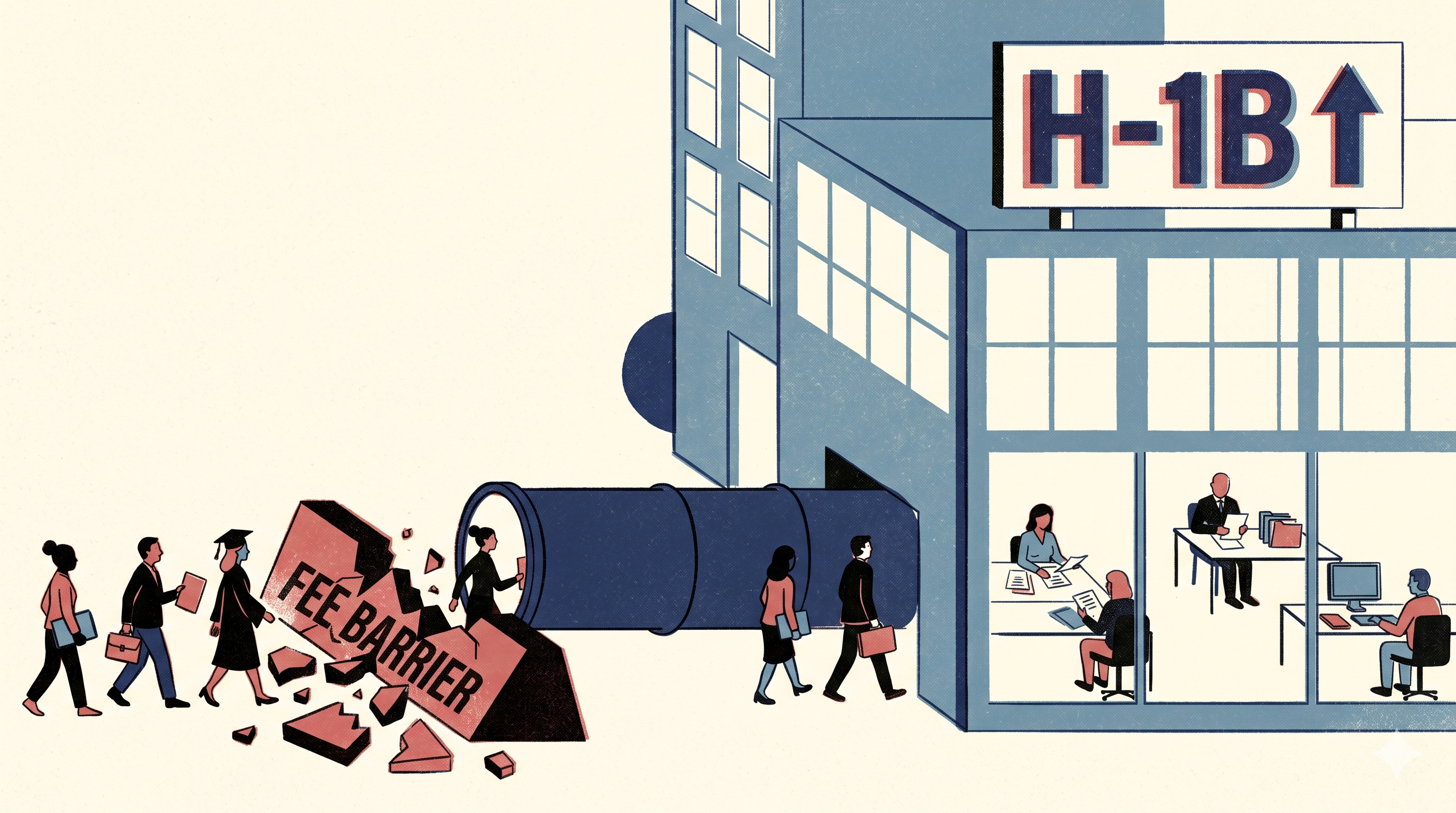
On June 8, a US federal judge struck down President Trump’s $100,000 H-1B visa fee and ordered the government to invalidate it.
US District Judge Leo Sorokin issued the ruling in a lawsuit brought by 20 Democratic state attorneys general. He found that the administration imposed the fee without congressional approval. The White House has already signalled that it plans to appeal the decision.
The ruling marks a major development for Indian professionals and students who depend on the H-1B pathway to build careers in the United States.
What the fee was and why it mattered
In September 2025, President Trump signed a proclamation that added a $100,000 annual fee to all new H-1B visa applications, regardless of salary or skill level.
The government planned to collect the fee alongside existing vetting procedures.
The impact became clear quickly. Department of Homeland Security Secretary Markwayne Mullin told a Senate panel that more than 200,000 applicants paid the $100,000 fee for expedited processing during fiscal year 2026 alone.
Indian professionals faced some of the biggest consequences. Indian citizens receive most H-1B visas issued each year. Around 790,000 H-1B visa holders currently live in the United States, along with nearly 500,000 dependents.
For many Indian families, the H-1B visa is more than a work permit. It often serves as the primary pathway to building a long-term future in America.
What the court said
Judge Sorokin ruled the fee unlawful because Congress never approved it. Federal law requires congressional approval for major policy changes of this scale.
Indian diaspora organisations welcomed the ruling immediately.
“We welcome the Massachusetts federal court’s decision striking down the USD 100,000 H-1B visa fee, which restores predictability and fairness to the employment-based immigration system,” said Khanderao Kand, Chief of Policy and Strategy at the Foundation for India and Indian Diaspora Studies.
“Access to highly skilled global talent remains essential for the continued growth of the US’s technology, healthcare, and advanced manufacturing sectors. The judgment reinforces the principle that major policy changes must be grounded in statutory authority and economic realities,” he added.
Some observers remain cautious.
“All stakeholders connected with H-1B visas will heave a sigh of relief after the court order, but one wonders if this is truly the end of the matter,” said Sanjeev Joshipura, Executive Director of Indiaspora.
He noted that the administration could pursue alternative legal or procedural routes to achieve a similar outcome.
The political response
The ruling exposed a sharp divide in Washington.
Democratic lawmakers celebrated the decision. Several argued that the fee had already hurt rural hospitals, schools, and healthcare systems that rely on H-1B workers to fill critical staffing shortages.
Republican lawmakers largely backed the administration. The White House said it remains confident that an appeals court will reverse the ruling.
What this means for Indian students and professionals
For Indian students on F-1 visas who plan to move from OPT to H-1B status, the ruling removes one of the biggest financial barriers introduced in recent years.
The $100,000 fee significantly increased sponsorship costs. As a result, many employers, especially startups and smaller companies, reconsidered hiring international talent through the H-1B program.
With the fee now blocked, employers may become more willing to sponsor international candidates again. That could improve hiring prospects for international graduates seeking long-term opportunities in the United States.
Students who had factored the additional cost into their post-graduation plans may also find more options available to them.
The White House’s decision to appeal means the issue is not fully settled. The legal battle will likely continue in the coming months.
For now, however, the fee is gone. That offers meaningful relief to hundreds of thousands of Indian professionals, students, and future H-1B applicants.
Source: Economic Times NRI, June 9, 2026






 Australia
  Canada
  France
  Germany
  India
India  Ireland
  UAE
UAE  United Kingdom
  United States