





Getting an F1 student visa rejected is disappointing – but here is a silver lining: you can reapply for your F1 visa. Most of the reasons why an F1 student visa is rejected are avoidable with careful planning and preparation.
All you need to do is understand the reasons for F1 student visa rejection and remedy that situation. Below are the most common reasons for F1 visa rejections for Indian students – and exactly what to do differently.
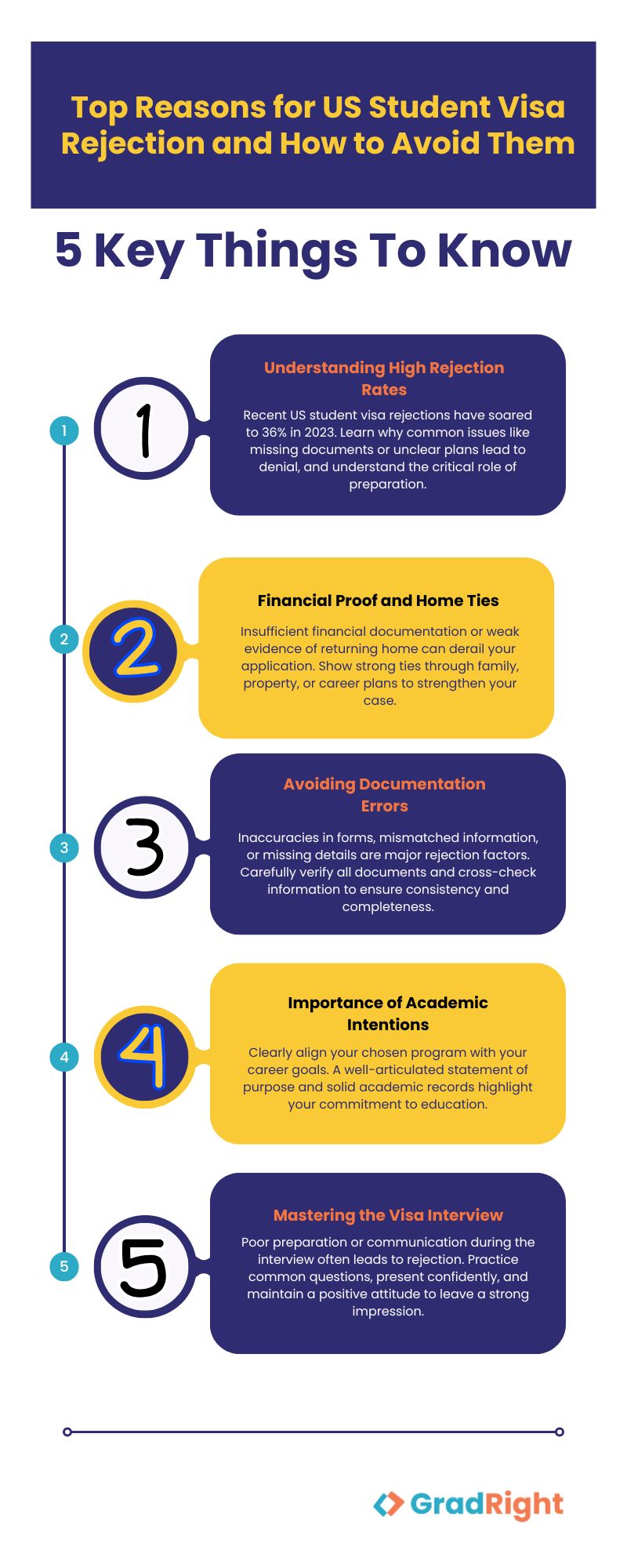
F1 Visa Rejection Reasons at a Glance
| Rejection Reason | Core Problem | Severity |
| Insufficient or suspicious financial documentation | Bank statement lacks transaction history, unexplained large deposits, or sponsor documentation is vague | Very High – financial reasons are the most common rejection cause |
| Weak ties to home country (Section 214(b)) | Visa officer not convinced you will return to India after completing studies | Very High – 214(b) presumption of immigrant intent is the most cited rejection basis |
| Course/background mismatch | Applying for a program that has no logical connection to your academic or professional history without explanation | High |
| Low credibility university choice | Applying to a university with poor reputation when your profile suggests you could do better | High – raises doubts about genuine academic intent |
| Poor interview performance | Unclear, scripted, or unconvincing answers; stumbling on basic questions | High – the interview is where many prepared applications fail |
| Incomplete or incorrect documentation | Missing DS-160, incorrect forms, expired documents, missing supporting materials | Medium-High – often caught early but can cause rejection |
| Prior immigration violations | Previous visa violations, overstays, or undisclosed history | High – must be disclosed and addressed honestly |
| Purpose of visit not clearly articulated | Vague or generic explanation of why you are going to the USA for this specific program | Medium-High |
1. Financial Issues: The Most Common F1 Rejection Reason
F1 visa rejection due to financial issues often means your proof of funds was not proper. You must show that you can cover at least one year’s tuition and living expenses.
| Financial Red Flag | What It Looks Like | How to Fix It |
| Unexplained large deposit | Bank statement shows Rs 20 lakh but has a recent large deposit with no transaction history to support it. Visa officer may find funds suspicious or unstable. | Maintain consistent account balance for 3-6+ months before applying. Avoid large deposits shortly before the application. |
| Vague sponsor documentation | Affidavit stating “uncle will pay” without Income Tax Returns, salary slips, or proof of sustained ability to fund education. | Sponsor documentation must include: salary slips (3-6 months), ITR (2-3 years), bank statements (6 months), and an affidavit that is specific about the amount being pledged. |
| Insufficient total funds | Bank balance does not cover first year tuition + living expenses combined. | First year USA costs: tuition (USD 20,000-65,000) + living expenses (USD 12,000-20,000). Show total coverage. Education loan sanction letter counts. |
| Inactive account | Bank account shows a high balance but minimal transactions over months. | Active accounts with regular inflow and outflow look more credible than dormant savings accounts with a single large balance. |
| Multiple uncoordinated funding sources | Combination of savings + education loan + sponsor without clear total calculation. | Prepare a clear funding summary showing: (a) total first-year cost, (b) how each source contributes, (c) documentation for each source. |
2. Weak Ties to India (Section 214(b) – Immigrant Intent Presumption)
Under Section 214(b) of the US Immigration and Nationality Act, every applicant is presumed to have immigrant intent unless they prove otherwise. This is the most commonly cited legal basis for F1 visa rejections. The visa officer must be convinced that you intend to return to India after completing your studies.
To show strong ties to India for an F1 visa, you can: show evidence of family, property, or job commitments in India; talk about your post-graduation career goals in India, family business involvement, or return plans. The officer needs to be convinced that you intend to come back after your studies.
| Strong Ties to India | What to Mention at Interview | Documentation (if asked) |
| Family in India | Spouse, children, parents, siblings remaining in India while you study abroad | Family photographs; parents employed/retired in India |
| Property/assets in India | Co-ownership of property, land, or business interests | Property deed or ownership document; account showing assets |
| Job or career plan in India | Specific role you intend to return to; family business; employer letter if applicable | Employer letter if currently employed; business registration if family business |
| Academic/career pathway clarity | Clear and specific reason why a US degree is necessary for your India career goal – not just “to settle abroad” | Supporting documents showing Indian industry relevance of your program |
| Community ties | Professional associations, community roles, civic involvement in India | Not typically documentable but should be mentioned in the interview |
3. Course/Background Mismatch
If your application makes it appear that you are choosing a course that does not align with your background, you may face rejection. That said, it does not mean that you cannot go for a course that is not directly related to your previous courses. All you need to do is show and explain the reason for the path change.
A B.Tech in Civil Engineering applying for an MS in Data Science needs to explain the pivot. A B.Com graduate applying for an MS in Electrical Engineering needs to explain the connection. The explanation does not need to be perfect – it needs to be coherent, specific, and backed by evidence.
- Prepare a clear narrative: what in your background led you to this course, what skills you already have that are relevant, and specifically what you expect to learn
- Include supporting evidence: relevant courses, projects, internships, or self-study that bridges the gap between your previous education and the new program
- Articulate the career outcome: how this program connects to a specific career goal, and why that career goal requires this program specifically
4. Low Credibility University Choice
Choosing a university known for low admission standards can raise red flags. If your academic record suggests you could attend better institutions, but you have chosen one with low credibility, the officer may doubt your academic motives.
This is a delicate balance. The issue is not simply about choosing a lower-ranked university – it is about whether the choice makes sense given your profile. A student with a strong academic record who has been rejected from better universities and is applying to a lower-ranked institution as a backup is different from a student who has only applied to low-credibility institutions despite a strong profile.
The question a visa officer is asking: ‘Does this university choice make sense for this student?’ If the answer is ‘no’ or ‘maybe not’, that raises doubt about genuine academic intent.
- Use a reliable university selection platform to choose universities that match your profile – not just rank.
- Apply to a mix of universities: some aspirational, some well-matched, some safety schools
- If you have chosen a less-known university, be prepared to explain why – specific program strengths, scholarships, proximity to industry, or specific research you want to do there
5. Poor F1 Visa Interview Performance
Your confidence and clarity during the interview matter enormously. The F1 visa interview is short – often 2-5 minutes – but it is where many prepared applications fail.
| Interview Failure | Example from Original Article | How to Prepare Instead |
| Cannot answer “Why this university?” | If you stumble when asked “Why this university?” and respond “My counselor told me to apply,” it suggests lack of genuine interest. This makes your intent questionable. | Know your university inside out: specific programs, faculty, research, location, industry connections. Have 3-4 genuine reasons ready. |
| Using robotic pre-scripted answers | Using robotic, pre-scripted answers is among the most common reasons for F1 visa denial. | Practice conversational answers; not memorised scripts. Officers can tell the difference immediately. |
| Cannot explain your academic plan | Unable to clearly state what you will study, what specialisation, what courses, what research | Know your degree plan, major subjects, and intended specialisation before the interview. |
| Cannot explain post-study plans | Vague answers about career goals after graduation; implies you may not return to India | Prepare a clear, specific answer: the role you are targeting, the employer type, why you need the US degree for that role, and why you will return to India. |
| Inconsistency between documents and interview | Saying something in the interview that contradicts your DS-160 or supporting documents | Review all submitted documents before the interview; ensure your verbal answers are consistent. |
6. Incomplete or Incorrect Documentation
This is often caught earlier in the process but can cause rejection at the interview stage if documents are missing or expired. Standard F1 documentation checklist:
- Valid passport (at least 6 months beyond intended stay in USA)
- DS-160 confirmation page (the non-immigrant visa application form, completed online at ceac.state.gov)
- SEVIS fee receipt (I-901 fee payment confirmation)
- Visa appointment confirmation letter
- SEVIS Form I-20 from the Designated School Official (DSO) at your US institution
- Financial documentation: bank statements (3-6 months), ITR, salary slips (co-sponsor or parents), education loan sanction letter if applicable
- Academic documents: transcripts, degree certificates, standardised test scores (GRE, TOEFL/IELTS)
- Passport-size photograph meeting US visa photo specifications
Also Read: Top Canada Visa Rejection Reasons and How to Avoid Them
7. Other F1 Visa Rejection Reasons
| Reason | What Happens | Prevention |
| Prior US visa violations or overstays | If you or a family member previously overstayed a US visa or had violations, this is flagged. Must be disclosed. | Always disclose; never conceal prior visa violations. Consult an immigration attorney if you have a complex history. |
| Applying to a program not matching your education level | PhD application with only a 2-year diploma; undergraduate application with gaps in high school record. | Ensure your academic qualification matches the program level you are applying for. |
| Criminal history not disclosed | Any undisclosed criminal history that appears in background checks. | Full disclosure is required. Consult an immigration attorney if applicable. |
| Health conditions not addressed | Failure to complete medical examinations if required. | Follow all health requirements specified by the US Embassy for your visa category. |
| Attempting to work on F1 beyond allowed hours | Past violations of work regulations on a prior visa. | Understand F1 work rules before applying; do not have prior unreported work violations. |
How to Avoid F1 Student Visa Rejection: GradRight Tips
| Tip | Action |
| Choose the right university from the start | Use a smart university selection platform to find the university that best matches your background. GradRight works on 60,000+ data points, removing human bias. |
| Secure credible education loans early | Get education loans from credible national and international lenders. A bank sanction letter from a recognised lender is strong financial proof for the visa interview. |
| Know your “Why this university?” answer cold | The most basic question asked by F1 visa officers. Know 3-4 specific, genuine reasons for your university choice. Never say your counselor told you to apply. |
| Show consistent, documented financial stability | 3-6 months of consistent bank statements beat a single large deposit. Document all sponsors with ITR and salary slips. |
| Prepare clear post-study ties to India | Family, property, career plan in India. Be specific. Officers need to believe you will return. |
| Practice conversational interview answers | Do not use scripted answers. Practice with a friend, mentor, or GradRight expert until your answers flow naturally and specifically. |
| Get expert guidance for SOP and interview prep | At GradRight, our experts are always ready to help you achieve your American education dream. GradRight is 100% free for students. |
How to Reapply After F1 Visa Rejection
If you face F1 student visa rejection, start by analysing the reason for rejection. Then strengthen your weak areas, gather stronger documents, and prepare better for the interview. Here is the reapplication process:
- Step 1: Carefully read your rejection notice. The visa officer will typically have stamped 214(b) or noted a specific reason. Understand exactly what was cited.
- Step 2: Address the cited reason completely. If it was financial, gather stronger, more consistent financial documentation. If it was the interview, practice significantly more. If it was ties to India, prepare stronger evidence.
- Step 3: Fill out a new DS-160 form (you cannot reuse the old form)
- Step 4: Schedule another interview appointment through the US Embassy or Consulate appointment system
- Step 5: Pay the MRV fee again (the visa application fee is generally non-refundable and must be paid again for each application)
- Step 6: Return to the interview better prepared. Show that the issues cited in the previous rejection have been specifically addressed.
There is no cooling-off period between F1 visa applications – you can reapply immediately. However, it is strongly advisable to wait until you have meaningfully addressed the rejection reason rather than reapplying with the same weak application.
GradRight uses 60,000+ data points to match you to the right US university for your profile – reducing mismatch risk at the visa interview. Free. Find Your US University on GradRight
Also Read: F1 Visa for Indian Students – Complete Guide
Get credible education loans for your US university. GradRight FundRight – 15+ lenders, strong loan sanction letter for your F1 visa interview. Apply on GradRight FundRight for USA
Related Guides
F1 Visa for Indian Students – Complete Guide
Top Canada Visa Rejection Reasons and How to Avoid Them
F1 Student Health Insurance USA
Best Colleges for MS in Computer Science Engineering
Education Loan Eligibility Criteria Guide for Indian Students
Documents Required to Study Abroad
GradRight SelectRight – University Selection Platform

 Australia
  Canada
  France
  Germany
  India
India  Ireland
  UAE
UAE  United Kingdom
  United States