




The first thing that shocks most Indian students when they arrive abroad is not the tuition fee – they expected that. It is the rent. A shared room in London costs GBP 700-900 per month (Rs 74,550-95,850). A studio in New York can cost USD 2,000+ alone.
Understanding why accommodation costs so much – and which factors you can actually control – is the first step to managing it effectively. This guide breaks down the seven real reasons student housing abroad is expensive, with current 2026 data, and what you can do about each one.
Student Accommodation Costs Abroad – 2026 Snapshot
|
City |
Shared Room/month |
University Dorm/month |
Solo Studio/month |
INR (shared room) |
|
London, UK |
GBP 700-900 |
GBP 800-1,200 |
GBP 1,400-2,000 |
Rs 74,550-95,850 |
|
New York, USA |
USD 900-1,400 |
USD 1,000-1,800 |
USD 2,000-3,500 |
Rs 75,600-1,17,600 |
|
Toronto, Canada |
CAD 800-1,200 |
CAD 900-1,400 |
CAD 1,500-2,200 |
Rs 49,600-74,400 |
|
Sydney, Australia |
AUD 900-1,300 |
AUD 1,000-1,600 |
AUD 1,800-2,800 |
Rs 49,500-71,500 |
|
Amsterdam, Netherlands |
EUR 700-1,000 |
EUR 500-800 |
EUR 1,200-1,800 |
Rs 63,000-90,000 |
|
Berlin, Germany |
EUR 500-700 |
EUR 250-450 |
EUR 900-1,400 |
Rs 45,000-63,000 |
|
Dublin, Ireland |
EUR 900-1,300 |
EUR 900-1,400 |
EUR 1,500-2,200 |
Rs 81,000-1,17,000 |
|
Manchester, UK |
GBP 500-750 |
GBP 550-900 |
GBP 900-1,400 |
Rs 53,250-79,875 |
Source: GradRight research, university accommodation office data, Numbeo 2026. INR at USD 1 = Rs 84, GBP 1 = Rs 106.5, EUR 1 = Rs 90, CAD 1 = Rs 62, AUD 1 = Rs 55. Costs vary by exact location, amenities, and availability.
Reason 1: Universities are in High-Demand Urban Areas
The most fundamental reason student accommodation is expensive: top universities are located in some of the most expensive cities in the world. Imperial College London is in South Kensington. NYU is in Manhattan. University of Toronto is in downtown Toronto.
These cities have high property values because millions of people want to live there – students, professionals, and tourists alike. A university cannot change its location. Students who want to attend it must compete in the same rental market as everyone else in that city.
|
City |
Overall Rental Market Rank (Global) |
Impact on Students |
|
London |
Top 5 most expensive rental markets globally |
GBP 700-900/month for shared room – 40-50% of total monthly budget |
|
New York |
Top 3 most expensive rental markets globally |
USD 900-1,400/month shared – challenging even in outer boroughs |
|
Sydney |
Top 10 most expensive |
AUD 900-1,300/month shared – student demand competes with young professionals |
|
Amsterdam |
Top 10 in Europe |
EUR 700-1,000/month shared – housing shortage drives prices up |
|
Dublin |
Most expensive in EU per sq m |
EUR 900-1,300/month shared – chronic housing shortage since 2018 |
What you can do: choose universities in cities with lower rental markets. Manchester vs London saves GBP 200-400/month (Rs 21,300-42,600). Smaller German cities like Leipzig or Karlsruhe vs Munich saves EUR 200-300/month.
Reason 2: Demand Far Exceeds Supply of Student Housing
The number of international students at top universities has grown significantly over the past decade. University-managed housing has not grown at the same rate. The result is a structural shortage – more students chasing fewer subsidized rooms.
In the UK, the number of international students reached a record 679,970 in 2022-23 (UCAS data). University-managed bed spaces have not kept pace. In London, many universities can only accommodate 30-50% of their first-year students in university halls. The rest must compete in the private rental market – at full London rates.
In Ireland, Dublin’s housing crisis is well-documented. Many students arrive with university offers but no confirmed housing because private rentals are snapped up within hours of listing. This shortage keeps prices high year-round.
- Apply for university accommodation the same day you receive your offer letter – not weeks later. The best value university rooms are allocated on a first-come, first-served basis at most institutions.
- Join your university’s international student Facebook or WhatsApp groups immediately after receiving your offer. Other students post room shares and sublets before they appear on any website.
Also Read: How to Pay for Student Accommodation Abroad – 5 Ways
Reason 3: Purpose-Built Student Accommodation (PBSA) Bundles Premium Services
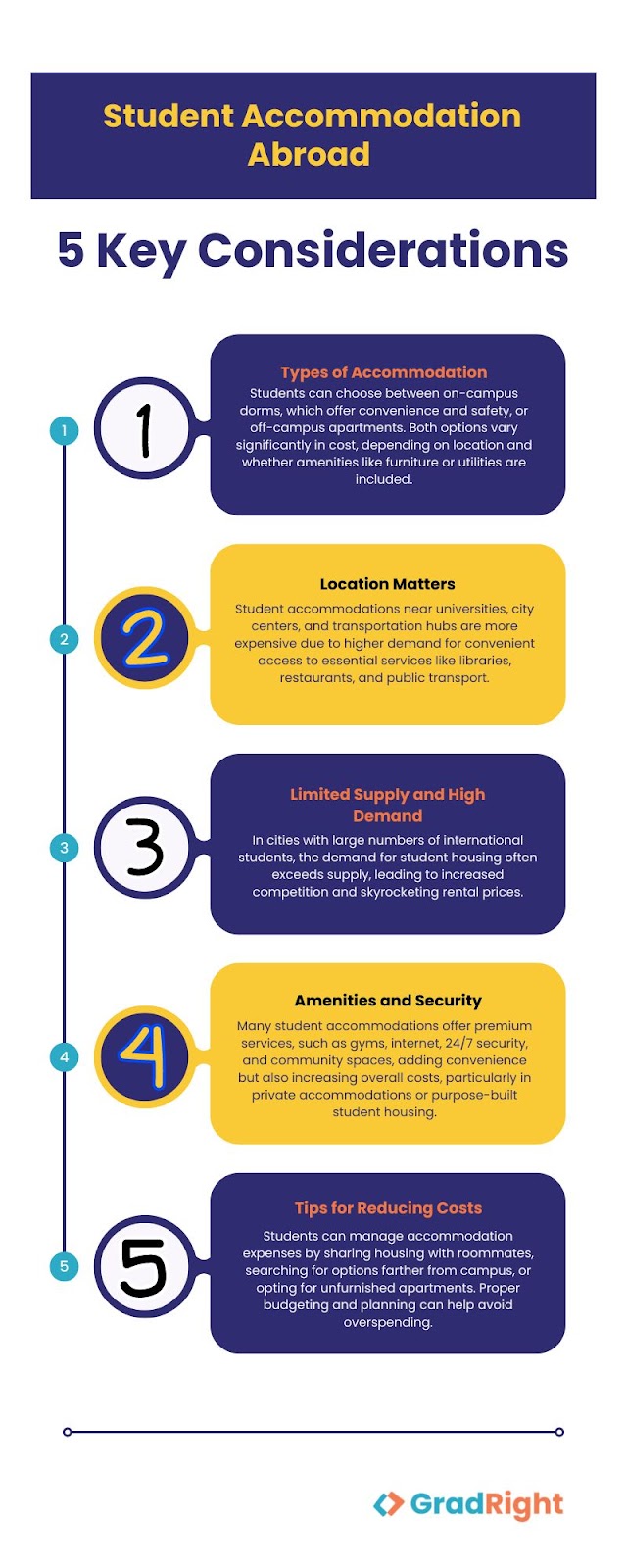
A significant share of student accommodation abroad – particularly in the UK and Australia – is Purpose-Built Student Accommodation (PBSA). These are private developments built specifically for students, offering single rooms with en-suite bathrooms, high-speed internet, gyms, study rooms, cinema rooms, and 24/7 security.
PBSA is popular because it is easy to book from India, bills are all-inclusive, and the environment is social and safe. But you pay a premium for every one of those services.
|
What PBSA includes |
What you pay vs private flat |
|
En-suite private bathroom |
GBP 100-200/month premium vs shared bathroom in private flat |
|
All bills included (electricity, gas, internet, water) |
Bills in private flat add GBP 80-150/month on top of rent |
|
24/7 security and CCTV |
Private flats may have building security or none |
|
Gym access |
Private gym membership GBP 20-50/month extra |
|
Social/study spaces |
Available at university for free anyway |
|
Cleaning of common areas |
Students handle this in private flats |
If you value safety and simplicity in your first year abroad, PBSA makes sense. If your priority is cost, a shared private flat with 2-3 others (where you handle your own bills) is almost always cheaper – even after accounting for utilities.
Reason 4: Location Premium Within the City
Even within the same city, accommodation costs vary enormously by neighborhood. Living 30 minutes from your university by public transport versus 10 minutes walking can mean a difference of GBP 200-400/month in London or USD 300-500/month in New York.
|
City |
Central / Campus area |
Suburb / 30 min away |
Monthly saving |
Transport cost to offset |
|
London |
GBP 900-1,200/month |
GBP 600-800/month |
GBP 200-400 |
GBP 80-130/month Oyster pass |
|
New York |
USD 1,200-1,800/month |
USD 800-1,100/month |
USD 400-700 |
USD 127/month MTA pass |
|
Sydney |
AUD 1,200-1,600/month |
AUD 800-1,100/month |
AUD 400-500 |
AUD 60-80/month Opal pass |
|
Berlin |
EUR 700-1,000/month |
EUR 450-650/month |
EUR 250-350 |
EUR 29/month (student pass) |
|
Toronto |
CAD 1,200-1,600/month |
CAD 800-1,000/month |
CAD 400-600 |
CAD 128/month TTC pass |
The math almost always favours living further away. A GBP 300/month saving in London covers 2+ years of Student Railcard and still leaves Rs 2.1 lakh per year ahead.
Reason 5: Utilities Are Often Not Included in Private Rentals
One of the most common budgeting mistakes Indian students make: comparing university dorm prices to private flat prices without accounting for utilities. University dorms almost always include electricity, gas, water, and internet in the quoted price. Private flats almost never do.
|
Utility |
Monthly Cost (UK) |
Monthly Cost (USA) |
Monthly Cost (Germany) |
|
Electricity + Gas |
GBP 60-100/person (shared) |
USD 50-100/person |
EUR 40-80/person |
|
Internet |
GBP 20-30/person (shared) |
USD 30-50/person |
EUR 15-30/person |
|
Water |
Often included in UK rent |
USD 15-30/person |
EUR 15-25/person |
|
Council Tax (UK only) |
Exempt if full-time student |
N/A |
N/A |
|
Total utilities add |
GBP 80-130/month |
USD 95-180/month |
EUR 70-135/month |
Always compare total monthly cost – rent plus utilities – not just headline rent. A private flat at GBP 650 with GBP 100 in utilities costs GBP 750 total. A university dorm at GBP 720 all-inclusive is actually cheaper.
Also Read: How to Calculate Cost of Living for Study Abroad Students
Reason 6: INR Depreciation Makes Everything More Expensive Over Time
For Indian students, there is an additional cost driver that does not affect local students: currency exchange. The Indian Rupee has historically weakened against major currencies by 5-10% annually.
|
Year |
GBP/INR Rate |
London shared room (GBP 800) |
INR Cost per month |
Annual difference |
|
2020 |
~98 |
GBP 800 |
Rs 78,400 |
– |
|
2022 |
~101 |
GBP 800 |
Rs 80,800 |
Rs 2,400/month more |
|
2024 |
~105 |
GBP 800 |
Rs 84,000 |
Rs 5,600/month more vs 2020 |
|
2026 (current) |
~106.5 |
GBP 800 |
Rs 85,200 |
Rs 6,800/month more vs 2020 |
The GBP cost of the same accommodation has not changed. The INR cost has increased by Rs 6,800/month just because of exchange rate movement – approximately Rs 81,600 per year more expensive for an Indian student vs a UK student paying the same rent.
What you can do: use Wise or Revolut for money transfers (significantly better rates than bank wires), monitor exchange rates, and build a 7-10% INR depreciation buffer into your second-year accommodation budget.
Reason 7: Post-COVID Inflation Hit Student Housing Markets Hard
Since 2021, most major English-speaking countries have experienced significant housing inflation. In the UK, average private rents rose approximately 27% between 2021 and 2025 according to ONS data. In Australia, rental prices in Sydney and Melbourne reached record highs in 2023-24.
Student accommodation providers and private landlords raised rents in line with – or ahead of – general market inflation. Meanwhile, student stipends and education loan amounts did not always adjust at the same pace.
This is a structural, ongoing issue. Accommodation costs in major study destinations are likely to remain high through 2026-2027. Plan for annual rent increases of 3-8% in your financial projections for multi-year programs.
Need help funding your accommodation abroad? Compare education loans from 18+ lenders – accommodation costs can be included in your loan amount. Compare Education Loans on GradRight
What Can You Actually Do About High Accommodation Costs?
Understanding the reasons helps you identify which levers you actually have control over:
|
What you can control |
Expected saving |
Trade-off |
|
Choose a university in a lower-cost city (Manchester vs London, Leipzig vs Munich) |
GBP 200-400/month, EUR 200-350/month |
Less central location, potentially fewer industry connections in that city |
|
Share with 2-3 people instead of 1 |
15-30% less per person |
Less personal space, more coordination |
|
Live 20-30 min from campus instead of on-campus |
GBP 150-300/month, USD 200-400/month |
Commute time, transport cost (offset by student pass) |
|
Choose private flat over PBSA |
GBP 100-250/month |
You handle utilities, cleaning, repairs yourself |
|
Apply for university dorms early (day 1 of offer) |
Up to 30% cheaper than private market |
Less independence, structured environment |
|
Use Wise for money transfers instead of bank wire |
Rs 3,000-8,000 per transfer in saved fees |
Slightly more setup time than bank transfer |
Related Accommodation and Finance Guides
How to Pay for Student Accommodation Abroad – 5 Ways
How to Save Money Studying Abroad – 12 Practical Tips
How to Calculate Cost of Living for Study Abroad Students
Hidden Costs of Studying Abroad
Cost of Studying in the UK for Indian Students
Cost of Studying in Germany for Indian Students
Education Loan for USA
Education Loan Without Collateral








 Australia
  Canada
  France
  Germany
  India
India  Ireland
  UAE
UAE  United Kingdom
  United States