

Studying abroad is expensive. Tuition fees alone can run Rs 30-80 lakh for a two-year program. Add living costs, accommodation, travel, and books – and the number climbs further.
But the students who struggle financially abroad are rarely the ones who ran out of money. They are the ones who did not have a plan. The ones who do not track spending, do not use student discounts, and treat every month as a fresh start instead of part of a larger budget.
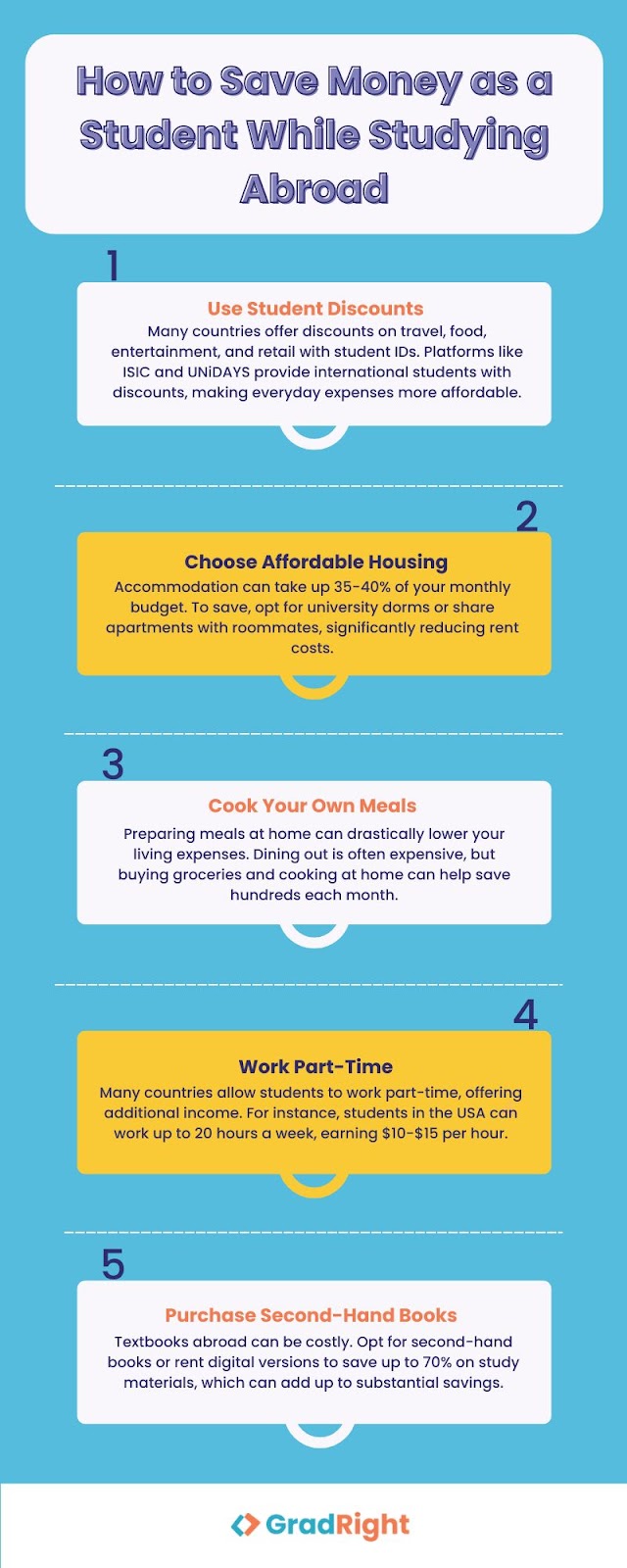
This guide gives you 12 practical, specific tips to reduce your living costs while studying abroad – without sacrificing the experience.
Monthly Cost Benchmarks – What Indian Students Actually Spend
|
City / Country |
Monthly Living Cost (excl. tuition) |
Biggest Cost Driver |
Cheapest Hack |
|
London, UK |
GBP 1,200-1,800 (Rs 1.3-1.9 lakh) |
Accommodation (40-50% of budget) |
Zone 2-3 housing + student Oyster card (30% off travel) |
|
New York, USA |
USD 1,500-2,200 (Rs 1.3-1.9 lakh) |
Rent + food |
Cook at home – $25 restaurant meal = 4-7 days of groceries |
|
Berlin, Germany |
EUR 800-1,100 (Rs 72,000-99,000) |
Accommodation |
EUR 80/month transport pass vs EUR 400 for a car |
|
Toronto, Canada |
CAD 1,200-1,800 (Rs 75,000-1.1 lakh) |
Rent (40%+ of budget) |
Share with 2-3 others, use university housing waitlist |
|
Sydney, Australia |
AUD 1,400-2,000 (Rs 77,000-1.1 lakh) |
Rent + groceries |
Part-time work allowed up to 48 hrs/fortnight |
|
Amsterdam, Netherlands |
EUR 900-1,300 (Rs 81,000-1.2 lakh) |
Accommodation |
Cycle everywhere – Amsterdam is built for it |
Source: GradRight research, student community surveys, and city-specific cost of living databases, 2026. INR conversions at approximate mid-2026 rates.
Tip 1: Choose Accommodation Strategically
Accommodation is typically 35-45% of your monthly budget abroad. Getting this right saves more than any other single decision.
|
Option |
Typical Cost |
Pros |
Cons |
|
University dorms |
Subsidized – usually 20-30% cheaper than private |
Bills included, close to campus, safe |
Limited availability, apply early |
|
Shared flat (2-3 people) |
Split rent saves 40-60% vs solo renting |
Freedom, cheaper per person |
Requires coordination, may need deposit |
|
Homestay (living with local family) |
Often includes meals, moderate cost |
Meals included, cultural experience, safe |
Less freedom, specific rules |
|
Solo apartment |
Most expensive option |
Privacy and independence |
Not recommended for first year abroad |
A one-bedroom flat in London costs approximately GBP 1,595/month solo. Sharing with one person halves that cost instantly. Over a full academic year, that is a saving of approximately GBP 9,570 (Rs 10.2 lakh).
Tip 2: Cook at Home – the Single Biggest Daily Saving
A meal in New York City averages USD 20-25. That same amount buys groceries for 4-7 days if you cook at home. In Europe, cooking at home saves approximately EUR 200-300 per month versus eating out regularly.
You do not need to cook every meal. A practical approach: cook dinner 5-6 days a week, pack lunch from leftovers, and budget for 1-2 meals out per week. This keeps food costs low without eliminating social eating entirely.
- Shop at discount supermarkets: Aldi and Lidl in Europe, Walmart and Trader Joe in USA, Costco for bulk buying with flatmates.
- Use student meal plans if your university offers them – often subsidized.
- Cook in batches on Sunday for the week ahead – saves both money and time.
- Local markets often sell fresh produce cheaper than supermarkets.
Also Read: Cost of Studying in Germany for Indian Students
Tip 3: Use Your Student ID for Everything
Your student ID is one of the most underused financial tools you have abroad. Carry it everywhere and ask about discounts everywhere.
|
Platform / Service |
Discount |
How to Access |
|
UNiDAYS |
Up to 50% on tech, fashion, food, services |
Register free with your university email at myunidays.com |
|
ISIC (International Student Identity Card) |
Discounts in 130+ countries on travel, food, culture |
Apply at isic.org – approximately USD 25/year |
|
UK Student Railcard |
30% off rail travel across UK |
Apply at railcard.co.uk with student ID – GBP 30/year |
|
Spotify / Apple Music |
50% off student subscription |
Verify student status on respective platforms |
|
Microsoft Office / Adobe |
Free or heavily discounted for students |
Check your university – many offer these free |
|
Amazon Prime Student |
6-month free trial then 50% off |
Sign up with university email at amazon.com/prime/student |
|
Local restaurants and shops |
Varies – often 10-20% |
Just ask – many small businesses offer unadvertised discounts |
Tip 4: Use Public Transport and Student Travel Passes
Owning a vehicle abroad as a student is almost never worth it. A car in Berlin costs approximately EUR 400/month. A monthly public transport pass costs EUR 80 – a saving of EUR 320/month (Rs 28,800).
- UK: 16-25 Railcard gives 30% off train fares nationwide (GBP 30/year). London Oyster card with student Travelcard saves significantly on daily commuting.
- Germany: Many state universities include a semester transport pass covering regional travel – check your university.
- USA: Most university towns have student bus passes at subsidized rates. Many campuses offer free campus shuttles.
- Netherlands / Denmark: Cycle everywhere. Cities are designed for it. A secondhand bike costs EUR 50-150 and eliminates most transport costs.
- Australia: Student concession cards give discounted fares on public transport in all major cities.
Tip 5: Never Buy New Textbooks
New textbooks abroad can cost USD 100-300 each. You do not need to buy new ones.
- Buy secondhand from seniors in your department – savings of up to 70% vs new.
- Chegg and AbeBooks: platforms for secondhand and rental textbooks at fraction of new cost.
- Amazon marketplace: used textbooks often available for USD 5-20 vs USD 150+ new.
- Kindle and VitalSource: digital rentals, often 50-80% cheaper than print.
- University library: most course texts are available. Reserve copies on day one of term before they run out.
- PDF sharing among classmates: check what is permissible under your university and local copyright law.
Also Read: Cost of Studying in the UK for Indian Students
Tip 6: Open a Local Bank Account and Use Smart Forex Tools
Using your Indian debit or credit card abroad for daily expenses costs you in two ways: foreign transaction fees (1.5-3.5% per transaction) and unfavorable exchange rates. Over a year, this can add up to Rs 20,000-50,000 in unnecessary charges.
- Open a local student bank account in your first week. Most countries have fee-free student accounts – Barclays, NatWest, HSBC in UK; Chase, Bank of America in USA; DKB, N26 in Germany.
- Use Wise (formerly TransferWise) for sending money from India – typically 3-5x cheaper than bank wire transfers.
- Use Revolut or N26 for day-to-day spending abroad – near-zero foreign exchange fees.
- Avoid airport currency exchange counters – worst rates available anywhere.
- Monitor INR-USD/GBP/EUR rates and transfer larger amounts when the rate is favorable.
Compare education loans from 18+ lenders and get the best rate for your study abroad. Starting from 8.33% per annum. Compare Education Loans on GradRight
Tip 7: Use Your Part-Time Work Allowance
Most student visas allow part-time work. This is one of the most underused financial tools available to international students.
|
Country |
Work Hours Allowed |
Typical Earnings |
Best On-Campus Jobs |
|
USA (F1 Visa) |
20 hrs/week during term, full-time during breaks |
USD 12-18/hr (varies by state) |
Library assistant, research assistant, campus dining, tutoring |
|
UK (Student Visa) |
20 hrs/week during term, full-time during holidays |
GBP 11.44/hr minimum wage (2026) |
Campus jobs, retail, hospitality, tutoring |
|
Canada (Student Visa) |
24 hrs/week (changed from 20 hrs, Nov 2024) |
CAD 15-17/hr minimum wage |
University admin, tutoring, retail, food service |
|
Germany (Student Visa) |
120 full days or 240 half days per year |
EUR 12.41/hr minimum wage (2026) |
Research assistant (Hiwi), student jobs at university |
|
Australia (Student Visa) |
48 hrs/fortnight during term, unlimited during breaks |
AUD 24.10/hr minimum wage (2026) |
Retail, hospitality, campus jobs |
Even 10 hours of part-time work per week at minimum wage covers Rs 50,000-80,000/month in living expenses depending on your country. Start with on-campus jobs – easier to find, more flexible around academic schedules.
Tip 8: Apply for Scholarships – Even Mid-Program
Most students research scholarships before applying and give up if they do not get one. But many scholarships are available during your program too – for academic performance, research, or specific communities.
- Check your university’s financial aid office every semester for in-program scholarships and emergency grants.
- External scholarships from organizations like DAAD (Germany), Chevening (UK), and Fulbright (USA) continue to accept applications for enrolled students in some programs.
- Department-level grants for research, conferences, or specific projects are often unclaimed – ask your professor or department coordinator.
- Teaching and research assistantships (TAs, RAs) at universities often include a stipend plus tuition waiver.
Also Read: Top Scholarships for Indian Students Studying Abroad
Tip 9: Build and Track a Monthly Budget
The students who run out of money abroad are rarely those who earn less – they are those who have no system for tracking what they spend. A simple monthly budget takes 30 minutes to set up and saves you from end-of-month panic.
|
Category |
Typical % of Budget |
Target % |
|
Accommodation (rent + utilities) |
35-45% |
Under 40% |
|
Food and groceries |
15-20% |
Under 20% (cook at home) |
|
Transport |
8-12% |
Under 10% (public transport + student pass) |
|
Academic (books, supplies) |
5-8% |
Under 5% (secondhand + library) |
|
Personal and social |
10-15% |
10-12% |
|
Emergency buffer |
5% |
Always maintain Rs 40,000-80,000 in savings |
|
Miscellaneous |
5-10% |
5% |
- Apps: Copilot Money (USA), Monzo (UK), N26 (Europe) – all track spending automatically by category.
- Review spending every Sunday – 10 minutes per week prevents end-of-month surprises.
- Maintain a minimum USD 500-1,000 / GBP 400-800 emergency buffer at all times.
Tip 10: Enjoy the City Without Overspending
Studying abroad is not just academics – experiences matter. But experiences do not need to be expensive.
- Most major museums in London are free (British Museum, National Gallery, V&A, Natural History Museum).
- Many US cities offer free or discounted museum admission for students on specific days.
- Student union events on campus are almost always free or heavily subsidized.
- Walking and cycling tours of your city cost nothing and give you the best introduction.
- Buy a city tourism card if you plan to visit multiple attractions – usually 30-50% cheaper than individual tickets.
- Travel during off-peak times – midweek flights and trains within Europe can be 50-70% cheaper than weekend travel.
Tip 11: Send Money Smart from India
How you receive money from India affects how much actually reaches your account. The wrong method can cost Rs 3,000-8,000 per transfer in fees and exchange rate losses.
- Wise: typically the best rate for international transfers – 70-90% cheaper than bank wires for most currency pairs.
- Niyo Global Card (GradRight partner): designed for Indian students, low forex markup, accepted globally.
- Avoid: airport kiosks, hotel exchange counters, Western Union for regular transfers (high fees).
- For large transfers (tuition payments), compare rates between Wise, ICICI Money2World, and your Indian bank on the day of transfer.
Tip 12: Refinance Your Education Loan if Rates Drop
If you took an education loan before traveling, you are probably paying 10-13% interest. Many students do not know that refinancing is possible – and that switching to a lower-rate lender can save Rs 2-5 lakh over the loan term.
GradRight’s refinancing platform compares offers from 18+ lenders in real time. If your academic performance is strong and you have a job offer or stable income, refinancing can significantly reduce your EMI.
Already studying abroad? Check if you can reduce your EMI by refinancing your education loan to a lower rate. Check Refinancing Options on GradRight
Country-Specific Money Saving Tips at a Glance
|
Country |
Top 3 Savings Hacks |
|
USA |
1. Cook at home (restaurant meals cost 4-7x groceries) 2. Use campus food pantries (free food at most US universities) 3. Buy a student railcard/bus pass for your city |
|
UK |
1. Student Railcard (30% off nationwide rail) 2. Free London museums 3. Student Oyster card for discounted London travel |
|
Germany |
1. Semester transport pass (often included in tuition) 2. Mensa (university canteen meals for EUR 2-4) 3. Buy secondhand everything – Germans have strong Flohmarkt culture |
|
Canada |
1. Work 24 hrs/week (new 2024 rule) 2. Use PC Optimum and Aeroplan for grocery discounts 3. Buy monthly transit pass – often cheaper with student ID |
|
Australia |
1. Work 48 hrs/fortnight (highest min wage = AUD 24.10/hr) 2. Aldi and Costco for groceries 3. Student concession cards for 50%+ off public transport |
|
Netherlands |
1. Cycle everywhere (zero transport cost after bike purchase) 2. Albert Heijn app for daily discounts 3. OV-chipkaart student discount for trains |
Related Cost and Finance Guides
Cost of Studying in the UK for Indian Students
Cost of Studying in Germany for Indian Students
Cost of Studying in Canada for Indian Students
Hidden Costs of Studying Abroad
Education Loan for USA
Education Loan Refinancing
Scholarships for Indian Students
Study in Germany – Free Education Guide
Student Health Insurance Abroad








 Australia
  Canada
  France
  Germany
  India
India  Ireland
  UAE
UAE  United Kingdom
  United States