





If you’re an Indian student sitting on an education loan, either back home or newly settled into a job in the US, you’ve probably heard “consolidation” and “refinancing” used like they mean the same thing. They don’t. And picking the wrong one can cost you real money, or worse, lock you into terms that don’t fit your situation at all.
This guide breaks down student loan consolidation vs refinancing in plain terms, with a specific focus on what actually applies to Indian students studying or working abroad.
What is student loan consolidation?
Loan consolidation means combining multiple loans into a single new loan. Instead of tracking three or four separate payments, each with its own due date, servicer, and interest rate, you end up with one loan and one monthly payment.
In the US, this is most commonly associated with federal Direct Consolidation Loans, where the new interest rate is a weighted average of the rates on the loans being combined, rounded up slightly. Consolidation doesn’t necessarily lower your interest rate; its biggest benefit is simplification, not savings. It also usually extends your repayment timeline, which can lower your monthly payment amount but increase the total interest you pay over the life of the loan.
For Indian students specifically, pure “consolidation” in the American federal sense is largely irrelevant, since Indian education loans are issued by Indian banks and NBFCs, not the US Department of Education, and aren’t eligible for federal consolidation programs. This is one of the biggest points of confusion: many Indian borrowers searching for “consolidation” are actually looking for what refinancing offers.
What is student loan refinancing?
Refinancing means replacing your current loan with a completely new loan from a different lender, potentially at a lower interest rate and better terms, which can save you money and simplify your payments.
For Indian students working in the US, this typically means transferring an education loan currently held with an Indian bank or NBFC (like SBI, Credila, or Avanse) to a USA-based financial institution, taking advantage of better interest rates and a stable currency in the process. In simple terms: refinancing replaces your Indian rupee-denominated loan with a new loan from a lender abroad, at a rate that’s often far lower than what Indian lenders charge.
Yes, refinancing allows you to switch your loan to a US-based lender and take advantage of better terms and rates, provided you meet the eligibility bar most refinance lenders set.
Also Read: Student Loan Refinancing in 2026: Everything Indian Students in the USA Need to Know
How refinancing works for Indian students
When you refinance, you’re not just moving your balance to a new number; you’re resetting your loan terms entirely. This usually results in:
- A lower interest rate
- A longer or restructured repayment tenure
- New terms around prepayment and foreclosure
The process itself has a few real-world checkpoints that trip up most first-time applicants:
- Eligibility uncertainty: Different lenders like SoFi, Citizens Bank, or MPOWER accept different visa categories, and each has its own bar for what counts as a “good enough” US credit file.
- Documentation: You’ll need a payoff statement from your Indian bank (SBI, HDFC, etc.), and getting one issued within a lender’s required window can involve some back-and-forth.
- Closing the loop in India: Once refinanced, you still need to collect the No-Objection Certificate (NOC) from your original Indian lender, release any collateral your parents pledged, and confirm the lien is cleared from your CIBIL record.
Student loan consolidation vs refinancing: Key differences
| Factor | Consolidation | Refinancing |
| What it does | Combines multiple existing loans into one | Replaces your loan entirely with a new one from a new lender |
| Interest rate | Usually a weighted average of existing rates | Often lower than your original rate, based on new lender’s terms |
| Lender | Typically stays within the same loan system (e.g., US federal loans) | Involves a different lender altogether, often across borders |
| Relevance to Indian borrowers | Not applicable to Indian bank loans; largely a US federal loan concept | Directly applicable – the standard route for moving from Indian rupee loans to USD loans |
| Primary goal | Simplify multiple payments into one | Reduce interest cost and/or improve loan terms |
| Currency impact | None | Removes INR exposure by shifting to a USD-denominated loan |
| Collateral/cosigner | Unaffected | Can release cosigner obligations and collateral pledged in India |
Why refinancing is the more common path for Indian students abroad
Given that consolidation, in the traditional sense, doesn’t apply to loans from Indian banks or NBFCs, refinancing is where nearly all the real savings and structural benefits sit for Indian borrowers working overseas.
Lower Interest Costs
Many Indian professionals in the USA end up overpaying on their education loans simply because they never explore refinancing. It’s common for borrowers who started at interest rates above 10% to bring that down to 7% or lower through the right refinancing plan, saving a meaningful amount over the life of the loan.
The “2% Rule”
A commonly cited guideline is that refinancing is worth considering only if your interest rate would drop by at least 2 percentage points or more. This is a guideline, not a hard rule; it doesn’t account for factors like your remaining loan tenure, currency risk, or how stable your income is, all of which should factor into the decision too.
Currency Stability
Swapping a rupee-denominated loan for a fixed-rate USD loan removes the currency risk that comes with earning in dollars while repaying in rupees. Your EMI stops fluctuating with the exchange rate and becomes predictable.
Cosigner and Collateral Release
Refinancing successfully also releases your parents (or whoever cosigned) from their obligation in India, and returns any collateral that was pledged for the original loan – a benefit consolidation simply doesn’t offer, since it never touches the original lender relationship.
Credit Building Abroad
Since refinancing establishes a new loan with a US-based lender, it also contributes to building your credit history in the country where you now live and work – something that matters for future decisions like buying a car, renting an apartment, or eventually applying for a mortgage.
What lenders actually look at: Eligibility explained
Before jumping into refinancing, it helps to check your standing against a few realistic factors:
- Visa status: Different refinance lenders accept different visa categories (OPT, H-1B, etc.), so not every lender is open to every applicant.
- Employment stability: A steady income stream abroad strengthens your application.
- Credit history: A “thin” US credit file can be a hurdle; lenders vary in how they define “good enough.”
- Cosigner access: Having someone with permanent residency abroad cosign can significantly ease approval, even though it isn’t the easiest option to arrange.
- Social Security Number (SSN): This is generally required for refinancing in the US, and functions similarly to an Aadhaar/UIDAI number back in India.
Popular US lenders for refinancing
Borrowers with loans currently serviced by Indian banks generally have fewer cross-border options than those already carrying USD-denominated debt. Right now, MPOWER Financing is one of the few mainstream lenders that wires a payoff directly to Indian banks like SBI and Avanse, with fixed APRs starting under 10% and no cosigner requirement. Prodigy Finance is another option worth watching, though availability can be inconsistent.
For borrowers who already hold dollar-denominated loans, comparison typically happens across lenders like SoFi, Citizens Bank, Laurel Road, Earnest, and ELFI, most of which let you pre-qualify online before committing to a full application.
Cross-border refinancing also comes with a few procedural realities: a mandatory federal rescission window before funds are wired, followed by a SWIFT transfer that can take several business days, plus additional time for your Indian lender to issue the NOC that releases your collateral.
Also Read: Education Loan for Studying in the USA: Interest Rates, Courses, Requirements & Banks
Steps to refinance your education loan
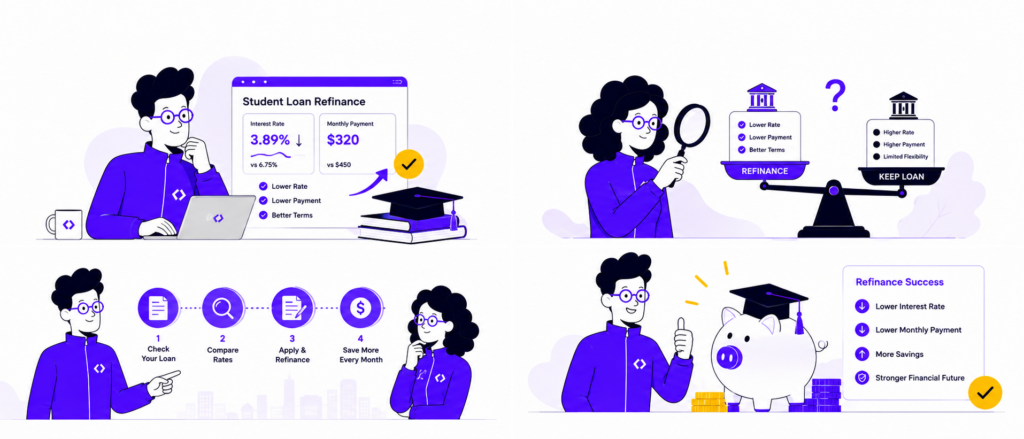
- Check your eligibility; visa status, income stability, and credit profile all factor in.
- Gather your documentation, including a payoff statement from your current Indian lender.
- Compare multiple lenders rather than accepting the first offer you receive; rates and terms vary meaningfully between lenders.
- Apply and complete the rescission window and fund transfer process.
- Close the loop in India; collect your NOC, retrieve any pledged collateral, and confirm your CIBIL lien is cleared.
- Set up autopay on your new US loan immediately, since many lenders offer a small interest rate discount (often around 0.25 points) for enrolling.
Which one should you choose: Consolidation or refinancing?
For Indian students and graduates specifically, this isn’t really an either/or decision in practice. Traditional loan consolidation, as it exists in the US federal loan system, doesn’t apply to loans from Indian banks or NBFCs, so it isn’t a real option for most Indian borrowers to begin with.
Refinancing, on the other hand, is the mechanism that actually applies: it’s how Indian students and working professionals abroad move from a high-interest rupee loan to a lower-interest, currency-stable USD loan, while also releasing cosigners and collateral back home.
The real question isn’t “consolidation or refinancing”; it’s whether refinancing makes sense for your specific situation right now, based on your visa status, how long you plan to stay abroad, and whether the rate drop you’d get clears a meaningful threshold like the 2% rule.
How GradRight simplifies the refinancing process
Instead of approaching multiple lenders individually and repeating the same documentation each time, GradRight lets you enter your financial details once and receive competing offers from multiple lenders through a reverse-bidding model. You upload your documents, describe your financial profile, and lenders bid for your business, rather than you chasing each one separately. This also helps avoid a common misstep: applying to several lenders only to discover, after hard credit pulls, that some of them don’t even refinance loans currently serviced by Indian banks.








 Australia
  Canada
  France
  Germany
  India
India  Ireland
  UAE
UAE  United Kingdom
  United States