

Business Analytics is one of the fastest-growing MS programs globally – and one of the most competitive. Universities in the USA, Canada, and UK receive thousands of applications from students with strong quant backgrounds, relevant tools experience, and decent GPAs.
What separates admits from rejections is often the SOP. A generic SOP that lists tools and courses gets filtered out fast. A specific, story-driven SOP that connects your data experience to a real career vision stands out. This guide shows you exactly how to write that SOP.
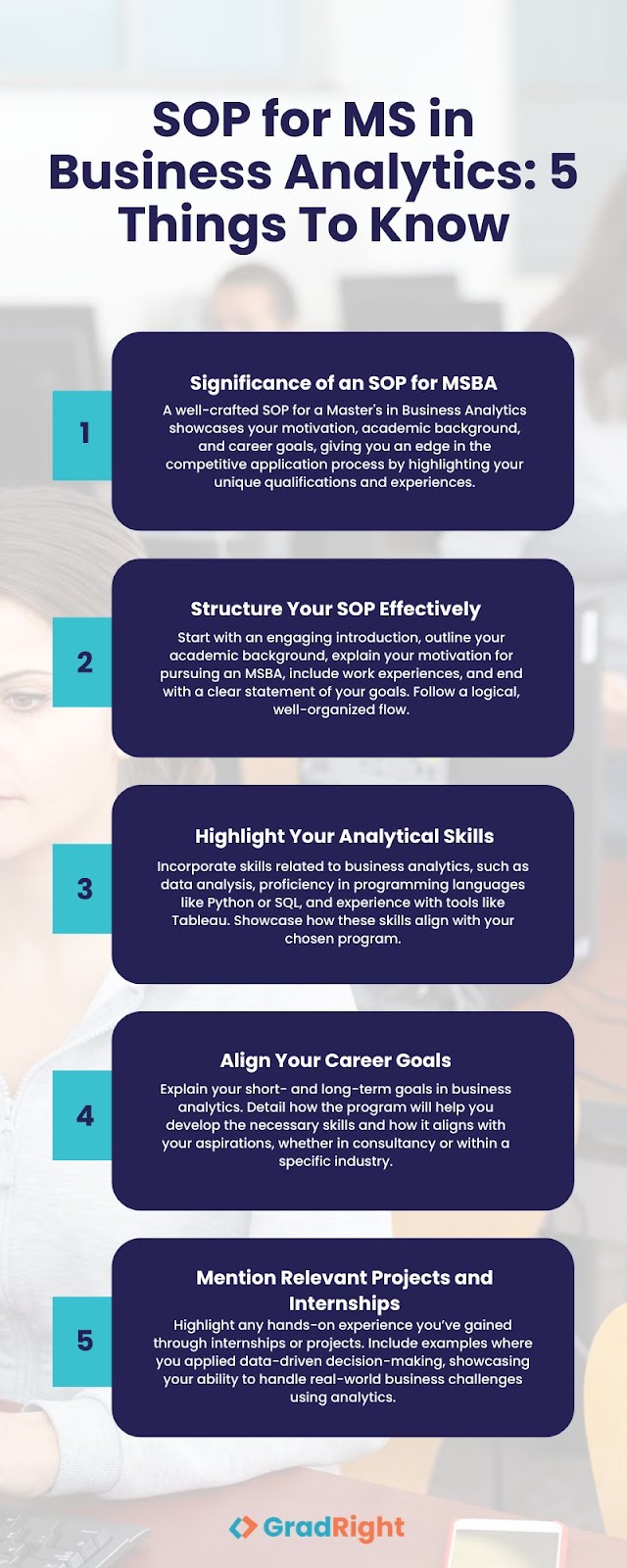
SOP for MS in Business Analytics – Quick Reference
|
Question |
Answer |
|
What is an MSBA SOP? |
A 800-1,200 word essay explaining your analytical background, data skills, motivation for business analytics, and career goals after the degree. |
|
How long should it be? |
800-1,200 words for most programs. Always check individual university requirements. |
|
What skills to highlight? |
Statistical tools (Python, R, SQL, Excel, Tableau, SAS), data projects with business impact, analytical thinking, and domain knowledge. |
|
Biggest MSBA SOP mistake? |
Writing a list of tools instead of a story. “I know Python, R, and SQL” tells the committee nothing useful. Show how you used them to solve a real problem. |
|
Fresh graduate vs working professional? |
Both can apply. Freshers should lead with academic projects. Working professionals should lead with professional data experience. |
What is an SOP for MS in Business Analytics?
An SOP for MS in Business Analytics is a written essay you submit as part of your application. It explains to the admissions committee why you want to study Business Analytics, what experience and skills you bring, and where you are headed after the degree.
The MSBA is a program at the intersection of data science and business strategy. Admissions committees are looking for students who understand both sides – who can work with data technically and translate it into business decisions. Your SOP needs to show that combination.
Universities have raised the bar significantly for MSBA admissions. A strong GRE/GMAT and GPA gets you considered. A strong SOP gets you admitted.
Also Read: MS in Business Analytics in USA – Top Universities, Costs and Careers
How is an MSBA SOP Different from Other MS SOPs?
|
Factor |
SOP for MS Business Analytics |
SOP for MS Computer Science |
|
Primary focus |
Data + business impact, analytical decision-making |
Technical skills, research, algorithms |
|
Key evidence to show |
Projects where data drove a business outcome |
Coding projects, research papers, technical depth |
|
Tools to mention |
Python, R, SQL, Tableau, SAS, Excel, Power BI, ML libraries |
C++, Java, Python, system design, CS fundamentals |
|
Career goal framing |
Business analyst, data analyst, strategy roles, product analytics |
Software engineer, ML engineer, researcher |
|
Work experience weight |
High – even 1-2 years of relevant work significantly strengthens the SOP |
Moderate – research or internships matter more |
SOP Format for MS in Business Analytics – Section by Section
A strong MSBA SOP follows a clear six-part structure. Here is what each section should contain:
|
Section |
What to Write |
Word Count |
|
1. Introduction / Hook |
Open with a specific data problem, analytical challenge, or professional moment that drove you toward Business Analytics. Not “data has always fascinated me.” A real, specific situation. |
100-150 words |
|
2. Academic Background |
Relevant coursework in statistics, mathematics, economics, computer science, or business. Highlight specific subjects and projects. GPA if strong. |
120-150 words |
|
3. Technical Skills and Projects |
Data tools you have used (Python, R, SQL, Tableau, etc.) with real project examples. Use numbers – “built a churn prediction model with 87% accuracy on 50,000 customer records.” Specificity matters. |
150-200 words |
|
4. Work Experience (if any) |
Analytics or data-related work – even if tangential. Internships, analyst roles, consulting, operations. Show where data was central to your work. |
100-150 words |
|
5. Why Business Analytics and Why This Program |
Why MSBA specifically – not just data science or MBA. Then why this university: specific faculty, courses, labs, or industry connections. Must be customized per school. |
150-200 words |
|
6. Career Goals |
Short-term: specific role post-graduation (data analyst, business analyst, product analytics, strategy consultant). Long-term: industry and impact you want to create. |
100-120 words |
|
7. Conclusion |
Brief, confident close. Connect your past, this program, and your future in 2-3 sentences. |
50-80 words |
Total target: 800-1,200 words. The technical skills section is where most MSBA SOPs either win or lose. Generic tool lists hurt you. Specific project outcomes with data and impact help you.
Also Read: SOP for MS – How to Write, Format, Samples and Tips
What to Highlight in Your MSBA SOP
Business Analytics programs specifically look for evidence of these four things in your SOP:
Quantitative and Technical Ability
Show that you can work with numbers and data tools. Mention specific tools you have used and what you did with them – not just that you know them. A capstone project in Python that predicted loan defaults using logistic regression tells a better story than listing Python as a skill.
Business Thinking Alongside Data Skills
MSBA is not pure data science. Programs want students who can connect analysis to business outcomes. Show moments where your data work led to a decision, recommendation, or measurable business result.
Clear Career Direction
Admissions committees want to see that you know what you want to do with this degree. Vague goals like ‘I want to work in data’ are weak. Specific goals like ‘I want to lead analytics for an e-commerce company’s growth team, focusing on customer lifetime value modeling’ are strong.
Fit with the Specific Program
Research each school before writing. Name a faculty member whose research interests you. Mention a specific course, lab, or partnership that matters to your goals. Generic ‘why this school’ sections are the most common reason otherwise strong SOPs get rejected.
Struggling to write your MSBA SOP? GradSOP generates a customized draft based on your profile, skills, and target program – free to use. Try GradSOP Free
Sample SOP for MS in Business Analytics – USA
Here is a sample SOP for an MS in Business Analytics program in the USA. Use this as a reference for structure, tone, and specificity – not as a template to copy.
[SAMPLE SOP – MS in Business Analytics, USA University]
During my internship at a retail analytics firm in Hyderabad, I was given a dataset of 1.2 million customer transactions and asked to identify which product categories were underperforming despite high traffic. Three weeks of SQL queries, cohort analysis, and a basic clustering model later, I found that the company was losing 18% of its repeat customers in the kitchenware category within 90 days of their first purchase. That analysis led to a targeted retention campaign that recovered 600 customers in the following quarter. That project changed how I thought about data – not as an academic exercise, but as a direct input to business decisions.
I completed my B.Tech in Information Technology from VIT Vellore with a CGPA of 8.4/10. My coursework included statistics, probability, database management, and machine learning. My final year project involved building a demand forecasting model for a regional FMCG distributor using time series analysis in Python – the model reduced their inventory overstock by 22% over a three-month pilot. Beyond academics, I completed certifications in SQL (HackerRank Gold), Tableau Desktop Specialist, and the Google Data Analytics Professional Certificate, which gave me hands-on experience with real datasets across retail, healthcare, and logistics.
I have been working for 18 months as a Data Analyst at [Company Name], an e-commerce startup in Bangalore. My work involves building dashboards in Power BI for the marketing team, running A/B test analyses, and maintaining our customer segmentation models in Python. I manage our data pipeline for campaign performance – a project that improved reporting turnaround from 3 days to 4 hours. This role has given me practical experience with production data systems, but I have hit the ceiling of what I can learn without formal training in advanced analytics methods, causal inference, and machine learning at scale.
I want to pursue an MS in Business Analytics because I need structured exposure to predictive modeling, optimization, and the strategic application of analytics at the enterprise level. An MBA would give me business breadth but not the technical depth I need. A pure data science program would deepen my technical skills but not the business decision-making context. An MSBA sits exactly at the intersection I need – and [University Name]’s program reflects that balance. Professor [Name]’s research on causal machine learning for marketing attribution directly connects to the problems I work on daily. The program’s industry practicum in the second semester, where students work on live analytics projects with partner companies, is the kind of applied learning that would accelerate my development significantly.
My short-term goal is to join a management consulting firm or a tech company’s analytics team as a senior analyst or associate, focusing on growth analytics and business strategy. Within five to seven years, I want to lead an analytics function at a company building data infrastructure for Tier 2 and Tier 3 Indian markets – a space I believe is significantly underserved and where the business impact of good analytics is highest.
I am confident that the MSBA at [University Name] will give me the technical foundation, industry exposure, and professional network to achieve these goals. I look forward to contributing to the program’s research community and bringing a practitioner’s perspective to my cohort.
[End of sample – approx. 550 words. Expand academic and technical sections to reach 900-1,100 words for your actual application.]
MSBA SOP Dos and Don’ts
|
Do’s |
Don’ts |
|
Show data skills through specific project examples |
List tools without showing what you did with them |
|
Connect data work to a business outcome |
Focus only on technical accuracy without business context |
|
Name specific tools with context (Python for X, SQL for Y) |
Write “proficient in Python, R, SQL, Tableau, SAS, Excel” |
|
Use numbers to describe project impact |
Use vague terms like “improved significantly” or “better results” |
|
Write clear short-term and long-term career goals |
Say “I want to work in data science or analytics” |
|
Customize “why this program” for every university |
Use the same school section for every application |
|
Show the business + data combination |
Write an SOP that reads like a pure data science application |
|
Keep sentences short and direct |
Write long, jargon-heavy paragraphs |
Also Read: MS in Business Analytics in USA – Top Universities, Fees and Careers
Top Universities for MS in Business Analytics – What Their SOPs Need
Different programs look for slightly different things. Here is what to emphasize based on your target school:
|
University |
MSBA SOP Focus |
|
MIT Sloan (MSBA) |
Quantitative rigor, research potential, specific technical projects, clear industry application goals |
|
UT Austin McCombs (MSBA) |
Business impact of data work, leadership, Texas/industry connections if relevant, community contributions |
|
USC Marshall (MSBA) |
Industry relevance, entrepreneurial mindset, specific career goals, why USC’s LA tech and entertainment connections |
|
Northeastern (MSBA) |
Co-op readiness, applied learning mindset, industry experience, Boston/tech hub career goals |
|
Arizona State W. P. Carey (MSBA) |
Program fit, data-driven decision-making examples, career clarity, why ASU’s growing analytics ecosystem |
|
University of Rochester Simon (MSBA) |
Quantitative background, finance + analytics combination if relevant, research interests |
Always verify current program focus areas on each university’s official MSBA page before writing. Program structures and emphases change from year to year.
MSBA SOP Length and Formatting Guidelines
|
Element |
Standard Guideline |
|
Word count |
800-1,200 words (check each school’s specific limit) |
|
Font |
Times New Roman 12pt or Arial 11pt |
|
Line spacing |
Single or 1.5 line spacing |
|
Margins |
1 inch on all sides |
|
File format |
PDF – prevents formatting shifts |
|
Paragraphs |
6-7 focused paragraphs, no bullet points within the SOP itself |
|
Headers |
Usually not needed – let the writing flow naturally between sections |
Found your target MSBA programs? Find universities that match your analytics profile from 40,000+ programs worldwide. Explore Universities on GradRight
Related Guides and Resources
SOP for MS – Complete Guide, Format and Sample
SOP for MS in Computer Science
SOP for USA – Samples, Format and Examples
SOP Samples – Course and Country-wise
GradSOP – AI SOP Writing Tool
How to Write a Professional LOR
MS in Business Analytics in USA – Top Universities
Top Universities in USA for MSBA
Study in USA – Complete Guide
Education Loan for USA





 Australia
  Canada
  France
  Germany
  India
India  Ireland
  UAE
UAE  United Kingdom
  United States